Home › Asbestos removal
Hazardous materials · older homesAsbestos removal cost calculator
Asbestos was used in houses for decades because it was cheap, fireproof and durable. In homes built before about 1980 it can be in pipe insulation, 9-inch floor tiles and the black glue under them, vermiculite attic insulation, drywall joint compound, textured ceilings, and cement siding shingles. Left alone and intact, it is usually not dangerous. Sanding, cutting, scraping or tearing it out releases fibers that stay in the air.
That is why any renovation in an older house should start with a lab test of suspect materials. If a sample comes back positive, a licensed abatement contractor sets up containment, removes or encapsulates the material under controlled conditions, seals the waste for disposal at an approved site, and in many cases an independent tester checks the air before the containment comes down.
This calculator prices those steps by material. Choose what was found, how much of it, whether it is removed or encapsulated (only tile and siding can be), and whether testing and air clearance are still needed. Each step is its own line.
Reviewed 25 October 2026 · Written by Mantu Kumar
See the photos · See the cost diagram · Open the calculator
Key facts at a glance
- Inspection and lab samples: about $250–$800.
- Removal by material: pipe wrap about $10–$30 per linear ft; floor tile and mastic about $4–$14; vermiculite about $7–$17; drywall compound about $6–$12; cement siding about $5–$10 per sq ft.
- Encapsulation: about $2–$6 per sq ft for tile or siding left in place.
- Containment and setup: about $250–$600; sealed disposal about $150–$500.
- Air clearance test: about $300–$700.
National 2026 planning ranges before your regional multiplier. State licensing and notification rules vary.
2026 planning ranges
- 1Inspection and lab samples
- 2Pipe insulation
- 3Floor tile and mastic
- 4Vermiculite attic insulation
- 5Drywall and joint compound
- 6Containment and setup
- 7Sealed disposal
- 8Air clearance test
- 9Cement siding
Price your asbestos abatement
No email · nothing sentDiagram, part by part
Asbestos abatement: every numbered part explained
The drawing above has 9 numbered parts, from Inspection and lab samples to Cement-asbestos siding. Each card zooms in on one part, says what pushes its price up or down, and tells you what to look for on a written quote. After you run the calculator, the parts in your scope show their dollar band.
1 Inspection and lab samples
$250–$800
A trained inspector takes small samples of each suspect material and sends them to a lab, usually for polarized light microscopy. The report says which materials contain asbestos and roughly how much. Without it, nobody knows what they are dealing with.
What moves it: Number of materials sampled, lab turnaround and whether the inspector writes a full survey for a renovation.
On the quote: Get the lab report with sample locations. If a contractor offers to remove material that was never tested, ask why.
2 Pipe insulation (wrap)
$10–$30 per linear foot
White or gray wrap on old heating pipes and boilers, often called pipe lagging, is one of the most common asbestos materials. It is usually removed with glove bags or inside full containment.
What moves it: Feet of pipe, fittings and elbows, and access in tight basements.
On the quote: Look for linear feet, method (glove bag or full containment), and how the bare pipe is cleaned and sealed afterward.
3 Floor tile and black mastic
$4–$14 per sq ft removed
9-inch square vinyl tiles and the black glue under them often contain asbestos. They can be removed with wet methods, or left in place and covered by new flooring, which counts as encapsulation.
What moves it: Area, number of layers and how hard the mastic is to strip.
On the quote: Ask whether mastic removal is included. Covering tile in place is often the cheapest legal option.
4 Vermiculite attic insulation
$7–$17 per sq ft
Pebbly gray-brown or gold insulation poured between attic joists. Much of it sold in the US came from a mine contaminated with asbestos. Removal is usually done with a large vacuum truck and full containment of the attic.
What moves it: Attic area, depth of material and access.
On the quote: Ask how the attic is sealed from the living space and how new insulation follows.
5 Drywall and joint compound
$6–$12 per sq ft
Joint compound and some textured finishes made before about 1980 can contain asbestos. Demolishing those walls needs containment and wet methods.
What moves it: Wall area, number of rooms and finishes on top.
On the quote: Confirm the area and that only tested walls are included.
6 Containment and negative air
$250–$600
The work area is sealed in plastic, air is pulled out through a HEPA machine to keep fibers in, and a decontamination area is set up. This protects the rest of the house.
What moves it: Room size, number of areas and the material.
On the quote: Ask how the HVAC is shut off and sealed during work.
7 Sealed disposal
$150–$500
Waste is wetted, double-bagged in labeled bags and taken to a landfill licensed to accept asbestos, with paperwork tracking it.
What moves it: Volume and landfill fees.
On the quote: Ask for the waste manifest or disposal record.
8 Air clearance test
$300–$700
After cleaning, an independent tester runs air samples inside the containment. Only when the result passes does the plastic come down.
What moves it: Number of areas and lab turnaround.
On the quote: Use a tester not employed by the abatement contractor.
9 Cement-asbestos siding
$5–$10 per sq ft removed
Hard, brittle shingles common on mid-century houses. They are stable if left alone and can be painted or covered with new siding, or removed whole without breaking.
What moves it: Wall area, height and how much breaks during removal.
On the quote: If residing over it, ask whether removal is needed at all.
Project photo guide
Asbestos abatement in photos: containment chamber, wet removal and sealed disposal
Licensed asbestos abatement costs are driven by containment and air safety rather than demolition speed: isolating the work zone under HEPA negative air pressure, keeping materials wet with amended water so fibers cannot become airborne, and sealing waste for manifested hazardous-material disposal.

How the job works in 3 key stages
All three step images are AI-generated illustrations for explanation. Not a site inspection, bid, or coverage decision.
 Step 01
Containment
The crew shuts down HVAC vents, seals floors, walls, and non-removable surfaces in multiple layers of 6-mil plastic sheeting, and builds a multi-stage flapped decontamination airlock at the entrance.
On the quote: Verify the contractor holds an active state asbestos abatement license and that mandatory state/EPA notification waiting periods are built into the schedule.
 Step 02
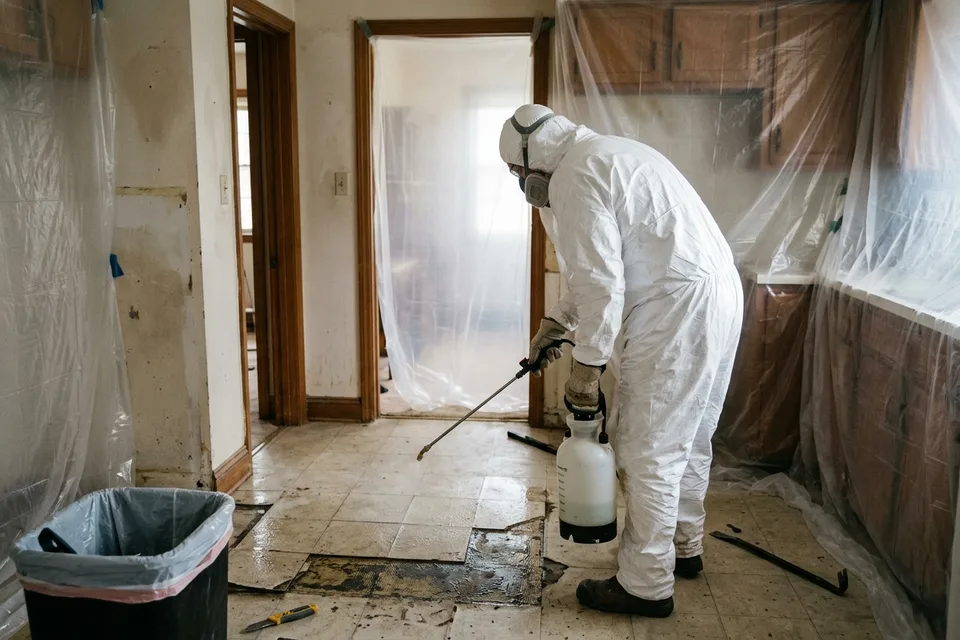
Wet removal
Workers wearing respirators and disposable coveralls mist the asbestos-containing material with surfactant-amended water to suppress dust while lifting tiles, mastic, or pipe insulation intact with hand tools.
On the quote: Confirm whether floor tile bids include removing black cutback adhesive mastic or encapsulating it, as mastic removal adds significant labor.
 Step 03
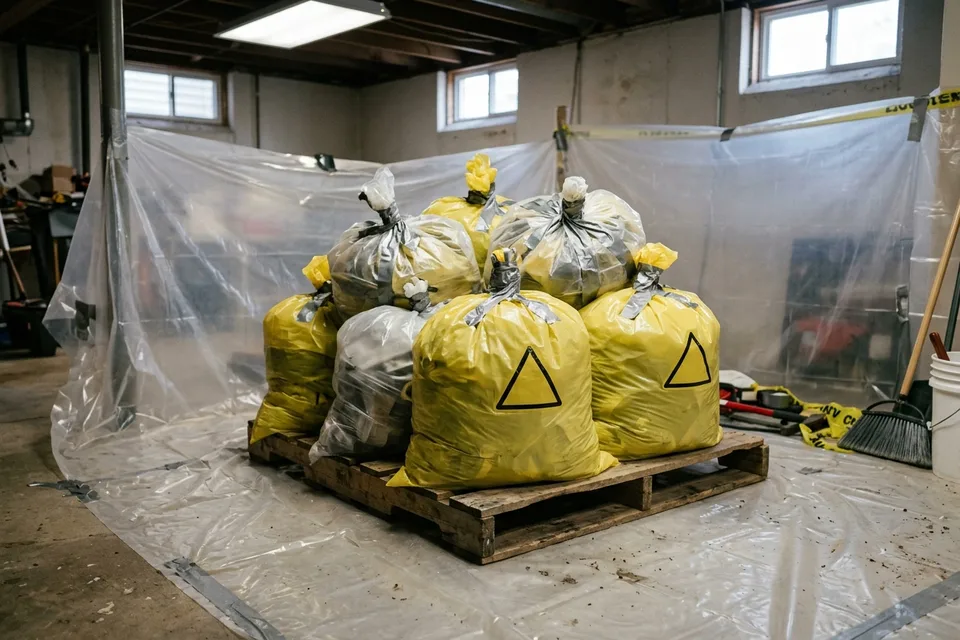
Sealed disposal
All wet waste and used PPE are double-bagged in heavy 6-mil labeled disposal bags, goose-necked and taped shut, wet-wiped through the decon chamber, and hauled to an approved landfill with a signed waste manifest.
On the quote: Insist on independent third-party final air clearance testing and a copy of the signed hazardous-waste disposal manifest at job completion.


What this photo guide helps you verify on a written quote
- Independent air clearance: The final air test should be performed by an independent environmental hygienist, not the removal crew itself.
- Friable vs. non-friable scope: Pipe wrap and vermiculite are friable and require full negative-pressure containment; intact vinyl tile is non-friable unless sanded or ground.
- Waste manifest paperwork: Keep the signed landfill manifest permanently with your house records for future buyers and contractors.
- Put-back exclusion: Abatement contractors leave bare clean substrates—budget separately for new insulation, drywall, or flooring.
On this page
- The diagram, part by part
- Photo guide: hero and 3 project steps
- Asbestos removal cost by material
- What common asbestos jobs cost
- Remove, encapsulate, or leave it alone
- Where asbestos hides in older houses
- Asbestos removal cost by region
- What “Material” does to the price
- What “Method” does to the price
- How age changes the asbestos removal claim payout
- How to read the quote, line by line
- How long the job takes
- Worked example
- Does insurance pay for asbestos removal?
- Ways to keep the cost down
- Sources and further reading
- Frequently asked questions
Asbestos removal cost by material
Per-unit removal rates; containment, disposal and testing are separate lines.
| Scope | 2026 planning range | Why it is its own line |
|---|---|---|
| Pipe insulation | $10 – $30 per linear ft | Glove bag or containment. |
| Floor tile and mastic, removed | $4 – $14 per sq ft | Wet methods. |
| Floor tile, encapsulated | $2 – $6 per sq ft | Covered in place. |
| Vermiculite attic insulation | $7 – $17 per sq ft | Vacuum removal. |
| Drywall and joint compound | $6 – $12 per sq ft | Demolition in containment. |
| Cement-asbestos siding, removed | $5 – $10 per sq ft | Removed whole. |
| Inspection and lab samples | $250 – $800 | Before any work. |
| Air clearance test | $300 – $700 | Before the plastic comes down. |
Popcorn ceilings have their own calculator. Many states also require notification before abatement; rules are not modeled here.
What common asbestos jobs cost
Four typical jobs at the national average.
| Job | Planning range | Midpoint |
|---|---|---|
| 200 sq ft kitchen floor tile, removed Testing and clearance included. | $1,750 – $5,400 | $3,575 |
| Same floor, encapsulated under new flooring Left in place. | $850 – $2,600 | $1,725 |
| 80 ft of basement pipe wrap Before a boiler swap. | $1,750 – $5,000 | $3,375 |
| 1,000 sq ft attic of vermiculite Before an attic insulation upgrade. | $7,950 – $19,600 | $13,775 |
Each row is this page’s calculator run with the inputs described, at the national average. Change the region and the inputs above to see your own numbers.
Remove, encapsulate, or leave it alone
Intact asbestos that will not be disturbed is often safest left alone. Removal makes sense when renovation, damage or a sale requires it.
| Option | Best when | Watch out for |
|---|---|---|
| Leave in place | Intact material that will not be touched. | Must be managed and disclosed; future work needs care. |
| Encapsulate | Floor tile under new flooring; siding under paint or new siding. | Still there for future renovations. |
| Remove | Damaged material, renovation, or friable materials like pipe wrap and vermiculite. | Highest cost; containment and clearance. |
| Enclose | Pipe wrap boxed in where removal is impractical. | Must stay sealed. |
Where asbestos hides in older houses
- 9-inch floor tiles and black mastic under them.
- White wrap on heating pipes or around an old boiler or furnace.
- Pebbly attic insulation that pours like gravel.
- Popcorn or textured ceilings before about 1980.
- Hard gray siding shingles with a dimpled face.
- Duct tape, window putty and roofing on older homes.
Asbestos removal cost by region
The calculator's default asbestos removal job, repriced for each of its six regions. At the national average it runs $1,750 – $5,400; South / Lower Midwest is the lowest at $1,523 – $4,698, and West Coast metro is the highest at $2,275 – $7,020, a gap of about $1,537 at the midpoint.
| Region | Planning range | Midpoint |
|---|---|---|
| National average | $1,750 – $5,400 | $3,575 |
| South / Lower Midwest | $1,523 – $4,698 | $3,110 |
| Mountain / Plains | $1,663 – $5,130 | $3,396 |
| Mid-Atlantic / Upper Midwest | $1,960 – $6,048 | $4,004 |
| Northeast metro | $2,205 – $6,804 | $4,504 |
| West Coast metro | $2,275 – $7,020 | $4,648 |
What “Material” does to the price
Every other input stays at its default and only “Material” changes. The cheapest choice, Cement-asbestos siding, comes to $1,950 – $4,600; the most expensive, Pipe insulation (wrap), comes to $2,950 – $8,600.
| Choice | Planning range | Midpoint vs default |
|---|---|---|
| Pipe insulation (wrap) | $2,950 – $8,600 | +$2,200 |
| Floor tile and mastic (default) | $1,750 – $5,400 | — |
| Vermiculite attic insulation | $2,350 – $6,000 | +$600 |
| Drywall and joint compound | $2,150 – $5,000 | −$0 |
| Cement-asbestos siding | $1,950 – $4,600 | −$300 |
What “Method” does to the price
Every other input stays at its default and only “Method” changes. The cheapest choice, Encapsulate (tile or siding only), comes to $1,150 – $3,300; the most expensive, Remove, comes to $1,750 – $5,400.
| Choice | Planning range | Midpoint vs default |
|---|---|---|
| Remove (default) | $1,750 – $5,400 | — |
| Encapsulate (tile or siding only) | $1,150 – $3,300 | −$1,350 |
How age changes the asbestos removal claim payout
Using the default job, a $1,000 deductible and a 30-year expected life. At 10 years old, about $1,192 is held back as depreciation; a replacement cost policy releases it after the work is finished, while an actual cash value policy keeps it.
| Age | Wear | First check | Held back |
|---|---|---|---|
| 2 years | 7% | $2,337 | $238 |
| 5 years | 17% | $1,979 | $596 |
| 10 years | 33% | $1,383 | $1,192 |
| 15 years | 50% | $788 | $1,788 |
| 20 years | 67% | $192 | $2,383 |
| 30 years | 80% | $0 | $2,860 |
How to read the quote, line by line
Asbestos quotes should be specific. Ask for these items.
- Lab report reference. Which samples were positive.
- Material and quantity. In feet or square feet.
- Method. Removal, encapsulation or enclosure.
- Containment. Areas, negative air and decontamination.
- Disposal. Landfill and manifest.
- Clearance testing. By an independent tester.
- License and notification. State license and any required filings.
How long the job takes
| Stage | Typical time | What happens |
|---|---|---|
| Testing | 3 – 10 days | Sampling and lab. |
| Notification | 0 – 10 days | Where a state requires it. |
| Setup and removal | 1 – 3 days | Most residential jobs. |
| Clearance testing | 1 – 2 days | Air samples and results. |
| Rebuild | Varies | New flooring, insulation or siding. |
Plan to stay out of the work area, and in some cases the house, during removal. The HVAC is usually shut down.
Worked example
A 1960s kitchen remodel. Old 9-inch tiles and black mastic must come up before the subfloor is replaced. The tiles have not been tested yet.
200 sq ft of floor tile and mastic, removed
Worked example| Line item | National planning range |
|---|---|
| Inspection and lab samples | $250 – $800 |
| Floor tile and mastic, removed | $800 – $2,800 |
| Containment and setup | $250 – $600 |
| Sealed disposal | $150 – $500 |
| Air clearance test | $300 – $700 |
| Total before regional adjustment | $1,750 – $5,400 |
Midpoint about $3,575. If the new flooring could go over the tile instead, encapsulation would cut the material line to about $400–$1,200.
Does insurance pay for asbestos removal?
Not as maintenance or before a remodel. Many policies also exclude pollutants. When a covered event, such as a fire or a burst pipe, damages asbestos-containing materials, the cost of handling them as part of the covered repair is sometimes included; read the pollution wording and ask the adjuster.
Keep lab reports and disposal records. They also matter when you sell.
What this page will not claim
- Whether a material contains asbestos. Only a lab can say.
- Health advice about exposure.
- State licensing, notification or disposal fees.
- That do-it-yourself removal is safe or legal in your state.
Ways to keep the cost down
Asbestos costs depend on material and amount.
- Test first. Avoid unnecessary removal.
- Encapsulate where allowed. Lower cost.
- Do it before renovation. Avoid contamination.
- Bundle materials. One containment.
- Get several quotes. Prices vary.
- Use an independent inspector. Fair scope.
Sources and further reading
- U.S. EPA — Asbestos
- U.S. EPA — Protect your family from exposures to asbestos
- U.S. EPA — Asbestos-contaminated vermiculite insulation
- OSHA — Asbestos
Prices on this page are planning ranges built from public 2026 US cost guides and contractor rate sheets, widened where they disagreed, and multiplied by the same regional index as every other ReplaceCost calculator. Rules and definitions come from the agencies listed. See the methodology for how ranges are set and reviewed.
Frequently asked questions
How much does asbestos removal cost in 2026?
Small jobs often run about $1,500 to $5,500 including testing, containment, disposal and clearance. Large attics or whole basements of pipe wrap cost more.
How do I know if something contains asbestos?
Only a lab test can tell. Do not disturb suspect material to look closer.
Can I leave asbestos tile in place?
Often yes, covered by new flooring. That is encapsulation, and it is usually the cheapest legal option.
Is vermiculite always asbestos?
Not always, but much vermiculite sold in the US was contaminated. The EPA advises treating it as if it is.
Do I need to leave the house during removal?
You will need to stay out of the work area. For large jobs or attic removal, many families stay elsewhere for a day or two.
What is an air clearance test?
Air samples taken inside the containment after cleanup to confirm fiber levels are low enough before the plastic comes down.
Can I remove asbestos myself?
Some states allow homeowners to do limited work on their own homes; others do not. Disposal rules still apply.
Does homeowners insurance cover asbestos removal?
Not as maintenance. Sometimes as part of a covered loss, depending on the pollution exclusion.
How long does asbestos removal take?
Small jobs such as pipe wrap in one room may take a day. Larger projects with several materials take days, plus time for air clearance testing before the area is reopened.
Is encapsulation allowed?
Often yes for intact material that will not be disturbed, such as pipe wrap or floor tile covered by new flooring. Renovation that will disturb the material usually requires removal first.
Do I need a permit?
Many states and cities require notification or permits for asbestos abatement above certain amounts. Licensed contractors usually file the paperwork as part of the job.
Can asbestos be found in drywall?
The board itself rarely contains asbestos, but joint compound and some textures made before about 1980 can. A lab test of a sample confirms it.
Is asbestos dangerous if undisturbed?
Intact, undisturbed material is lower risk. The hazard comes when it is damaged, sanded, cut or crumbling, releasing fibers into the air.
Who tests for asbestos?
Licensed or accredited asbestos inspectors take samples and send them to accredited labs. Some states allow homeowners to collect their own samples.
How is asbestos disposed of?
Waste is wetted, double-bagged in labeled bags and taken to landfills approved for asbestos, with paperwork that tracks it.