Home › Radon mitigation
Indoor air · soil gasRadon mitigation cost calculator
Radon is a radioactive gas that seeps out of the soil under almost every house. You cannot see or smell it, and the only way to know your level is a test. When a test comes back at or above 4 picocuries per liter (pCi/L), the EPA recommends fixing the house; between 2 and 4 it suggests considering it.
The fix that works in most houses is active sub-slab depressurization: a hole through the basement floor, a small pit dug in the gravel underneath, a sealed PVC pipe from that pit up and out of the house, and an inline fan that pulls soil gas out before it can come in. Crawl spaces get a sealed plastic membrane with the suction under it. Then a retest proves the level dropped.
This calculator prices that system by foundation type, adds a second suction point, a closet pipe route, sealing, an outlet and the retest as separate lines, and handles fan-only replacements on an existing system. Your test number does not change the price; it changes how soon you should do it.
Reviewed 25 October 2026 · Written by Mantu Kumar
See the photos · See the cost diagram · Open the calculator
Key facts at a glance
- Basement or slab system: about $800–$2,800 for one suction point, fan, pipe and labels.
- Crawl space or combination: about $1,400–$3,800 and $1,800–$4,500 with a membrane.
- Second suction point: about $350–$900. Closet route finish repair about $250–$800.
- Fan replacement only: about $250–$650, plus a retest.
- Retest: about $150–$300. The EPA action level is 4 pCi/L.
National 2026 planning ranges before your regional multiplier. Not medical advice.
2026 planning ranges
- 1Suction point and system
- 2Pipe route (closet adds finish)
- 3Inline fan (in the system price)
- 4Manometer
- 5Seal obvious openings
- 6Outlet for the fan
- 7Post-install retest
- 8Second suction point
- 9Crawl space membrane
Price your radon system
No email · nothing sentDiagram, part by part
Radon mitigation: every numbered part explained
The drawing above has 9 numbered parts, from Suction point and the active system to Crawl space membrane. Each card zooms in on one part, says what pushes its price up or down, and tells you what to look for on a written quote. After you run the calculator, the parts in your scope show their dollar band.
1 Suction point and the active system
$800–$4,500 by foundation
A 4- or 5-inch hole is cored through the slab, and a few buckets of gravel or soil are dug out to make a small pit. The pipe is sealed into the hole so the fan pulls from the whole gravel layer under the floor. Crawl spaces get a sealed plastic membrane with the suction under it instead.
What moves it: Foundation type, how well gas moves through the material under the slab, house size, and whether one point reaches the whole floor.
On the quote: Ask where the suction point goes and why. A good installer often runs a quick suction test before deciding on one point or two. A second point is its own line at about $350–$900.
2 Pipe route: outside wall or through a closet
$250–$800 if it runs through a closet
The cheapest route leaves the basement through the rim joist and climbs the outside wall or a garage. Running the pipe up through an interior closet to the attic looks better from the street but means opening and patching ceilings.
What moves it: Where the pit is, how the house looks from outside, local code for discharge location and HOA rules.
On the quote: The route should be drawn or described on the quote, with the discharge point above the roof edge and away from windows.
3 The inline radon fan
$250–$650 if replaced alone
The fan runs 24 hours a day and creates the suction. It must sit outside the living space, in an attic, garage or on the outside wall, so that a leak in the pressurized pipe after it cannot push gas into rooms. Fans typically last around 5 to 10 years or more.
What moves it: Fan model and size for your soil, and its location. Fan replacement on an existing system is a separate, smaller job on this page.
On the quote: Ask for the fan model, its watts, and its warranty. On a fan swap, the retest is still part of the job.
4 U-tube manometer on the pipe
$0–$80
A small U-shaped tube with colored liquid shows whether the fan is pulling. If the two sides go level, the fan has stopped. It is a pressure gauge, not a radon test.
What moves it: Usually included; some installers add an electronic alarm instead.
On the quote: Confirm a manometer or alarm is on the pipe at eye level, and that you are shown what a normal reading looks like.
5 Sealing cracks, gaps and the sump lid
$150–$500
Sealing big cracks, the joint where floor meets wall, and putting an airtight lid on a sump pit helps the fan work and keeps conditioned air from being pulled out of the house.
What moves it: How many openings there are and how much is hidden under finished flooring.
On the quote: The quote should list what will be sealed. Sealing alone rarely fixes a high reading; it supports the fan.
6 Electrical outlet for the fan
$180–$550
The fan needs power at its location, usually a weatherproof outlet or a hard-wired disconnect outside or in the attic. If none is nearby, an electrician runs one.
What moves it: Distance from the panel and whether a new circuit is needed.
On the quote: Ask if electrical work is included or by a separate electrician, and whether a permit is needed.
7 The retest that proves it worked
$150–$300
A short-term test run at least 24 hours after the fan starts, and usually within 30 days, shows whether the level dropped. Most systems bring a house well below 4 pCi/L; retesting every couple of years, and after big renovations, is recommended.
What moves it: Lab or digital monitor, who places it, and whether a state requires an independent tester.
On the quote: The quote should include a written retest result, ideally by someone other than the installer, and many installers guarantee a result below 4 pCi/L.
8 Second suction point
Added for large or divided slabs
Large basements, divided footings or dense soil under the slab may need a second suction point tied into the same pipe and fan so the whole slab is depressurized.
What moves it: Slab size, sub-slab material and test results.
On the quote: Ask whether a pressure field test under the slab was done to decide the number of points.
9 Crawl space membrane
Higher than slab systems
In a crawl space, a sealed plastic membrane covers the dirt floor and the fan draws radon from under it. It costs more than a slab system because of the membrane and the sealing work.
What moves it: Crawl space area, height and pier count.
On the quote: Ask for the membrane thickness and how it is sealed at walls and piers.
Project photo guide
Radon mitigation in photos: testing, sub-slab suction point and fan assembly
An active sub-slab depressurization system lowers indoor radon levels by drawing soil gas from beneath the concrete slab before it enters the house and exhausting it safely above the roofline through a sealed PVC riser and continuous inline fan.

How the job works in 3 key stages
All three step images are AI-generated illustrations for explanation. Not a site inspection, bid, or coverage decision.
 Step 01
Testing
A continuous digital radon monitor or lab test kit is placed in the lowest lived-in level away from drafts and sump pits to establish baseline picocuries per liter (pCi/L) before sizing the mitigation system.
On the quote: Ensure the quote includes an independent post-mitigation clearance test conducted at least 24 hours after the fan starts running.
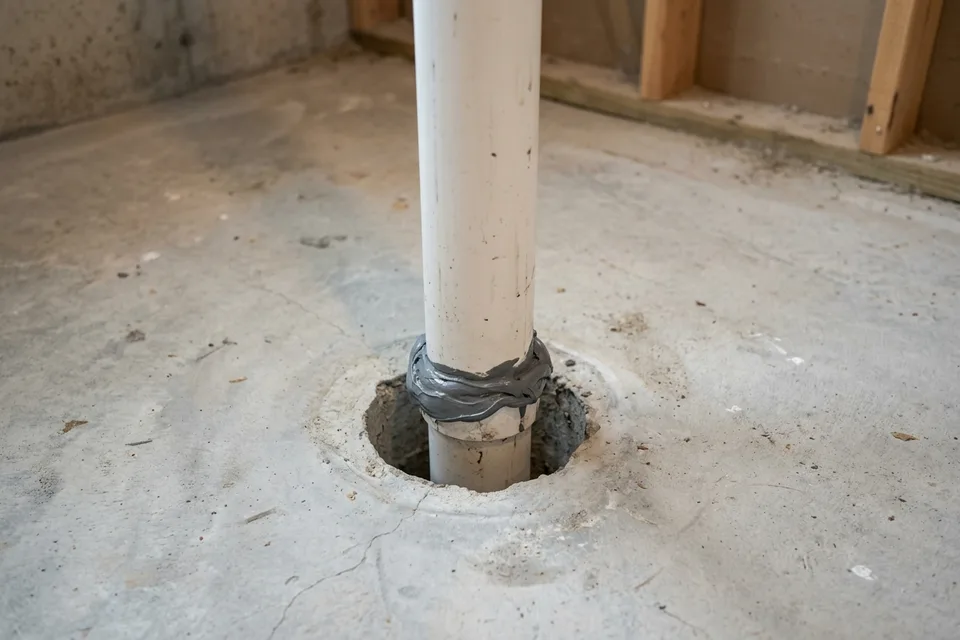 Step 02
Suction point in slab
The installer core-drills a 4- to 5-inch hole through the basement slab, excavates a suction pit in the aggregate below to maximize airflow, and seals a Schedule 40 PVC riser into the slab with elastomeric urethane caulk.
On the quote: Check that the quote includes sub-slab pit excavation, sealing of major slab cracks and the sump lid, and Schedule 40 cellular or solid-core PVC.
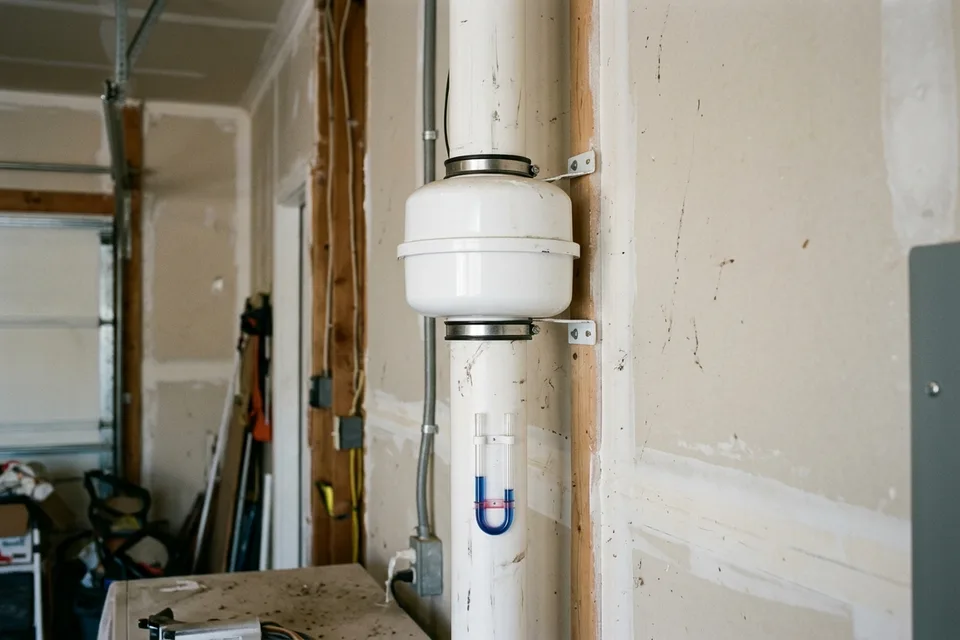 Step 03
Fan and gauge
The radon fan is mounted in an unconditioned attic, garage, or exterior wall—never inside conditioned basement space—while a U-tube liquid manometer on the basement riser lets you see vacuum pressure at a glance.
On the quote: Verify electrical wiring for the fan is included along with a labeled U-tube manometer, system ID label, and a written target below 4.0 pCi/L (or 2.0 pCi/L).


What this photo guide helps you verify on a written quote
- Fan location rule: The fan housing must sit outside conditioned living space (attic, garage, or exterior) so a positive-pressure leak cannot push radon indoors.
- Sump pit & crack sealing: Open sump basins must receive a gasketed airtight lid with a viewing port.
- Electrical connection: Check whether a licensed electrician's switch/circuit for the fan is included or billed separately.
- Post-mitigation guarantee: Look for a written guarantee to bring readings below the EPA 4.0 pCi/L action threshold.
On this page
- The diagram, part by part
- Photo guide: hero and 3 project steps
- Radon mitigation cost by foundation and line item
- What common radon jobs cost
- Which radon fix fits your house
- When to test, and when to fix
- Radon mitigation cost by region
- What “Existing system” does to the price
- What “Foundation” does to the price
- How age changes the radon mitigation claim payout
- How to read the quote, line by line
- How long the job takes
- Worked example
- Does insurance pay for radon mitigation?
- Sources and further reading
- Frequently asked questions
Radon mitigation cost by foundation and line item
The foundation sets the main price. Everything else is a small, separate line you can see on a quote.
| Scope | 2026 planning range | Why it is its own line |
|---|---|---|
| Basement or slab, new system | $800 – $2,800 | One suction point, pipe, fan, labels. |
| Crawl space, new system | $1,400 – $3,800 | Sealed membrane and suction under it. |
| Combination foundation | $1,800 – $4,500 | Basement plus crawl, connected. |
| Second suction point | $350 – $900 | For large slabs or poor gravel. |
| Closet route finish repair | $250 – $800 | Ceilings opened and patched. |
| Sealing obvious openings | $150 – $500 | Cracks, joints, sump lid. |
| Outlet for the fan | $180 – $550 | Only if there is no power nearby. |
| Manometer | $0 – $80 | Usually included. |
| Fan replacement only | $250 – $650 | Existing system, new fan. |
| Retest | $150 – $300 | The proof the system works. |
The pCi/L reading is not a price multiplier on this page. A reading of 20 does not cost five times a reading of 4; it raises urgency.
What common radon jobs cost
Four typical jobs at the national average.
| Job | Planning range | Midpoint |
|---|---|---|
| Basement, one point, outside route The standard system. | $1,100 – $3,680 | $2,390 |
| Large slab, two points When one point cannot reach the whole floor. | $1,450 – $4,580 | $3,015 |
| Crawl space with membrane, needs an outlet Membrane and suction, new outlet. | $1,880 – $5,230 | $3,555 |
| Fan replacement on an old system Fan swap and a retest. | $400 – $950 | $675 |
Each row is this page’s calculator run with the inputs described, at the national average. Change the region and the inputs above to see your own numbers.
Which radon fix fits your house
Almost every house with a high reading gets some form of active soil depressurization. What changes is where the suction goes.
| Option | Best when | Watch out for |
|---|---|---|
| Sub-slab depressurization | Basements and slabs on gravel. | Very tight soil under the slab may need a second point. |
| Sub-membrane depressurization | Crawl spaces with dirt or gravel floors. | Membrane must be sealed at walls and piers. |
| Sump or drain-tile suction | Houses with a perimeter drain to a sump. | Needs an airtight sump lid and a way to service the pump. |
| Sealing or ventilation alone | Low readings only, or as support. | Rarely enough by itself to get below 4 pCi/L. |
When to test, and when to fix
- No test in the last two years or ever. Radon varies by house, not by street.
- A result of 4 pCi/L or more on a short-term or long-term test: fix the house.
- A result between 2 and 4 consider fixing, especially if the basement is lived in.
- Buying or selling a house a test is a normal part of many sales.
- After finishing a basement or after major foundation or HVAC work.
- A system with a level manometer means the fan may have stopped.
Radon mitigation cost by region
The calculator's default radon mitigation job, repriced for each of its six regions. At the national average it runs $1,100 – $3,680; South / Lower Midwest is the lowest at $957 – $3,202, and West Coast metro is the highest at $1,430 – $4,784, a gap of about $1,028 at the midpoint.
| Region | Planning range | Midpoint |
|---|---|---|
| National average | $1,100 – $3,680 | $2,390 |
| South / Lower Midwest | $957 – $3,202 | $2,080 |
| Mountain / Plains | $1,045 – $3,496 | $2,270 |
| Mid-Atlantic / Upper Midwest | $1,232 – $4,122 | $2,677 |
| Northeast metro | $1,386 – $4,637 | $3,012 |
| West Coast metro | $1,430 – $4,784 | $3,107 |
What “Existing system” does to the price
Every other input stays at its default and only “Existing system” changes. The cheapest choice, Fan replacement only, comes to $400 – $950; the most expensive, New system, comes to $1,100 – $3,680.
| Choice | Planning range | Midpoint vs default |
|---|---|---|
| New system (default) | $1,100 – $3,680 | — |
| Fan replacement only | $400 – $950 | −$1,715 |
What “Foundation” does to the price
Every other input stays at its default and only “Foundation” changes. The cheapest choice, Basement or slab, comes to $1,100 – $3,680; the most expensive, Combination, comes to $2,100 – $5,380.
| Choice | Planning range | Midpoint vs default |
|---|---|---|
| Basement or slab (default) | $1,100 – $3,680 | — |
| Crawl space | $1,700 – $4,680 | +$800 |
| Combination | $2,100 – $5,380 | +$1,350 |
How age changes the radon mitigation claim payout
Using the default job, a $1,000 deductible and a 15-year expected life. At 10 years old, about $1,593 is held back as depreciation; a replacement cost policy releases it after the work is finished, while an actual cash value policy keeps it.
| Age | Wear | First check | Held back |
|---|---|---|---|
| 2 years | 13% | $1,071 | $319 |
| 5 years | 33% | $593 | $797 |
| 10 years | 67% | $0 | $1,593 |
| 15 years | 80% | $0 | $1,912 |
| 20 years | 80% | $0 | $1,912 |
| 30 years | 80% | $0 | $1,912 |
How to read the quote, line by line
Radon quotes are short. Make sure these items are on yours.
- Number and location of suction points. And whether a suction test is done first.
- Pipe route and discharge point. Above the roof edge, away from windows.
- Fan model and location. Outside the living space.
- Sealing. What exactly will be sealed.
- Manometer or alarm. Installed and explained.
- Electrical. Outlet or disconnect included or not.
- Retest and guarantee. Who tests, when, and what level is promised.
How long the job takes
| Stage | Typical time | What happens |
|---|---|---|
| Initial test | 2 – 90 days | Short-term kits take a few days; long-term tests take months. |
| Install | 4 – 8 hours | Most systems are a one-day job. |
| Wait before retest | 24 hours – 30 days | Fan running, house closed up. |
| Retest | 2 – 4 days | Short-term test after install. |
| Ongoing | Every 2 years | Retest and glance at the manometer. |
The house can be lived in normally during the install. Expect some noise from coring the slab for an hour or so.
Worked example
A 1980s house with a full basement tested at 6.8 pCi/L. The installer plans one suction point near the middle of the floor, a pipe out through the rim joist and up the garage wall, and an outlet is already in the garage.
New sub-slab system, one point, garage route
Worked example| Line item | National planning range |
|---|---|
| Active radon system | $800 – $2,800 |
| Seal obvious slab or membrane openings | $150 – $500 |
| Manometer | $0 – $80 |
| Post-install retest | $150 – $300 |
| Total before regional adjustment | $1,100 – $3,680 |
Midpoint about $2,390. If the slab were large or the gravel poor, a second point would add about $350–$900. The reading of 6.8 does not move the price.
Does insurance pay for radon mitigation?
Almost never. Radon is not a sudden, accidental loss, so homeowners policies treat mitigation as an improvement the owner pays for. A failed fan is likewise a maintenance item.
Some states and local health departments run test-kit or low-income mitigation programs. Check with your state radon office. This page gives cost ranges only and does not give medical advice.
What this page will not claim
- That the house is safe after the install. The retest tells you.
- Medical advice about radon exposure.
- That a higher reading costs more to fix.
- That a sump pump and a radon system are the same thing.
Sources and further reading
- U.S. EPA — Radon
- U.S. EPA — Consumer’s guide to radon reduction
- CDC — Radon and your health
- AARST — Radon standards of practice
Prices on this page are planning ranges built from public 2026 US cost guides and contractor rate sheets, widened where they disagreed, and multiplied by the same regional index as every other ReplaceCost calculator. Rules and definitions come from the agencies listed. See the methodology for how ranges are set and reviewed.
Frequently asked questions
How much does radon mitigation cost in 2026?
A typical basement or slab system with a retest runs about $1,100 to $3,700. Crawl spaces and combination foundations cost more because of the membrane.
Does a higher radon level cost more to fix?
Not on this page. The same system usually handles a reading of 5 or 25. A very high reading raises urgency and may lead to a second suction point after a suction test.
How long does a radon fan last?
Often around 5 to 10 years or more, depending on the model and conditions. A level manometer is the sign it has stopped.
Can I install a radon system myself?
Some owners do, but many states require certified installers for real estate transactions, and a professional install usually comes with a guaranteed result.
Where should the radon pipe discharge?
Above the roof edge and away from windows, doors and other openings, so the gas is not drawn back in.
Will a radon system raise my electric bill?
Slightly. Most fans draw roughly 15 to 150 watts and run all the time, plus a small amount of heated or cooled air drawn out of the house.
Is a radon system the same as a sump pump?
No. A sump pump moves water. A radon system moves soil gas, though it can use a sealed sump pit as its suction point.
How soon after install can I retest?
Wait at least 24 hours with the fan running and the house closed, then run a short-term test. Many installers schedule it within 30 days.