Home › Slab leak repair
Plumbing · under the floorSlab leak repair cost calculator
A slab leak is a supply pipe leaking in the sand bed under a concrete floor. You usually find out from a water bill that jumps for no reason, a warm patch on the tile, or the sound of running water when every tap is off. The repair itself is often a few hours of plumbing. What makes the bill swing from about $2,000 to well past $10,000 is everything around it: finding the leak, getting to it, and putting the house back.
This calculator keeps those pieces separate. Pick whether detection is done, how the plumber will reach the pipe (spot repair through the floor, a tunnel from outside, or abandoning the line and rerouting it overhead), how many rooms of flooring get disturbed, and whether water has already soaked finishes. It prints each line so you can hold a written quote against it.
One rule runs through the whole page: one leak is a repair, but three leaks, or leaks in old polybutylene, are a signal that the system is failing. In that case the calculator stops and sends you to the whole-house repipe price instead of multiplying a spot repair.
Reviewed 25 October 2026 · Written by Mantu Kumar
See the photos · See the cost diagram · Open the calculator
Key facts at a glance
- Detection: about $300–$900 for electronic leak location with acoustic and thermal tools, often credited if the same company does the repair.
- Spot repair through the slab: about $1,500–$4,500 for one leak, before concrete and flooring.
- Tunnel or reroute: a tunnel runs about $2,800–$7,500; abandoning the line and rerouting it overhead runs about $2,200–$6,500.
- Put-back lines: concrete patch about $400–$1,600; flooring about $500–$2,000 per room; drywall for a reroute about $350–$1,400.
- Stop rule: three leaks or polybutylene pipe means a repipe, not three spot repairs.
National 2026 planning ranges before your regional multiplier. Sources and method are listed at the bottom of the page.
2026 planning ranges
- 1Leak detection
- 2Opening and repair path
- 3Which line failed
- 4Concrete or drywall patch
- 5Flooring and finishes
- 6Dry-out
- 7Not one spot: repipe signal
- 8Warning signs
- 9Insurance: access + damage
Price the leak under your slab
No email · nothing sentDiagram, part by part
Slab leak repair: every numbered part explained
The drawing above has 9 numbered parts, from Electronic leak detection to What insurance may pay. Each card zooms in on one part, says what pushes its price up or down, and tells you what to look for on a written quote. After you run the calculator, the parts in your scope show their dollar band.
1 Electronic leak detection
$300–$900
Before anyone cuts concrete, a leak-detection tech pressure-tests each line to prove which one is losing water, then walks the floor with an acoustic ground microphone and often a thermal camera. A hot-line leak shows as a warm bloom on the camera; a cold-line leak is found mostly by sound and by isolating sections.
What moves it: Hard floors carry sound well; thick carpet, deep fill and a noisy house make it slower. Some companies credit the fee back if they also do the repair.
On the quote: Ask for the marked location, which line failed and the pressure-test readings in writing. A quote that skips detection is guessing where to dig.
2 The repair path: spot, tunnel or reroute
$1,500–$7,500
A spot repair cuts a hole about two feet square right over the leak, digs out the sand, and splices the pipe with a new section and couplings. A tunnel reaches the same spot from outside or from the edge of the slab so the floor inside stays untouched. A reroute leaves the failed line in the slab, caps it, and runs new PEX or copper through the walls and attic.
What moves it: Depth of the pipe, how far the leak sits from an outside wall, the floor finish above it, and whether you have an attic or crawl space to run a new line through.
On the quote: The quote should name the method, the length of new pipe, and whether more than one leak is included. Two leaks are priced around 1.7 times one leak on this page, not twice.
3 Hot line or cold line
Changes method, not a separate line
Hot lines fail more often under slabs: heat expands and contracts the copper every day, and the pipe rubs on gravel or rebar. A hot-line leak also warms the floor and runs up the gas or power bill. Cold-line leaks are quieter and mostly show up on the water bill or as damp at the slab edge.
What moves it: Knowing which line failed decides whether only that line is rerouted or both, and whether the water heater needs to be checked after the repair.
On the quote: If the quote says “unknown line”, ask why the pressure test did not isolate it. Rerouting both lines when one has failed is a choice, not a requirement.
4 Concrete patch, or drywall for a reroute
$350–$1,600
After a spot repair the hole is backfilled with sand, compacted, and patched with new concrete level with the old slab. A reroute does not touch concrete but opens small holes in drywall to fish the new line, which then need patching, taping and paint.
What moves it: Size of the opening, whether the slab had rebar or a post-tension cable nearby, and whether the patch must cure before flooring goes back.
On the quote: Look for “compacted backfill” and “patch flush to the slab”. Ask if drywall repair includes paint or stops at primed mud.
5 Flooring and finishes put back
$500–$2,000 per room
Tile, plank or hardwood over the leak has to come up, and matching it can cost more than the plumbing. Many owners keep a box of spare tile for exactly this. Where the old floor is discontinued, the repair often spreads to the whole room so the patch does not show.
What moves it: The finish (carpet is cheap to relay; tile and site-finished hardwood are not), how many rooms the work crosses, and whether you have attic stock.
On the quote: Most plumbers exclude flooring. Get a separate flooring quote and make sure someone owns the transition between rooms.
6 Dry-out of wet finishes
$800–$2,800 allowance
If water has been coming up through the slab or soaking a cabinet base, the room needs fans, a dehumidifier and moisture readings before anything is closed up. Skipping this is how a plumbing repair turns into a mold job a month later.
What moves it: How long the water sat, what it soaked (carpet pad and particleboard soak up fast), and how humid the house is.
On the quote: Ask for moisture readings at the start and end. For a real wet-room scope, use the water damage calculator instead of this allowance.
7 When it is not one spot
Price a whole-house repipe
Three leaks in a few years, leaks in two different areas, or any leak in polybutylene pipe means the pipe itself is giving up. Patching each one in turn usually costs more than repiping the house overhead, and each patch can damage another finished floor.
What moves it: Pipe material and age, water chemistry (aggressive water thins copper from the inside), and how many leaks you have already paid for.
On the quote: If a plumber offers a third spot repair, ask for a repipe quote side by side. This page stops and links to the repipe calculator when you choose three leaks or polybutylene.
8 Signs of a slab leak
Check before calling
A warm spot on the floor, the water meter moving with every tap off, a higher water bill, the sound of running water or damp flooring are the usual signs. A hot-line leak can also make the water heater run more often.
What moves it: Which line is leaking and how long it has run.
On the quote: Turn off every fixture and watch the meter for 15 minutes; note the result for the leak detection tech.
9 What insurance may pay
Depends on your policy
Many homeowners policies pay to break out and replace the slab and floor to reach a sudden leak, and the water damage it caused, but not the failed pipe itself. Slow leaks over a long time are often excluded.
What moves it: Your policy wording and how long the leak ran.
On the quote: Report the leak promptly and keep the leak detection report for the adjuster.
Project photo guide
Slab leak repair in photos: from pinpointing the leak to closing the floor
A slab leak job moves through three distinct trade stages: isolating and pinpointing the leaking line without unnecessary demolition, opening either a targeted slab access point or an exterior tunnel, and completing the repair or overhead PEX reroute before floor finishes go back.

How the job works in 3 key stages
All three step images are AI-generated illustrations for explanation. Not a site inspection, bid, or coverage decision.
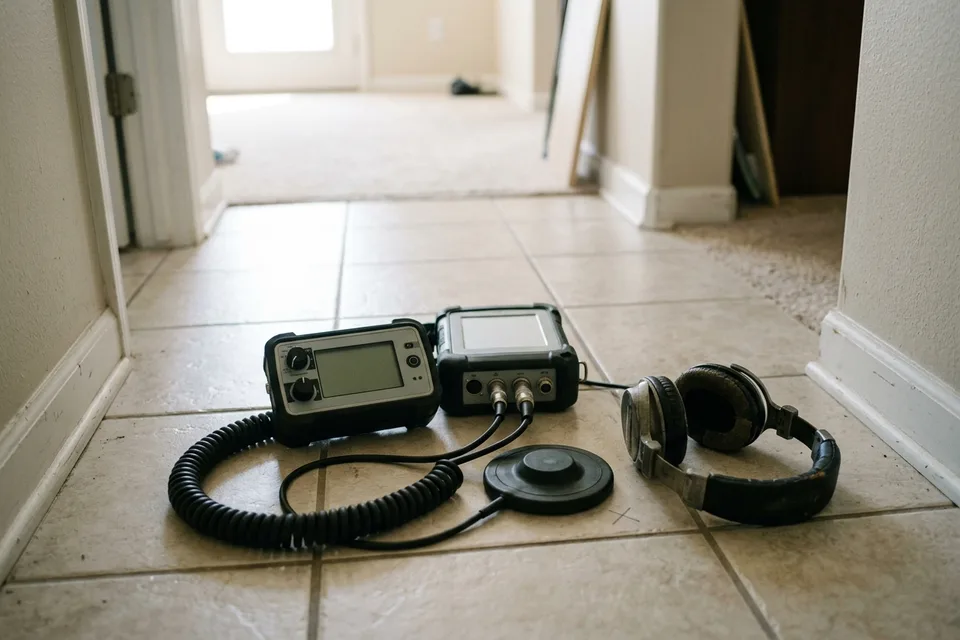 Step 01
Leak detection
Before any concrete saw touches the floor, a specialist isolates the hot and cold manifolds with a pressure gauge and sweeps the slab using an electronic acoustic ground microphone and thermal imaging to mark the leak within a one- to two-foot target zone.
On the quote: Confirm the quote lists electronic leak location, states which line failed (hot or cold), and notes whether the detection fee is credited toward the repair.
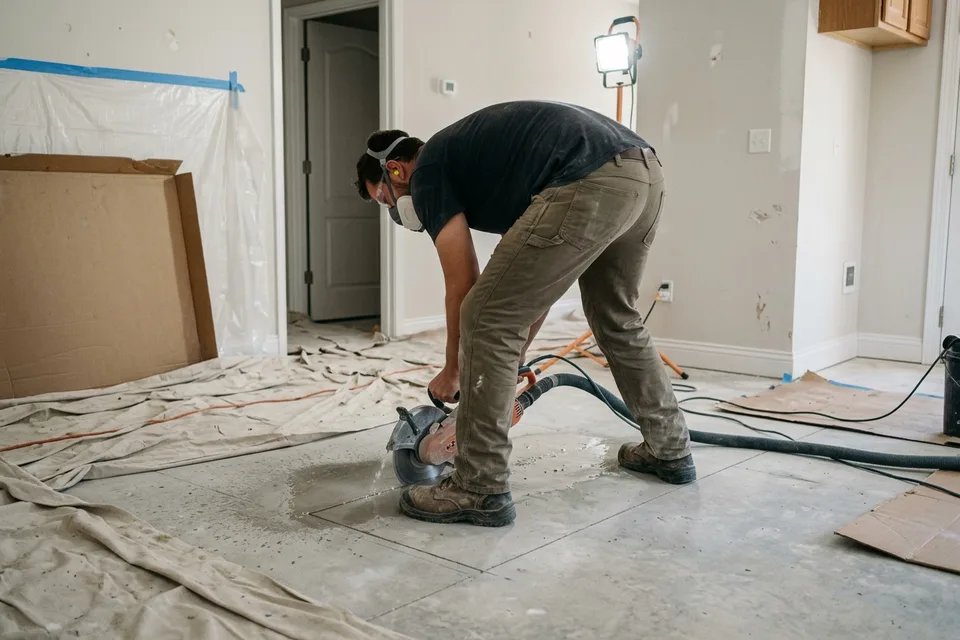 Step 02
Slab access
For a direct spot repair, the crew protects nearby rooms with plastic sheeting, scores a neat square through the slab with a wet or dust-extracted concrete saw, and hand-digs the damp sand bed down to the copper line without nicking adjacent pipes or post-tension cables.
On the quote: Ask whether the price includes dust containment, haul-away of broken concrete and wet spoil, compacted sand backfill, and a doweled concrete patch poured flush with the slab.
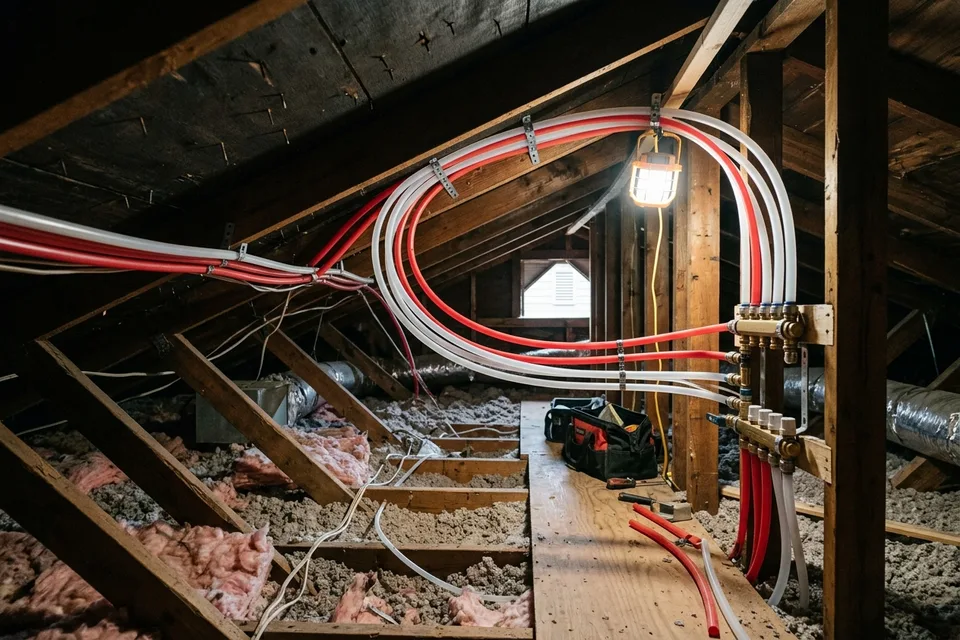 Step 03
Repair or reroute
When an older copper loop has leaked more than once or sits beneath kitchen cabinets and stone tile, plumbers cap the under-slab line at both manifolds and route new insulated PEX piping overhead through the walls and attic framing.
On the quote: Verify pipe material (Type L copper or PEX-A), pipe insulation in unconditioned attic spaces, pressure-test verification, and whether drywall patching and paint are included.


What this photo guide helps you verify on a written quote
- Detection vs. excavation: Make sure the target spot is marked and pressure-tested before you authorize breaking the floor.
- Spot repair vs. reroute: If the line is old or under cabinets, ask for an overhead reroute price alongside the spot-repair quote.
- Concrete & vapor barrier: Confirm the vapor barrier is lapped and sealed before the concrete patch is poured.
- Flooring exclusion: Most plumbing bids stop at rough concrete—budget separately for tile, plank, or hardwood replacement.
On this page
- The diagram, part by part
- Photo guide: hero and 3 project steps
- Slab leak repair cost by line item
- What common slab leak jobs cost
- Spot repair, tunnel or reroute: which one fits
- Signs you may have a slab leak
- How to read the quote, line by line
- How long the job takes
- Worked example
- Does homeowners insurance cover a slab leak?
- Sources and further reading
- Frequently asked questions
Slab leak repair cost by line item
These are the pieces a written quote should break out. Most real jobs combine detection, one repair path, and at least one put-back line.
| Scope | 2026 planning range | Why it is its own line |
|---|---|---|
| Electronic leak detection | $300 – $900 | Finding the leak is a separate trade skill and is often billed by a different company. |
| Spot repair through the slab, one leak | $1,500 – $4,500 | Cut, dig, splice and backfill. The plumbing itself is a small part of the cost. |
| Tunnel repair, one leak | $2,800 – $7,500 | Hand-dug from outside or the slab edge; costs more labor but saves the floor. |
| Overhead reroute of one line | $2,200 – $6,500 | Old line capped in the slab, new line through walls and attic. |
| Concrete patch | $400 – $1,600 | Only for spot repairs; tunnels and reroutes avoid it. |
| Flooring and finish repair | $500 – $2,000 per room | Tile, wood and discontinued finishes push it to the top. |
| Drywall where a reroute is fished | $350 – $1,400 | Small openings in walls and ceilings, patched and painted. |
| Dry-out allowance | $800 – $2,800 | Fans, dehumidifier and moisture checks if water sat on finishes. |
Two leaks are scaled to about 1.7 times one leak, because the crew, detection and mobilization are shared. Three leaks are not priced as spot repairs at all.
What common slab leak jobs cost
Four typical jobs, run through the calculator on this page so you can see how the method and the floor change the total more than the leak itself.
| Job | Planning range | Midpoint |
|---|---|---|
| Spot repair under one tiled room Detection, one leak through the slab, concrete patch, one room of flooring. | $2,700 – $9,000 | $5,850 |
| Tunnel to a leak under a kitchen Detection and a tunnel so cabinets and tile stay put. | $3,500 – $10,000 | $6,750 |
| Reroute the hot line overhead Detection already done; new line through the attic and walls. | $2,550 – $7,900 | $5,225 |
| Two leaks, two rooms, with dry-out The bad case short of a repipe. | $5,050 – $16,950 | $11,000 |
Each row is this page’s calculator run with the inputs described, at the national average. Change the region and the inputs above to see your own numbers.
Spot repair, tunnel or reroute: which one fits
The right method depends less on the leak and more on what sits above it and how old the rest of the pipe is. A good plumber will usually explain why they picked one, and will price a second option if you ask.
| Option | Best when | Watch out for |
|---|---|---|
| Spot repair | One leak under carpet, vinyl or a floor you plan to replace anyway; pipe otherwise in good shape. | Matching tile or hardwood; noise and dust inside; a second leak nearby later. |
| Tunnel | Leak under cabinets, a tub or expensive tile, and close enough to an outside wall to dig to. | Higher labor; soil that caves; long tunnels under the middle of the house get expensive fast. |
| Reroute one line | Hot line with a history of leaks, or a leak under something you cannot disturb; attic or crawl space available. | Drywall holes; a longer new line; the other line is still the same age. |
| Whole-house repipe | Three or more leaks, polybutylene, or both lines failing in different rooms. | Higher one-time cost, but it ends the cycle of cutting floors. |
Signs you may have a slab leak
- A water bill that jumps by a third or more with no change in use, or a meter dial that moves with every tap and toilet off.
- A warm patch on the floor that you can feel through tile in bare feet, often in a hallway or near the kitchen. That points to the hot line.
- The sound of running water when nothing is on, usually loudest at night when the house is quiet.
- Damp carpet or a musty smell along a baseboard with no plumbing fixture above it.
- Cracks or lifting in tile or wood that appear quickly, sometimes with efflorescence (white residue) at grout lines.
- A water heater that runs constantly or a gas bill that climbs with the water bill.
How to read the quote, line by line
Slab leak quotes vary a lot because each company bundles different pieces. Use these checks to compare two quotes on equal terms.
- Who found the leak and how. There should be a detection report or at least a marked spot and the line named.
- Method in writing. Spot repair, tunnel or reroute, with the reason.
- Pipe material and length. Copper type L or PEX, and how many feet of new pipe.
- Pressure test after the repair. The line should hold pressure before anything is closed up.
- Concrete or drywall included or not. Many quotes stop at “rough patch”.
- Flooring excluded? Most plumbing quotes exclude it. Get that number before you sign.
- Warranty on the repair. Ask how long, and whether a new leak elsewhere on the same line is covered.
How long the job takes
| Stage | Typical time | What happens |
|---|---|---|
| Leak detection | 2 – 4 hours | Pressure tests, acoustic and thermal search, location marked on the floor. |
| Spot repair | 1 – 2 days | Cut, dig, repair, test, backfill and pour the patch. |
| Tunnel repair | 2 – 5 days | Most of the time is hand digging and backfill. |
| Reroute | 1 – 3 days | Running new line, then drywall patching after. |
| Concrete cure before flooring | 2 – 7 days | Depends on patch depth and the flooring maker’s moisture limit. |
Water is usually off only for part of one day. If the house has to stay without water for longer, ask whether a temporary bypass line can be run.
Worked example
A 1990s single-story house on a slab. The water bill rose by about $60 a month and a warm strip appeared in the hallway tile. Detection is not done yet, the plumber plans a spot repair, and one room of tile will need resetting.
Spot repair under a tiled hallway
Worked example| Line item | National planning range |
|---|---|
| Electronic leak detection | $300 – $900 |
| Spot repair through the slab | $1,500 – $4,500 |
| Concrete patch | $400 – $1,600 |
| Flooring and finish repair | $500 – $2,000 |
| Total before regional adjustment | $2,700 – $9,000 |
Midpoint about $5,850. The plumbing is less than half of the total; detection, concrete and tile make up the rest. If the tile is discontinued, add the cost of redoing the hallway rather than patching it.
Does homeowners insurance cover a slab leak?
Most homeowners policies treat a sudden leak from plumbing as a covered cause of water damage, subject to the deductible. That often pays to repair the floor and finishes the water damaged, and some policies also pay to tear out and replace the slab or floor needed to reach the leak. The pipe itself is often excluded as wear and tear.
Long, slow leaks are different. Damage that built up over weeks or months is commonly limited or denied as continuous seepage. That is why it is worth calling the insurer early, taking photos before anything is opened, and keeping the detection report. This page does not subtract a deductible or estimate a claim check; it prices the work so you can compare it with what the adjuster writes.
What this page will not claim
- That a pinhole leak means the whole system has to be replaced.
- That a policy will or will not pay; that depends on the wording and how long the leak ran.
- That three spot repairs cost three times one. It stops and points to a repipe.
- That it can price a full water-damage restoration. Use the water damage calculator for that.
Sources and further reading
- U.S. EPA WaterSense — Fix a Leak Week and checking for hidden leaks
- International Code Council — International Residential Code (plumbing chapters)
- NAIC — Actual cash value vs replacement cost coverage
- U.S. EPA — Mold cleanup in your home
- HomeAdvisor — Main water line replacement cost
Prices on this page are planning ranges built from public 2026 US cost guides and contractor rate sheets, widened where they disagreed, and multiplied by the same regional index as every other ReplaceCost calculator. Rules and definitions come from the agencies listed. See the methodology for how ranges are set and reviewed.
Frequently asked questions
How much does it cost to fix a slab leak in 2026?
Most single-leak repairs land between about $2,200 and $9,000 once detection, the repair and put-back work are included. The plumbing alone is often $1,500 to $4,500; tunnels and floors push it higher.
Is it cheaper to reroute or to break the slab?
For one leak under cheap flooring, a spot repair through the slab is usually cheaper. If the leak sits under cabinets or expensive tile, or the hot line has leaked before, a reroute often costs about the same and avoids future floor damage.
How do plumbers find a leak under concrete?
They pressure-test each line to see which one loses water, then listen with an acoustic ground microphone and look for heat with a thermal camera. A good tech can usually mark the spot within a foot or two.
Can I live in the house during a slab leak repair?
Usually yes. Water is shut off for part of a day. A spot repair is dusty and loud for a day or two; a reroute leaves small drywall holes until they are patched.
Why do slab leaks happen?
Copper under slabs wears from expansion and contraction, rubbing against gravel or rebar, aggressive water chemistry, and poor installation. Hot lines fail more often because they move more.
Will a slab leak damage my foundation?
A leak that runs for months can wash out soil under the slab and contribute to settling, especially in expansive clay. Most leaks caught within weeks do not cause structural damage, but the sooner it is fixed the better.
Does insurance pay for slab leak detection?
Some policies pay for access and detection as part of a covered water loss; many do not pay to repair the pipe itself. Read the water damage and “tear out” wording, and call before work starts.
When should I repipe instead of repairing?
When you have a third leak, leaks in different parts of the house, or polybutylene pipe. Repiping overhead costs more once but stops the cycle of cutting floors.