Home › HVAC › Ductwork replacement
Heating and cooling · air distributionDuctwork replacement cost calculator
Ducts are the hidden half of a forced-air system. A new furnace or heat pump cannot fix rooms that never get warm, a hot upstairs, dust that comes back a day after cleaning, or a high energy bill if the ducts behind the walls are crushed, disconnected or leaking into the attic.
Duct replacement is priced mostly by length, material and access. Flex duct in an open attic is the cheapest per foot; sheet metal in a tight crawl space costs the most. Houses with ducts buried in the concrete slab are a different job: the old runs are sealed and abandoned, and new ducts go overhead.
Use the floor area for a first estimate, or enter linear feet if a contractor has measured. The calculator adds removal of the old ducts, extra return drops, the plenum connection at the air handler and any permit as separate lines. If asbestos tape or mold is suspected, it stops and tells you to test first.
Reviewed 25 October 2026 · Written by Mantu Kumar
See the photos · See the cost diagram · Open the calculator
Key facts at a glance
- Per linear foot, installed: flex about $18–$29; duct board about $22–$38; sheet metal about $30–$50. Attic and crawl work adds about 8%.
- Whole-house estimate: about 0.12 ft of duct per sq ft for one story, 0.14 for two.
- Removal of old ducts: about $1.50–$4 per foot.
- Slab ducts: abandon and reroute overhead about $5,000–$17,000, plus capping and concrete.
- Leaks: ENERGY STAR estimates typical systems lose about 20–30% of air through leaks and poor connections.
National 2026 planning ranges before your regional multiplier. A Manual D design is the right way to size new ducts.
2026 planning ranges
- 1New ducts, supply and install
- 2Remove old ducts
- 3Seal and insulate
- 4Return drops
- 5Plenum connection
- 6Slab: concrete patch
- 7Permit
- 8Flex, board or metal
- 9Asbestos check (old ducts)
Price your duct replacement
No email · nothing sentDiagram, part by part
Ductwork replacement: every numbered part explained
The drawing above has 9 numbered parts, from New duct runs to Asbestos tape or wrap check. Each card zooms in on one part, says what pushes its price up or down, and tells you what to look for on a written quote. After you run the calculator, the parts in your scope show their dollar band.
1 New duct runs
$18–$50 per foot
The main line is the new supply ducts from the plenum to each room, including fittings, hangers, insulation and sealing. In an open attic most installers use a sheet-metal trunk with insulated flex branches. Sheet metal throughout lasts longer and moves air with less resistance.
What moves it: Total length, material, number of rooms, and attic, crawl space or basement access.
On the quote: Look for linear feet or room count, the material, insulation R-value (attics usually R-8), and whether the design is based on Manual D.
2 Removing the old ducts
$1.50–$4 per foot
Old ducts are disconnected, pulled out and hauled away. In slab houses the buried runs are capped and sealed instead.
What moves it: Length, attic insulation that has to be moved, and disposal.
On the quote: Confirm removal and haul-away are included, and that attic insulation disturbed by the work is put back.
3 Sealing and insulating every joint
Included in the duct rate
Every joint, collar and boot is sealed with mastic or approved tape, then wrapped. Sealing is what makes new ducts deliver the air you pay to heat and cool.
What moves it: Workmanship more than material.
On the quote: Ask for a duct leakage test result after install. Many codes now require one for new systems.
4 Return air drops
$180–$400 each beyond two
Air has to get back to the system. Many older houses have one central return, which starves bedrooms with closed doors. Extra returns, or jumper ducts, balance the house.
What moves it: Number of returns and how hard it is to reach each wall cavity.
On the quote: The design should say how air returns from each bedroom.
5 Plenum and air handler connection
$250–$800
The plenum is the box on the air handler that the trunk ducts connect to. It is often rebuilt with a new duct system to fit the new layout and seal properly.
What moves it: Size, fitting complexity and filter location.
On the quote: Look for a sealed plenum with access for the coil and filter.
6 Ducts buried in the slab
$700–$2,800 patch
Some 1950s–1970s houses have ducts cast into the concrete floor. They rust, collapse and fill with water and dirt. The fix is to cap and seal them and run new ducts through the attic, with concrete patched where registers were.
What moves it: House size, attic access, and how many floor registers are abandoned.
On the quote: Ask how each old floor register is sealed and patched, and whether any slab duct is tested for asbestos.
7 Permit if the town requires one
$0–$350
Many towns require a mechanical permit for duct replacement, sometimes with a duct leakage test.
What moves it: Local rules.
On the quote: Ask if a permit is needed and included, and who runs any leakage test.
8 Duct material: flex, board or sheet metal
$18–$50 per foot by material
Flex duct is the least expensive and quickest to install but loses airflow if it sags or kinks. Duct board is insulated and quiet. Sheet metal costs the most but is the most durable, easiest to clean and moves air with the least resistance.
What moves it: Material choice, run length and access.
On the quote: Ask which material is used for trunks and branches, and how flex runs are supported so they stay straight.
9 Asbestos tape or wrap check
Stops the ordinary price
Ducts installed before about 1980 may have asbestos tape at the joints or asbestos wrap on the trunks. If it is suspected, it must be tested and removed by a licensed abatement crew before ordinary duct work can start.
What moves it: The age of the system and lab test results.
On the quote: Ask for a lab test of suspect tape or wrap before removal, and get abatement priced on its own.
Project photo guide
Ductwork replacement in photos: old duct damage, mastic sealing and finished registers
Replacing leaky, crushed, or under-insulated attic and crawl-space ducts restores airflow and cuts heating and cooling waste: crews strip out torn flex runs, hang properly sized trunks and takeoffs sealed with mastic, and connect insulated boots to clean room registers.

How the job works in 3 key stages
All three step images are AI-generated illustrations for explanation. Not a site inspection, bid, or coverage decision.
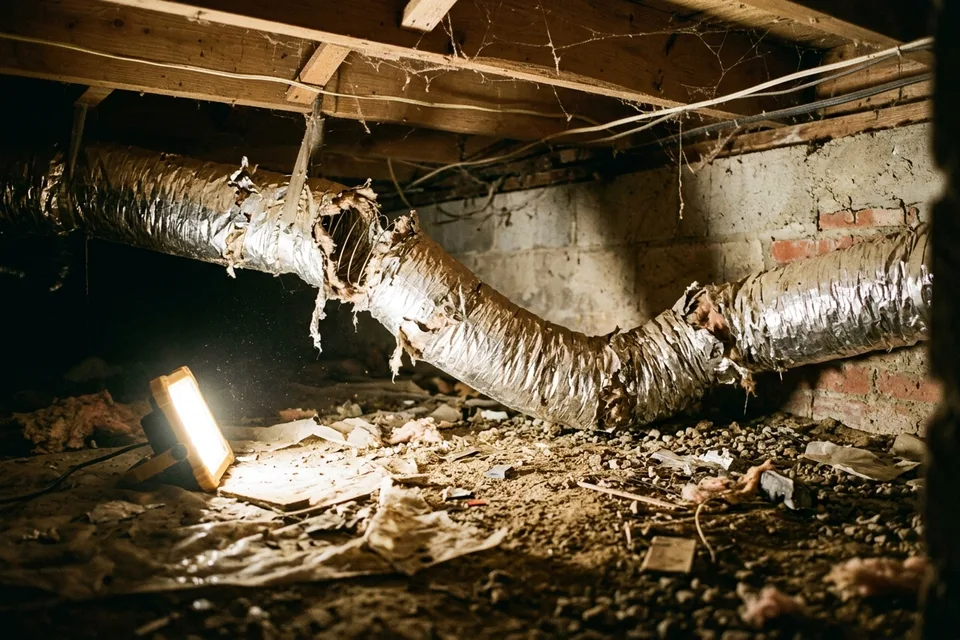 Step 01
Old duct damage
In attics and crawl spaces, older flex ducts often suffer from disintegrated vapor barriers, disconnected collars, kinks, or rodent damage—dumping conditioned air into unconditioned space.
On the quote: Ask whether the contractor inspected all supply and return trunks and whether removal and disposal of the old duct runs are included.
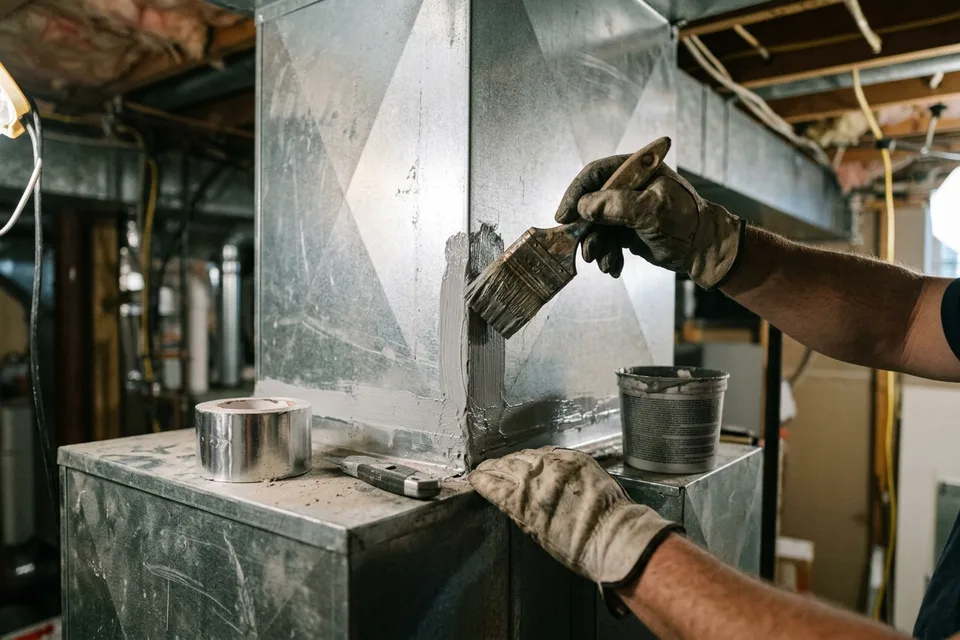 Step 02
Sealing joints
Every sheet-metal takeoff collar, plenum seam, and boot connection is mechanically fastened with sheet-metal screws, wrapped with UL 181 foil tape, and brushed thick with fiber-reinforced mastic sealant.
On the quote: Insist on brushed UL 181 mastic sealant and mechanical fasteners at every joint—never standard cloth 'duct tape', which dries out and fails.
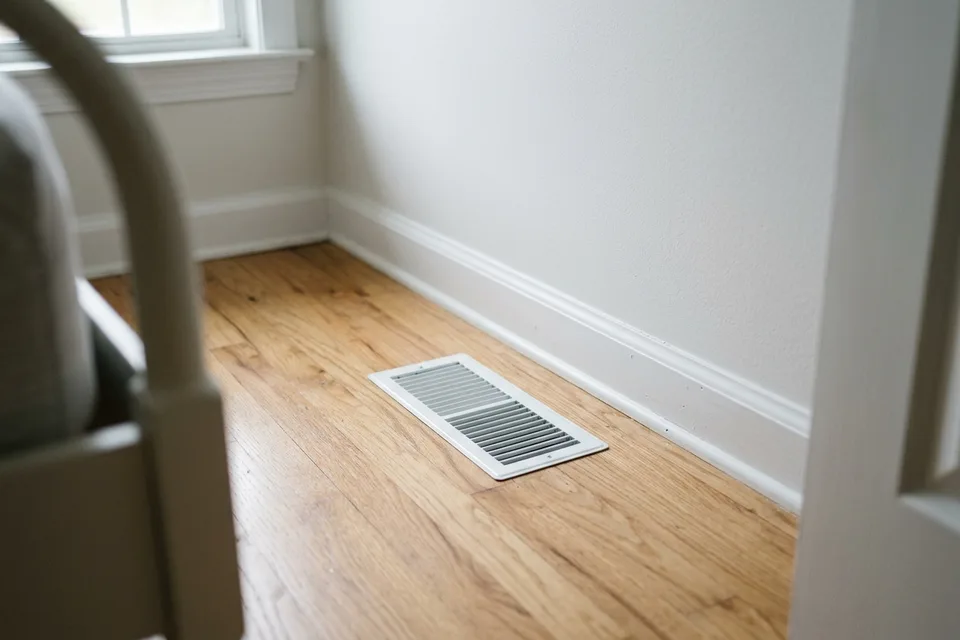 Step 03
Registers and boots
Inside the living space, each supply boot is caulked airtight to the subfloor or ceiling drywall so attic or crawl-space air cannot bypass around the register grille.
On the quote: Check that the quote specifies R-6 or R-8 duct insulation (R-8 in unconditioned attics), sealed register boots, and airflow balancing dampers.


What this photo guide helps you verify on a written quote
- Insulation R-value: Attic ductwork in most climate zones requires R-8 insulated flex or duct board to prevent summer condensation.
- Support straps & straight runs: Flex duct must be pulled taut and hung on 1.5-inch-wide straps every 4 feet with minimal sag.
- Return air sizing: Many older homes are starved for return air—ask if the return drop or filter grille should be upsized while the plenum is open.
- Duct leakage testing: If local code requires a duct blaster test at permit closeout, confirm who pays the testing fee.
On this page
- The diagram, part by part
- Photo guide: hero and 3 project steps
- Ductwork cost by material, access and scope
- What common duct jobs cost
- Repair, seal or replace
- Signs your ducts need work
- Ductwork replacement cost by region
- What “Asbestos or mold suspected” does to the price
- What “Access” does to the price
- How age changes the ductwork replacement claim payout
- How to read the quote, line by line
- How long the job takes
- Worked example
- Does insurance pay for new ductwork?
- Ways to keep the cost down
- Sources and further reading
- Frequently asked questions
Ductwork cost by material, access and scope
The per-foot rates below include fittings, insulation and sealing. Access and returns are added separately.
| Scope | 2026 planning range | Why it is its own line |
|---|---|---|
| Flex duct | $18 – $29 per ft | Fast in open attics; keep runs short and straight. |
| Duct board | $22 – $38 per ft | Insulated board; common in some regions. |
| Sheet metal | $30 – $50 per ft | Longest-lived and lowest resistance. |
| Attic or crawl access | +8% | Tight work and insulation moved. |
| Remove old ducts | $1.50 – $4 per ft | Haul-away. |
| Extra return drops | $180 – $400 each | Beyond two in a basic layout. |
| Plenum connection | $250 – $800 | At the air handler. |
| Slab duct abandon and reroute | $5,000 – $17,000 | Package price, plus capping and concrete. |
If asbestos tape or wrap is on old ducts, or there is mold, the calculator stops. Test first; abatement or remediation is priced separately.
What common duct jobs cost
Four typical jobs at the national average.
| Job | Planning range | Midpoint |
|---|---|---|
| 2,000 sq ft, one story, flex in the attic Full replacement with four returns. | $5,636 – $10,427 | $8,032 |
| Partial replacement, 45% of runs Worst runs only. | $2,872 – $5,765 | $4,318 |
| Two-story, sheet metal, basement Sheet metal throughout. | $9,430 – $17,070 | $13,250 |
| Slab ducts abandoned, new ducts overhead The slab-house package. | $6,710 – $23,150 | $14,930 |
Each row is this page’s calculator run with the inputs described, at the national average. Change the region and the inputs above to see your own numbers.
Repair, seal or replace
Not every duct problem needs new ducts. A good contractor will test first and tell you which of these fits.
| Option | Best when | Watch out for |
|---|---|---|
| Seal in place | Ducts are in good shape but leak at joints. | Hidden joints in walls cannot be reached. |
| Partial replacement | A few crushed or undersized runs. | Mixing materials; the rest is still old. |
| Full replacement | Ducts are old, crushed, uninsulated, or the system is changing size. | Highest cost; attic insulation disturbed. |
| Ductless instead | No room for ducts or slab ducts failing. | Different price; see mini-split. |
Signs your ducts need work
- Rooms that are always too hot or cold even after a new system.
- Dust that returns quickly especially near registers.
- Visible damage in the attic crushed, torn or disconnected runs.
- High bills with a newer furnace or AC.
- Musty smells when the system starts.
- Ducts older than 20–25 years especially flex or duct board.
Ductwork replacement cost by region
The calculator's default ductwork replacement job, repriced for each of its six regions. At the national average it runs $5,636 – $10,427; South / Lower Midwest is the lowest at $4,903 – $9,071, and West Coast metro is the highest at $7,327 – $13,555, a gap of about $3,454 at the midpoint.
| Region | Planning range | Midpoint |
|---|---|---|
| National average | $5,636 – $10,427 | $8,032 |
| South / Lower Midwest | $4,903 – $9,071 | $6,987 |
| Mountain / Plains | $5,354 – $9,906 | $7,630 |
| Mid-Atlantic / Upper Midwest | $6,312 – $11,678 | $8,995 |
| Northeast metro | $7,101 – $13,138 | $10,120 |
| West Coast metro | $7,327 – $13,555 | $10,441 |
What “Asbestos or mold suspected” does to the price
Every other input stays at its default and only “Asbestos or mold suspected” changes. The cheapest choice, Yes — stop a normal price, comes to $0 – $0; the most expensive, No, comes to $5,636 – $10,427.
| Choice | Planning range | Midpoint vs default |
|---|---|---|
| No (default) | $5,636 – $10,427 | — |
| Yes — stop a normal price | $0 – $0 | −$8,032 |
What “Access” does to the price
Every other input stays at its default and only “Access” changes. The cheapest choice, Basement or open joists, comes to $5,290 – $9,870; the most expensive, Abandon slab ducts and reroute, comes to $6,710 – $23,150.
| Choice | Planning range | Midpoint vs default |
|---|---|---|
| Basement or open joists | $5,290 – $9,870 | −$452 |
| Attic (default) | $5,636 – $10,427 | — |
| Crawl space | $5,636 – $10,427 | −$0 |
| Abandon slab ducts and reroute | $6,710 – $23,150 | +$6,898 |
How age changes the ductwork replacement claim payout
Using the default job, a $1,000 deductible and a 25-year expected life. At 10 years old, about $3,213 is held back as depreciation; a replacement cost policy releases it after the work is finished, while an actual cash value policy keeps it.
| Age | Wear | First check | Held back |
|---|---|---|---|
| 2 years | 8% | $6,389 | $643 |
| 5 years | 20% | $5,425 | $1,606 |
| 10 years | 40% | $3,819 | $3,213 |
| 15 years | 60% | $2,213 | $4,819 |
| 20 years | 80% | $606 | $6,425 |
| 30 years | 80% | $606 | $6,425 |
How to read the quote, line by line
Duct quotes are hard to compare unless they describe the design.
- Design basis. Manual D or at least a room-by-room airflow plan.
- Feet and material. Per trunk and branch.
- Insulation and sealing. R-value and mastic or tape.
- Returns. How each bedroom returns air.
- Removal and haul-away. Included or not.
- Leakage test. Before and after numbers.
- Permit. If required.
How long the job takes
| Stage | Typical time | What happens |
|---|---|---|
| Inspection and design | 1 – 3 hours | Measure, test, plan. |
| Install, one story | 1 – 3 days | Attic work is weather dependent. |
| Install, two story | 2 – 5 days | More wall access. |
| Slab reroute | 3 – 7 days | Plus concrete patches. |
| Leakage test and balancing | 2 – 4 hours | Final check. |
Attic work is best done on cool mornings in summer. The system is usually off only during the day.
Worked example
A 1990s ranch with original flex ducts in the attic, several crushed and two disconnected. The owner replaces all of them and adds two bedroom returns.
2,000 sq ft one story, flex ducts in the attic
Worked example| Line item | National planning range |
|---|---|
| Flex ducts, supply and install | $4,666 – $7,517 |
| Remove and dispose of the old ducts | $360 – $960 |
| Seal and insulate the new runs | $0 |
| Extra return drops | $360 – $800 |
| Plenum connection at the air handler | $250 – $800 |
| Permit, if the town requires one | $0 – $350 |
| Total before regional adjustment | $5,636 – $10,427 |
Midpoint about $8,032. Choosing sheet metal for the same 240 feet would raise the duct line to roughly $7,800–$13,000.
Does insurance pay for new ductwork?
Ducts that wear out, sag or leak are maintenance. Insurance may pay when a covered event damages them, such as fire, smoke contamination, or water from a burst pipe, minus the deductible.
After a fire or smoke loss, duct cleaning or replacement is often part of the claim. Document it with the adjuster before work starts.
What this page will not claim
- A duct design. Sizing needs a Manual D calculation.
- A price for asbestos tape or mold removal.
- That duct cleaning fixes leaks.
- The furnace or air conditioner itself.
Ways to keep the cost down
Duct costs depend on access and material.
- Seal before replacing. Leaks may be the problem.
- Replace only failed runs. Partial replacement.
- Choose flex where suitable. Lower cost.
- Improve access. Less labor.
- Do it with HVAC replacement. One project.
- Test leakage. Proves the need.
Sources and further reading
- ENERGY STAR — Duct sealing
- U.S. DOE Energy Saver — Minimizing energy losses in ducts
- ACCA — Manual D residential duct systems
- U.S. EPA — Asbestos
Prices on this page are planning ranges built from public 2026 US cost guides and contractor rate sheets, widened where they disagreed, and multiplied by the same regional index as every other ReplaceCost calculator. Rules and definitions come from the agencies listed. See the methodology for how ranges are set and reviewed.
Frequently asked questions
How much does it cost to replace ductwork in 2026?
A typical 2,000 sq ft one-story house with flex ducts in the attic runs about $5,600 to $10,400 with removal, returns and the plenum. Sheet metal and tight access cost more.
How long does ductwork last?
Sheet metal can last decades. Flex duct and duct board often need replacement after about 20 to 25 years, sooner in hot attics.
Is flex duct as good as metal?
Flex is fine when runs are short, straight and well supported. Long, sagging or kinked flex runs restrict airflow.
Should I replace ducts when I replace my AC or furnace?
If the ducts are old, leaky or undersized for the new system, yes. Otherwise test and seal them.
What do I do about ducts in the slab?
Most contractors cap and seal them and run new ducts overhead, because buried ducts cannot be fixed in place.
Can I just seal my ducts instead?
If they are in good shape, sealing accessible joints can cut leakage a lot for much less money.
Does old duct tape contain asbestos?
Some ducts from before the 1980s used asbestos tape or wrap. Test before disturbing it.
How long does duct replacement take?
One to three days for most one-story houses.
Do new ducts improve air quality?
Sealed ducts pull less dusty air from attics, crawl spaces and wall cavities, which can reduce dust in the home. Good filtration at the return does the rest.
Should ducts be insulated?
Ducts in attics, crawl spaces and garages should be insulated to cut heat loss and prevent condensation in summer. Ducts inside the conditioned space need little or no insulation.
Can ducts be cleaned instead of replaced?
Cleaning removes dust and debris but does not fix leaks, crushed runs or poor sizing. Leaky ducts need sealing or replacement.