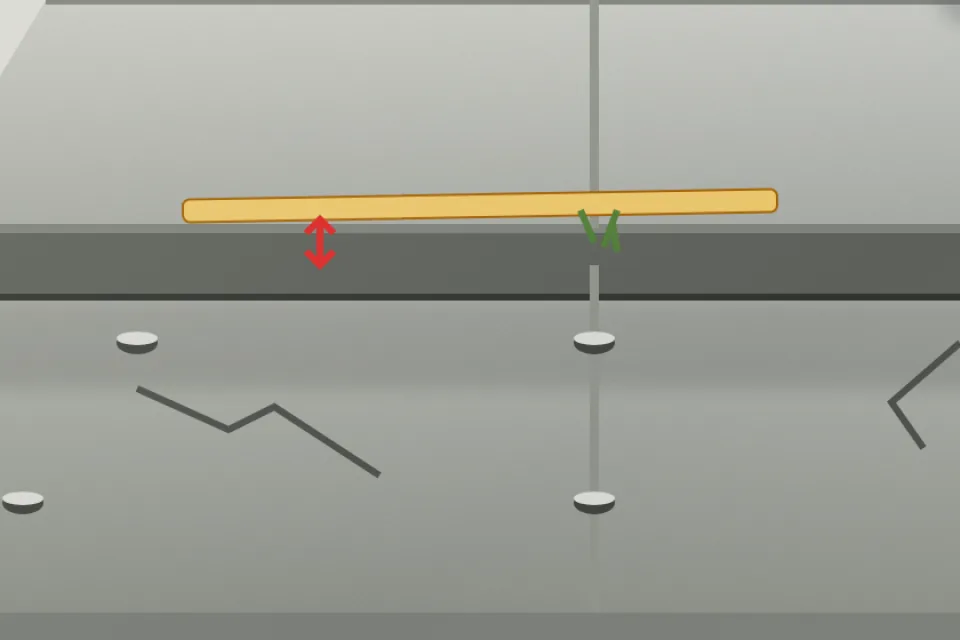
Measure the drop
Lay a straightedge across the joint and measure the gap. Under an inch is routine; three inches or more needs more fill and a careful lift.
Home › Concrete leveling
Mudjacking · Foam lifting · Joint sealing · Lift or replaceLifting a sunken driveway, sidewalk or patio panel usually costs $650 to $1,900, and the average job is about $1,200. Mudjacking runs about $3 to $6 per square foot. Polyurethane foam is closer to $6 to $15 for most home jobs and can reach $25 on hard access. Tearing the slab out and pouring new costs roughly $6.50 to $16.50 per square foot, so leveling only makes sense while the panel is still in one piece.
Reviewed 25 October 2026 · Written by Mantu Kumar
See the illustration · See the live cost diagram · Open the calculator
2026 planning bands from published concrete-leveling cost guides. Minimum trip charges apply to small jobs.
2026 planning ranges
Lift or replace?: Lift: $3–$15 per sq ft Replace: $6.50–$16.50 Broken in pieces? Replace.
Diagram, part by part
The concrete leveling drawing above has 9 numbered parts, from Sunken panel lifted back to Regrade the soil. Each card below frames one of them, and after you run the calculator it shows what that part adds to your estimate.
Included in the lift price
The sunken panel is raised back to level by filling the space underneath it through small holes. Lifting works only while the slab is still in one piece; once it is broken into loose sections, the pieces rock and settle again and replacement is the better spend.
What moves it: How far the panel has dropped and whether it is still in one piece.
On the quote: Ask how many inches the panel will be lifted and how they will check it is level with the next panel.
Included in the lift price
Water running off a roof or along a crack washes soil out from under the slab and leaves an empty void. Filling that void is what actually supports the panel afterwards, so the volume of the void drives how much material is pumped.
What moves it: The size of the void and how loose the soil underneath is.
On the quote: Ask whether the crew will fill voids under neighboring panels that have not dropped yet.
Included in the lift price
Holes are drilled through the slab to pump in the fill, then patched with matching cement. Foam needs holes about the size of a coin; mudjacking needs larger holes, so the patches are more visible afterwards.
What moves it: The method chosen and the number of holes needed.
On the quote: Ask how many holes will be drilled, their size and how the patches will be colored.
Mudjacking $3–$6 · foam $6–$15 per sq ft
Mudjacking pumps a cement and soil slurry under the slab; polyurethane foam expands into the void and weighs far less, so it adds little load to soft soil. Foam costs more per square foot but usually lasts longer and cures within minutes.
What moves it: Area to lift, the method and the depth of the void.
On the quote: Ask which method is used, how many square feet are priced and whether there is a warranty against settling again.
Sealing control joints and cracks with flexible sealant keeps rain from running under the slab and washing out the fill. It is the cheapest step that protects the lift.
What moves it: Linear feet of joints and cracks.
On the quote: Ask for a flexible polyurethane or self-leveling sealant, not rigid mortar.
A downspout dumping water at the edge of the slab is the most common cause of sinking. Moving the discharge several feet away, or burying an extension, stops the slab from sinking again.
What moves it: Number of downspouts and how far the water must be carried.
On the quote: Ask where each downspout will discharge after the job.
Tear out and pour new
When a slab has broken into loose pieces, lifting it only levels fragments that will rock and crack again. The calculator switches to tear-out and a new pour, which costs more per square foot but gives a solid surface.
What moves it: How many pieces the slab is in and the area to replace.
On the quote: Ask for both a lift price and a replacement price when the slab has a crack running through it.
Changes the base rate
Driveways and garage floors carry vehicles and are thicker, while sidewalks, patios and steps carry only foot traffic. Steps and pool decks are harder to reach and lift evenly, so the slab type changes both the method and the price.
What moves it: The slab type, its thickness and the load it carries.
On the quote: Tell the contractor exactly which slab is sinking and what drives or sits on it.
Priced with the downspout line
Soil that slopes toward the slab sends rainwater straight under it. Regrading so the ground falls away from the concrete, about an inch per foot for the first few feet, keeps the void from coming back.
What moves it: How much soil must be moved and how much the yard slopes now.
On the quote: Ask whether regrading is included or only the downspout extension.
Lift or replace
Leveling fills the empty space under a slab and pushes it back up. It works on a panel that has dropped but is still in one piece. A slab cracked through in several places will lift unevenly, and a new pour is the honest bid.

Three things to check on your own slab first. These close-ups are crops of the same AI-generated illustration.
Lay a straightedge across the joint and measure the gap. Under an inch is routine; three inches or more needs more fill and a careful lift.
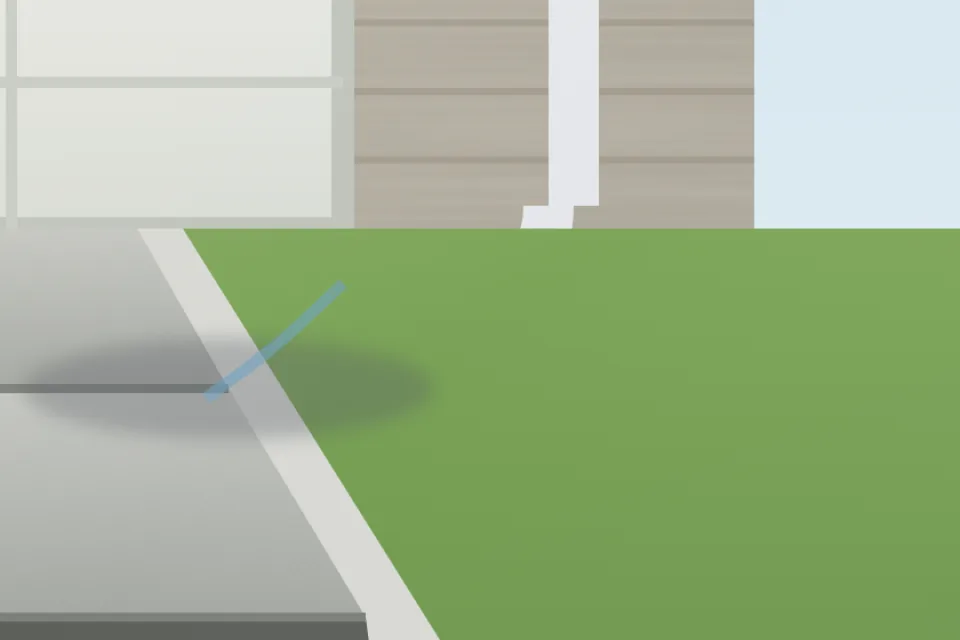
Sinking almost always starts with water: a downspout, a sprinkler or a low spot that drains under the slab. Fix that in the same job.
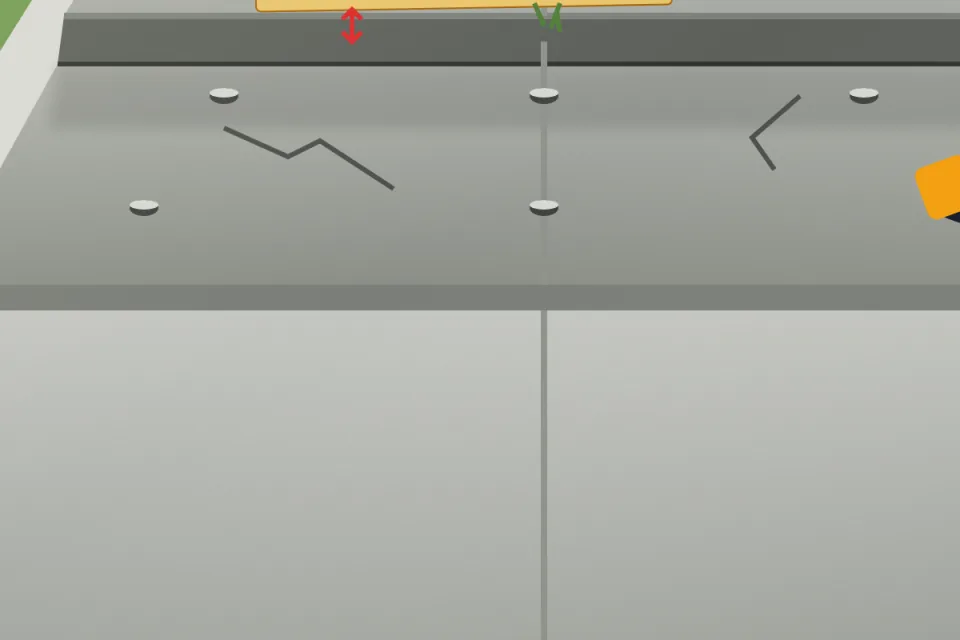
Hairline surface cracks are fine. A panel split into several loose pieces will not lift as one and should be replaced.
| Job | Mudjacking | Foam |
|---|---|---|
| Sidewalk section, about 100 sq ft | $320 – $650 | $650 – $1,500 |
| Part of a driveway, about 200 sq ft | $650 – $1,300 | $1,500 – $3,200 |
| Whole driveway, about 450 sq ft | $1,500 – $3,000 | $3,200 – $7,500 |
| Patio | $650 – $3,400 | Often 1.5–2× |
| Garage floor, one section | $550 – $1,100 | About 2× |
| Concrete steps | $220 – $550 | $450 – $950 |
| Replace instead of lift | $6.50 – $16.50 per sq ft | |
Mudjacking pumps a cement, sand and soil slurry through holes about an inch and a half across. The slurry is heavy, cheap and fills large voids well. It adds weight to soil that already gave way once, and the bigger holes stay visible after they are patched. Expect five to ten years from it on a driveway, more on a sidewalk that carries less load.
Polyurethane foam goes in through holes about the size of a pencil eraser. It expands, weighs a fraction of the slurry and cures in minutes, so you can drive on it the same day. It costs roughly twice as much per square foot. Contractors prefer it for garage floors, pool decks and slabs near the house, where extra weight and big holes are a problem.
Either method needs a slab that is still one piece. If the panel has broken into loose sections, the lift will crack it further and the quote should be for removal and a new pour, priced on the driveway calculator.
Concrete rarely sinks on its own. Water does it. A downspout that empties at the edge of the driveway, a sprinkler head aimed at a sidewalk, or a patio that slopes toward the house all wash fine soil out from under the slab, and the panel settles into the gap. Poorly compacted fill around a newer house does the same thing over the first few years.
That is why a good leveling quote includes the drainage fix. Extending a downspout ten feet costs a fraction of the lift and is the difference between a five-year repair and a twenty-year one. A slab next to the foundation that keeps dropping is also worth a look at the foundation itself; the foundation calculator covers piers and drainage.
| Line | Range |
|---|---|
| Mudjacking, 200 sq ft at $3–$6 | $600 – $1,200 |
| Joint sealing, about 60 ft | $120 – $240 |
| Downspout extension or regrade | $150 – $600 |
| Planning total | $870 – $2,040 |
The same panel lifted with foam lands closer to $1,470 to $3,840. Replacing it instead would be about $1,300 to $3,300 before the drainage work, which is why a whole, sunken panel is almost always cheaper to lift.
The calculator's default concrete leveling job, repriced for each of its six regions. At the national average it runs $870 – $2,040; South / Lower Midwest is the lowest at $757 – $1,775, and West Coast metro is the highest at $1,131 – $2,652, a gap of about $626 at the midpoint.
| Region | Planning range | Midpoint |
|---|---|---|
| National average | $870 – $2,040 | $1,455 |
| South / Lower Midwest | $757 – $1,775 | $1,266 |
| Mountain / Plains | $827 – $1,938 | $1,382 |
| Mid-Atlantic / Upper Midwest | $974 – $2,285 | $1,630 |
| Northeast metro | $1,096 – $2,570 | $1,833 |
| West Coast metro | $1,131 – $2,652 | $1,892 |
Every other input stays at its default and only “Condition of the slab” changes. The cheapest choice, Sunken but in one piece, comes to $870 – $2,040; the most expensive, Broken into loose pieces, comes to $1,570 – $4,140.
| Choice | Planning range | Midpoint vs default |
|---|---|---|
| Sunken but in one piece (default) | $870 – $2,040 | — |
| Sunken with a crack through it | $1,020 – $2,540 | +$325 |
| Broken into loose pieces | $1,570 – $4,140 | +$1,400 |
Every other input stays at its default and only “Method” changes. The cheapest choice, Mudjacking (cement slurry), comes to $870 – $2,040; the most expensive, Polyurethane foam, comes to $1,470 – $3,840.
| Choice | Planning range | Midpoint vs default |
|---|---|---|
| Mudjacking (cement slurry) (default) | $870 – $2,040 | — |
| Polyurethane foam | $1,470 – $3,840 | +$1,200 |
Using the default job, a $1,000 deductible and a 10-year expected life. At 10 years old, about $1,164 is held back as depreciation; a replacement cost policy releases it after the work is finished, while an actual cash value policy keeps it.
| Age | Wear | First check | Held back |
|---|---|---|---|
| 2 years | 20% | $164 | $291 |
| 5 years | 50% | $0 | $728 |
| 10 years | 80% | $0 | $1,164 |
| 15 years | 80% | $0 | $1,164 |
| 20 years | 80% | $0 | $1,164 |
| 30 years | 80% | $0 | $1,164 |
Leveling quotes are easiest to compare by area and method.
| Stage | Typical time | What happens |
|---|---|---|
| Inspection | 30 minutes | Voids and cracks checked. |
| Lifting | 1 – 4 hours | Most jobs are one visit. |
| Curing | Minutes – 1 day | Foam cures fast; mudjacking needs a day. |
| Joint sealing | 1 – 2 hours | After lifting. |
Avoid driving on a mudjacked slab for about a day; foam-lifted slabs can usually take traffic sooner.
Leveling costs less than replacement when slabs are whole.
Most jobs cost about $650 to $1,900, with an average near $1,200. Mudjacking is about $3 to $6 per square foot and polyurethane foam about $6 to $15 for typical home jobs.
Foam uses smaller holes, weighs less, cures in minutes and usually lasts longer, but costs about twice as much. Mudjacking is cheaper and fills big voids well. Both need a slab that is still in one piece.
Mudjacking often lasts 5 to 10 years and foam 20 years or more, as long as the water that washed out the soil is fixed.
When the slab is broken into several loose pieces, crumbling, or has dropped so far that lifting would crack it. Replacement runs about $6.50 to $16.50 per square foot.
After foam, usually within an hour. After mudjacking, most contractors ask you to wait a day or so.
Usually not. Settling and earth movement are standard exclusions. A sudden covered water loss that washed the soil out is the main exception, depending on the policy.
They are patched with grout. Mudjacking holes are about 1½ inches and stay visible; foam holes are about ⅝ inch and much harder to spot.
Yes, usually with foam, because it is light and needs small holes. Very large or badly cracked floors may need replacement.
Yes. Mudjacking, slabjacking, concrete jacking and concrete lifting all describe the same method: pumping a cement and soil slurry through holes in the slab to raise it, at about $3 to $6 per square foot. Polyjacking, also called foam leveling, is the different method. It uses expanding polyurethane through smaller holes and costs roughly twice as much. When you compare quotes, check which material is named, not just the word on the estimate.
Measure the square feet that sank, not the length. A 200 sq ft section of driveway is often $650 to $1,300 by mudjacking. A 4-foot-wide sidewalk is about 4 square feet per running foot, which works out to roughly $12 to $24 per foot by mudjacking or $24 to $60 per foot with foam. Most contractors also have a minimum charge for the trip and setup, so lifting two or three panels in one visit costs little more than lifting one.
Slabs with small cracks can often be lifted as one piece. Slabs broken into several loose pieces usually rock and settle again and are better replaced.
No. Leveling fills the void and raises the slab, but downspouts, grading and joint sealing must also be fixed or the soil will wash out again.
Often yes. Sunken steps can be lifted with foam or slurry if the step is still in one piece.
Use the companion calculators when the job touches another part of the house or the claim.
Planning topics covered in the calculator and guide above.