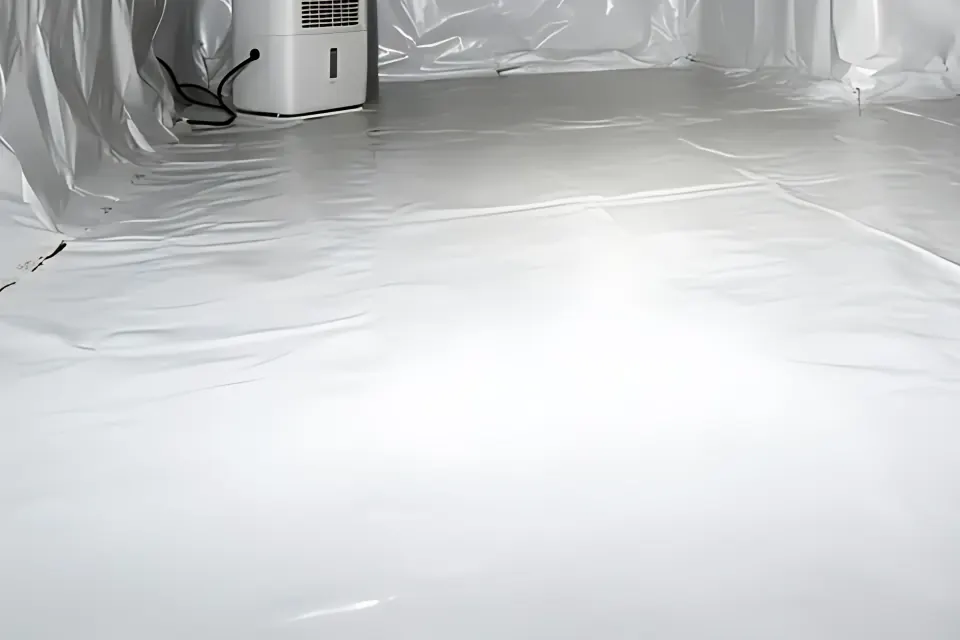
Water on the ground
Standing water, a failed gutter, or a foundation leak has to be handled before a liner. Otherwise you wrap the problem.
Home › Crawl space
20-mil barrier · Rim joist · Dehumidifier · SisteringEncapsulating an average crawl space — a heavy vapor barrier up the walls, sealed vents, and a dehumidifier — commonly costs $3,000 to $15,000. A liner alone is less. Sistering rotten floor joists is a separate structural line, often $8 to $25 per foot of joist, and it is not included in a liner quote.
Reviewed 25 October 2026 · Written by Mantu Kumar
See the photo · See the cost diagram · Open the calculator
2026 planning bands for residential crawl encapsulation and carpentry sistering. Structural repairs need someone who can see the wood.
2026 planning ranges
Total, most homes: $3,000–$15,000; a 1,000 sq ft crawl often $3,000–$10,000.
Diagram, part by part
The crawl space encapsulation and joist repair drawing above has 9 numbered parts, from Encapsulation to Mold treatment on joists. Each card below frames one of them, and after you run the calculator it shows what that part adds to your estimate.
$3–$10 / sq ft
Encapsulation covers the dirt floor with heavy plastic so ground moisture cannot evaporate into the crawl space and rise into the house. Price follows the floor area and the liner thickness, with thicker reinforced liners costing more but surviving foot traffic and storage.
What moves it: Floor area, liner thickness and how many piers the liner must wrap.
On the quote: Ask for the liner thickness in mils and whether the seams and piers are taped.
Included with encapsulation
The liner continues up the foundation walls and is mechanically fastened and sealed near the top, so the whole crawl space becomes a closed, dry box rather than a floor covering.
What moves it: Wall height and the condition of the foundation walls.
On the quote: Ask how high the liner runs up the walls and how it is fastened and sealed.
The rim joist, where the floor framing sits on the foundation, is one of the biggest air leaks in a house. Closed-cell spray foam or cut rigid foam seals and insulates it.
What moves it: The perimeter length and the foam type.
On the quote: Ask whether foam is spray-applied or cut board, and its thickness.
$1,000–$3,000 installed
Once the space is sealed, a crawl space dehumidifier keeps relative humidity low, usually under 60%. It needs a condensate drain to a sump or to the outside and a dedicated outlet.
What moves it: Crawl space volume, local humidity and drain routing.
On the quote: Ask for the dehumidifier model and capacity, and where the condensate drains.
$800–$3,000
If water enters the crawl space during storms, a perimeter drain and sump pump must come first. Sealing a wet crawl space only traps the water against the liner and framing.
What moves it: How much water gets in and how far the drain must run.
On the quote: Ask the contractor to fix water entry first and price drainage separately from encapsulation.
separate structural line
Damp crawl spaces often have sagging or rotted joists. Sistering new lumber alongside them or replacing them is structural work, priced separately from encapsulation.
What moves it: Linear feet of damaged joists and access height.
On the quote: Ask how many joists will be sistered and whether rotted sill plates are included.
Included with the liner
Old foundation vents are closed and sealed so humid summer air cannot enter, and the access door is weatherstripped and insulated. Without this step the dehumidifier fights outside air all summer.
What moves it: The number of vents and the access door size.
On the quote: Ask how many vents are being sealed and whether a new insulated access door is included.
12 to 20 mil, seams taped
Thicker liners, often 12 to 20 mil, resist punctures from foot traffic and stored items. Overlapped seams are taped and the liner is sealed around piers and pipes so moisture cannot slip through the gaps.
What moves it: Liner thickness, reinforcement and the number of piers.
On the quote: Ask for the liner thickness, whether it is reinforced and how seams and piers are sealed.
Priced on the mold tool
Joists and subfloor in a damp crawl space often carry surface mold. It should be treated and cleaned before the space is sealed so it does not keep growing inside the closed box.
What moves it: How much framing is affected.
On the quote: Ask whether mold treatment is included and get it priced separately if it is not.
Under the floor
A finished encapsulation looks like a clean room under the house: barrier up the wall, wood visible overhead, and a machine keeping the air dry. The photo is the end state. The bid should still list the liner thickness, the dehumidifier and any wood repair separately.

Read the quote against the crawl you actually have. These close-ups are crops of the same AI-generated illustration.
Standing water, a failed gutter, or a foundation leak has to be handled before a liner. Otherwise you wrap the problem.
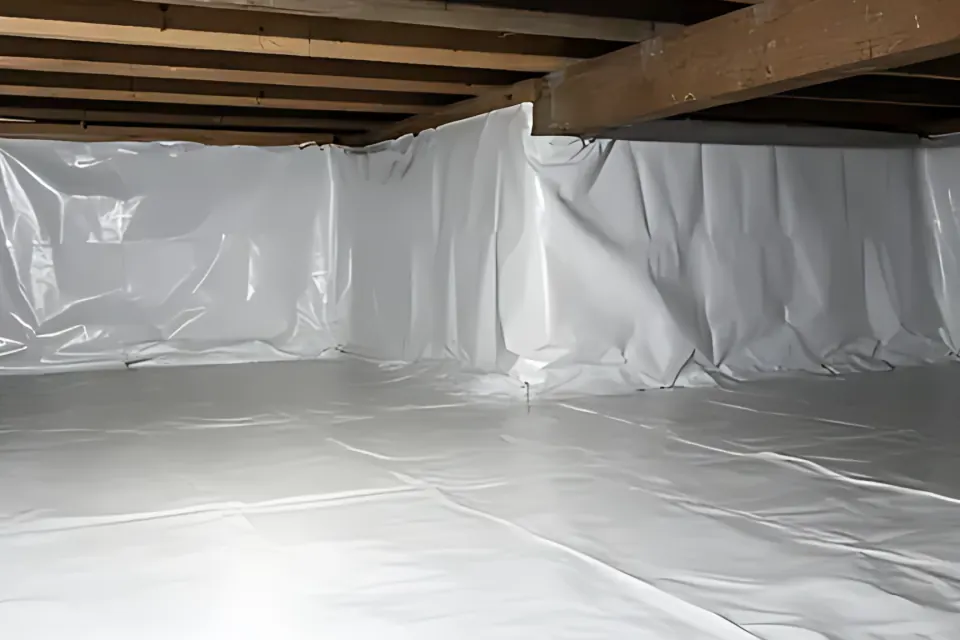
Ask for 20-mil, taped seams, and a dehumidifier sized to the volume. A 6-mil sheet and no machine is a vapor barrier, not an encapsulation.
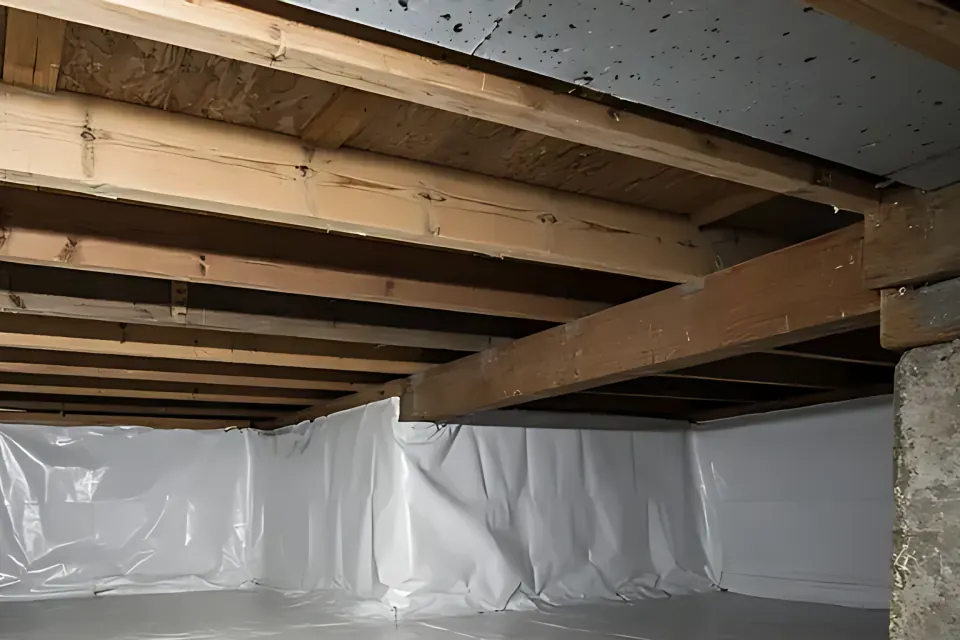
Probe joists and the sill. Sistering is carpentry. Powder-post or termite damage may need treatment before the new wood goes in.
| Scope | Planning range | What you should see |
|---|---|---|
| 6–10 mil liner, loose | $1.50 – $3 / sq ft | A sheet, not a system |
| 20-mil sealed liner | $2 – $5 / sq ft | Taped, up the wall |
| Full encapsulation | $5 – $9 / sq ft | Liner, seals, dehumidifier |
| Dehumidifier | $1,200 – $2,500 | Often inside the full price |
| Rim-joist foam | $3 – $7 / ft | Of perimeter |
| Sister a joist | $8 – $25 / ft | Of the damaged length |
Contractors sell “encapsulation,” “vapor barrier,” “crawl space insulation” and “joist repair” as separate visits. Under the house they are one condition. Ground moisture loads the joists. A liner without a drainage path floats. A dehumidifier in a vented crawl runs forever. Foam on the rim joist does nothing about a sill that is already soft.
Price the liner by the thickness and by whether the seams are taped and the vents are closed. Price the machine on its own line even if it is bundled, so you can see it. Price sistering by the foot of bad joist, on both faces if both faces are specified, and do not let it hide inside a per-square-foot liner rate.
Attic insulation is the lid of the house, not the floor. Use the attic calculator for R-value overhead. Use the foundation and sump tools if the water is hydrostatic against a wall rather than humidity off the soil. Mold on the joists gets the mold tool only after the water source is named.
| Line | Range |
|---|---|
| Sealed liner and closed vents, 1,200 sq ft | $3,600 – $7,200 |
| Dehumidifier and condensate | $1,200 – $2,500 |
| Rim-joist foam, about 150 ft | $450 – $1,050 |
| Sister 40 ft of joist | $320 – $1,000 |
| Planning total | $5,570 – $11,750 |
A liner-only visit on the same crawl is often $2,400 to $6,000 and will not dry the air. A beam replacement or a pier is outside this example. If the number you were given is far below the liner-only band, ask which mil and whether the seams are taped.
The calculator's default crawl space encapsulation job, repriced for each of its six regions. At the national average it runs $5,537 – $11,673; South / Lower Midwest is the lowest at $4,817 – $10,156, and West Coast metro is the highest at $7,198 – $15,175, a gap of about $3,700 at the midpoint.
| Region | Planning range | Midpoint |
|---|---|---|
| National average | $5,537 – $11,673 | $8,605 |
| South / Lower Midwest | $4,817 – $10,156 | $7,486 |
| Mountain / Plains | $5,260 – $11,089 | $8,174 |
| Mid-Atlantic / Upper Midwest | $6,201 – $13,074 | $9,638 |
| Northeast metro | $6,977 – $14,708 | $10,842 |
| West Coast metro | $7,198 – $15,175 | $11,186 |
Every other input stays at its default and only “Moisture scope” changes. The cheapest choice, Sealed 20-mil liner only, comes to $3,137 – $7,973; the most expensive, Liner, seals and dehumidifier, comes to $5,537 – $11,673.
| Choice | Planning range | Midpoint vs default |
|---|---|---|
| Sealed 20-mil liner only | $3,137 – $7,973 | −$3,050 |
| Liner, seals and dehumidifier (default) | $5,537 – $11,673 | — |
Every other input stays at its default and only “Rim-joist foam” changes. The cheapest choice, Not in this quote, comes to $5,120 – $10,700; the most expensive, Foam the rim, comes to $5,537 – $11,673.
| Choice | Planning range | Midpoint vs default |
|---|---|---|
| Not in this quote | $5,120 – $10,700 | −$695 |
| Foam the rim (default) | $5,537 – $11,673 | — |
Using the default job, a $1,000 deductible and a 40-year expected life. At 10 years old, about $2,151 is held back as depreciation; a replacement cost policy releases it after the work is finished, while an actual cash value policy keeps it.
| Age | Wear | First check | Held back |
|---|---|---|---|
| 2 years | 5% | $7,175 | $430 |
| 5 years | 12% | $6,529 | $1,076 |
| 10 years | 25% | $5,454 | $2,151 |
| 15 years | 38% | $4,378 | $3,227 |
| 20 years | 50% | $3,303 | $4,303 |
| 30 years | 75% | $1,151 | $6,454 |
Encapsulation quotes vary widely, so compare the same scope line by line.
| Stage | Typical time | What happens |
|---|---|---|
| Inspection | 1 – 2 hours | Moisture, framing and water entry checked. |
| Drainage and repairs | 1 – 3 days | Only when needed. |
| Liner and sealing | 1 – 3 days | Liner, seams, vents and rim joist. |
| Dehumidifier setup | 0.5 day | Drain, outlet and humidity setting. |
| Humidity check | 2 – 4 weeks | Confirm readings stay below about 60%. |
Ask for a humidity reading at handover and again a month later, so you can see the system working.
Fix the cause first and size the job correctly.
Moisture problems show up in the house too.
An average crawl often runs $3,000 to $15,000 for a sealed liner and dehumidifier. Liner-only jobs are less. Joist repair is extra.
A reinforced 20-mil liner with taped seams is the usual specification. Six-mil polyethylene is a lighter, easier-to-puncture product.
Sometimes at the rim joist. Batts stuffed in the floor joists are a different, older approach and fight a sealed crawl. Ask which one the bid uses.
Often $8 to $25 per linear foot of the damaged joist, more if the end bearing or a beam is gone.
Almost never as maintenance. A covered sudden loss may pay for drying and for wood it actually damaged.
Not first. Move the water — grading, gutters, a drain or a sump — or the liner fails.
In humid climates, vents often let in moist summer air that condenses under the house. Encapsulation keeps that air out and controls humidity, which is why many building scientists prefer it there.
Most encapsulated crawl spaces need either a dehumidifier or a small supply of conditioned air to keep humidity low.
It can help by sealing air leaks and warming floors, especially with rim joist insulation, but savings vary by house and climate.
Yes; that is the most common case. The liner covers the dirt and runs up the walls.
A heavy reinforced liner can last decades if it is not torn by foot traffic or stored items.
No, but a dry crawl space is less attractive to pests. Leave inspection strips at the top of walls if your area requires termite inspections.
Usually not for the liner itself, but electrical work for a dehumidifier, a new sump pump circuit or structural joist repair may need permits in your town.
Many contractors aim for relative humidity below about 60%, which discourages mold and wood decay. A small humidity monitor lets you check it over time.
Yes, with care. Use plastic bins on boards or mats so they do not tear the liner, and keep access paths clear for inspections and the dehumidifier.
Use the companion calculators when the job touches another part of the house or the claim.
Planning topics covered in the calculator and guide above.