Home › Ice dam removal
Roof · winterIce dam removal cost calculator
An ice dam is a ridge of ice along the roof edge. Heat leaking from the house melts snow higher on the roof; the water runs down to the cold overhang and freezes again. Over days the ridge grows, and meltwater pools behind it, backs up under the shingles and drips into the wall or ceiling. The stain on the ceiling is often the first sign.
Professional removal uses low-pressure steam to cut channels and melt the ridge without damaging shingles. It is priced by the hour, so the size of the dam matters more than the length of the roof. Raking snow off first, installing heat cable along the eave, and patching a ceiling stain are separate lines on this page.
Removal fixes this winter. The lasting fix is in the attic: sealing the air leaks that let warm air reach the roof, adding insulation, and making sure the roof is ventilated. The calculator does not price that work, but the page explains why it matters and links to the attic insulation calculator.
Reviewed 25 October 2026 · Written by Mantu Kumar
See the photos · See the cost diagram · Open the calculator
Key facts at a glance
- Steaming: about $400–$700 per hour; light dams about 2–3 hours, moderate 3–5, heavy 5–8.
- Roof snow removal: about $250–$500 before steaming.
- Heat cable along the eave: about $6–$15 per foot of eave, with a minimum around $400–$900.
- Inside patch: about $600–$3,500 for a stained ceiling or wall.
- Root cause: warm air and heat escaping into the attic. Air sealing and insulation stop most ice dams.
National 2026 planning ranges before your regional multiplier. Emergency and storm-day rates can run higher.
2026 planning ranges
- 1Roof snow removal
- 2Ice ridge
- 3Backed-up water
- 4Steaming removal
- 5Heat cable
- 6Inside ceiling and wall
- 7Attic cause (air leaks)
- 8Iced gutters + downspouts
- 9Roof check after thaw
Price your ice dam removal
No email · nothing sentDiagram, part by part
Ice dam removal: every numbered part explained
The drawing above has 9 numbered parts, from Roof snow removal to Roof check after the thaw. Each card zooms in on one part, says what pushes its price up or down, and tells you what to look for on a written quote. After you run the calculator, the parts in your scope show their dollar band.
1 Roof snow removal
$250–$500
Snow is raked or shoveled off the lower part of the roof first, so there is less to melt and less weight on the eave. Removing snow early in a storm cycle can prevent a dam from forming at all.
What moves it: Snow depth, roof pitch and height, and how much of the roof needs clearing.
On the quote: Ask how much of the roof will be cleared and whether shingles will be scraped. A light layer is usually left to protect them.
2 The ice ridge at the eave
Sets the steaming hours
The ridge forms over the cold overhang and gutter. It can be several inches thick and run the length of the eave, often loading the gutter until it bends or pulls off.
What moves it: Thickness and length of the ridge, and whether it extends into valleys.
On the quote: Have the crew describe the dam size before starting; that drives the hours.
3 Water backing up under the shingles
Why it leaks inside
Water trapped behind the ice can rise under shingle laps, past the underlayment and into the wall or ceiling. Ice-and-water membrane at the eaves reduces this but does not always stop it.
What moves it: Roof pitch, underlayment and how long the water stands.
On the quote: Look in the attic for wet sheathing or insulation after a thaw.
4 Steaming the ice off
$400–$700 per hour
A trained crew uses a steamer that produces low-pressure, high-temperature steam to cut channels through the ice and melt it in sections. Pressure washers, hammers and chemicals damage shingles and are not used.
What moves it: Dam size, roof height and access, and how busy crews are after a storm.
On the quote: Ask for a steamer, not a pressure washer, and confirm insurance and an hourly rate with a minimum.
5 Heat cable along the eave
$6–$15 per foot
A self-regulating cable is clipped in a zig-zag along the eave and through the gutter and downspout, keeping a channel open for meltwater. It treats the symptom, not the cause, and uses electricity.
What moves it: Eave length, gutters and downspouts, and whether an outlet is nearby.
On the quote: Ask for self-regulating cable on a GFCI circuit, and how it attaches without piercing shingles.
6 Inside ceiling and wall patch
$600–$3,500
Water stains, wet insulation and soft drywall need drying, stain-blocking primer and paint, or replacement. Wet insulation in the wall often has to come out.
What moves it: Area of damage, wall cavities and paint matching.
On the quote: Dry first and confirm with a moisture meter before patching.
7 The real cause: heat in the attic
See the attic insulation calculator
Ice dams form because the roof deck is warm above the attic. Air leaks around lights, chimneys, plumbing stacks and attic hatches carry heat up; thin insulation and blocked vents make it worse.
What moves it: Air leakage, insulation depth and ventilation.
On the quote: Ask for an attic inspection after the thaw; air sealing usually comes before more insulation.
8 Gutters and downspouts full of ice
Steamed with the eave
Ice dams usually fill the gutters and downspouts first. The weight can pull gutters loose from the fascia, and frozen downspouts send meltwater back over the eave. Steaming them open lets water drain once the ridge is cut.
What moves it: Gutter length, downspout count and how solid the ice is.
On the quote: Ask whether gutters and downspouts are steamed clear and checked for damage.
9 Roof check after the thaw
Not in this estimate
Once the snow is gone, look for lifted or cracked shingles, loose gutters and stains on the decking from the attic. Damage from ice dams can be part of a homeowners claim, while the cause, attic heat loss, is maintenance.
What moves it: How long water backed up and the roof's age.
On the quote: Photograph inside and outside damage and keep the steaming invoice for your claim.
Project photo guide
Ice dam removal and prevention in photos: roof raking, low-pressure steam and attic air sealing
When heat escaping into an attic melts snow on the upper roof and refreezes at the cold eave, water backs up under the shingles: safe removal uses a roof rake for loose snow and low-pressure high-temperature steam to melt the ice ridge without shredding shingles, followed by attic air sealing and insulation so the dam does not return.

How the job works in 3 key stages
All three step images are AI-generated illustrations for explanation. Not a site inspection, bid, or coverage decision.
 Step 01
Roof snow
Pulling fresh snow off the bottom three to four feet of the roof edge from the ground with a wheeled aluminum roof rake removes the water supply that feeds a growing ice dam.
On the quote: Never climb onto an icy roof or chip at ice with hammers, axes, or salt—mechanical chipping voids shingle warranties and punctures the roof deck.
 Step 02
Steam removal
Professional crews in fall-protection harnesses use a dedicated low-pressure (200–300 PSI), high-temperature (250°F+) steamer wand to slice channels and melt the ice dam gently off the shingles and gutters.
On the quote: Verify the company uses a true low-pressure steam machine (not a 3,000 PSI hot-water pressure washer, which strips granules and cuts shingles) and quotes a clear hourly rate plus minimum.
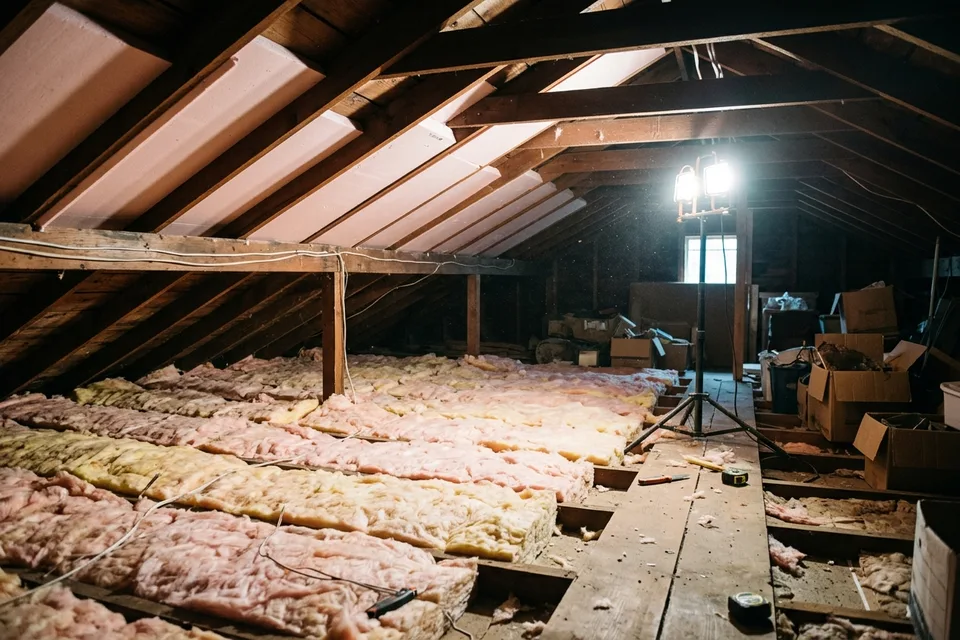 Step 03
Insulation and ventilation
The permanent cure happens inside the attic once winter passes: air-sealing recessed lights, bath fans, and top plates with foam, installing rafter baffles at the soffits, and blowing insulation to R-49 or R-60.
On the quote: When pricing prevention, make sure air sealing of attic bypasses comes before adding insulation—insulation alone without air sealing still lets warm air reach the roof deck.


What this photo guide helps you verify on a written quote
- Steam vs. hot pressure washer: Ask the dispatcher for the machine's PSI and temperature—true ice-dam steamers run under 300 PSI at ~250°F+.
- Hourly minimum & travel fee: Emergency winter steaming is almost always billed hourly with a 2- to 3-hour minimum; get both numbers upfront.
- Interior leak dry-out: If water is already dripping from a window header or ceiling, open a small drain hole and check wall cavities with a moisture meter.
- Permanent attic fix: Budget for attic air sealing, soffit baffles, and R-49–R-60 insulation before next winter so you only pay for steaming once.
On this page
- The diagram, part by part
- Photo guide: hero and 3 project steps
- Ice dam removal cost by size and add-on
- What common ice dam calls cost
- Steam now, or fix the attic
- Signs of an ice dam problem
- Ice dam removal cost by region
- What “Ice dam size” does to the price
- What “Water came inside” does to the price
- How age changes the ice dam removal claim payout
- How to read the quote, line by line
- How long the job takes
- Worked example
- Does homeowners insurance cover ice dams?
- Ways to keep the cost down
- Sources and further reading
- Frequently asked questions
Ice dam removal cost by size and add-on
Steaming is billed by the hour. Snow removal, heat cable and inside repairs are separate.
| Scope | 2026 planning range | Why it is its own line |
|---|---|---|
| Light ice dam, 2–3 hours | $800 – $2,100 | Small ridge, low roof. |
| Moderate ice dam, 3–5 hours | $1,200 – $3,500 | The common call. |
| Heavy ice dam, 5–8 hours | $2,000 – $5,600 | Thick ridge, long eave. |
| Roof snow removal | $250 – $500 | Before steaming. |
| Heat cable, 80 ft eave | $480 – $1,200 | Self-regulating cable. |
| Inside ceiling and wall patch | $600 – $3,500 | After drying. |
Air sealing and insulation are priced on the attic insulation calculator. That is where the long-term fix lives.
What common ice dam calls cost
Four typical jobs at the national average.
| Job | Planning range | Midpoint |
|---|---|---|
| Moderate dam, steaming only The common call. | $1,200 – $3,500 | $2,350 |
| Heavy dam with snow removal After a big storm. | $2,250 – $6,100 | $4,175 |
| Moderate dam, heat cable added 80 ft eave. | $1,680 – $4,700 | $3,190 |
| Light dam with a ceiling stain Water got inside. | $1,400 – $5,600 | $3,500 |
Each row is this page’s calculator run with the inputs described, at the national average. Change the region and the inputs above to see your own numbers.
Steam now, or fix the attic
If water is coming in, steaming is the urgent fix. Once winter ends, the attic work is what keeps it from happening next year.
| Option | Best when | Watch out for |
|---|---|---|
| Steam removal | Active leak or heavy ridge. | Recurring cost every bad winter. |
| Heat cable | Problem eaves over porches, valleys or north sides. | Electricity use; treats the symptom. |
| Air sealing + insulation | Most homes with recurring dams. | Upfront cost; needs a good contractor. |
| Roof ventilation | Poorly vented attics. | Must be paired with air sealing. |
Signs of an ice dam problem
- Thick ice along the eave or in the gutters.
- Long icicles hanging from the roof edge, especially with ice on the siding.
- Water stains on ceilings or walls near outside walls.
- Frost or wet sheathing in the attic.
- Uneven snow melt with bare patches over warm spots.
- Peeling paint or swollen trim near the roof edge.
Ice dam removal cost by region
The calculator's default ice dam removal job, repriced for each of its six regions. At the national average it runs $1,200 – $3,500; South / Lower Midwest is the lowest at $1,044 – $3,045, and West Coast metro is the highest at $1,560 – $4,550, a gap of about $1,010 at the midpoint.
| Region | Planning range | Midpoint |
|---|---|---|
| National average | $1,200 – $3,500 | $2,350 |
| South / Lower Midwest | $1,044 – $3,045 | $2,044 |
| Mountain / Plains | $1,140 – $3,325 | $2,232 |
| Mid-Atlantic / Upper Midwest | $1,344 – $3,920 | $2,632 |
| Northeast metro | $1,512 – $4,410 | $2,961 |
| West Coast metro | $1,560 – $4,550 | $3,055 |
What “Ice dam size” does to the price
Every other input stays at its default and only “Ice dam size” changes. The cheapest choice, Light, about 2 to 3 hours, comes to $800 – $2,100; the most expensive, Heavy, about 5 to 8 hours, comes to $2,000 – $5,600.
| Choice | Planning range | Midpoint vs default |
|---|---|---|
| Light, about 2 to 3 hours | $800 – $2,100 | −$900 |
| Moderate, about 3 to 5 hours (default) | $1,200 – $3,500 | — |
| Heavy, about 5 to 8 hours | $2,000 – $5,600 | +$1,450 |
What “Water came inside” does to the price
Every other input stays at its default and only “Water came inside” changes. The cheapest choice, No, comes to $1,200 – $3,500; the most expensive, Ceiling or wall stain, comes to $1,800 – $7,000.
| Choice | Planning range | Midpoint vs default |
|---|---|---|
| No (default) | $1,200 – $3,500 | — |
| Ceiling or wall stain | $1,800 – $7,000 | +$2,050 |
How age changes the ice dam removal claim payout
Using the default job, a $1,000 deductible and a 25-year expected life. At 10 years old, about $940 is held back as depreciation; a replacement cost policy releases it after the work is finished, while an actual cash value policy keeps it.
| Age | Wear | First check | Held back |
|---|---|---|---|
| 2 years | 8% | $1,162 | $188 |
| 5 years | 20% | $880 | $470 |
| 10 years | 40% | $410 | $940 |
| 15 years | 60% | $0 | $1,410 |
| 20 years | 80% | $0 | $1,880 |
| 30 years | 80% | $0 | $1,880 |
How to read the quote, line by line
Ice dam calls happen fast. Ask these on the phone.
- Steam equipment. Low-pressure steam, not pressure washing.
- Hourly rate and minimum. In writing.
- Insurance. Liability and workers’ comp.
- Snow removal. Included or not.
- Gutter care. Who is responsible if a gutter pulls off.
- Heat cable. Type, length and circuit.
- Follow-up. Attic inspection after the thaw.
How long the job takes
| Stage | Typical time | What happens |
|---|---|---|
| Booking after a storm | Same day – 1 week | Crews book up fast. |
| Snow removal | 1 – 3 hours | Before steaming. |
| Steaming | 2 – 8 hours | By dam size. |
| Drying inside | 2 – 5 days | Before patching. |
| Attic fixes | Spring or summer | Air sealing and insulation. |
Book early in a cold snap. The first storm after a thaw is when demand and prices spike.
Worked example
A 1960s cape after a week of snow and sun. A ridge of ice runs along the back eave and icicles hang from the gutter, but no water has come inside yet.
Moderate ice dam, 80 ft of eave, steaming only
Worked example| Line item | National planning range |
|---|---|
| Steaming ice dam removal | $1,200 – $3,500 |
| Total before regional adjustment | $1,200 – $3,500 |
Midpoint about $2,350. If a stain appears on the ceiling, add about $600–$3,500 after drying. Plan an attic air-sealing job for the summer.
Does homeowners insurance cover ice dams?
Many standard policies cover sudden interior water damage caused by ice dams, subject to the deductible. The cost of removing the ice itself is often treated as maintenance, though some insurers pay for removal to prevent further damage.
Photograph the ice and the stains, and call your insurer before major repairs. Long-term leaks and rot are usually excluded.
What this page will not claim
- Attic air sealing or insulation cost; use the attic insulation calculator.
- Roof replacement.
- That heat cable alone solves the cause.
- Whether your insurer pays for removal.
Ways to keep the cost down
Ice dam costs can be avoided with prevention.
- Rake snow early. Prevents dams.
- Air seal the attic. Stops heat loss.
- Add insulation. Keeps roof cold.
- Improve ventilation. Cold roof deck.
- Use steam, not chipping. Avoids roof damage.
- Install heat cable where needed. Problem areas.
Sources and further reading
- Building Science Corporation — BSD-135 Ice dams
- U.S. DOE Energy Saver — Air sealing your home
- ENERGY STAR — Seal and insulate
- National Roofing Contractors Association (NRCA)
Prices on this page are planning ranges built from public 2026 US cost guides and contractor rate sheets, widened where they disagreed, and multiplied by the same regional index as every other ReplaceCost calculator. Rules and definitions come from the agencies listed. See the methodology for how ranges are set and reviewed.
Frequently asked questions
How much does ice dam removal cost?
Most steaming jobs run about $1,200 to $3,500 for a moderate dam. Heavy dams, snow removal and inside repairs add more.
Why is ice dam removal charged by the hour?
Because the work depends on ice thickness and length, not roof size. A heavy dam can take a crew most of a day.
Can I remove an ice dam myself?
Raking snow from the ground is reasonable. Climbing an icy roof or chipping ice is dangerous and damages shingles.
Do heat cables prevent ice dams?
They keep channels open and reduce damage in problem spots, but they do not fix the heat loss that causes the dam.
What causes ice dams?
Heat escaping into the attic warms the roof, melting snow that refreezes at the cold eave.
Does insurance cover ice dam damage?
Interior water damage is often covered; ice removal itself may or may not be.
Will more insulation stop ice dams?
Air sealing first, then insulation and ventilation, stops most ice dams.
Is it OK to use salt or calcium chloride?
Calcium chloride in a sock can open a channel, but rock salt and chipping damage roofs and plants.
When should ice dams be removed?
Remove them when water is backing up inside, when icicles are heavy enough to pull gutters loose or when a long cold spell is forecast. Small dams without leaks can sometimes wait for a thaw.
Can ice dams damage gutters?
Yes. Heavy ice can bend gutters, pull hangers out of the fascia and tear downspouts loose. Meltwater that runs behind the gutter can also rot the fascia and soffit.
Are roof rakes safe to use?
Roof rakes used from the ground can safely pull snow off the lower few feet of a roof. Keep away from power lines and avoid scraping shingles.