Home › HVAC › Boiler replacement
Heating · hot water and steamBoiler replacement cost calculator
A boiler heats water and pumps it to baseboards, radiators or tubing in the floor. Good boilers last 20 to 30 years, so most owners replace one only once, often after a leak at the base, a cracked section, or a repair bill that no longer makes sense.
The boiler is usually the only part that changes. The baseboards or radiators stay, and the work is in the near-boiler piping, the circulator pumps, the venting and the controls. Moving to a high-efficiency condensing boiler adds PVC venting and a condensate drain; staying with a standard boiler may mean a new liner for an old masonry chimney.
This calculator prices the boiler by fuel and type, then adds the piping, venting, liner, an optional indirect water heater and permit as separate lines. If an oil tank is coming out at the same time, it points you to the oil tank calculator instead of hiding that cost inside the boiler.
Reviewed 25 October 2026 · Written by Mantu Kumar
See the photos · See the cost diagram · Open the calculator
Key facts at a glance
- Gas boiler, installed: about $5,000–$10,500 standard; $8,500–$16,000 condensing.
- Oil boiler: about $6,500–$13,000 standard; $9,500–$17,500 condensing.
- Near-boiler piping and circulator: about $400–$1,200, or $800–$2,200 for radiant floors.
- Chimney liner: about $900–$2,800. Indirect water heater about $1,800–$4,500.
- Condensing boilers work best when return water is cool, so radiant floors and well-sized baseboards gain the most.
National 2026 planning ranges before your regional multiplier. Steam systems need a specialist and can cost more.
2026 planning ranges
- 1Boiler, installed
- 2Near-boiler piping
- 3Venting or condensate
- 4Baseboard, radiators or radiant
- 5Chimney liner
- 6Indirect water heater
- 7Permit and combustion test
- 8Old oil tank (own tool)
- 9Expansion tank + controls
Price your new boiler
No email · nothing sentDiagram, part by part
Boiler replacement: every numbered part explained
The drawing above has 9 numbered parts, from The boiler, installed to Expansion tank, flush and controls. Each card zooms in on one part, says what pushes its price up or down, and tells you what to look for on a written quote. After you run the calculator, the parts in your scope show their dollar band.
1 The boiler, installed
$5,000–$17,500 by fuel and type
The main line covers removing the old boiler, setting the new one, connecting it to the existing supply and return, controls and start-up. Standard cast-iron boilers are simple and tough. Condensing boilers, usually wall-hung with a modulating burner, reach the mid-90s in efficiency when return water is cool enough.
What moves it: Fuel, standard or condensing, output size, brand, and whether the system is hot water or steam.
On the quote: Ask for the model, output in BTU, AFUE, and a heat-loss calculation. Old boilers are often far oversized.
2 Near-boiler piping and circulators
$400–$2,200
The pipes, pumps, valves, air separator and expansion tank within a few feet of the boiler. Condensing boilers usually need primary-secondary piping or a low-loss header so the boiler and the house loops do not fight each other.
What moves it: Number of zones, radiant versus baseboard, and how tidy the existing piping is.
On the quote: Look for the number of zones, the circulator models (variable-speed pumps save electricity), and whether zone valves or pumps are replaced.
3 Venting and condensate
$150–$1,600
A standard boiler connects to the existing chimney or flue. A condensing boiler vents through PVC or polypropylene pipe to a side wall and drains acidic condensate, often through a neutralizer.
What moves it: Distance to an outside wall, vent material, and whether a neutralizer or condensate pump is needed.
On the quote: The quote should show where the vent exits and how condensate is handled.
4 Heat emitters that stay
Kept, not replaced
Baseboards, radiators and radiant tubing normally stay. They matter to the price because they set the water temperature the boiler needs. Cast-iron radiators and radiant floors run cooler, which helps a condensing boiler condense.
What moves it: Emitter type and size compared with the heat loss of each room.
On the quote: Ask whether any emitter is undersized. Adding a little baseboard can let the whole system run cooler.
5 Chimney liner
$900–$2,800
Older masonry chimneys are often too big or cracked for a modern boiler or a water heater left alone on the flue. A stainless liner sized to the appliance keeps exhaust drafting properly and protects the masonry from acidic condensation.
What moves it: Chimney height, liner size and material, and access to the roof.
On the quote: Ask for a chimney inspection result and the liner size. A water heater left alone on a big chimney is a common failure point.
6 Indirect water heater
$1,800–$4,500
An indirect tank heats domestic hot water with a coil fed by the boiler. It is efficient, long-lived and lets the boiler replace a separate water heater.
What moves it: Tank size, brand, and piping as a priority zone.
On the quote: Look for tank size, the warranty, and a mixing valve to prevent scalding.
7 Permit and combustion test
$200–$700
Boiler work needs a mechanical permit and often a gas or oil inspection. A good installer also runs a combustion analysis at start-up to set the burner.
What moves it: Local fees and whether oil-burner permits are separate.
On the quote: Ask for the printed combustion test result at start-up.
8 Old oil tank
Priced on the oil tank calculator
Switching from oil to gas often leaves a tank behind in the basement or yard. Removing it is a separate job with its own permits and possible soil testing.
What moves it: Tank location, size and any leak.
On the quote: Make sure the boiler quote says whether the tank is removed, abandoned, or left.
9 Expansion tank, flush and controls
Part of the near-boiler work
A new boiler usually gets a new expansion tank, air separator and a flush of the old system so sludge does not foul the new heat exchanger. Condensing boilers also use an outdoor reset sensor that lowers water temperature in mild weather, which is where most of their savings come from.
What moves it: System age, water condition and the boiler type.
On the quote: Ask whether the system will be flushed, whether a dirt separator is added and how outdoor reset is set up.
Project photo guide
Boiler replacement in photos: old cast-iron removal, near-boiler piping and heat delivery
A residential hydronic or steam boiler replacement is a custom piping job in the mechanical room: dismantling the heavy cast-iron block, building the near-boiler copper header with circulator pumps and zone valves, and purging air so every baseboard or radiator heats evenly.

How the job works in 3 key stages
All three step images are AI-generated illustrations for explanation. Not a site inspection, bid, or coverage decision.
 Step 01
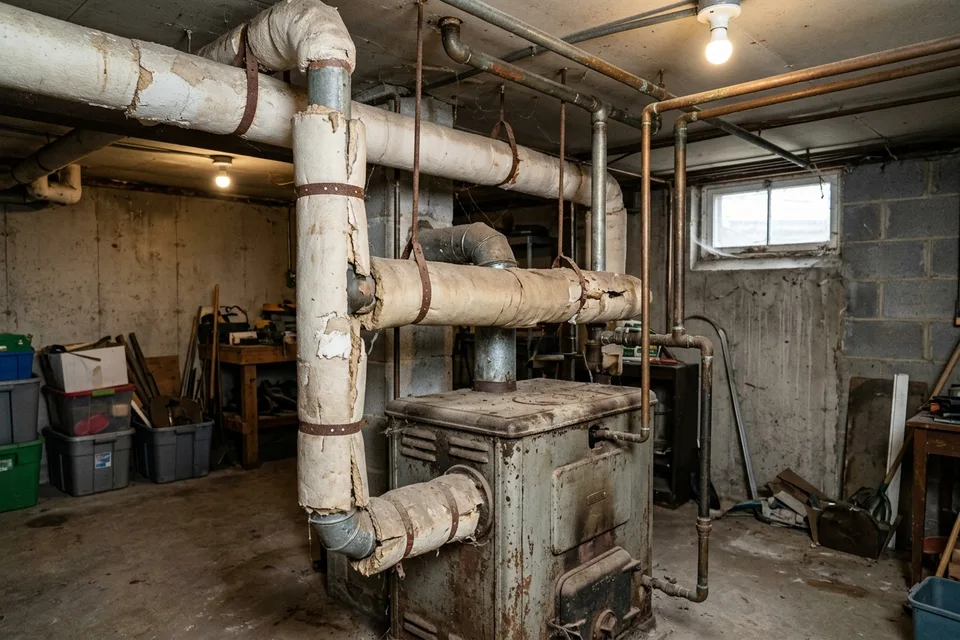
Old boiler out
The existing hydronic or steam system is drained, electrical and fuel lines are capped, and the heavy cast-iron boiler sections are unbolted or dollied out of the basement.
On the quote: Confirm whether old pipe insulation looks suspect—if asbestos wrap is present on legacy steam headers, licensed abatement must happen before demolition.
 Step 02
New piping and pumps
Technicians solder or press new near-boiler copper headers, installing a spirovent air eliminator, expansion tank, backflow preventer, automatic feed valve, and zone valves or circulator pumps.
On the quote: Verify the quote replaces the expansion tank, air separator, relief valve, and zone controls rather than reusing worn 20-year-old trim.
 Step 03
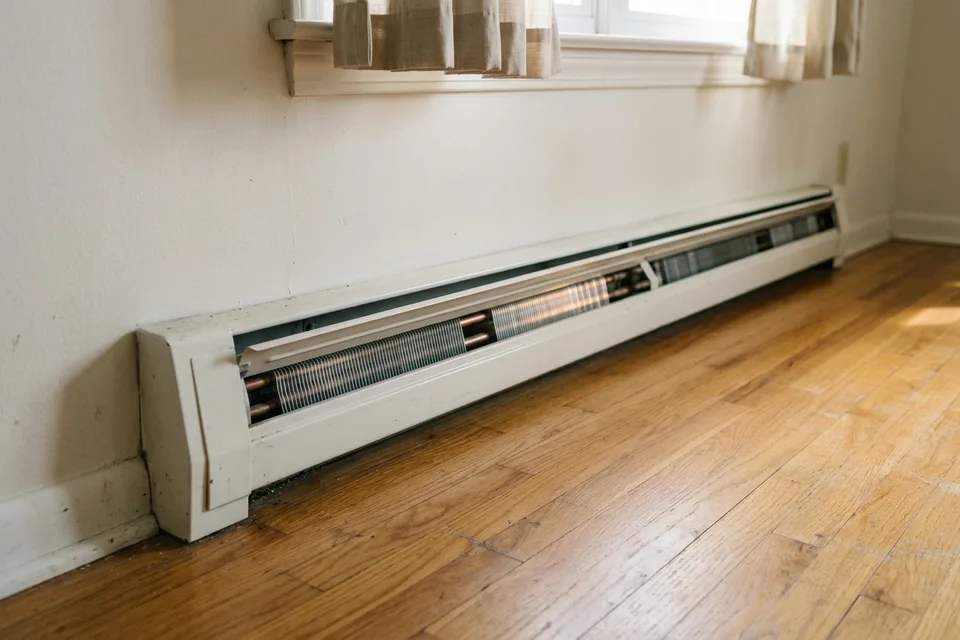
Heat delivery
Once the boiler is filled and purged of air zone by zone, heated water circulates quietly through the fin-tube baseboard convectors or radiators while outdoor-reset controls modulate water temperature.
On the quote: Ensure the contract includes purging all heating zones, bleeding radiators or baseboards throughout the house, and setting up outdoor-reset controls.


What this photo guide helps you verify on a written quote
- Near-boiler trim package: A complete quote includes a new expansion tank, air eliminator, backflow preventer, and pressure-reducing fill valve.
- Primary-secondary loop: Wall-hung condensing boilers require closely spaced tees or a hydraulic separator to protect the heat exchanger.
- Venting & condensate neutralizer: High-efficiency condensing boilers produce acidic condensate that should pass through a limestone neutralizer.
- Zone purge & combustion test: Every zone must be purged of air and tested under load before the crew leaves.
On this page
- The diagram, part by part
- Photo guide: hero and 3 project steps
- Boiler replacement cost by fuel and type
- What common boiler jobs cost
- Standard or condensing boiler
- Signs your boiler is near the end
- Boiler replacement cost by region
- What “Boiler type” does to the price
- What “Indirect water heater” does to the price
- How age changes the boiler replacement claim payout
- How to read the quote, line by line
- How long the job takes
- Worked example
- Does homeowners insurance cover boiler replacement?
- Ways to keep the cost down
- Sources and further reading
- Frequently asked questions
Boiler replacement cost by fuel and type
Installed boiler prices before piping, venting, liner, indirect tank and permit.
| Scope | 2026 planning range | Why it is its own line |
|---|---|---|
| Gas, standard | $5,000 – $10,500 | Cast-iron or similar, chimney vented. |
| Gas, condensing | $8,500 – $16,000 | Wall-hung or floor, PVC vented. |
| Oil, standard | $6,500 – $13,000 | Common in the Northeast. |
| Oil, condensing | $9,500 – $17,500 | Fewer models; check service support. |
| Propane, standard | $5,500 – $12,000 | Conversion kit and regulator. |
| Propane, condensing | $9,000 – $16,500 | Modulating burners help with tank costs. |
| Chimney liner | $900 – $2,800 | Standard boilers and orphaned water heaters. |
| Indirect water heater | $1,800 – $4,500 | Replaces a separate water heater. |
Steam boilers are a specialty and often cost more than these ranges because the near-boiler piping has to be built to the manufacturer’s exact geometry.
What common boiler jobs cost
Four typical replacements at the national average.
| Job | Planning range | Midpoint |
|---|---|---|
| Gas standard, baseboard, existing chimney Like-for-like. | $5,750 – $13,000 | $9,375 |
| Gas condensing with an indirect tank Boiler also makes hot water. | $11,300 – $24,000 | $17,650 |
| Oil standard with a new liner Old chimney relined. | $8,150 – $18,300 | $13,225 |
| Propane condensing, radiant floors Low water temperature system. | $10,400 – $21,000 | $15,700 |
Each row is this page’s calculator run with the inputs described, at the national average. Change the region and the inputs above to see your own numbers.
Standard or condensing boiler
A condensing boiler only reaches its rated efficiency when the water coming back from the house is below roughly 130°F. Radiant floors and generous baseboards do that easily; small baseboards on very cold days do not.
| Option | Best when | Watch out for |
|---|---|---|
| Standard cast-iron | Simple systems, high water temperatures, or a long-lived chimney that is already lined. | Lower efficiency; heavy; may need a liner. |
| Condensing, modulating | Radiant floors, large radiators, or outdoor reset control. | Higher price; more service; needs clean water and good piping. |
| Combi boiler | Small homes that want heat and hot water from one wall unit. | Limited hot water flow for big households. |
| Heat pump conversion | Low-temperature systems in mixed climates. | Needs emitters sized for low water temperature. |
Signs your boiler is near the end
- Water at the base or rust streaks down the jacket.
- A cracked section or a heat exchanger that keeps fouling.
- Age past 20–25 years with growing repair bills.
- Banging, kettling or gurgling that service does not fix.
- Rising fuel use with no change in weather or use.
- Soot or fumes near the boiler; stop and call for service.
Boiler replacement cost by region
The calculator's default boiler replacement job, repriced for each of its six regions. At the national average it runs $5,750 – $13,000; South / Lower Midwest is the lowest at $5,003 – $11,310, and West Coast metro is the highest at $7,475 – $16,900, a gap of about $4,031 at the midpoint.
| Region | Planning range | Midpoint |
|---|---|---|
| National average | $5,750 – $13,000 | $9,375 |
| South / Lower Midwest | $5,003 – $11,310 | $8,156 |
| Mountain / Plains | $5,463 – $12,350 | $8,906 |
| Mid-Atlantic / Upper Midwest | $6,440 – $14,560 | $10,500 |
| Northeast metro | $7,245 – $16,380 | $11,812 |
| West Coast metro | $7,475 – $16,900 | $12,188 |
What “Boiler type” does to the price
Every other input stays at its default and only “Boiler type” changes. The cheapest choice, Standard cast-iron or similar, comes to $5,750 – $13,000; the most expensive, High-efficiency condensing, comes to $9,500 – $19,500.
| Choice | Planning range | Midpoint vs default |
|---|---|---|
| Standard cast-iron or similar (default) | $5,750 – $13,000 | — |
| High-efficiency condensing | $9,500 – $19,500 | +$5,125 |
What “Indirect water heater” does to the price
Every other input stays at its default and only “Indirect water heater” changes. The cheapest choice, No, comes to $5,750 – $13,000; the most expensive, Yes, new indirect tank, comes to $7,550 – $17,500.
| Choice | Planning range | Midpoint vs default |
|---|---|---|
| No (default) | $5,750 – $13,000 | — |
| Yes, new indirect tank | $7,550 – $17,500 | +$3,150 |
How age changes the boiler replacement claim payout
Using the default job, a $1,000 deductible and a 20-year expected life. At 10 years old, about $4,688 is held back as depreciation; a replacement cost policy releases it after the work is finished, while an actual cash value policy keeps it.
| Age | Wear | First check | Held back |
|---|---|---|---|
| 2 years | 10% | $7,438 | $938 |
| 5 years | 25% | $6,031 | $2,344 |
| 10 years | 50% | $3,688 | $4,688 |
| 15 years | 75% | $1,344 | $7,031 |
| 20 years | 80% | $875 | $7,500 |
| 30 years | 80% | $875 | $7,500 |
How to read the quote, line by line
Boiler quotes often hide the important part, the piping, in one line. Ask for these.
- Heat-loss calculation. And the boiler output it supports.
- Model, output and AFUE. Exact model numbers.
- Piping layout. Zones, pumps, valves and any low-loss header.
- Venting and condensate. Route and neutralizer.
- Chimney. Inspection result and liner if needed.
- Controls. Outdoor reset and thermostat changes.
- Permit, start-up and combustion test. All included.
How long the job takes
| Stage | Typical time | What happens |
|---|---|---|
| Heat-loss visit | 1 – 2 hours | Room-by-room measurements. |
| Equipment lead time | 1 – 14 days | Oil and steam models can take longer. |
| Install | 1 – 3 days | Most hot-water swaps are 1–2 days. |
| Inspection | 1 – 14 days | Town dependent. |
| First-year service | 1 year | Clean, test, and adjust. |
Plan replacement outside the heating season if you can. In an emergency, ask about temporary heat while parts arrive.
Worked example
A 1960s cape with baseboard heat and a 28-year-old gas boiler leaking at the base. The owner keeps the baseboards and the chimney, which was relined ten years ago, and chooses a standard boiler.
Gas standard boiler, baseboard, existing vent
Worked example| Line item | National planning range |
|---|---|
| Gas standard boiler, installed | $5,000 – $10,500 |
| Near-boiler piping and circulator | $400 – $1,200 |
| Existing vent connection | $150 – $600 |
| Permit | $200 – $700 |
| Total before regional adjustment | $5,750 – $13,000 |
Midpoint about $9,375. Moving to a condensing boiler would raise the boiler line and swap the vent connection for PVC and condensate work, but cut fuel use if water temperatures can be kept low.
Does homeowners insurance cover boiler replacement?
Age and wear are not covered. A sudden covered event, such as a fire, or a burst pipe that floods the boiler, can be. Equipment breakdown endorsements, sold by some insurers, cover sudden mechanical or electrical failure.
If the boiler froze because heat was lost while the house was empty, check the vacancy and freeze clauses in the policy before filing.
What this page will not claim
- The size your house needs; that needs a heat-loss calculation.
- Steam system pricing, which is a specialist job.
- Federal tax credits, which ended for 2026 installs.
- Oil tank removal, which is its own calculator.
Ways to keep the cost down
Boiler costs depend on fuel and type.
- Keep the same fuel. No conversion.
- Size correctly. Load calculation.
- Keep emitters. Radiators and baseboard.
- Add an indirect tank together. Shared labor.
- Check rebates. Efficient boilers.
- Service yearly. Longer life.
Sources and further reading
- U.S. DOE Energy Saver — Furnaces and boilers
- ENERGY STAR — Boilers
- AHRI — Directory of certified product performance
- Chimney Safety Institute of America
- IRS — Energy efficient home improvement credit
Prices on this page are planning ranges built from public 2026 US cost guides and contractor rate sheets, widened where they disagreed, and multiplied by the same regional index as every other ReplaceCost calculator. Rules and definitions come from the agencies listed. See the methodology for how ranges are set and reviewed.
Frequently asked questions
How much does a new boiler cost in 2026?
A standard gas boiler with piping, venting and permit usually runs about $5,750 to $12,800. Condensing and oil boilers cost more.
Is a condensing boiler worth it?
It is when your system can run cool return water, such as radiant floors or large radiators with outdoor reset. With small baseboards, savings are smaller.
How long does a boiler last?
Cast-iron boilers often last 20 to 30 years. Condensing boilers are often expected to last around 15 to 20 years with good water and service.
Can I keep my radiators?
Almost always. Radiators are long-lived and pair well with condensing boilers because they work at lower water temperatures.
Do I need a chimney liner?
Often for a standard boiler into an old masonry chimney, or when a water heater is left alone on the chimney after a condensing upgrade.
What is an indirect water heater?
A storage tank heated by a coil from the boiler. It replaces a separate water heater and usually lasts longer.
Should I switch from oil to gas when replacing the boiler?
If gas is available, it is often cheaper to run, but it adds a gas line and leaves an oil tank to deal with.
Does insurance cover a leaking boiler?
Not for age or corrosion. Sudden covered events may be.
How often should a boiler be serviced?
Once a year, ideally before the heating season. Service checks combustion, venting, safety controls, the expansion tank and water quality.
What is a combi boiler?
A combination boiler heats the home and supplies hot water on demand without a separate tank. It saves space but has limited hot water flow for large households.
Can a boiler heat floors?
Yes. Boilers can supply radiant floor tubing, often at lower water temperatures that suit condensing boilers.