Home › Termite damage repair
Structure · wood-destroying insectsTermite damage repair cost calculator
Termite damage is usually found by accident: a baseboard that crumbles when vacuumed, a door that sticks, a floor that dips, or a home inspector’s report during a sale. Subterranean termites eat wood from the inside and build mud tubes up the foundation, so by the time you see damage, the colony has often been working for years.
Repair always comes second. First the colony is treated, with a liquid barrier in the soil or a bait system, so new wood is not fed to the same termites. Then the damaged pieces are repaired or replaced, piece by piece: floor joists are sistered with new lumber, sill plates are replaced while the house is shored, wall studs are cut out and replaced, and trim, door frames and subfloor are patched.
This calculator counts those pieces. Enter how many joists, studs and trim pieces are damaged, how many feet of sill plate and square feet of subfloor, and whether an engineer’s letter is needed. Each becomes its own line so you can match it to a contractor’s scope.
Reviewed 25 October 2026 · Written by Mantu Kumar
See the photos · See the cost diagram · Open the calculator
Key facts at a glance
- Inspection and WDI report: about $75–$300.
- Treatment: liquid perimeter about $800–$2,500; bait system about $1,500–$3,500.
- Sistered joists: about $150–$400 each. Wall studs about $150–$400 each with the wall opened and closed.
- Sill plate: about $80–$150 per linear foot, plus $500–$2,500 for temporary shoring.
- Subfloor: about $5–$12 per sq ft. Trim and door frames about $150–$500 per piece. Engineer letter about $400–$900.
National 2026 planning ranges before your regional multiplier. Hidden damage often shows up once walls are opened.
2026 planning ranges
- 1Treatment
- 2Temporary shoring
- 3Sill plate
- 4Floor joists
- 5Wall studs
- 6Subfloor
- 7Trim and door frames
- 8Inspection / WDI report
- 9Engineer letter
Price your termite repair
No email · nothing sentDiagram, part by part
Termite damage repair: every numbered part explained
The drawing above has 9 numbered parts, from Treating the colony first to Structural engineer letter. Each card zooms in on one part, says what pushes its price up or down, and tells you what to look for on a written quote. After you run the calculator, the parts in your scope show their dollar band.
1 Treating the colony first
$800–$3,500
A liquid termiticide is trenched and injected into the soil around the foundation, creating a treated zone termites cross and carry back to the colony. Bait systems use stations in the yard that the colony feeds on and shares. Either way, repairs start once treatment is in place.
What moves it: Perimeter length, foundation type, slab penetrations to drill, and bait station monitoring fees.
On the quote: Look for the product, the treated linear feet, and the warranty with re-treatment and damage terms. Bait systems usually carry an annual renewal.
2 Temporary shoring
$500–$2,500
Replacing a sill plate means lifting the weight of the wall and floor off it. Steel jacks and beams carry the load while the damaged wood is cut out.
What moves it: Length of sill being replaced, crawl space height and the load above.
On the quote: Ask how the house is supported and checked for level before and after.
3 Sill plate replacement
$80–$150 per linear foot
The sill plate is the wood that sits on top of the foundation, and it is often the first thing termites reach. Replacement uses pressure-treated lumber anchored to the foundation.
What moves it: Length, access, anchor bolts and how much framing rests on it.
On the quote: Look for pressure-treated lumber, a sill gasket and anchoring to code.
4 Sistering floor joists
$150–$400 per joist
Most damaged joists are not removed. A new full-length joist is bolted or nailed alongside the damaged one so the pair carries the load. Badly damaged joists may be replaced.
What moves it: Joist length, crawl space height, and pipes or wires in the way.
On the quote: Ask for the joist count, the lumber size, the fastening schedule, and whether any are fully replaced.
5 Wall studs
$150–$400 per stud
Damaged studs are cut out or doubled with new ones. Drywall or plaster has to come off first, then go back, be taped and painted.
What moves it: Stud count, wall finish and whether the wall is load-bearing.
On the quote: The price should include opening and closing the wall, not only the stud.
6 Subfloor
$5–$12 per sq ft
Soft or hollow subfloor under a bathroom or near a door is cut out and replaced with new plywood or OSB, glued and screwed. Flooring above is extra.
What moves it: Area and the flooring that has to be lifted.
On the quote: Ask whether flooring removal and replacement are included.
7 Trim and door frames
$150–$500 per piece
Baseboards, casings and door jambs are often where damage is first seen. They are replaced and painted to match.
What moves it: Profile matching and paint.
On the quote: Count of pieces, profile, and paint included.
8 Inspection and WDI report
$75–$300
A wood-destroying insect inspection documents active termites, damage and conditions that attract them. Lenders often require one for a sale.
What moves it: House size and access.
On the quote: Read the report for damage locations and whether further inspection is recommended.
9 Structural engineer letter
$400–$900
When damage is extensive, a buyer, lender or the building department may want an engineer’s letter describing the damage and approving the repair plan.
What moves it: Site visit, report detail and follow-up visits.
On the quote: Ask whether the engineer will inspect the finished repair.
Project photo guide
Termite damage repair in photos: mud tubes, probing joists and sistering new lumber
Repairing subterranean termite damage combines two separate scopes that must work together: eliminating the active colony so termites stop feeding on the structure, and jacking, sistering, or replacing hollowed sill plates, rim joists, and floor joists to restore load capacity.

How the job works in 3 key stages
All three step images are AI-generated illustrations for explanation. Not a site inspection, bid, or coverage decision.
 Step 01
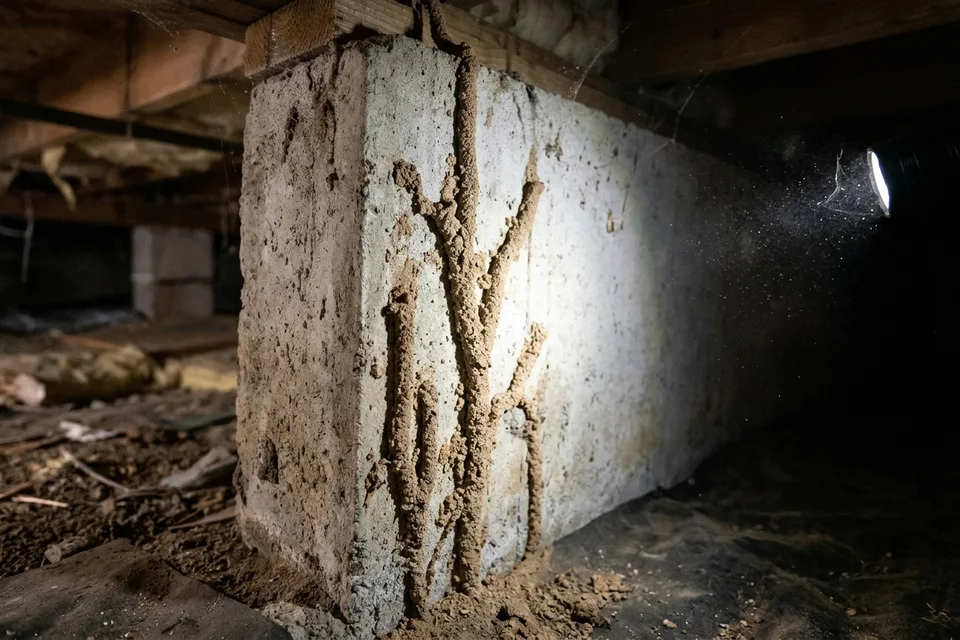
Mud tubes
Subterranean termites build pencil-thick earthen shelter tubes up concrete foundation walls and piers to travel from damp soil into the wood framing without drying out in open air.
On the quote: Always confirm colony treatment (liquid termiticide trenching or perimeter bait stations) is completed and warranted alongside any carpentry repair.
 Step 02
Probing wood
Because termites eat the softer springwood from the inside out while leaving a thin outer paint or wood shell intact, an inspector or carpenter probes every suspect sill, rim joist, and joist end with an awl or screwdriver.
On the quote: Expect a unit-price contingency per linear foot of hidden sill or joist damage discovered once drywall, subfloor, or insulation is pulled back.
 Step 03
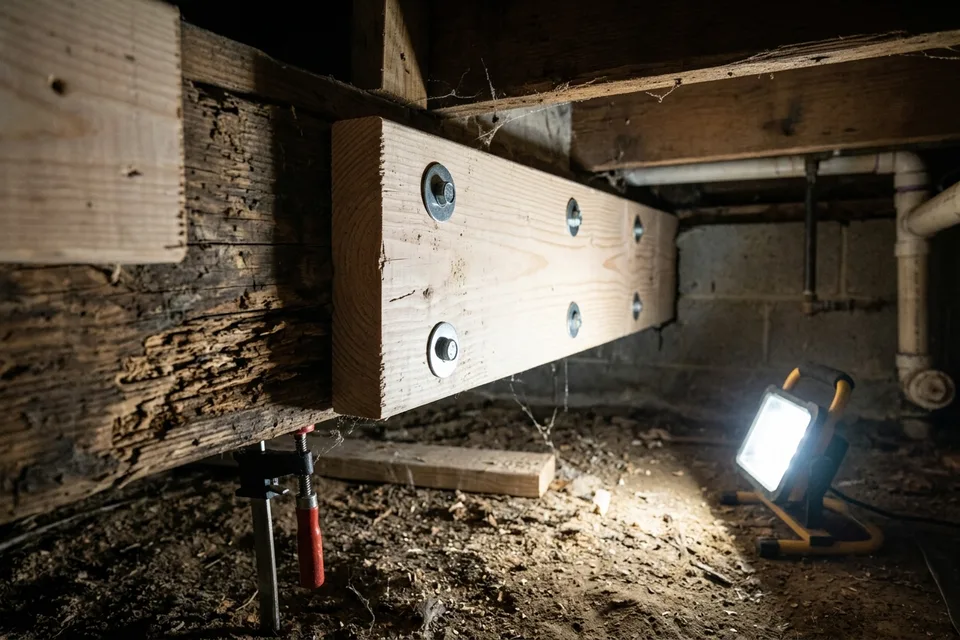
Sistering and treatment
Where floor joists are weakened, carpenters temporarily jack the floor level, coat exposed wood with borate preservative, and bolt full-depth new structural lumber ('sisters') alongside the damaged members with structural lag screws.
On the quote: Verify that any wood touching concrete uses pressure-treated sill lumber over a foam sill sealer and that structural bolts or screws meet code.


What this photo guide helps you verify on a written quote
- Treatment vs. carpentry: Pest-control companies rarely do structural framing, and general contractors cannot apply termiticide—make sure both scopes are covered.
- Sill plate jacking: Replacing a crushed sill plate requires hydraulic bottle jacks and temporary shoring beams to support the house wall safely.
- Moisture & wood-to-soil contact: Fix leaky crawl-space plumbing, poor grading, or wood touching soil so termites are not invited straight back.
- Hidden damage unit rate: Agree in writing on a per-linear-foot rate for additional joists or studs found once walls or floors are opened.
On this page
- The diagram, part by part
- Photo guide: hero and 3 project steps
- Termite repair cost by component
- What common termite repairs cost
- Liquid barrier or bait system
- Signs of termite damage
- Termite damage repair cost by region
- What “Treatment” does to the price
- What “Structural engineer letter” does to the price
- How age changes the termite damage repair claim payout
- How to read the quote, line by line
- How long the job takes
- Worked example
- Does insurance cover termite damage?
- Ways to keep the cost down
- Sources and further reading
- Frequently asked questions
Termite repair cost by component
Damage is priced by the piece. Treatment and inspection are separate lines.
| Scope | 2026 planning range | Why it is its own line |
|---|---|---|
| Inspection and WDI report | $75 – $300 | Often free with a treatment contract. |
| Liquid perimeter treatment | $800 – $2,500 | Soil barrier. |
| Bait system | $1,500 – $3,500 | Plus annual monitoring. |
| Sistered floor joist | $150 – $400 each | New lumber alongside. |
| Sill plate | $80 – $150 per linear ft | With shoring $500 – $2,500. |
| Wall stud | $150 – $400 each | Wall opened and closed. |
| Subfloor | $5 – $12 per sq ft | Flooring extra. |
| Trim or door frame | $150 – $500 per piece | Painted to match. |
| Engineer letter | $400 – $900 | For extensive damage. |
Expect hidden damage. Many contractors write a unit price per joist or stud so extra pieces found during work are priced the same way.
What common termite repairs cost
Four typical repairs at the national average.
| Job | Planning range | Midpoint |
|---|---|---|
| Small: 4 joists, 2 studs, trim Liquid treatment included. | $2,075 – $6,200 | $4,138 |
| Sill plate section with shoring 16 ft of sill. | $2,955 – $8,500 | $5,728 |
| Bathroom subfloor and joists Common under tubs and toilets. | $1,675 – $4,980 | $3,328 |
| Extensive, with engineer Sale or lender-driven. | $6,995 – $19,120 | $13,058 |
Each row is this page’s calculator run with the inputs described, at the national average. Change the region and the inputs above to see your own numbers.
Liquid barrier or bait system
Both treatments work when done well. The choice depends on the house, the soil, and how you feel about drilling and chemicals near the foundation.
| Option | Best when | Watch out for |
|---|---|---|
| Liquid barrier | Fast knockdown, most foundation types. | Drilling through slabs and patios; wells and cisterns nearby. |
| Bait system | Sensitive sites, hard-to-trench areas, long-term monitoring. | Slower; annual renewal fees. |
| Spot treatment | Drywood termites in one piece of wood. | Not for subterranean colonies. |
| Fumigation | Widespread drywood termites. | Move out for days; different pricing. |
Signs of termite damage
- Mud tubes on foundation walls, piers or slab edges.
- Hollow-sounding wood when tapped, or paint that bubbles.
- Discarded wings near windows and doors after a swarm.
- Sagging or bouncy floors over a crawl space.
- Doors and windows that stick suddenly.
- Small pin holes or frass (droppings) for drywood termites.
Termite damage repair cost by region
The calculator's default termite damage repair job, repriced for each of its six regions. At the national average it runs $2,075 – $6,200; South / Lower Midwest is the lowest at $1,805 – $5,394, and West Coast metro is the highest at $2,698 – $8,060, a gap of about $1,780 at the midpoint.
| Region | Planning range | Midpoint |
|---|---|---|
| National average | $2,075 – $6,200 | $4,138 |
| South / Lower Midwest | $1,805 – $5,394 | $3,600 |
| Mountain / Plains | $1,971 – $5,890 | $3,930 |
| Mid-Atlantic / Upper Midwest | $2,324 – $6,944 | $4,634 |
| Northeast metro | $2,615 – $7,812 | $5,214 |
| West Coast metro | $2,698 – $8,060 | $5,379 |
What “Treatment” does to the price
Every other input stays at its default and only “Treatment” changes. The cheapest choice, Already treated, comes to $1,275 – $3,700; the most expensive, Bait system, comes to $2,775 – $7,200.
| Choice | Planning range | Midpoint vs default |
|---|---|---|
| Liquid perimeter treatment (default) | $2,075 – $6,200 | — |
| Bait system | $2,775 – $7,200 | +$850 |
| Already treated | $1,275 – $3,700 | −$1,650 |
What “Structural engineer letter” does to the price
Every other input stays at its default and only “Structural engineer letter” changes. The cheapest choice, Not needed, comes to $2,075 – $6,200; the most expensive, Include, comes to $2,475 – $7,100.
| Choice | Planning range | Midpoint vs default |
|---|---|---|
| Not needed (default) | $2,075 – $6,200 | — |
| Include | $2,475 – $7,100 | +$650 |
How age changes the termite damage repair claim payout
Using the default job, a $1,000 deductible and a 50-year expected life. At 10 years old, about $828 is held back as depreciation; a replacement cost policy releases it after the work is finished, while an actual cash value policy keeps it.
| Age | Wear | First check | Held back |
|---|---|---|---|
| 2 years | 4% | $2,972 | $166 |
| 5 years | 10% | $2,724 | $414 |
| 10 years | 20% | $2,310 | $828 |
| 15 years | 30% | $1,896 | $1,241 |
| 20 years | 40% | $1,483 | $1,655 |
| 30 years | 60% | $655 | $2,483 |
How to read the quote, line by line
Termite work often involves two companies: a pest control firm and a carpenter. Make sure the two quotes cover everything between them.
- Treatment product and warranty. Re-treatment and damage terms.
- Piece counts. Joists, studs, trim, feet of sill, square feet of subfloor.
- Unit prices for extra damage. In writing.
- Shoring plan. For sill replacement.
- Wall and floor finishes. Opened and closed by whom.
- Moisture fixes. Leaks and wood-to-soil contact corrected.
- Permit and engineer. If structural.
How long the job takes
| Stage | Typical time | What happens |
|---|---|---|
| Inspection | 1 – 2 hours | WDI report. |
| Treatment | 1 day | Liquid; bait installs quickly. |
| Structural repairs | 2 – 10 days | By damage extent. |
| Wall and floor finishes | 2 – 7 days | Drywall, paint, flooring. |
| Follow-up inspection | Annual | Keeps the warranty active. |
Fix moisture problems at the same time: leaking pipes, poor drainage and wood touching soil invite termites back.
Worked example
A WDI report for a sale finds old termite damage in the crawl space under a 1970s ranch: four joists, two wall studs behind a laundry wall, and a damaged door casing.
Four joists, two studs, two trim pieces, liquid treatment
Worked example| Line item | National planning range |
|---|---|
| Inspection, WDI report | $75 – $300 |
| Liquid termite treatment | $800 – $2,500 |
| Sistered floor joists | $600 – $1,600 |
| Wall studs, wall opened and closed | $300 – $800 |
| Trim and door frames | $300 – $1,000 |
| Total before regional adjustment | $2,075 – $6,200 |
Midpoint about $4,138. If the sill under that wall is also damaged, add shoring plus about $80–$150 per foot of sill.
Does insurance cover termite damage?
Almost never. Standard homeowners policies exclude damage from insects and vermin, treating it as preventable maintenance. A rare exception is a covered collapse caused by hidden insect damage, depending on the policy wording.
Your best protection is a treatment warranty that includes repair coverage, and annual inspections to keep it valid.
What this page will not claim
- That treatment alone fixes damaged wood.
- That insurance will pay for termite damage.
- Drywood termite fumigation pricing.
- How much hidden damage there is.
Ways to keep the cost down
Termite repair costs grow the longer damage continues.
- Treat first. Repairs before treatment can be wasted.
- Get a WDI inspection. Finds all damage.
- Repair only damaged wood. Sister rather than replace where possible.
- Fix moisture sources. Termites like damp wood.
- Keep a bond or warranty. Covers re-treatment.
- Inspect yearly. Catches activity early.
Sources and further reading
- U.S. EPA — Termites: how to identify and control them
- National Pest Management Association — Termites
- International Code Council — International Residential Code
- NAIC — Actual cash value vs replacement cost coverage
Prices on this page are planning ranges built from public 2026 US cost guides and contractor rate sheets, widened where they disagreed, and multiplied by the same regional index as every other ReplaceCost calculator. Rules and definitions come from the agencies listed. See the methodology for how ranges are set and reviewed.
Frequently asked questions
How much does termite damage repair cost?
Small repairs with treatment often run about $2,000 to $6,000. Sill plates, many joists and an engineer can push it past $15,000.
Should I treat or repair first?
Treat first. New wood installed before the colony is controlled can be eaten again.
Can termite-damaged joists be saved?
Usually yes, by sistering a new joist alongside the damaged one rather than removing it.
Does homeowners insurance cover termites?
Generally no; insect damage is excluded as maintenance.
How do I know if termites are still active?
Live termites in mud tubes or wood, new tubes after scraping old ones, or a fresh swarm. An inspector can confirm.
How long does a termite treatment last?
Liquid treatments are often warranted for several years; bait systems last while they are monitored.
Will termite damage stop a home sale?
Not usually, if it has been treated and repaired with documentation. Lenders may require a WDI report.
Do I need a structural engineer for termite damage?
For extensive damage to sills, beams or load-bearing walls, or when a lender asks.
What is a WDI report?
A wood-destroying insect inspection report, often required for home sales and some loans. It notes active termites or other wood pests, signs of past infestation and conditions that attract them, such as wood touching soil.
Can damaged wood be treated instead of replaced?
Wood with light surface damage can often stay once the colony is treated. Members that have lost strength, such as hollowed joists or sill plates, are reinforced by sistering or replaced.
Do termite bonds pay for repairs?
It depends on the bond. Some cover only re-treatment if termites return; repair bonds also pay to fix new damage up to a limit. Read whether existing damage is excluded.
What attracts termites?
Moisture, wood touching soil, firewood or mulch against the foundation, leaky gutters and damp crawl spaces all attract termites. Fixing these conditions helps any treatment last longer.
Can termites come back?
Yes. New colonies can find their way in, especially where moisture or wood-to-soil contact returns, which is why bonds and yearly inspections are common.
Who repairs termite damage?
A carpenter or general contractor usually repairs damaged wood, sometimes with a structural engineer for beams, joists and sill plates.