
Gaps between old boards
Shingles need solid decking. Spaced boards from older roofs are covered with plywood or OSB, which is a code cost, not storm damage.
Home › Code upgrade (Ordinance or Law)
Ordinance or Law · Code upgrades · 10% limit · Undamaged partsWhen you repair after a fire or storm, the building department can require work that was not damaged and was legal when the house was built: re-sheathing over old plank decking, ice barrier and drip edge, AFCI breakers, linked smoke alarms, sometimes tearing down and rebuilding an undamaged section. Your dwelling coverage does not pay for that. Ordinance or Law does, and on a standard homeowners policy the limit is only 10% of Coverage A. This calculator prices the upgrades and shows the gap.
Reviewed 25 October 2026 · Written by Mantu Kumar
See the illustration · See the live cost diagram · Open the calculator
Policy forms differ by insurer and state. Read the Ordinance or Law section and the declarations page.
2026 planning ranges
Ordinance or law: Standard form: 10% of Coverage A Endorsement: 25%, 50% or 100% Pays code work, not the damage
Diagram, part by part
The ordinance or law drawing above has 9 numbered parts, from Re-sheathing & nailing to Permit and plan-review fees. Each card below frames one of them, and after you run the calculator it shows what that part adds to your estimate.
Older roofs often have spaced plank boards with gaps between them. Current code usually wants solid plywood or OSB sheathing under new shingles, and in high-wind areas tighter nailing patterns as well. The cost scales with the number of roofing squares replaced.
What moves it: Roof squares replaced, plank or solid decking, and wind-zone nailing rules.
On the quote: Ask the roofer to list re-sheathing and any upgraded nailing as code items, separate from the storm damage.
Ice barrier membrane along the eaves and metal drip edge at the eaves and rakes are now required in many areas where the old roof had neither. They are code upgrades, not storm damage, so they come from Ordinance or Law coverage.
What moves it: Eave and rake length, and your local code requirements.
On the quote: Ask the roofer to cite the code requirement and list ice barrier and drip edge on their own lines.
When windows are replaced, codes may require tempered glass near doors, tubs and floors, or a larger bedroom opening for emergency escape. Those upgrades cost more than a like-for-like replacement and fall under Ordinance or Law.
What moves it: How many windows are affected and whether openings must be enlarged.
On the quote: Ask which windows need tempered or egress upgrades and why each one is required.
Rebuilt circuits usually need arc-fault and ground-fault protection. An old panel without room or compatible breakers may need to be replaced or the service upgraded, which can be the largest electrical code item.
What moves it: How many circuits are rebuilt and the age and capacity of the panel.
On the quote: Ask whether the inspector requires AFCI and GFCI only on rebuilt circuits or a panel upgrade.
During a permitted repair, inspectors usually require hardwired smoke and carbon monoxide alarms that are interconnected so one sets off all. Older battery-only alarms rarely pass once walls are open.
What moves it: Number of bedrooms, hallways and levels that need alarms.
On the quote: Ask how many alarms are required and whether they are hardwired and interconnected.
Plumbing code items such as missing vents, backflow prevention and water heater strapping or expansion tanks may need to be brought up to date while walls are open for the repair.
What moves it: Which fixtures are rebuilt and what the inspector flags.
On the quote: Ask for each plumbing code item to be listed with the code section the inspector cited.
Rebuilt walls and attics may need insulation brought up to today's energy code, which is often much higher than when the house was built. The added depth and material are a code cost, not storm damage.
What moves it: Wall and attic area rebuilt and your climate zone.
On the quote: Ask the contractor to separate code-required insulation from the damaged insulation being replaced.
If damage passes a threshold, often around 50% of the building's value, the city can order the undamaged part torn down and rebuilt to current code. That demolition and rebuild cost comes only from Ordinance or Law coverage.
What moves it: The percentage of damage and your local substantial-damage rule.
On the quote: Ask the building department for a written substantial-damage determination before demolition starts.
$300–$1,500
Permit and plan-review fees on the code-upgrade portion of the job can be claimed under Ordinance or Law. Larger rebuilds may also need stamped drawings, which add design fees before work can start.
What moves it: Project size, your town's fee schedule and whether drawings are required.
On the quote: Keep every permit and plan-review receipt so the code share of the fees can be claimed.
Rebuild to code
Codes change every few years. A house built in 1975 can pass inspection for decades, then need new decking, new wiring protection and new alarms the moment a permit is pulled to repair storm or fire damage.

Three code items that most often surprise owners. These close-ups are crops of the same AI-generated illustration.
Shingles need solid decking. Spaced boards from older roofs are covered with plywood or OSB, which is a code cost, not storm damage.

Rebuilt circuits must meet current electrical code, which often means AFCI and GFCI breakers or a new panel.
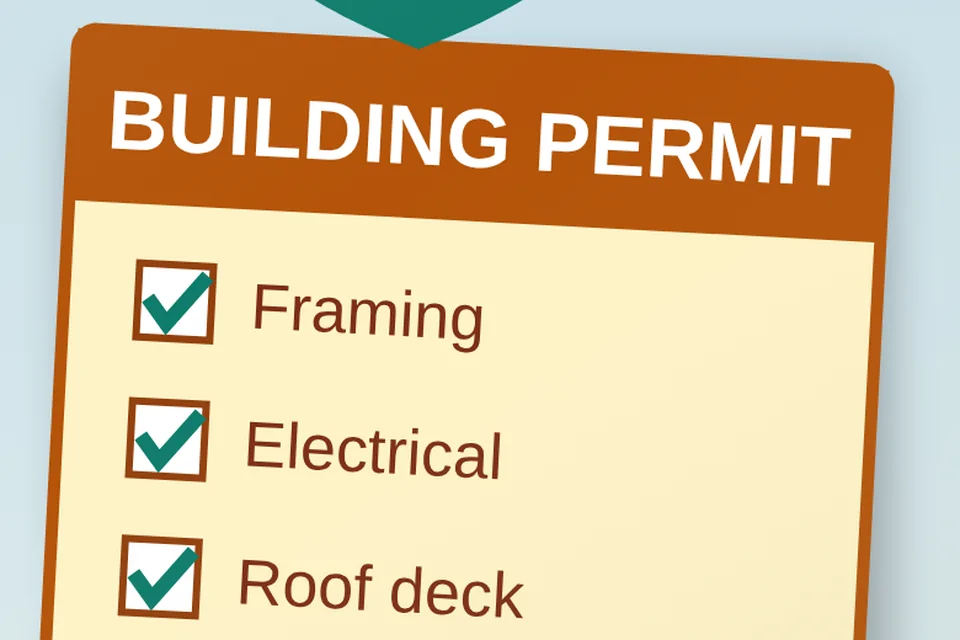
Each inspection can add requirements. Keep the card and the inspector’s notes; insurers often ask for them before paying code costs.
A homeowners policy pays to repair damage the way the house was. Building codes, though, apply to the repair as it is done today. Ordinance or Law coverage fills the gap in three ways: the added cost of building the damaged part to current code, the cost to demolish undamaged parts the city orders taken down, and the cost to rebuild those undamaged parts. Coverage A pays none of it.
| Upgrade | Typical added cost |
|---|---|
| Re-sheath over spaced plank decking | $2.40 – $3.80 per sq ft |
| Upgraded roof deck nailing, high-wind areas | $25 – $45 per square |
| Ice barrier at the eaves | $1.90 – $2.90 per sq ft |
| Drip edge at eaves and rakes | $3.00 – $4.80 per ft |
| Tempered or egress window upgrade | $350 – $900 each |
| AFCI and GFCI protection on rebuilt circuits | $800 – $2,500 |
| Panel and service brought to code | $2,500 – $5,500 |
| Hardwired, interconnected smoke and CO alarms | $600 – $1,600 |
| Rebuild an undamaged part to code | $150 – $260 per sq ft |
| Code item | Range |
|---|---|
| Re-sheath over spaced plank decking, 2,800 sq ft | $6,720 – $10,640 |
| Ice barrier at the eaves | $1,391 – $2,123 |
| Drip edge at eaves and rakes | $642 – $1,027 |
| Tempered or egress windows, 2 | $700 – $1,800 |
| AFCI and GFCI protection | $800 – $2,500 |
| Interconnected smoke and CO alarms | $600 – $1,600 |
| Permit and plan-review fees | $300 – $1,500 |
| Code upgrade cost | $11,153 – $21,190 |
On a $350,000 dwelling limit the standard 10% gives $35,000, which covers this. Add an order to rebuild 400 sq ft of undamaged house and the code cost moves to roughly $74,000 to $130,000, far beyond 10%.
Many communities, especially in flood zones and older downtowns, require the whole building to meet current code once damage passes a share of its value, often 50%. This is called a substantial damage determination. When it happens, parts of the house that were never touched by the fire or storm may have to be rebuilt. That cost sits entirely in Ordinance or Law, and it is why owners of older homes are told to carry more than 10%.
The calculator's default code upgrade (ordinance or law) scenario, repriced for each of its six regions. At the national average it runs $11,153 – $21,190; South / Lower Midwest is the lowest at $9,703 – $18,435, and West Coast metro is the highest at $14,499 – $27,547, a gap of about $6,954 at the midpoint.
| Region | Planning range | Midpoint |
|---|---|---|
| National average | $11,153 – $21,190 | $16,172 |
| South / Lower Midwest | $9,703 – $18,435 | $14,069 |
| Mountain / Plains | $10,595 – $20,131 | $15,363 |
| Mid-Atlantic / Upper Midwest | $12,491 – $23,733 | $18,112 |
| Northeast metro | $14,053 – $26,699 | $20,376 |
| West Coast metro | $14,499 – $27,547 | $21,023 |
Every other input stays at its default and only “Old plank decking with gaps” changes. The cheapest choice, No, solid decking, comes to $4,433 – $10,550; the most expensive, Yes, re-sheath with plywood or OSB, comes to $11,153 – $21,190.
| Choice | Planning range | Midpoint vs default |
|---|---|---|
| Yes, re-sheath with plywood or OSB (default) | $11,153 – $21,190 | — |
| No, solid decking | $4,433 – $10,550 | −$8,680 |
Every other input stays at its default and only “Insulation brought to current energy code” changes. The cheapest choice, No, comes to $11,153 – $21,190; the most expensive, Yes, rebuilt walls and attic, comes to $14,513 – $27,910.
| Choice | Planning range | Midpoint vs default |
|---|---|---|
| Yes, rebuilt walls and attic | $14,513 – $27,910 | +$5,040 |
| No (default) | $11,153 – $21,190 | — |
Ordinance or law items are paid when they are shown to be required, not just recommended.
| Stage | Typical time | What happens |
|---|---|---|
| Damage estimate | 1 – 4 weeks | Like-kind repair approved first. |
| Permit review | 1 – 4 weeks | The building department lists required upgrades. |
| Code supplement | 1 – 3 weeks | Send citations and the corrections list. |
| Work and inspections | Varies | Upgrades installed and inspected. |
| Payment | 1 – 4 weeks | Code items paid up to the policy limit. |
Ask the contractor to flag code items before walls are closed, so they can be photographed and documented.
Code items are paid when they are documented as required.
Older homes face the biggest gaps.
It pays the extra cost of rebuilding to current building code after a covered loss, plus the cost to tear down and rebuild undamaged parts the city requires. The dwelling coverage does not pay for these.
A standard homeowners form includes 10% of the dwelling limit. Endorsements raise it to 25%, 50% or 100%.
Only through Ordinance or Law coverage, up to its limit. Without it, code upgrades are the owner’s cost.
Where the current code requires them and the old roof did not have them, yes. Some insurers include them in the regular repair estimate; ask which limit pays.
Many local rules require a building to meet current code once repairs or damage pass about half its value. That can force upgrades or rebuilding of undamaged parts.
Often not. Many policies pay code costs only after the work is done, so keep permits, inspection records and invoices.
Usually a few percent of the premium for 25% or 50%. Prices vary by state and insurer.
It covers the code-required portions, such as re-sheathing over spaced planks, when the policy includes it. The shingles themselves are paid under the dwelling coverage.
The local building department decides, based on the codes it has adopted. The permit review or inspection usually lists required items.
No. Limits, what is covered and when payment is made vary by policy and endorsement.
Many versions cover the cost to demolish and rebuild undamaged portions when a law requires it, such as after substantial damage. Check your policy wording.
Code upgrades are usually paid without depreciation once completed, but policies differ.
Some policies limit ordinance or law payment if you do not rebuild at the same location. Ask before deciding.
Yes. Ask the contractor to show code items as separate lines with the code section, so the adjuster can review them.
In flood zones, if repair costs reach 50% of the building's market value, the whole structure may need to meet current floodplain rules, which can mean elevating it.
Standard ordinance or law coverage rarely pays for elevation in full. Flood insurance may include Increased Cost of Compliance coverage, which helps pay to elevate or floodproof after substantial damage.
Rebuilds often require hardwired, interconnected smoke alarms and carbon monoxide alarms where the old house had battery units. Those items are typical code upgrade lines.
Use the companion calculators when the job touches another part of the house or the claim.
Planning topics covered in the calculator and guide above.