Mini-split cost by zone calculator
A ductless mini-split is a heat pump with an outdoor unit and one or more slim indoor heads mounted high on a wall. Each head is a zone with its own temperature. They are the usual answer for an addition, a converted garage, a hot bonus room, an old house with radiators and no ducts, or a house moving off oil or electric baseboard.
Mini-splits are priced by the zone. The first zone carries the outdoor unit and most of the setup cost; every added head adds less. Line-set length, a new 240-volt circuit, the mounting for the outdoor unit and the wall penetrations are small lines that add up, so this calculator lists each one.
Choose cold-climate equipment if winter nights regularly drop well below freezing and the mini-split will be a main heat source. Those units hold their output at low temperatures and cost more.
Reviewed 25 October 2026 · Written by Mantu Kumar
See the photos · See the cost diagram · Open the calculator
Key facts at a glance
- First zone, installed: about $2,200–$6,500 for a 12,000 BTU head; about 22% more for cold-climate models.
- Each added zone: about $1,800–$4,200 for a similar head.
- Line set and cover: about $200–$550 per run, or $550–$1,300 for long runs.
- New 240V circuit and disconnect: about $400–$1,200. Mounting about $150–$700.
- Condensate: about $80–$250 per head; wall sleeve and finish about $120–$400 per opening.
National 2026 planning ranges before your regional multiplier. Utility heat pump rebates are not applied.
2026 planning ranges
- 1Zones and equipment
- 2Line set and cover
- 3Condensate
- 4240V circuit
- 5Bracket or pad
- 6Wall sleeve and finish
- 7Permit
- 8Cold-climate model
- 9Wall, cassette or ducted head
Price your mini-split by zone
No email · nothing sentDiagram, part by part
Mini-split installation: every numbered part explained
The drawing above has 9 numbered parts, from Zones: the heads and the outdoor unit to Head type: wall, ceiling or ducted. Each card zooms in on one part, says what pushes its price up or down, and tells you what to look for on a written quote. After you run the calculator, the parts in your scope show their dollar band.
1 Zones: the heads and the outdoor unit
$2,200–$6,500 first zone
Each indoor head is a zone. The first zone includes the outdoor unit, so it costs the most. Additional heads can share a multi-zone outdoor unit or each get their own single-zone unit, which is often more efficient and easier to service.
What moves it: Number of heads, their size, cold-climate rating, brand, and single versus multi-zone outdoor units.
On the quote: Look for model numbers, BTU size per head, SEER2 and HSPF2, and the low-temperature heating output for cold-climate units.
2 Line set and line-set cover
$200–$1,300 per run
Two insulated copper refrigerant lines, a control cable and the condensate tube run from each head to the outdoor unit, usually inside a plastic cover on the outside wall. Longer runs cost more and may need extra refrigerant.
What moves it: Run length, number of stories, and whether lines run inside walls or outside.
On the quote: Ask for run lengths and whether the line set is pressure-tested and evacuated with a micron gauge.
3 Condensate from each head
$80–$250 per head
Heads make water when cooling. It drains by gravity through the wall or, for interior walls, through a small pump in the head or the line-set cover.
What moves it: Wall location and whether a pump is needed.
On the quote: Make sure each head has a drain path and that pumps are named on the quote.
4 240-volt circuit and disconnect
$400–$1,200
The outdoor unit needs a dedicated 240-volt circuit with a disconnect switch within sight. If the panel is full, a panel upgrade is a separate, bigger job.
What moves it: Distance from the panel, panel capacity and local electrical rules.
On the quote: Ask whether the electrician is licensed and the permit covers electrical work.
5 Wall bracket or ground pad
$150–$700
The outdoor unit sits on a wall bracket above snow and debris, or on a pad on the ground. In snowy areas, keeping the unit high and clear matters for heating.
What moves it: Wall type, snow depth and access.
On the quote: Look for anti-vibration pads and enough height above expected snow.
6 Wall sleeve and interior finish
$120–$400 per opening
A 3-inch hole is cut through the wall behind each head, sleeved and sealed. Interior paint touch-up and exterior sealing are part of it.
What moves it: Wall type (brick and stone cost more), and interior finish.
On the quote: Ask how the hole is sealed against air and water on both sides.
7 Permit
$150–$450
Most towns require a mechanical and electrical permit for a mini-split. Inspection checks the circuit, the disconnect and refrigerant work.
What moves it: Local fees.
On the quote: Permit included, and who meets the inspector.
8 Cold-climate heat pump
About 20% more per zone
Cold-climate mini-splits keep most of their heating output down to about 5 degrees Fahrenheit and keep running well below zero. In northern climates they can be the main heat source instead of a backup.
What moves it: Your winter design temperature and whether the system is the main heat.
On the quote: Ask for the heating capacity at 5 degrees Fahrenheit, not just the rated capacity at 47.
9 Head type: wall, ceiling or ducted
Wall heads cost the least
Wall-mounted heads are the most common and least expensive. Ceiling cassettes sit flush in the ceiling, and slim ducted units hide in a closet or attic to serve several rooms through short ducts.
What moves it: Room layout, ceiling space and how visible the unit can be.
On the quote: Ask which head type suits each room and how filters are reached for cleaning.
Project photo guide
Ductless mini-split installation in photos: indoor wall bracket, line set and outdoor condenser
Installing a ductless mini-split heat pump links one or more quiet indoor air handlers to an variable-speed outdoor inverter compressor through a 3-inch wall penetration carrying insulated copper refrigerant lines, communication wire, and a gravity condensate drain.

How the job works in 3 key stages
All three step images are AI-generated illustrations for explanation. Not a site inspection, bid, or coverage decision.
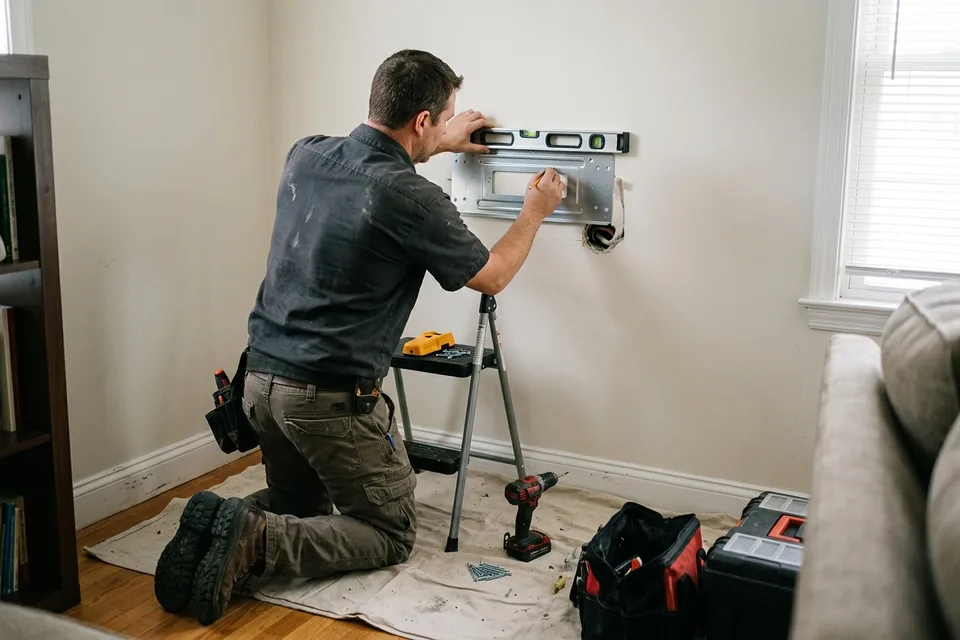 Step 01
Mounting plate
The installer locates wall studs, checks clearances from the ceiling for return airflow, bolts the galvanized steel mounting plate dead-level so the condensate pan drains properly, and drills a slightly pitched 3-inch hole through the exterior wall.
On the quote: Confirm the indoor head placement has unobstructed airflow and that gravity drainage works without an noisy auxiliary condensate pump where possible.
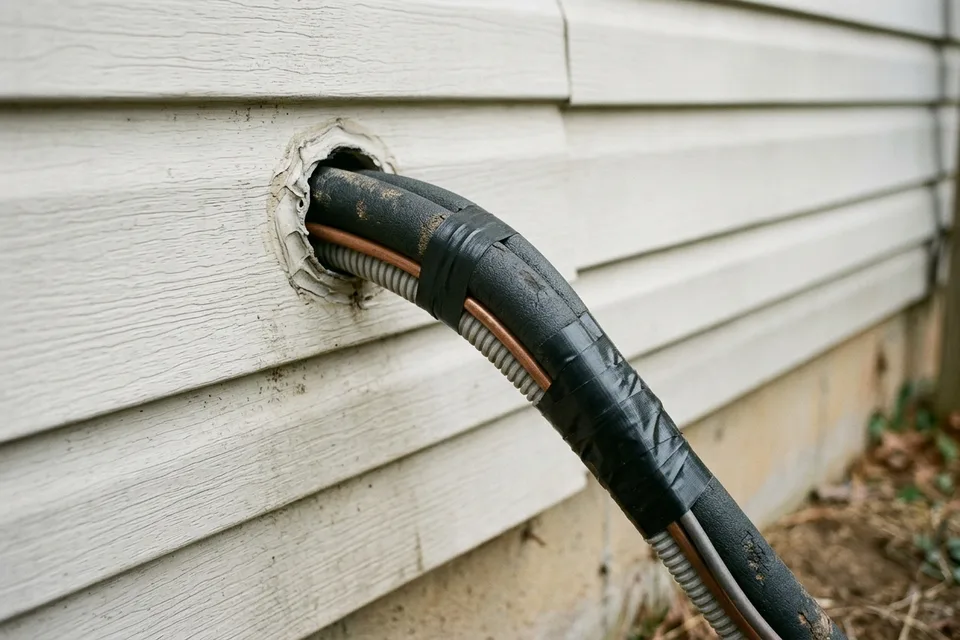 Step 02
Line set
Twin insulated copper refrigerant lines, the 14/4 communication cable, and the condensate drain tube are sleeved through the wall opening, sealed against drafts and pests, and Torque-flared to the indoor coil.
On the quote: Verify the quote includes exterior PVC line-hide covers painted or color-matched to your siding rather than exposed foam insulation.
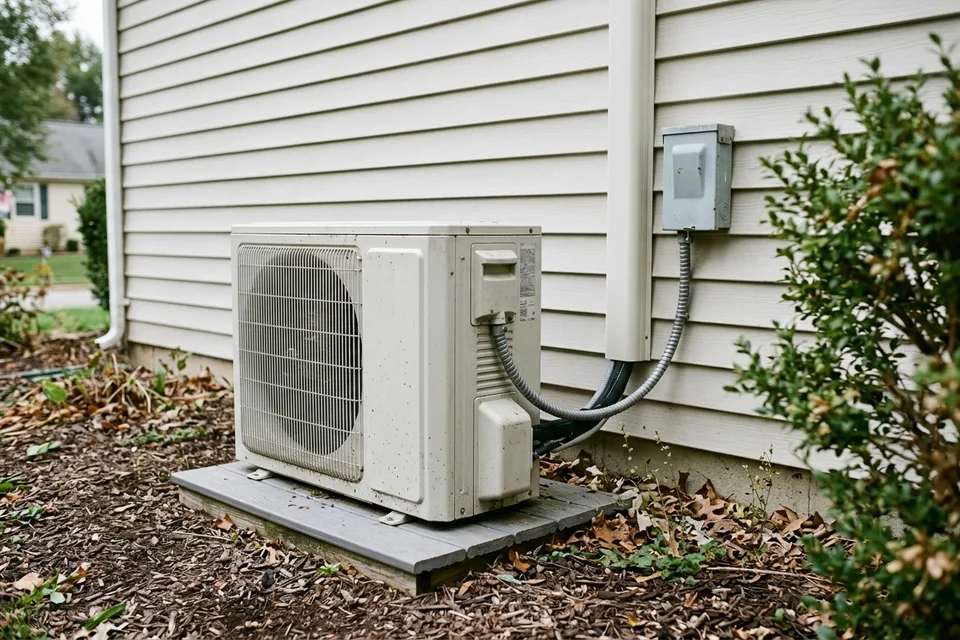 Step 03
Outdoor unit
Outside, the inverter heat pump is anchored on a composite pad or elevated wall brackets above snow level, wired to a dedicated 240V weatherproof disconnect box, pressure-tested with dry nitrogen, and evacuated to 500 microns.
On the quote: Make sure the dedicated 240V electrical circuit, outdoor disconnect, surge protector, pad or snow stand, and a 500-micron vacuum decay test are all included.


What this photo guide helps you verify on a written quote
- Electrical circuit included: Confirm whether the 240V breaker, whip, and outdoor disconnect box are included in the HVAC bid or require a separate electrician.
- Cold-climate rating: In northern states, verify whether the outdoor unit is a low-ambient hyper-heat model rated down to -5°F or -13°F.
- Line-set hide covers: Exposed foam insulation degrades in UV sunlight—make sure rigid UV-resistant line-set covers are specified.
- Nitrogen & micron test: Proper flare torque, nitrogen pressure testing, and a 500-micron vacuum pull prevent future refrigerant leaks.
On this page
- The diagram, part by part
- Photo guide: hero and 3 project steps
- Mini-split cost by zone and option
- What common mini-split jobs cost
- Mini-split or ducted system
- When a mini-split makes sense
- Mini-split cost by region
- What “Zones (indoor heads)” does to the price
- What “Typical head size” does to the price
- How age changes the mini-split claim payout
- How to read the quote, line by line
- How long the job takes
- Worked example
- Does insurance pay for a mini-split?
- Ways to keep the cost down
- Sources and further reading
- Frequently asked questions
Mini-split cost by zone and option
Installed costs for typical heads before the smaller lines.
| Scope | 2026 planning range | Why it is its own line |
|---|---|---|
| First zone, 9k BTU | $1,980 – $5,850 | Small bedroom or office. |
| First zone, 12k BTU | $2,200 – $6,500 | The common size. |
| First zone, 18k BTU | $2,684 – $7,930 | Large rooms and open plans. |
| Cold-climate upgrade | +22% | For main heat in cold winters. |
| Each added zone, 12k | $1,800 – $4,200 | Per head. |
| Line set, typical run | $200 – $550 per run | 15–25 ft. |
| New 240V circuit and disconnect | $400 – $1,200 | If not already there. |
| Wall bracket / ground pad | $150 – $450 / $250 – $700 | Mounting. |
A full panel upgrade is not included. If your panel is full, use the electrical panel calculator alongside this one.
What common mini-split jobs cost
Four typical installs at the national average.
| Job | Planning range | Midpoint |
|---|---|---|
| One zone for a bonus room 12k head, typical line set. | $3,300 – $9,800 | $6,550 |
| Three zones, cold climate Main heat for one floor. | $8,976 – $23,878 | $16,427 |
| Four zones, whole small house Longer runs. | $11,300 – $29,000 | $20,150 |
| One 9k head, circuit already there The simplest install. | $2,480 – $7,400 | $4,940 |
Each row is this page’s calculator run with the inputs described, at the national average. Change the region and the inputs above to see your own numbers.
Mini-split or ducted system
Mini-splits shine where ducts are missing or poor. For a house with good ducts, a ducted heat pump or a furnace and AC is often simpler.
| Option | Best when | Watch out for |
|---|---|---|
| Single-zone mini-split | One room or addition without ducts. | Only conditions that room. |
| Multi-zone mini-split | Several rooms, no ducts, each with its own control. | Many heads on walls; one outdoor unit failure affects all. |
| Ducted heat pump | Good ducts in place. | Duct losses if ducts are poor. |
| Ducted mini-split (slim air handler) | A few rooms served by short ducts in an attic. | Needs space for a small air handler. |
When a mini-split makes sense
- An addition or converted space that the main system cannot reach.
- No ducts in a house heated by radiators or baseboard.
- Hot or cold rooms that ductwork changes have not fixed.
- Oil or electric resistance heat with high bills.
- A window AC you want to replace with something quieter and efficient.
- Rooms used at different times that benefit from their own control.
Mini-split cost by region
The calculator's default mini-split job, repriced for each of its six regions. At the national average it runs $3,300 – $9,800; South / Lower Midwest is the lowest at $2,871 – $8,526, and West Coast metro is the highest at $4,290 – $12,740, a gap of about $2,816 at the midpoint.
| Region | Planning range | Midpoint |
|---|---|---|
| National average | $3,300 – $9,800 | $6,550 |
| South / Lower Midwest | $2,871 – $8,526 | $5,698 |
| Mountain / Plains | $3,135 – $9,310 | $6,222 |
| Mid-Atlantic / Upper Midwest | $3,696 – $10,976 | $7,336 |
| Northeast metro | $4,158 – $12,348 | $8,253 |
| West Coast metro | $4,290 – $12,740 | $8,515 |
What “Zones (indoor heads)” does to the price
Every other input stays at its default and only “Zones (indoor heads)” changes. The cheapest choice, 1 zone, comes to $3,300 – $9,800; the most expensive, 5 zones, comes to $12,100 – $31,400.
| Choice | Planning range | Midpoint vs default |
|---|---|---|
| 1 zone (default) | $3,300 – $9,800 | — |
| 2 zones | $5,500 – $15,200 | +$3,800 |
| 3 zones | $7,700 – $20,600 | +$7,600 |
| 4 zones | $9,900 – $26,000 | +$11,400 |
| 5 zones | $12,100 – $31,400 | +$15,200 |
What “Typical head size” does to the price
Every other input stays at its default and only “Typical head size” changes. The cheapest choice, About 9,000 BTU, comes to $3,080 – $9,150; the most expensive, About 18,000 BTU, comes to $3,784 – $11,230.
| Choice | Planning range | Midpoint vs default |
|---|---|---|
| About 9,000 BTU | $3,080 – $9,150 | −$435 |
| About 12,000 BTU (default) | $3,300 – $9,800 | — |
| About 18,000 BTU | $3,784 – $11,230 | +$957 |
How age changes the mini-split claim payout
Using the default job, a $1,000 deductible and a 15-year expected life. At 10 years old, about $4,367 is held back as depreciation; a replacement cost policy releases it after the work is finished, while an actual cash value policy keeps it.
| Age | Wear | First check | Held back |
|---|---|---|---|
| 2 years | 13% | $4,677 | $873 |
| 5 years | 33% | $3,367 | $2,183 |
| 10 years | 67% | $1,183 | $4,367 |
| 15 years | 80% | $310 | $5,240 |
| 20 years | 80% | $310 | $5,240 |
| 30 years | 80% | $310 | $5,240 |
How to read the quote, line by line
Mini-split quotes vary widely. Line these up.
- Heads, sizes and rooms. One line per zone.
- Equipment model and ratings. SEER2, HSPF2, low-temperature output.
- Single or multi-zone outdoor units. And why.
- Line-set runs. Lengths and routing.
- Electrical. Circuit, disconnect and any panel work.
- Condensate. Gravity or pump per head.
- Permit and warranty. Including labor years.
How long the job takes
| Stage | Typical time | What happens |
|---|---|---|
| Site visit and sizing | 1 hour | Room measurements. |
| Single zone install | 4 – 8 hours | One day. |
| Multi-zone install | 1 – 3 days | Depends on heads and runs. |
| Electrical and inspection | 1 – 14 days | Town dependent. |
| Filter cleaning | Monthly in season | Owner maintenance. |
Ask the installer to show you how to clean the head filters; dirty filters are the most common service call.
Worked example
A finished bonus room over a garage that is too hot in summer. One 12,000 BTU head on the outside wall, a wall bracket for the outdoor unit, and a new 240V circuit.
One 12k zone, typical line set, new circuit
Worked example| Line item | National planning range |
|---|---|
| First zone, equipment and install | $2,200 – $6,500 |
| Line set and cover | $200 – $550 |
| Condensate from each head | $80 – $250 |
| New 240V circuit and disconnect | $400 – $1,200 |
| Wall bracket | $150 – $450 |
| Wall sleeve and interior finish | $120 – $400 |
| Permit | $150 – $450 |
| Total before regional adjustment | $3,300 – $9,800 |
Midpoint about $6,550. Adding a second head for the bedroom next door would add about $1,800–$4,200 for the zone plus its line set, condensate and wall sleeve.
Does insurance pay for a mini-split?
A new mini-split is an improvement, not a claim. If an existing system is damaged by a covered event, such as a lightning surge, fire or a falling tree, the policy may pay to repair or replace it, minus the deductible and any depreciation.
Outdoor units stolen for copper may also be covered under theft. Keep the model numbers and receipts.
What this page will not claim
- Sizing, which needs a load calculation for each room.
- A panel upgrade.
- Federal tax credits, which ended for 2026 installs.
- Utility rebates, which vary.
Ways to keep the cost down
Mini-split costs depend on zones and line sets.
- Use multi-zone outdoor units. Fewer units.
- Keep line sets short. Lower cost.
- Choose wall heads. Cheapest head type.
- Check rebates. Heat pump incentives.
- Size zones correctly. Avoid oversizing.
- Add circuits with other work. One permit.
Sources and further reading
- U.S. DOE Energy Saver — Ductless mini-split heat pumps
- ENERGY STAR — Air-source heat pumps
- NEEP — Cold climate air-source heat pump list
- IRS — Energy efficient home improvement credit
Prices on this page are planning ranges built from public 2026 US cost guides and contractor rate sheets, widened where they disagreed, and multiplied by the same regional index as every other ReplaceCost calculator. Rules and definitions come from the agencies listed. See the methodology for how ranges are set and reviewed.
Frequently asked questions
How much does a mini-split cost per zone in 2026?
The first zone typically runs about $3,300 to $9,800 installed with all small lines. Each added zone adds roughly $2,200 to $5,400 with its own line set and finish work.
Is a cold-climate mini-split worth it?
If the mini-split will be a main heat source where winter nights go well below freezing, yes. Standard units lose much of their output in deep cold.
How many zones do I need?
Usually one per room or open area you want controlled separately. A load calculation decides head sizes.
Single-zone or multi-zone outdoor units?
Single-zone units are often more efficient and keep working if one fails. Multi-zone units save wall space outside.
Do mini-splits need a permit?
In most places yes, for mechanical and electrical work.
How long do mini-splits last?
Often 15 to 20 years with clean filters and annual service.
Can a mini-split heat a whole house?
Yes in many homes, especially well insulated ones with an open layout, using several zones and cold-climate equipment.
Is there a federal tax credit for mini-splits?
The 25C credit ended for equipment placed in service after 2025. Check state and utility rebates.
Do mini-splits need maintenance?
Clean or rinse the indoor filters about monthly in heavy use, keep the outdoor unit clear and schedule a professional coil cleaning every year or two.
Are mini-splits quiet?
Indoor heads are usually very quiet at low speed, often quieter than a window unit. Outdoor units are similar to small central air condensers.
Can one outdoor unit serve several rooms?
Yes. Multi-zone outdoor units serve two to five or more indoor heads, though single-zone units are often more efficient and avoid a single point of failure.
Can mini-splits cool a whole house?
Yes, with enough zones or a ducted indoor unit, though open floor plans work better than many small closed rooms.
Do mini-splits work in cold weather?
Cold-climate models keep heating at very low outdoor temperatures. Standard models lose capacity as it gets colder.
Where should indoor heads go?
Usually high on an outside wall with clear airflow across the room and a short route for the line set and condensate drain.