Home › Lead paint removal
Hazardous materials · pre-1978 homesLead paint removal cost calculator
Lead was a common ingredient in house paint until it was banned for residential use in 1978. In older homes it is usually buried under newer coats, and it becomes a hazard when paint chips, when windows rub it into dust, or when someone sands or scrapes it. Young children are most at risk, which is why lead work comes up when a family with kids moves into an older house, or when a landlord gets a notice.
There are three ways to deal with lead paint. Encapsulation seals it under a special coating. Enclosure covers it with new drywall, siding or trim. Removal strips it off the surface entirely, which costs the most and creates the most dust. Windows and doors are often the worst spots, because opening and closing them grinds paint into dust on the sill.
This calculator starts with testing, then prices the method you choose per square foot, adds window and door openings, containment and HEPA cleanup, waste disposal, clearance testing and optional repainting.
Reviewed 25 October 2026 · Written by Mantu Kumar
See the photos · See the cost diagram · Open the calculator
Key facts at a glance
- Inspection: about $300–$700; risk assessment about $500–$1,500.
- Per sq ft of painted surface: encapsulate about $6–$10; enclose about $8–$13; strip and remove about $15–$45.
- Window or door openings: about $400–$1,500 each.
- Containment and HEPA cleanup: about $300–$900; waste disposal about $200–$800.
- Clearance testing: about $300–$500 per round.
National 2026 planning ranges before your regional multiplier. Federal and state certification rules apply to paid work in pre-1978 homes.
2026 planning ranges
- 1Inspection or risk assessment
- 2Strip and remove
- 3Window and door openings
- 4Encapsulation
- 5Enclosure
- 6Containment and HEPA cleanup
- 7Waste disposal
- 8Clearance testing
- 9Repaint
Price your lead paint work
No email · nothing sentDiagram, part by part
Lead paint abatement: every numbered part explained
The drawing above has 9 numbered parts, from Inspection or risk assessment to Repainting stripped surfaces. Each card zooms in on one part, says what pushes its price up or down, and tells you what to look for on a written quote. After you run the calculator, the parts in your scope show their dollar band.
1 Inspection or risk assessment
$300–$1,500
A lead inspection finds which painted surfaces contain lead, usually with an XRF analyzer that reads through paint without damaging it. A risk assessment goes further and looks at the condition of the paint, dust and soil to tell you where the hazards are now.
What moves it: House size, number of rooms and whether dust and soil samples are included.
On the quote: Use a certified inspector or risk assessor. Ask for a written report listing each tested surface.
2 Strip and remove
$15–$45 per sq ft
Paint is removed with wet scraping, chemical strippers or low-temperature heat, never dry sanding or open-flame burning. It is the most permanent fix and the most expensive, and it generates the most waste.
What moves it: Surface type, number of paint layers and detail work like trim profiles.
On the quote: Ask which removal method is used and how dust is controlled.
3 Windows and doors
$400–$1,500 per opening
Friction and impact surfaces such as window sashes, jambs, sills and door edges grind paint into dust every day. Common fixes are replacing windows, stripping and rebuilding sashes, or covering jambs and sills.
What moves it: Replacement versus treatment, and window size and condition.
On the quote: Ask what happens to friction surfaces specifically, not only the visible paint.
4 Encapsulation
$6–$10 per sq ft
A thick, flexible coating made for lead paint is rolled or sprayed over intact paint, sealing it in. It works on stable surfaces, not on peeling paint or friction surfaces.
What moves it: Surface prep, product and coats needed.
On the quote: Check that the product is designed as a lead encapsulant, and that failing paint is stabilized first.
5 Enclosure
$8–$13 per sq ft
The painted surface is covered with a durable material such as drywall, paneling, vinyl siding or capped trim, sealed at the edges so dust cannot escape.
What moves it: Material and the amount of trim detail.
On the quote: Enclosed lead is still there and must be disclosed and handled carefully in future renovations.
6 Containment and HEPA cleanup
$300–$900
Floors and doorways are covered with plastic, work areas are sealed off, and cleanup uses HEPA vacuums and wet wiping. Outside, plastic is spread on the ground to catch chips.
What moves it: Number of rooms or wall faces, and whether the family stays in the house.
On the quote: Look for lead-safe work practices in the scope and a daily cleanup plan.
7 Waste disposal
$200–$800
Paint chips, plastic and debris are bagged and disposed of according to local rules.
What moves it: Volume and local disposal requirements.
On the quote: Ask how waste is handled and where it goes.
8 Clearance testing
$300–$500 per round
After cleanup, dust-wipe samples from floors and window sills go to a lab. If levels are above the standard, the area is cleaned again and retested.
What moves it: Number of samples, lab turnaround and whether a second round is needed.
On the quote: Use an independent clearance examiner and keep the results.
9 Repainting stripped surfaces
$1–$5 per sq ft
Stripped surfaces need primer and paint. Exterior repainting costs more than interior.
What moves it: Surface area, interior or exterior, and trim detail.
On the quote: Confirm repainting is in the scope, not assumed.
Project photo guide
Lead-safe work and abatement in photos: testing, HEPA containment and sealed finish
In pre-1978 homes, disturbing layered lead-based paint without containment spreads toxic lead dust across floors and windowsills: EPA RRP and abatement protocols rely on testing first, sealing the work zone with plastic and HEPA vacuums, and stabilizing or replacing friction surfaces like windows and doors.

How the job works in 3 key stages
All three step images are AI-generated illustrations for explanation. Not a site inspection, bid, or coverage decision.
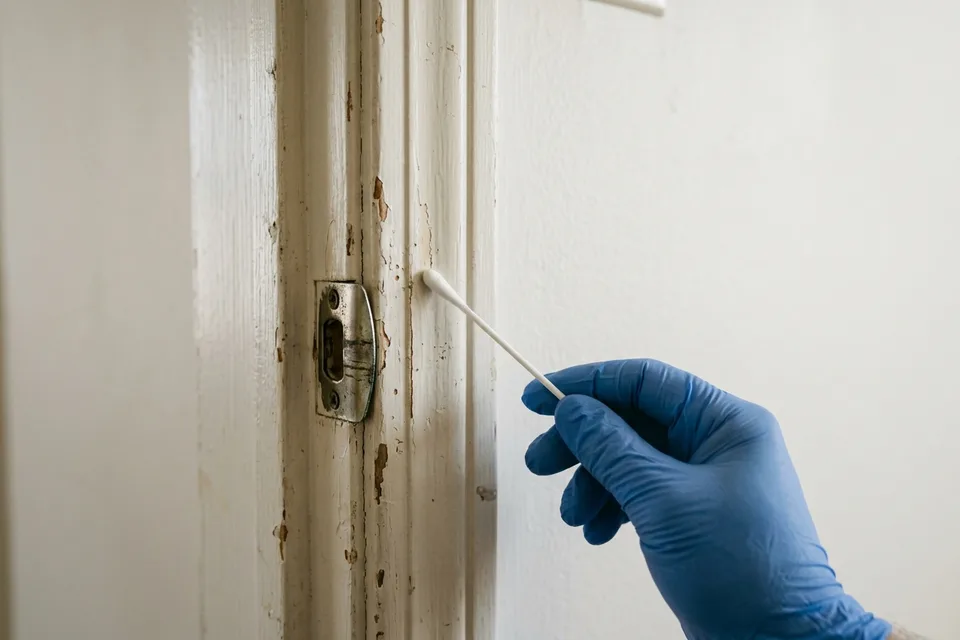 Step 01
Testing
Before renovation or abatement starts, an EPA-recognized swab test or a licensed inspector's portable XRF analyzer checks each painted component—windows, doors, baseboards, and siding—to map exactly where lead is present.
On the quote: For full abatement or HUD grant work, hire a certified lead risk assessor using an XRF gun rather than relying on spot swabs alone.
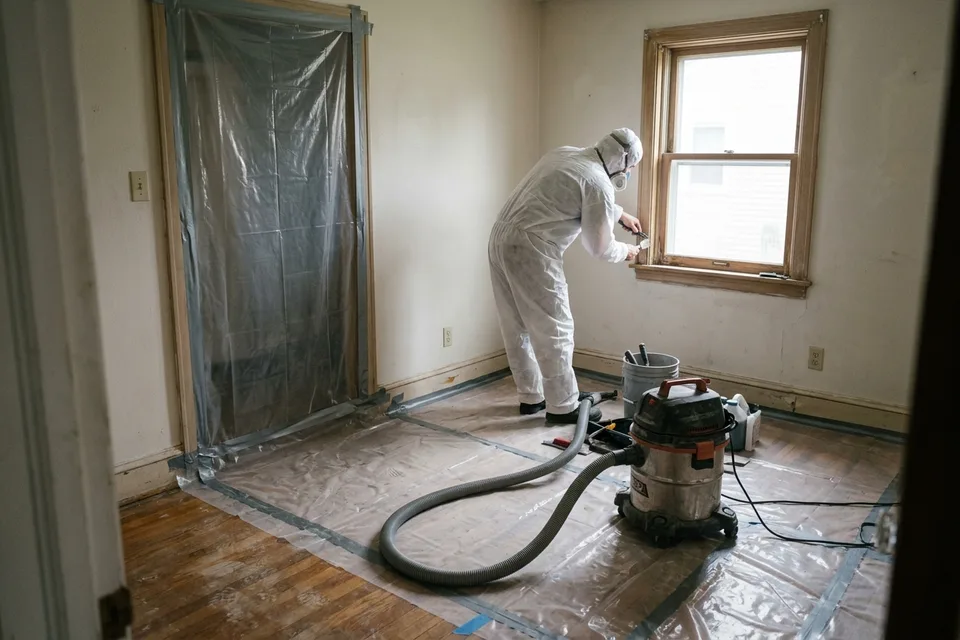 Step 02
Contained work
Certified workers tape heavy plastic sheeting across the floor and doorway, seal HVAC registers, and use wet scraping or HEPA-shrouded tools connected directly to a true HEPA vacuum—never dry sanding or open heat guns.
On the quote: Ask for the firm's EPA RRP certificate (or state lead abatement license) and confirm true HEPA vacuuming and wet-cleaning are included.
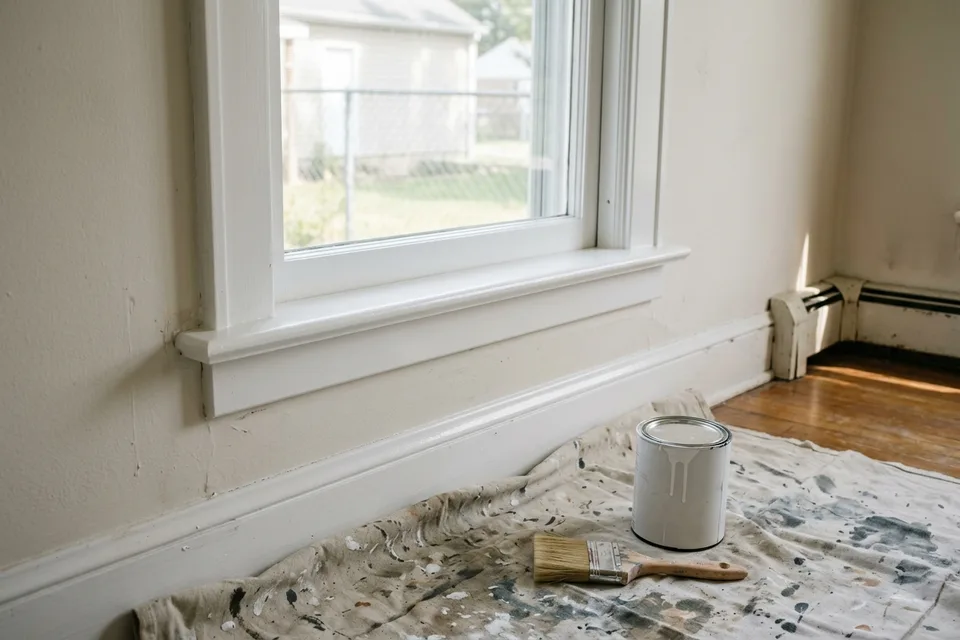 Step 03
Sealed finish
Once loose paint is wet-scraped and high-friction window channels are replaced or clad, surfaces receive a bonding primer or elastomeric lead encapsulant and smooth topcoats, followed by HEPA-wet-heb cleaning and dust-wipe clearance.
On the quote: Require lab-analyzed dust-wipe clearance tests on floors, interior sills, and window troughs before children or pets re-enter the room.


What this photo guide helps you verify on a written quote
- RRP vs. certified abatement: RRP is lead-safe containment during normal painting/remodeling; abatement permanently removes or encapsulates lead hazards.
- Windows are the main friction source: Replacing old weighted wood sashes with new pocket windows often costs less long-term than stripping lead from every sash track.
- Prohibited methods: Confirm the contract forbids dry scraping, unshrouded power sanding, open-flame torching, and heat guns above 1,100°F.
- Dust-wipe clearance: A visual check cannot see microscopic lead dust—always get lab dust-wipe results from floors and sills.
On this page
- The diagram, part by part
- Photo guide: hero and 3 project steps
- Lead paint cost by method
- What common lead paint jobs cost
- Encapsulate, enclose or remove
- When to test for lead paint
- Lead paint removal cost by region
- What “Method for that area” does to the price
- What “Testing before work” does to the price
- How age changes the lead paint removal claim payout
- How to read the quote, line by line
- How long the job takes
- Worked example
- Does insurance pay for lead paint removal?
- Common mistakes that raise the cost
- Ways to keep the cost down
- Sources and further reading
- Frequently asked questions
Lead paint cost by method
Rates per square foot of treated painted surface, before containment, disposal and testing.
| Scope | 2026 planning range | Why it is its own line |
|---|---|---|
| Inspection | $300 – $700 | Which surfaces have lead. |
| Risk assessment | $500 – $1,500 | Where the hazards are now. |
| Encapsulation | $6 – $10 per sq ft | Coating over stable paint. |
| Enclosure | $8 – $13 per sq ft | Covered with new material. |
| Removal (strip) | $15 – $45 per sq ft | Gone for good. |
| Window or door opening | $400 – $1,500 each | Friction surfaces. |
| Containment and HEPA cleanup | $300 – $900 | Every job. |
| Clearance testing | $300 – $500 per round | Dust wipes to a lab. |
Some cities, states and HUD-funded programs help pay for lead hazard control, especially for homes with young children. Eligibility is not modeled.
What common lead paint jobs cost
Four typical jobs at the national average.
| Job | Planning range | Midpoint |
|---|---|---|
| 400 sq ft interior, encapsulate Inspection and one clearance round. | $3,500 – $6,900 | $5,200 |
| Interior with 6 windows treated Friction surfaces addressed. | $5,900 – $15,900 | $10,900 |
| 600 sq ft exterior, strip and repaint Removal outside. | $11,000 – $32,900 | $21,950 |
| Risk assessment, enclose 300 sq ft Covered with drywall. | $3,700 – $7,600 | $5,650 |
Each row is this page’s calculator run with the inputs described, at the national average. Change the region and the inputs above to see your own numbers.
Encapsulate, enclose or remove
The cheapest option that controls the hazard is usually the right one. Removal is for surfaces that keep failing or will be disturbed.
| Option | Best when | Watch out for |
|---|---|---|
| Encapsulate | Stable walls and ceilings. | Not for friction surfaces or peeling paint; needs monitoring. |
| Enclose | Walls getting new drywall or siding anyway. | Lead stays behind the new surface. |
| Remove | Doors, trim and windows that will be disturbed; failing paint. | Highest cost and most dust; needs tight controls. |
| Replace the component | Old windows and doors. | Often the best fix for friction surfaces. |
When to test for lead paint
- Built before 1978 and especially before 1950.
- Chipping or peeling paint inside or out.
- Windows that stick or rub leaving paint dust on sills.
- Planning to renovate any painted surface in an older home.
- A child under six living in or often visiting the home.
- A notice from a health department or a landlord inspection.
Lead paint removal cost by region
The calculator's default lead paint removal job, repriced for each of its six regions. At the national average it runs $3,500 – $6,900; South / Lower Midwest is the lowest at $3,045 – $6,003, and West Coast metro is the highest at $4,550 – $8,970, a gap of about $2,236 at the midpoint.
| Region | Planning range | Midpoint |
|---|---|---|
| National average | $3,500 – $6,900 | $5,200 |
| South / Lower Midwest | $3,045 – $6,003 | $4,524 |
| Mountain / Plains | $3,325 – $6,555 | $4,940 |
| Mid-Atlantic / Upper Midwest | $3,920 – $7,728 | $5,824 |
| Northeast metro | $4,410 – $8,694 | $6,552 |
| West Coast metro | $4,550 – $8,970 | $6,760 |
What “Method for that area” does to the price
Every other input stays at its default and only “Method for that area” changes. The cheapest choice, Encapsulate, comes to $3,500 – $6,900; the most expensive, Remove (strip), comes to $7,100 – $20,900.
| Choice | Planning range | Midpoint vs default |
|---|---|---|
| Encapsulate (default) | $3,500 – $6,900 | — |
| Enclose | $4,300 – $8,100 | +$1,000 |
| Remove (strip) | $7,100 – $20,900 | +$8,800 |
What “Testing before work” does to the price
Every other input stays at its default and only “Testing before work” changes. The cheapest choice, Already have a report, comes to $3,200 – $6,200; the most expensive, Risk assessment, comes to $3,700 – $7,700.
| Choice | Planning range | Midpoint vs default |
|---|---|---|
| Inspection (default) | $3,500 – $6,900 | — |
| Risk assessment | $3,700 – $7,700 | +$500 |
| Already have a report | $3,200 – $6,200 | −$500 |
How age changes the lead paint removal claim payout
Using the default job, a $1,000 deductible and a 25-year expected life. At 10 years old, about $2,080 is held back as depreciation; a replacement cost policy releases it after the work is finished, while an actual cash value policy keeps it.
| Age | Wear | First check | Held back |
|---|---|---|---|
| 2 years | 8% | $3,784 | $416 |
| 5 years | 20% | $3,160 | $1,040 |
| 10 years | 40% | $2,120 | $2,080 |
| 15 years | 60% | $1,080 | $3,120 |
| 20 years | 80% | $40 | $4,160 |
| 30 years | 80% | $40 | $4,160 |
How to read the quote, line by line
Lead work quotes should name the method and the testing.
- Certification. Firm and worker certifications.
- Testing report. Which surfaces are included.
- Method per surface. Encapsulate, enclose or remove.
- Openings. Windows and doors listed.
- Containment and cleanup. Daily and final.
- Clearance. Independent and included.
- Repaint. Included or not.
How long the job takes
| Stage | Typical time | What happens |
|---|---|---|
| Inspection or risk assessment | 1 day | Report in 1–2 weeks. |
| Setup and containment | 0.5 – 1 day | Per area. |
| Work | 2 – 10 days | By method and area. |
| Clearance testing | 1 – 5 days | Lab results. |
| Repaint | 1 – 5 days | If included. |
Children and pregnant family members should stay out of work areas until clearance passes.
Worked example
A 1920s house with stable but lead-positive paint in a nursery and hallway. The family chooses encapsulation after an inspection.
400 sq ft of interior walls, encapsulated
Worked example| Line item | National planning range |
|---|---|
| Lead paint inspection | $300 – $700 |
| Interior walls and trim, encapsulated | $2,400 – $4,000 |
| Containment and HEPA cleanup | $300 – $900 |
| Waste disposal | $200 – $800 |
| Clearance testing, one round | $300 – $500 |
| Total before regional adjustment | $3,500 – $6,900 |
Midpoint about $5,200. If the windows in those rooms also test positive, treating or replacing them would add about $400–$1,500 per opening.
Does insurance pay for lead paint removal?
No. Lead abatement is treated as maintenance or an improvement, and most policies exclude pollutants. Liability for lead poisoning claims is often excluded in rental property policies too.
Look instead at local lead hazard control grants and loans, often funded by HUD and run by cities, counties and states.
What this page will not claim
- Medical advice about lead exposure.
- Whether your paint contains lead. Testing tells you.
- Grant eligibility.
- That dry sanding or open-flame burning is acceptable.
Common mistakes that raise the cost
- Dry sanding or burning. These spread lead dust and fumes.
- Skipping clearance testing. Dust can remain after cleanup.
- Uncertified contractors. Work on pre-1978 homes requires lead-safe certified firms.
- Ignoring friction surfaces. Windows and doors keep making dust.
- Staying home during work. Children and pregnant people should stay away from the work area.
Ways to keep the cost down
Lead work costs depend on method and area.
- Encapsulate where possible. Often cheaper than removal.
- Replace friction surfaces. Windows and doors.
- Do it with other renovation. Shared containment.
- Check grant programs. Lead hazard control funds exist in many areas.
- Test before work. Avoid unnecessary removal.
- Keep paint in good shape. Intact paint is less hazardous.
Sources and further reading
- U.S. EPA — Lead
- U.S. EPA — Lead renovation, repair and painting program
- HUD — Office of Lead Hazard Control and Healthy Homes
- CDC — Childhood lead poisoning prevention
Prices on this page are planning ranges built from public 2026 US cost guides and contractor rate sheets, widened where they disagreed, and multiplied by the same regional index as every other ReplaceCost calculator. Rules and definitions come from the agencies listed. See the methodology for how ranges are set and reviewed.
Frequently asked questions
How much does lead paint removal cost?
A small interior job with testing, encapsulation and clearance often runs about $3,500 to $7,000. Stripping, windows and exteriors cost more.
Is encapsulation as good as removal?
For stable surfaces, encapsulation controls the hazard for much less. It is not suitable for friction surfaces or failing paint.
Can I remove lead paint myself?
Homeowners can work on their own homes in many places, but dust control is critical and paid contractors must be certified under federal rules.
How do I know if my paint has lead?
A certified inspector with an XRF analyzer or lab samples. Store-bought kits can give false results.
What is clearance testing?
Dust-wipe samples from floors and sills tested by a lab after cleanup, to confirm the area is safe to reoccupy.
Do I need to move out during lead abatement?
Often for removal work in living areas, especially with children or pregnant family members.
Are there grants for lead paint removal?
Many local programs funded by HUD help eligible households, especially with young children.
Does insurance cover lead paint removal?
No; it is maintenance and often excluded as a pollutant.
What is RRP certification?
The EPA Renovation, Repair and Painting rule requires firms paid to disturb paint in most pre-1978 homes to be certified and to follow lead-safe practices for containment, cleanup and verification.
Is lead paint dangerous if it is not peeling?
Intact paint on walls is lower risk, but friction and impact surfaces such as window sashes, door edges and stairs grind paint into dust that settles on floors and sills.
How long does abatement take?
Small jobs such as a few windows can take a few days. Whole-house abatement can take weeks, including the time needed for clearance testing and any repeat cleaning.
Who does clearance testing?
An independent certified lead inspector or risk assessor usually takes dust-wipe samples after cleanup. Using someone other than the abatement contractor avoids a conflict of interest.
Does lead paint affect home sales?
Sellers of most pre-1978 homes must disclose known lead paint and give buyers a chance to test. It rarely stops a sale but can affect negotiations.
Can lead paint be painted over?
Ordinary paint is not a lead fix. Encapsulants made for lead paint can seal stable surfaces, but failing paint must be stabilized first.
Is lead dust visible?
Often not. Hazardous levels of lead dust can be invisible, which is why dust-wipe testing is used to confirm cleanup.