Home › HVAC › Furnace replacement
Heating · forced airFurnace replacement cost calculator
Most furnaces are replaced in a hurry: the old one stops on a cold night, a technician finds a cracked heat exchanger, or the repair quote is half the price of a new unit. That is the worst time to compare prices, so it helps to know what a fair quote looks like before you need one.
The furnace itself is only part of the price. Moving from an 80% furnace to a 95%+ condensing model means new PVC vent pipes and a condensate drain. A furnace in an attic or crawl space costs more labor than one in a basement. If your air conditioner is staying, the indoor coil on top of the furnace may need to match it. This calculator lists each of those so you can see where the money goes.
Set the fuel, the efficiency tier, where the unit sits and what changes around it. The ranges are installed prices for a like-for-like size; sizing itself should come from a load calculation done by the contractor, not from the old unit’s label.
Reviewed 25 October 2026 · Written by Mantu Kumar
See the photos · See the cost diagram · Open the calculator
Key facts at a glance
- Gas furnace, installed: about $2,800–$6,500 for 80% single-stage; $4,600–$9,500 for 95–96% two-stage; $6,300–$12,000 for 97%+ modulating.
- Venting: new PVC intake and exhaust about $400–$1,500; a new metal flue for an 80% unit about $700–$2,200.
- Gas line or circuit: about $300–$1,400 for gas; about $350–$1,100 for an electric furnace circuit.
- Matching AC coil: about $900–$2,200 if the coil is replaced with the furnace.
- Federal tax credit: the 25C energy credit ended for equipment placed in service after 31 December 2025.
National 2026 planning ranges before your regional multiplier. Check local utility rebates; federal credits are not applied.
2026 planning ranges
- 1Furnace, installed
- 2Venting: flue or PVC
- 3Gas line or circuit
- 4Condensate drain
- 5Matching AC coil
- 6Attic, crawl or closet access
- 7Permit and inspection
- 880% vs 95%+ AFUE
- 9Load calculation (sizing)
Price your new furnace
No email · nothing sentDiagram, part by part
Furnace replacement: every numbered part explained
The drawing above has 9 numbered parts, from The furnace, installed to Sizing from a load calculation. Each card zooms in on one part, says what pushes its price up or down, and tells you what to look for on a written quote. After you run the calculator, the parts in your scope show their dollar band.
1 The furnace, installed
$2,000–$13,800 by fuel and tier
The main line covers the new furnace, removal of the old one, connection to the existing ducts and start-up. An 80% furnace sends a lot of heat up a metal flue. A 95–96% two-stage condensing furnace pulls extra heat out of the exhaust and runs on low most of the time. A 97%+ modulating furnace adjusts in small steps for the steadiest temperature.
What moves it: Fuel, efficiency tier, brand, size, and the variable-speed blower option.
On the quote: Look for model numbers, AFUE, size in BTU, and the warranty length on parts and on the heat exchanger. Ask for the load calculation that picked the size.
2 Venting: PVC pipes or a metal flue
$200–$2,200
Condensing furnaces vent through two PVC pipes, one bringing combustion air in and one carrying cool exhaust out, through a side wall or roof. An 80% furnace needs a lined chimney or metal flue. Switching from 80% to 95% often leaves a water heater alone on the old chimney, which may then need a liner.
What moves it: Distance to an outside wall, roof versus wall termination, and whether the chimney has to be relined for the water heater.
On the quote: The quote should say where the pipes exit and what happens to the old chimney. Orphaned water heater venting is a common miss.
3 Gas line or electric circuit
$300–$1,400
A new furnace may need a larger gas line, a new shutoff and sediment trap, or a code-required change near the unit. An electric furnace needs a heavy dedicated circuit from the panel.
What moves it: Furnace size, distance to the meter or panel, and whether the panel has room.
On the quote: Ask whether a gas pressure test or panel upgrade is part of it. A panel replacement is a separate, larger job.
4 Condensate drain or pump
$150–$450
A condensing furnace makes water, a few gallons a day in cold weather. It has to drain to a floor drain or sink, or be lifted by a small pump. In cold climates the line must not run where it can freeze.
What moves it: Distance to a drain, pump or gravity, and a neutralizer where local code asks for one.
On the quote: Look for where the water goes and whether a pump has a safety switch that shuts the furnace off if it fails.
5 Matching the AC coil
$900–$2,200
The AC evaporator coil sits on top of the furnace. If the new furnace is a different width, or the AC is newer and must stay matched to its rating, the coil may be replaced or adapted now.
What moves it: Age and refrigerant of the existing AC, cabinet width, and whether the AC is being replaced too.
On the quote: If the AC is old, price a full system now. If it is newer, ask how the coil is matched so the AC keeps its rated efficiency.
6 Attic, crawl space or closet installs
$200–$1,800
A furnace in a basement is the easy case. Attic and crawl space units mean carrying equipment through tight openings, working on platforms, and adding a drain pan. Closet units have strict clearances and often need a different cabinet style.
What moves it: Hatch size, height, platform and service clearances, and the furnace style (upflow, downflow or horizontal).
On the quote: Ask about a secondary drain pan and float switch for attic units, and safe service access for future repairs.
7 Permit and inspection
$150–$500
Furnace replacements normally need a mechanical permit, and gas work often needs an inspection. The inspector checks venting, gas connections and clearances, which protects you as much as the contractor.
What moves it: Local fee schedules and whether gas and electrical permits are separate.
On the quote: The quote should say permit included. A contractor who suggests skipping it is skipping the safety check on combustion venting.
8 Efficiency: 80% or 95%+ AFUE
Changes the furnace price
AFUE is the share of fuel that becomes heat in the house. An 80% furnace vents through a metal flue; a 95% or higher condensing furnace vents through PVC and needs a condensate drain. Two-stage and modulating models run longer at low output for steadier heat and quieter operation.
What moves it: Your climate, gas price and how long you plan to stay.
On the quote: Ask for the AFUE, the number of stages and whether the blower is variable-speed.
9 Sizing from a load calculation
Free with good contractors
Many old furnaces are oversized. A load calculation based on the house, its insulation and windows usually shows a smaller furnace will do, which costs less and short-cycles less.
What moves it: Insulation, windows, air leakage and climate.
On the quote: Ask for a Manual J load calculation instead of matching the old nameplate.
Project photo guide
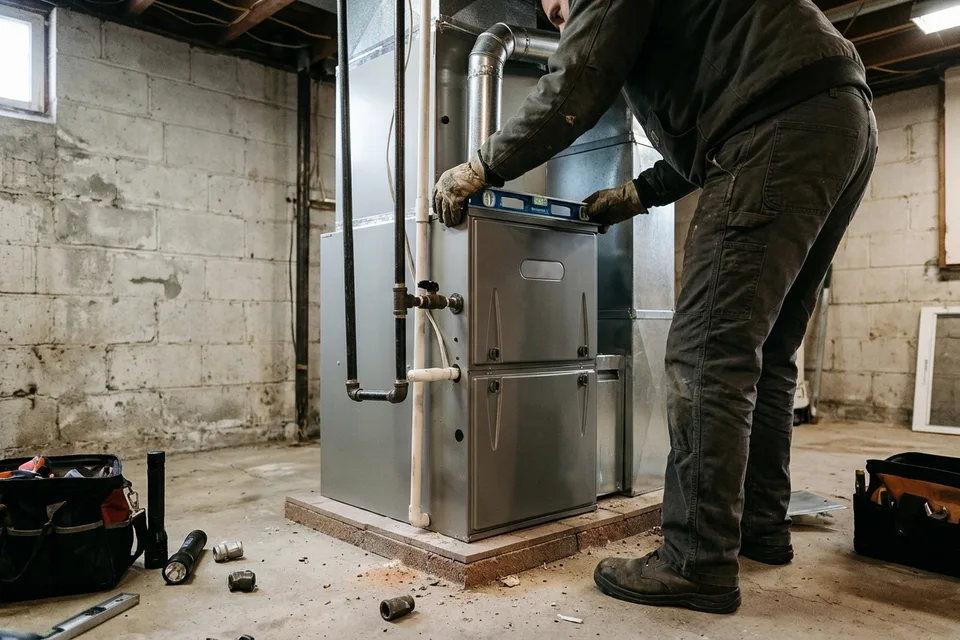
Gas furnace replacement in photos: removal, levelling, venting and combustion checks
Swapping an aging gas furnace involves disconnecting and hauling out the old cabinet, setting and levelling the new unit on a sealed return base, running code-compliant PVC or metal flue venting, and verifying safe firing with a digital combustion analyzer.

How the job works in 3 key stages
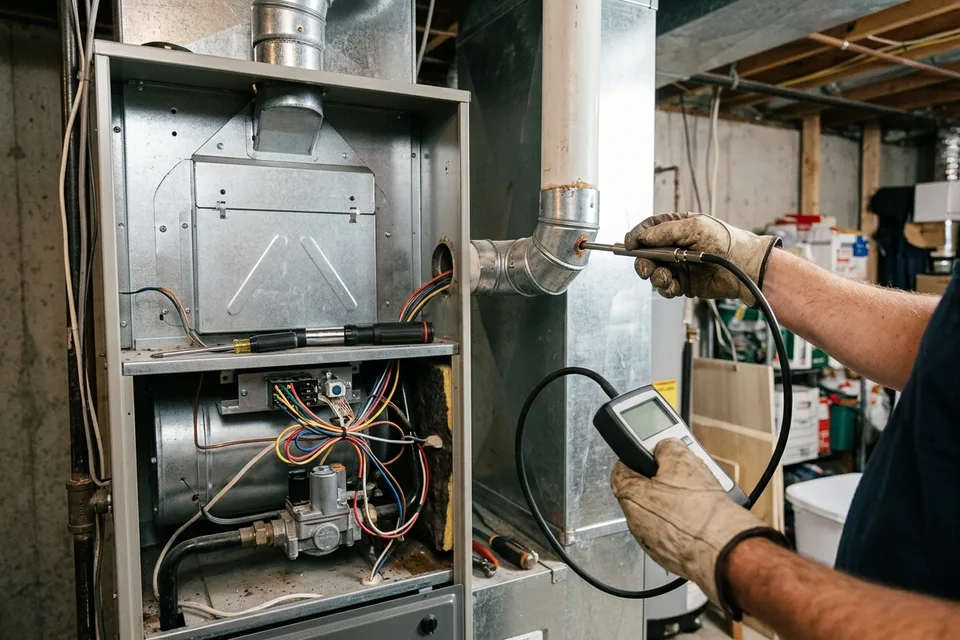
All three step images are AI-generated illustrations for explanation. Not a site inspection, bid, or coverage decision.
 Step 01
Removing the old unit
After shutting off gas and electrical power, technicians disconnect the flue, gas union, and sheet-metal plenum transition, then wheel the old furnace cabinet out of the basement or utility closet for recycling.
On the quote: Make sure haul-away of the old furnace, a new filter rack, and any sheet-metal plenum transition work are included in the base quote.
 Step 02
Setting and venting
The new cabinet is set level on isolating pads or a return box so condensate drains freely, connected to a gas shutoff valve with a sediment trap (drip leg), and vented with sloped twin PVC pipes for 90%+ AFUE models.
On the quote: Confirm the quote specifies the exact AFUE rating, blower motor type (two-stage or variable-speed ECM), sediment trap, and condensate pump if needed.
 Step 03
Start-up checks
Before handing over the system, the installer measures manifold gas pressure, static duct pressure, temperature rise across the heat exchanger, and flue-gas oxygen/CO levels with a calibrated combustion analyzer.
On the quote: Ask for a commissioning printout or checklist showing gas pressure, temperature rise within manufacturer limits, and static pressure readings.


What this photo guide helps you verify on a written quote
- 80% vs. 95%+ venting: High-efficiency condensing furnaces need new PVC intake/exhaust routing and a condensate drain line that cannot freeze.
- Plenum & filter cabinet: New furnaces are often shorter than 20-year-old units—make sure custom sheet-metal transitions and a tight filter rack are included.
- Gas code upgrades: Look for a new flexible gas connector (where code allows), manual shutoff valve, and full-size sediment trap.
- Permit & commissioning: Require a mechanical permit and documented static-pressure and combustion-analyzer startup readings.
On this page
- The diagram, part by part
- Photo guide: hero and 3 project steps
- Furnace replacement cost by fuel and efficiency
- What common furnace jobs cost
- Which furnace efficiency makes sense
- Signs your furnace is due for replacement
- Furnace replacement cost by region
- What “Efficiency tier” does to the price
- What “Fuel” does to the price
- How age changes the furnace replacement claim payout
- How to read the quote, line by line
- How long the job takes
- Worked example
- Does homeowners insurance pay for a new furnace?
- Sources and further reading
- Frequently asked questions
Furnace replacement cost by fuel and efficiency
Installed prices for a typical single-family size, before venting, gas or electrical changes, coil and permit.
| Scope | 2026 planning range | Why it is its own line |
|---|---|---|
| Gas, 80% single-stage | $2,800 – $6,500 | Lowest upfront, uses a metal flue. |
| Gas, 95–96% two-stage | $4,600 – $9,500 | The common choice in cold climates. |
| Gas, 97%+ modulating | $6,300 – $12,000 | Quietest and most even heat. |
| Propane, 95–96% | $5,200 – $11,000 | Propane conversion kit and regulator. |
| Electric furnace | $2,000 – $7,500 | Simple install; costly to run in cold areas. |
| New PVC intake and exhaust | $400 – $1,500 | Condensing furnaces only. |
| Attic or crawl access | $600 – $1,800 | Labor in tight spaces. |
| Matching AC coil | $900 – $2,200 | If the coil changes with the furnace. |
If the AC is more than about 12 years old, ask for a price on a matched furnace and AC or heat pump at the same time. Two separate replacements usually cost more.
What common furnace jobs cost
Four typical replacements at the national average.
| Job | Planning range | Midpoint |
|---|---|---|
| 80% gas, basement, reuse the flue Like-for-like swap. | $2,950 – $7,000 | $4,975 |
| 95–96% gas, new PVC vents The common upgrade. | $5,300 – $11,950 | $8,625 |
| 97% modulating in the attic, new coil Premium unit in a hard spot. | $8,500 – $18,450 | $13,475 |
| Electric furnace in a closet New circuit, no venting. | $2,700 – $9,400 | $6,050 |
Each row is this page’s calculator run with the inputs described, at the national average. Change the region and the inputs above to see your own numbers.
Which furnace efficiency makes sense
Efficiency pays back through fuel bills, so the answer depends on how cold your winters are and how long you will stay. In mild climates an 80% furnace can still make sense; in cold climates a condensing furnace almost always does. A federal rule adopted in 2023 is set to require condensing efficiency for most new gas furnaces from late 2028.
| Option | Best when | Watch out for |
|---|---|---|
| 80% single-stage | Mild winters, short stay, or no way to run PVC vents. | Higher gas bills; louder starts; being phased out for most new installs. |
| 95–96% two-stage | Most cold and mixed climates. | Needs PVC venting and a condensate drain. |
| 97%+ modulating | Long stay, comfort-sensitive rooms, very cold climates. | Higher price and more complex parts. |
| Heat pump instead | Mild to cold climates with good electricity rates. | Different price; see the HVAC calculator. |
Signs your furnace is due for replacement
- Age past 15–20 years with a growing list of repairs.
- A cracked heat exchanger reported by a technician, often with carbon monoxide concerns.
- Rooms that never get warm or short cycling on and off.
- Rising gas bills with no change in use.
- Yellow, flickering burner flames instead of steady blue.
- A repair quote over about a third of the cost of a new furnace on an older unit.
Furnace replacement cost by region
The calculator's default furnace replacement job, repriced for each of its six regions. At the national average it runs $5,300 – $11,950; South / Lower Midwest is the lowest at $4,611 – $10,397, and West Coast metro is the highest at $6,890 – $15,535, a gap of about $3,708 at the midpoint.
| Region | Planning range | Midpoint |
|---|---|---|
| National average | $5,300 – $11,950 | $8,625 |
| South / Lower Midwest | $4,611 – $10,397 | $7,504 |
| Mountain / Plains | $5,035 – $11,353 | $8,194 |
| Mid-Atlantic / Upper Midwest | $5,936 – $13,384 | $9,660 |
| Northeast metro | $6,678 – $15,057 | $10,868 |
| West Coast metro | $6,890 – $15,535 | $11,212 |
What “Efficiency tier” does to the price
Every other input stays at its default and only “Efficiency tier” changes. The cheapest choice, 80% AFUE, single-stage, comes to $3,650 – $9,200; the most expensive, 97%+ modulating, comes to $7,000 – $14,450.
| Choice | Planning range | Midpoint vs default |
|---|---|---|
| 80% AFUE, single-stage | $3,650 – $9,200 | −$2,200 |
| 95–96% two-stage (default) | $5,300 – $11,950 | — |
| 97%+ modulating | $7,000 – $14,450 | +$2,100 |
What “Fuel” does to the price
Every other input stays at its default and only “Fuel” changes. The cheapest choice, Electric, comes to $2,700 – $9,300; the most expensive, Propane, comes to $5,900 – $13,450.
| Choice | Planning range | Midpoint vs default |
|---|---|---|
| Natural gas (default) | $5,300 – $11,950 | — |
| Propane | $5,900 – $13,450 | +$1,050 |
| Electric | $2,700 – $9,300 | −$2,625 |
How age changes the furnace replacement claim payout
Using the default job, a $1,000 deductible and a 18-year expected life. At 10 years old, about $4,792 is held back as depreciation; a replacement cost policy releases it after the work is finished, while an actual cash value policy keeps it.
| Age | Wear | First check | Held back |
|---|---|---|---|
| 2 years | 11% | $6,667 | $958 |
| 5 years | 28% | $5,229 | $2,396 |
| 10 years | 56% | $2,833 | $4,792 |
| 15 years | 80% | $725 | $6,900 |
| 20 years | 80% | $725 | $6,900 |
| 30 years | 80% | $725 | $6,900 |
How to read the quote, line by line
Furnace quotes are easy to compare once you line up these items.
- Load calculation. Size from a room-by-room calculation, not the old nameplate.
- Model, AFUE and size. Exact model numbers.
- Venting plan. Where the pipes go and what happens to the chimney.
- Gas, electrical and condensate. Each listed or excluded.
- Coil and AC match. Whether the AC coil changes.
- Permit and haul-away. Both included.
- Warranty. Parts, heat exchanger and labor, with registration steps.
How long the job takes
| Stage | Typical time | What happens |
|---|---|---|
| Quote and load calculation | 1 – 2 hours | In-home visit. |
| Equipment order | 0 – 7 days | Common sizes are in stock. |
| Install | 4 – 10 hours | Most basement swaps are one day. |
| Inspection | 1 – 14 days | Depends on the town. |
| First service | 1 year | Annual tune-up keeps the warranty healthy. |
If the old furnace has failed in cold weather, ask about temporary electric heaters while the new unit is ordered.
Worked example
A 1990s two-story house with a 20-year-old 80% gas furnace in the basement. The owner moves to a 96% two-stage furnace, which needs new PVC intake and exhaust through the rim joist and a condensate drain. The AC coil stays.
95–96% gas furnace, basement, new PVC vents
Worked example| Line item | National planning range |
|---|---|
| Gas furnace, 95–96% two-stage, installed | $4,600 – $9,500 |
| New PVC intake and exhaust | $400 – $1,500 |
| Condensate drain | $150 – $450 |
| Permit | $150 – $500 |
| Total before regional adjustment | $5,300 – $11,950 |
Midpoint about $8,625. Ask the contractor whether the water heater left alone on the old chimney needs a liner. If so, add that to the venting line.
Does homeowners insurance pay for a new furnace?
A furnace that wears out is a maintenance cost and is not covered. Insurance can pay when a covered event damages it, such as a fire, a lightning surge, or a flood under flood coverage, minus the deductible and often depreciation. Some home warranty plans and equipment breakdown endorsements cover sudden mechanical failure.
If a claim is possible, keep the damaged unit and the technician’s written cause before it is hauled away.
What this page will not claim
- The right size for your house. That needs a load calculation.
- Federal tax credits. 25C ended for equipment placed in service after 2025.
- Utility rebates, which change by area.
- That a cracked heat exchanger is safe to run.
Sources and further reading
- U.S. DOE Energy Saver — Furnaces and boilers
- ENERGY STAR — Furnaces
- ACCA — Manual J residential load calculation
- IRS — Energy efficient home improvement credit
- U.S. CPSC — Carbon monoxide information center
Prices on this page are planning ranges built from public 2026 US cost guides and contractor rate sheets, widened where they disagreed, and multiplied by the same regional index as every other ReplaceCost calculator. Rules and definitions come from the agencies listed. See the methodology for how ranges are set and reviewed.
Frequently asked questions
How much does a new furnace cost in 2026?
A gas furnace installed in a basement usually runs about $3,500 to $11,000 with venting, drain and permit. Attic installs, modulating units and coil changes push it higher.
Is a 96% furnace worth it over an 80%?
In most cold and mixed climates yes, because it uses roughly a sixth less gas for the same heat. In mild climates with short winters, the payback can be long.
How long do furnaces last?
Often 15 to 20 years with regular service. Heat exchanger cracks, blower motor failure and control board issues become common late in life.
Can I replace the furnace and keep my AC?
Yes, if the AC is fairly new. The indoor coil may need to be matched or adapted so the AC keeps its rating.
Is there still a federal tax credit for furnaces?
The 25C energy efficient home improvement credit ended for equipment placed in service after 31 December 2025. Check for state and utility rebates instead.
How long does furnace replacement take?
Most basement swaps take one day. Attic installs and vent changes can take two.
What size furnace do I need?
One sized by a load calculation such as ACCA Manual J, based on insulation, windows and climate. Copying the old size often leads to an oversized unit.
Does insurance cover a broken furnace?
Not for age or wear. A covered event like fire or lightning can be, minus the deductible.