Home › Oil tank removal
Buried heating oil tankUnderground oil tank removal cost calculator
Many houses that once heated with oil still have a steel tank buried in the yard, often abandoned when the house switched to gas decades ago. It usually comes to light during a sale: a home inspector spots a fill pipe or vent pipe sticking out of the lawn, and the buyer’s lender or insurer wants the tank gone, or proof it was closed properly.
A clean removal is a short, well-understood job. A crew locates the tank, digs it out, pumps any oil left in it, cuts it open and cleans it, hauls it to a scrap or disposal yard, and backfills the hole. Soil samples taken from the bottom of the dig show whether oil got into the ground. The calculator prices those pieces, plus a driveway or concrete patch when the tank is under hard surface.
If the soil is already known to be contaminated, the math changes completely. The page stops adding lines and shows a wide warning range instead, because cleanup cost depends on how far the oil spread, and only an environmental contractor can price that after testing.
Reviewed 25 October 2026 · Written by Mantu Kumar
See the photos · See the cost diagram · Open the calculator
Key facts at a glance
- Clean pull under a lawn: about $1,500–$4,000 for a 275–330 gallon tank, before pumping and samples.
- Under a driveway or slab: about $2,800–$7,500 and $4,500–$13,000, before the patch.
- Extras: pumping leftover oil $250–$800; soil samples $350–$1,200; tight access $1,200–$4,000.
- Surface patch: asphalt about $800–$2,800; concrete about $1,000–$3,500.
- Known contamination: a warning range of $8,000–$80,000, not a bid.
National 2026 planning ranges before your regional multiplier. State programs and fees vary and are not modeled.
2026 planning ranges
- 1Locate and excavate
- 2Tight access
- 3Pump remaining oil
- 4Tank cleaned and cut open
- 5Soil samples
- 6Clean backfill
- 7Driveway or concrete patch
- 8Contamination warning
- 9Permit + closure report
Price your oil tank removal
No email · nothing sentDiagram, part by part
Oil tank removal: every numbered part explained
The drawing above has 9 numbered parts, from Locate, excavate, clean and dispose to Permit and closure report. Each card zooms in on one part, says what pushes its price up or down, and tells you what to look for on a written quote. After you run the calculator, the parts in your scope show their dollar band.
1 Locate, excavate, clean and dispose
$1,500–$13,000 by location
The crew confirms where the tank sits and how deep, using the fill and vent pipes, a metal locator or ground-penetrating radar. Then a small excavator opens the ground down to the tank. This main line includes digging, cleaning and disposal of the tank itself.
What moves it: Where the tank is (lawn, driveway or under the house), tank size, depth, and utilities crossing the dig.
On the quote: Ask how the tank will be located and whether utility mark-out is included. Get the disposal or scrap receipt at the end.
2 Tight access and hand digging
$1,200–$4,000
Tanks close to a foundation, behind a fence, or between houses often cannot be reached by an excavator. Part or all of the dig is then done by hand, and the tank may be cut up in place.
What moves it: Gate width, fences, decks, slope, and how close the tank sits to the house.
On the quote: The quote should say machine or hand dig, and who takes down and rebuilds a fence or step if needed.
3 Pumping out leftover oil
$250–$800
Tanks abandoned in place often still hold oil and water sludge. A vacuum truck pumps it out before the tank is lifted, and the liquid is taken for recycling or disposal.
What moves it: How many gallons are left, how much sludge and water, and disposal fees.
On the quote: Ask for the gallons pumped and where the oil went. Some contractors credit usable oil back.
4 The tank: cleaned, cut and hauled
Inside the main line
Once out of the ground, the tank is cut open, the sludge scraped out, and the steel hauled away. A tank with visible holes is a warning that oil may have gone into the soil underneath.
What moves it: Tank size and condition. A tank full of holes leads to closer testing.
On the quote: Photos of the tank out of the ground and a disposal receipt. Note any holes the crew sees; they matter for the samples.
5 Soil samples from the bottom of the dig
$350–$1,200
Samples taken under and around the tank go to a lab. Clean results are what a buyer’s attorney or lender usually wants to see. They do not prove every corner of the property is clean, only the places sampled.
What moves it: Number of samples, lab tests ordered, rush fees, and whether a state report has to be filed.
On the quote: Ask for the lab report itself, not a verbal all-clear, and the sample locations on a sketch.
6 Clean backfill and compaction
$300–$1,200
The hole is filled with clean fill or stone in layers and compacted so the lawn or driveway does not sink later. Topsoil and seed go on top for a lawn.
What moves it: Hole size, fill type, and whether trucks can dump close to the dig.
On the quote: Look for the fill type and compaction. Contaminated soil cannot go back in the hole and is priced separately.
7 Driveway or concrete patch
$800–$3,500
A tank under a driveway or patio means saw-cutting and replacing a section of hard surface. Lawn restoration is inside the dig price; hard surfaces are not.
What moves it: Patch size, asphalt or concrete, and whether the new section has to match the old.
On the quote: Ask who does the patch, and whether it is a separate paving contractor with its own schedule.
8 If the soil is contaminated
$8,000–$80,000 warning range
If oil has leaked, contaminated soil has to be dug out and disposed of as regulated waste, and groundwater may need testing. Costs vary enormously with how far the oil spread.
What moves it: Volume of soil, groundwater, state rules and how close the plume is to the house.
On the quote: Stop and get an environmental contractor’s written scope after testing. Do not plan a closing around the midpoint of this range.
9 Permit and closure report
Often required at sale
Most towns or fire departments require a permit to remove or abandon a tank, and the contractor files a closure report with soil results. Buyers, lenders and insurers often ask for this paperwork when the house is sold.
What moves it: Your town's rules and whether soil sampling is required.
On the quote: Ask for the permit, the closure report and the lab results in writing, and keep them with the house records.
Project photo guide
Heating oil tank removal in photos: basement tanks, yard excavation and soil testing
Decommissioning an old residential heating-oil tank—whether on legs in a basement corner or buried under the lawn—requires pumping out residual sludge, disconnecting fill and vent piping so no fuel delivery can ever be made by mistake, extracting the steel shell, and collecting lab soil samples.

How the job works in 3 key stages
All three step images are AI-generated illustrations for explanation. Not a site inspection, bid, or coverage decision.
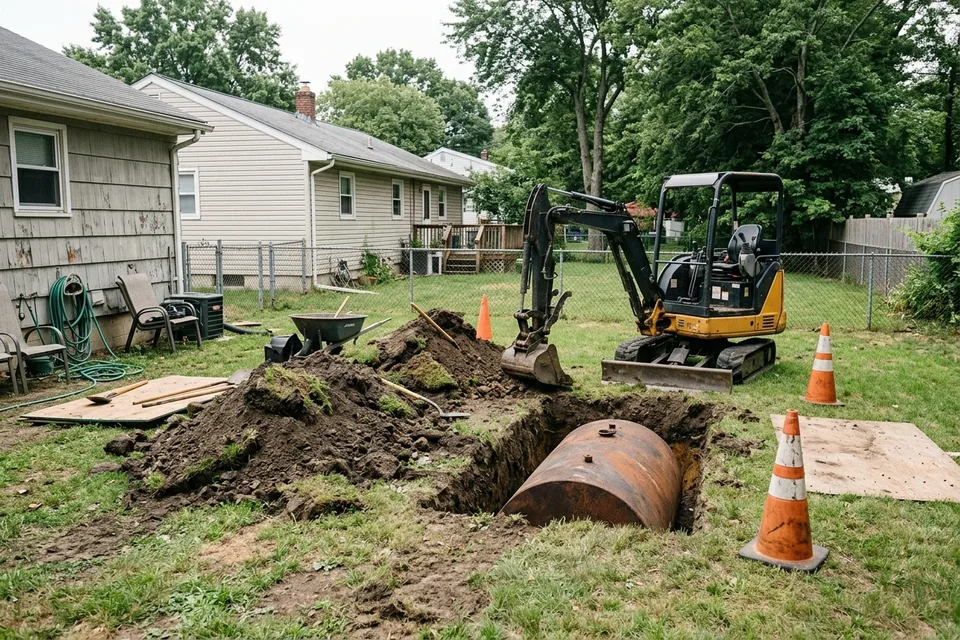 Step 01
Locating a buried tank
For underground tanks, crews locate the footprint with a metal sweep and utility mark-out, set safety cones, and excavate the overburden down to the top of the steel tank so it can be opened, pumped, and wiped clean.
On the quote: Make sure the quote covers 811 utility mark-out, pumping and disposal of remaining oil/sludge per gallon, and removal of exterior fill and vent pipes.
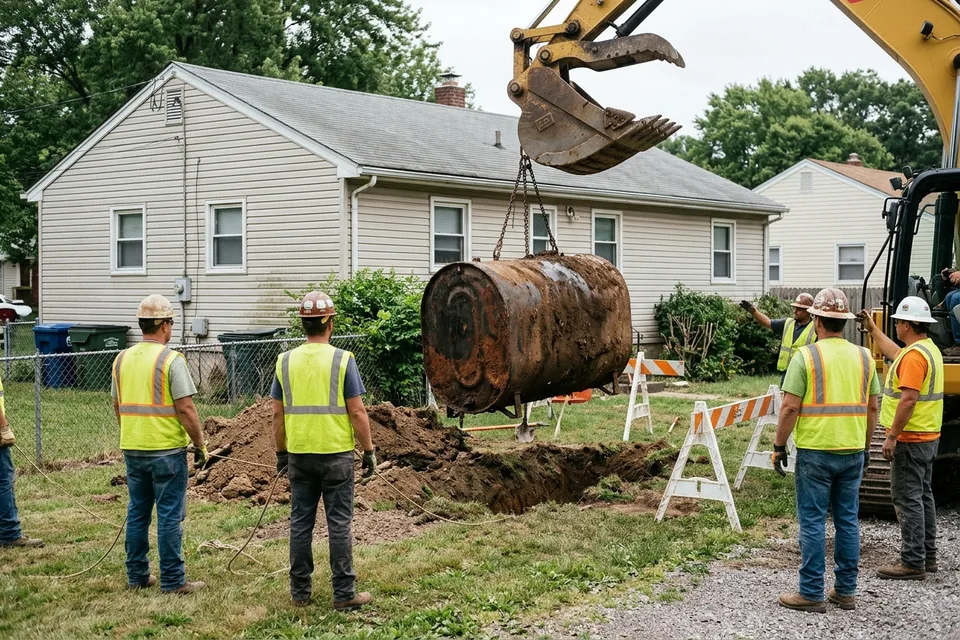 Step 02
Lifting the tank
Once the tank is pumped dry, vented, and triple-rinsed, rigging chains lift the empty shell out of the pit so the inspector and crew can examine the bottom for pinholes or rust-through before transport to a licensed scrap facility.
On the quote: Confirm the bid includes the municipal fire or building permit, tank destruction/scrap manifest, and clean compacted backfill.
 Step 03
Soil testing
A technician collects soil samples from beneath both ends and the centerline of the excavation into sealed laboratory jars to document clean closure—or identify whether contaminated soil remediation is needed.
On the quote: Ask whether accredited laboratory soil analysis and a written closure report for future home buyers and insurers are included in the base price.


What this photo guide helps you verify on a written quote
- Sludge & liquid allowance: Check how many gallons of oil/sludge pump-out are included before per-gallon overage fees apply.
- Fill & vent pipe removal: Both exterior pipes must be removed or permanently grouted so a delivery driver never pumps oil into an empty basement.
- Certified lab samples: Even when a state does not mandate sampling, buyers and mortgage lenders almost always ask for the lab closure report.
- Remediation exclusion: Standard removal quotes exclude contaminated soil dig-out—ask for unit rates just in case.
On this page
- The diagram, part by part
- Photo guide: hero and 3 project steps
- Oil tank removal cost by location and line item
- What common oil tank jobs cost
- Remove or abandon in place?
- Signs you have a buried oil tank
- Oil tank removal cost by region
- What “Known contamination” does to the price
- What “Where the tank is” does to the price
- How age changes the oil tank removal claim payout
- How to read the quote, line by line
- How long the job takes
- Worked example
- Does insurance pay to remove an oil tank?
- Sources and further reading
- Frequently asked questions
Oil tank removal cost by location and line item
Location drives the main line; small extras are added only when they apply.
| Scope | 2026 planning range | Why it is its own line |
|---|---|---|
| Clean pull under a lawn, 275–330 gal | $1,500 – $4,000 | Locate, excavate, clean, dispose, lawn restored. |
| Clean pull under a driveway | $2,800 – $7,500 | Before the driveway patch. |
| Clean pull under a slab or the house | $4,500 – $13,000 | Access dominates the price. |
| Larger tank (550 or 1,000+ gal) | +15% to +35% | Applied to the main line. |
| Pump remaining oil | $250 – $800 | Only if oil is still in the tank. |
| Tight access | $1,200 – $4,000 | Hand digging where a machine cannot reach. |
| Soil samples | $350 – $1,200 | Lab results for a sale or a state closure. |
| Clean backfill | $300 – $1,200 | Always needed. |
| Asphalt or concrete patch | $800 – $3,500 | Only for hard surfaces. |
| Known contamination | $8,000 – $80,000 | Warning range only. |
Many states run their own tank programs and paperwork; some offer assistance funds. None is modeled here, and no state fee is added.
What common oil tank jobs cost
Four typical removals at the national average.
| Job | Planning range | Midpoint |
|---|---|---|
| Small tank under the lawn, empty, no samples The simplest clean pull. | $1,800 – $5,200 | $3,500 |
| Small tank under the lawn, for a sale Oil still in it, samples on. | $2,400 – $7,200 | $4,800 |
| Tank under the driveway Samples and an asphalt patch. | $4,500 – $13,500 | $9,000 |
| Large tank, tight access by the house Hand digging next to the foundation. | $3,825 – $11,800 | $7,812 |
Each row is this page’s calculator run with the inputs described, at the national average. Change the region and the inputs above to see your own numbers.
Remove or abandon in place?
Some towns allow a buried tank to be closed in place: pumped, cleaned, and filled with sand or foam. It can be cheaper, but buyers and insurers often prefer removal because it lets the soil underneath be seen and sampled.
| Option | Best when | Watch out for |
|---|---|---|
| Remove the tank | Selling soon, lender or insurer asks, or the tank is in an easy spot. | Higher cost under drives or slabs; any leak found must be dealt with. |
| Abandon in place | Tank under the house or a structure where digging is risky, and local rules allow it. | Some buyers walk away; samples are still needed to show no leak. |
| Leave it alone | Rarely a good idea with an old steel tank. | Leaks get more expensive the longer they go. |
| Environmental cleanup | Samples show oil in the soil. | Wide cost range; needs testing first. |
Signs you have a buried oil tank
- A fill pipe or vent pipe sticking out of the lawn, or a capped pipe near the foundation.
- Copper lines through the basement wall that lead to nothing, near an old boiler location.
- A house built before the 1970s that once heated with oil, even if it is on gas now.
- Old records such as fuel delivery receipts or a permit for a heating conversion.
- An oily smell or sheen in the basement or on a sump pit.
- Dead patches of grass over a rectangle-shaped area.
Oil tank removal cost by region
The calculator's default oil tank removal job, repriced for each of its six regions. At the national average it runs $2,400 – $7,200; South / Lower Midwest is the lowest at $2,088 – $6,264, and West Coast metro is the highest at $3,120 – $9,360, a gap of about $2,064 at the midpoint.
| Region | Planning range | Midpoint |
|---|---|---|
| National average | $2,400 – $7,200 | $4,800 |
| South / Lower Midwest | $2,088 – $6,264 | $4,176 |
| Mountain / Plains | $2,280 – $6,840 | $4,560 |
| Mid-Atlantic / Upper Midwest | $2,688 – $8,064 | $5,376 |
| Northeast metro | $3,024 – $9,072 | $6,048 |
| West Coast metro | $3,120 – $9,360 | $6,240 |
What “Known contamination” does to the price
Every other input stays at its default and only “Known contamination” changes. The cheapest choice, No, price a normal dig, comes to $2,400 – $7,200; the most expensive, Yes — show a wide warning range, comes to $8,000 – $80,000.
| Choice | Planning range | Midpoint vs default |
|---|---|---|
| No, price a normal dig (default) | $2,400 – $7,200 | — |
| Yes — show a wide warning range | $8,000 – $80,000 | +$39,200 |
What “Where the tank is” does to the price
Every other input stays at its default and only “Where the tank is” changes. The cheapest choice, Under the lawn, comes to $2,400 – $7,200; the most expensive, Under a slab or the house, comes to $5,400 – $16,200.
| Choice | Planning range | Midpoint vs default |
|---|---|---|
| Under the lawn (default) | $2,400 – $7,200 | — |
| Under a driveway | $3,700 – $10,700 | +$2,400 |
| Under a slab or the house | $5,400 – $16,200 | +$6,000 |
How age changes the oil tank removal claim payout
Using the default job, a $1,000 deductible and a 30-year expected life. At 10 years old, about $1,600 is held back as depreciation; a replacement cost policy releases it after the work is finished, while an actual cash value policy keeps it.
| Age | Wear | First check | Held back |
|---|---|---|---|
| 2 years | 7% | $3,480 | $320 |
| 5 years | 17% | $3,000 | $800 |
| 10 years | 33% | $2,200 | $1,600 |
| 15 years | 50% | $1,400 | $2,400 |
| 20 years | 67% | $600 | $3,200 |
| 30 years | 80% | $0 | $3,840 |
How to read the quote, line by line
Oil tank quotes look similar until something goes wrong. These lines make the difference.
- How the tank is located and whether utility mark-out is included.
- Machine or hand dig. And who restores fences or steps.
- Oil pumped and disposed. Gallons and the receipt.
- Tank disposal receipt. And photos of the tank out of the ground.
- Soil samples. How many, where, which tests, and who files any state report.
- Backfill and restoration. Fill type, compaction, topsoil and seed or a hard-surface patch.
- What happens if a leak is found. Day rates, stop-work terms and who decides.
How long the job takes
| Stage | Typical time | What happens |
|---|---|---|
| Locate and permits | 1 – 2 weeks | Town permit if required, utility mark-out. |
| Dig, pump and remove | 1 day | Usually a single day for a lawn pull. |
| Lab results | 3 – 10 days | Rush service costs more. |
| Backfill and grade | Same day | Topsoil and seed or patch later. |
| Paving patch | 1 – 3 weeks | Paving crew schedule. |
During a sale, book the removal early. Lab results and any state closure letter often take longer than the dig itself.
Worked example
A 1950s colonial heated by gas since the 1990s. The buyer’s inspector found a fill pipe in the side yard. An excavator can reach the tank, it still holds some oil, and the buyer wants soil samples.
330-gallon class under the lawn, oil still in it, samples
Worked example| Line item | National planning range |
|---|---|
| Locate, excavate, clean and dispose of the tank | $1,500 – $4,000 |
| Pump remaining oil | $250 – $800 |
| Soil samples | $350 – $1,200 |
| Clean backfill | $300 – $1,200 |
| Total before regional adjustment | $2,400 – $7,200 |
Midpoint about $4,800. If the samples come back dirty, this total no longer applies. The calculator would switch to the contamination warning range.
Does insurance pay to remove an oil tank?
A planned removal of an old tank is a maintenance or sale cost, not a claim. Leaked oil is often excluded under pollution wording in standard homeowners policies, though some insurers and some states offer separate tank coverage or assistance programs.
Check the policy for a pollution exclusion and any tank endorsement, and check your state environmental agency for program rules before work starts. This page does not promise any payment or grant.
What this page will not claim
- That insurance will pay for a removal or a cleanup.
- A state fee, grant, or program rule.
- A tight price for contaminated soil.
- That clean samples prove the whole property is clean.
Sources and further reading
- U.S. EPA — Frequent questions about underground storage tanks
- U.S. EPA — Underground storage tanks
- National Oilheat Research Alliance (NORA)
- NAIC — Actual cash value vs replacement cost coverage
Prices on this page are planning ranges built from public 2026 US cost guides and contractor rate sheets, widened where they disagreed, and multiplied by the same regional index as every other ReplaceCost calculator. Rules and definitions come from the agencies listed. See the methodology for how ranges are set and reviewed.
Frequently asked questions
How much does it cost to remove a buried oil tank?
A clean pull of a 275–330 gallon tank under a lawn usually runs about $2,400 to $7,200 with pumping, samples and backfill. Driveways, slabs and tight access cost more; contamination is a different range.
Do I have to remove an old oil tank before selling?
There is no single national rule, but buyers, lenders and insurers often require removal or a documented closure with clean soil samples. Local and state rules vary.
Can an oil tank be filled in place instead?
In many towns yes, with a permit: the tank is pumped, cleaned and filled with sand or foam. Samples are still taken to show the soil is clean.
What happens if the tank leaked?
The contaminated soil has to be removed and disposed of under state rules, and groundwater may need testing. That is priced by an environmental contractor after sampling.
How long does oil tank removal take?
The dig is usually one day. Permits, lab results and paperwork often take two to four weeks in total.
Are home heating oil tanks federally regulated?
Federal underground storage tank rules exclude tanks storing heating oil used on the premises. States and towns often have their own rules.
Does homeowners insurance cover oil tank leaks?
Often not, because of pollution exclusions. Some insurers sell separate tank coverage, and some states run assistance funds.
How do I find out if my house has a buried tank?
Look for fill or vent pipes, unused lines through the foundation, and old fuel records. A tank sweep with a metal detector or radar confirms it.