Home › Concrete patio
Yard · pedestrian flatworkConcrete and paver patio cost calculator
A backyard patio is pedestrian flatwork—it carries patio furniture, grills, and foot traffic rather than two-ton axles. Stop here if cars, trucks, or RVs will drive or park on the slab: vehicle-rated flatwork belongs on the driveway calculator. Also stop if your existing patio slab is structurally intact and merely tilted or settled an inch or two—polyurethane foam or mudjacking lift belongs on the concrete leveling calculator, while adding a roof over the slab sits on the covered porch calculator or the patio cover calculator.
Flatwork crews buy the same 4,000 PSI ready-mix concrete whether they pour a driveway or a backyard patio, so the installed per-square-foot bands here line up with the driveway calculator; the difference is load and thickness. In 2026, a broom-finished poured concrete patio runs $9.00 to $16.00 per square foot (base $8.50 to $14.50 plus joints/base), exposed aggregate or stamped decorative concrete runs $14.00 to $24.00 per square foot, and interlocking concrete or brick pavers run a separate, higher band of $16.00 to $30.00 per square foot.
Use the calculator below to price your square footage, 4-inch default thickness, crushed-stone base, old slab tear-out, steps down from the back door, and optional penetrating sealer.
Reviewed 25 October 2026 · Written by Mantu Kumar
See the photos · See the cost diagram · Open the calculator · Every part explained
Key facts at a glance
- Broom-finished 4,000 PSI poured concrete runs $9.00 to $16.00 per square foot installed ($8.50 to $14.50 base rate), the same installed concrete rate as a driveway, with a 4-inch pedestrian thickness default.
- Exposed aggregate or stamped decorative concrete runs $14.00 to $24.00 per square foot installed ($13.50 to $22.50 base rate).
- Interlocking concrete or clay brick pavers sit in a separate, higher band of $16.00 to $30.00 per square foot ($15.50 to $28.00 base rate) due to deep base excavation, bedding sand, edge restraints, and hand-laying labor.
- Breaking up and hauling away an old 4-inch concrete patio slab adds $2.00 to $4.50 per square foot.
- Poured concrete steps at the house door add $220 to $480 per riser, and rolling on a breathable penetrating silane/siloxane or acrylic sealer adds $0.65 to $1.40 per square foot.
National 2026 planning ranges before your regional multiplier. Sources and method are at the bottom of the page.
2026 planning ranges
- 1Layout and drainage grade
- 2Old surface removed
- 3Base stone
- 4Forms and reinforcement
- 5Concrete or pavers
- 6Joints and edges
- 7Steps
- 8Sealer (optional)
- 9Slab thickness and steel
Price your concrete and paver patio
No email · nothing sentDiagram, part by part
Concrete and paver patio: every numbered part explained
The drawing above has 9 numbered parts, from Layout and drainage grade to Slab thickness and steel. Each card zooms in on one part, says what pushes its price up or down, and what to check on a written quote. After you run the calculator, the parts in your scope show their dollar figure.
1 Layout and drainage grade
Included in base preparation ($0.50 – $1.50 / sq ft)
Every patio against a house wall must slope away from the foundation at 1/8 inch to 1/4 inch per foot (roughly 1.5 to 3 inches of drop across a 12-foot patio). If a contractor pours a patio dead-level or pitched slightly back toward the house siding, rainwater pools against the sill plate or leaks into the basement. Setting string lines with a laser level before excavation locks in positive drainage.
What moves it: Yard slope, distance from the house door threshold to the lawn grade, and whether a channel drain is needed.
On the quote: Require the written contract to specify a minimum 1/8-inch to 1/4-inch per foot slope away from the house foundation.
2 Old surface removed
$2.00 – $4.50 per sq ft ($0 on bare sod)
When replacing a cracked, root-lifted concrete patio or decaying brick slab, the crew brings in a skid-steer with a hydraulic breaker attachment (or electric jackhammers in a gated backyard), breaks the old 4-inch slab into chunks, pulls out rusted wire mesh, and hauls the concrete tonnage to a recycling crusher ($2.00–$4.50/sq ft). Pouring new concrete directly on top of a cracked, settling patio causes the cracks to telegraph straight through.
What moves it: Whether the old slab contains steel rebar, thickness over 4 inches, and whether a skid-steer can fit through your side gate.
On the quote: Ask whether old slab removal includes hauling away any tree roots that lifted the previous concrete.
3 Base stone
$0.50 – $1.50 per sq ft (poured concrete) | Included in paver band
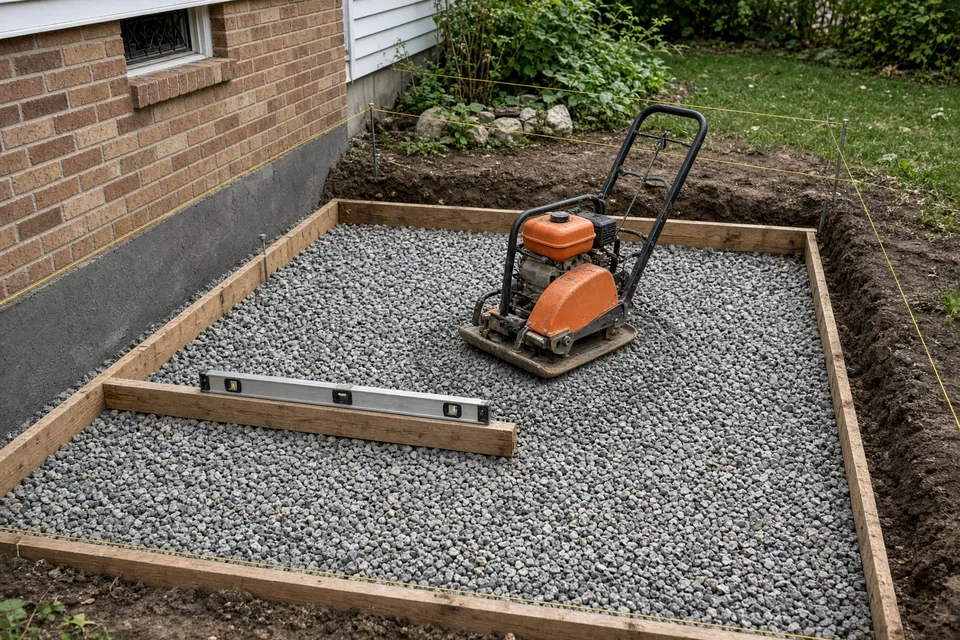
Pouring concrete directly on black topsoil or uncompacted clay invites winter frost heave and corner cracking. The crew strips off 6 to 8 inches of sod and organic soil, lays woven geotextile fabric over soft clay if needed, and compacts 4 to 6 inches of crushed angular limestone or road base (3/4-inch minus with stone dust fines) in lifts using a vibratory plate compactor. Interlocking pavers require an even deeper 6-inch compacted base plus 1 inch of screeded bedding sand.
What moves it: Soil stability, frost depth, and whether concrete (4-in base) or pavers (6-in base + 1-in sand bed) are being installed.
On the quote: Confirm that the quote specifies compacted crushed angular aggregate rather than round pea gravel (which rolls underfoot and never locks).
4 Forms and reinforcement
Included in concrete rate (+12% for 5-in slab w/ #4 rebar grid)
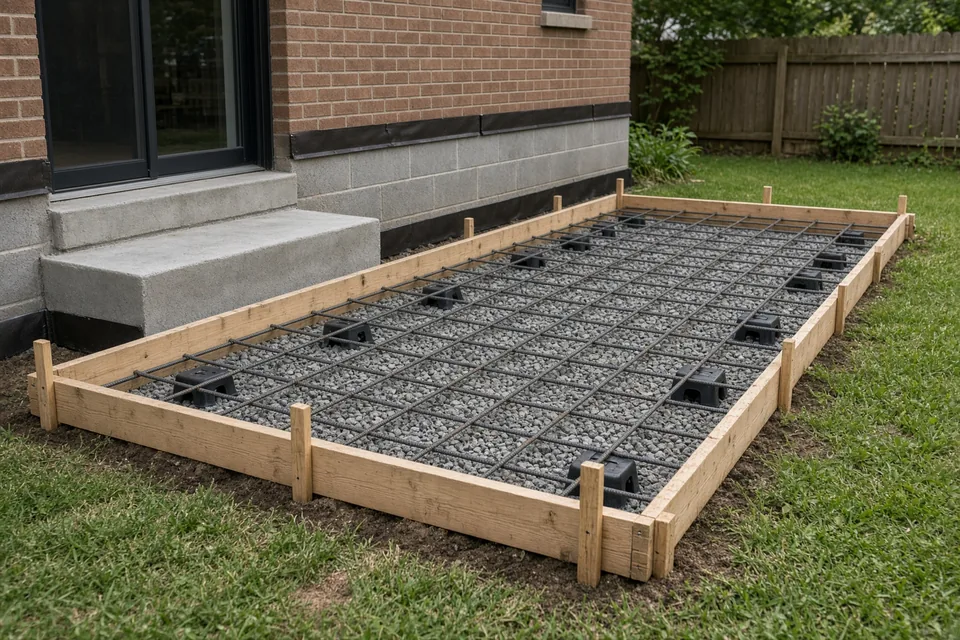
Wood or flexible poly forms shape the perimeter of the patio, while steel reinforcement holds hairline shrinkage cracks tightly together so the two sides of a crack cannot shift vertically. While a standard 4-inch pedestrian patio uses welded wire mesh on chairs or #3/#4 rebar on 18-to-24-inch centers, upgrading to a 5-inch slab with a #4 steel rebar grid (+12%) is essential wherever an 8-person hot tub (4,000+ lbs filled) or masonry outdoor kitchen will sit.
What moves it: Curved versus straight perimeter forms and upgrading from standard 4-inch pedestrian mesh/rebar to a 5-inch hot-tub slab.
On the quote: Verify that any wire mesh or rebar is supported on plastic chairs at mid-slab depth—mesh lying flat on the dirt at the bottom of the pour does nothing.
5 Concrete or pavers
$9 – $16 / sq ft (broom) | $14 – $24 / sq ft (exposed/stamped) | $16 – $30 / sq ft (pavers)
The installed concrete rates match driveway calculator; the difference is load and thickness. Broom-finished 4,000 PSI concrete runs $9.00 to $16.00 per square foot ($8.50–$14.50 base + sub-base). Exposed aggregate (washing away top paste to reveal decorative pebbles) or stamped concrete runs $14.00 to $24.00 per square foot. Interlocking concrete or clay brick pavers sit in a higher band of $16.00 to $30.00 per square foot because every paver is hand-set and vibrated into polymeric sand.
What moves it: Surface choice (broom concrete vs exposed aggregate/stamped vs hand-laid interlocking pavers).
On the quote: Ensure concrete quotes specify a minimum 4,000 PSI air-entrained mix (5%–7% air entrainment in freeze-thaw states).
6 Joints and edges
$150 – $400 (isolation joint & buggy access) + saw cuts included
Concrete shrinks as it cures; without planned weak lines, it cracks randomly across the middle. Finishers tool or early-entry saw-cut control joints to 1/4 of the slab thickness (1 inch deep on a 4-inch slab) in square panels every 8 to 10 feet. Where the patio meets your house foundation wall or brick veneer, a 1/2-inch closed-cell expansion strip isolates the slab so seasonal movement never pushes against the house.
What moves it: Linear feet of house-wall contact requiring expansion foam and linear feet of spiked paver edge restraints.
On the quote: Check that control joints are spaced no more than 8 to 10 feet apart (2 to 2.5 times slab thickness in inches, expressed in feet).
7 Steps
$220 – $480 per step riser
Most sliding patio doors and back entry doors sit 7 to 24 inches above the backyard grade, requiring one to three risers stepping down onto the main patio slab. Forming and pouring solid monolithic concrete steps (or building segmental block steps with bullnose treads on a paver patio) costs $220 to $480 per riser depending on width. Keep step riser heights uniform (maximum 7-3/4 inches under IRC R311.7.5) so guests do not trip.
What moves it: Number of vertical risers from the door threshold to the patio surface and whether steps are 4 feet wide or wrap around.
On the quote: Ask the contractor to confirm the exact step riser height from the finished patio surface up to your door threshold.
8 Sealer (optional)
$0.65 – $1.40 per sq ft
Applying a breathable penetrating silane/siloxane water repellent on broom concrete—or a UV-stable clear acrylic enhancer on exposed aggregate and stamped concrete—keeps grease from the grill, red wine, and winter meltwater out of the concrete pores ($0.65–$1.40/sq ft). On interlocking paver patios, this line covers sweeping and mist-activating polymeric joint sand so weeds and ants cannot colonize the joints.
What moves it: Penetrating invisible silane/siloxane sealer versus high-gloss wet-look acrylic sealer or polymeric paver sand.
On the quote: If you choose a glossy film-forming sealer on stamped or exposed concrete, ask that a fine non-slip grit additive be mixed into the final coat.
9 Slab thickness and steel
5-inch heavy slab adds about 12%
A 4-inch slab with reinforcement handles foot traffic and patio furniture. A hot tub, outdoor kitchen or masonry fire pit concentrates weight, so those areas move to a 5-inch slab with a #4 rebar grid set on chairs at mid-depth. The extra concrete and steel raise the surface line by about 12%.
What moves it: Planned loads on the slab, such as a hot tub, outdoor kitchen or heavy planters.
On the quote: Ask the contractor to write the slab thickness and the reinforcement type and spacing on the contract.
Project photo guide
Concrete patio in photos: the stone base, the rebar and the finish
A backyard patio lasts 30 to 40 years when the base stone, reinforcement, and control joints are built right. These four scenes show a finished broom-and-border concrete backyard patio, compacting the 4-inch crushed-stone base pitched away from the house, setting #4 steel rebar on chairs inside the perimeter forms, and saw-cutting control joints.

How the job works in 3 key stages
All three step images are AI-generated illustrations for explanation. Not a site inspection, bid, or coverage decision.
 Step 01
Grade and compact the base
Excavate the backyard sod, grade a 1/8-to-1/4-inch per foot slope away from the house foundation, and compact 4 to 6 inches of crushed angular limestone sub-base.
Why it matters: Compacting 4 to 6 inches of crushed angular stone pitched 1/8 to 1/4 inch per foot away from the house prevents both frost heave and foundation water pooling.
 Step 02
Forms, strip and rebar
Set the perimeter wood forms, fasten a 1/2-inch closed-cell expansion joint strip against the house foundation wall, and support #4 steel rebar on chairs at mid-slab depth.
Why it matters: Supporting steel rebar on plastic chairs keeps the reinforcement centered inside the 4-inch slab rather than pressed into the wet gravel.
 Step 03
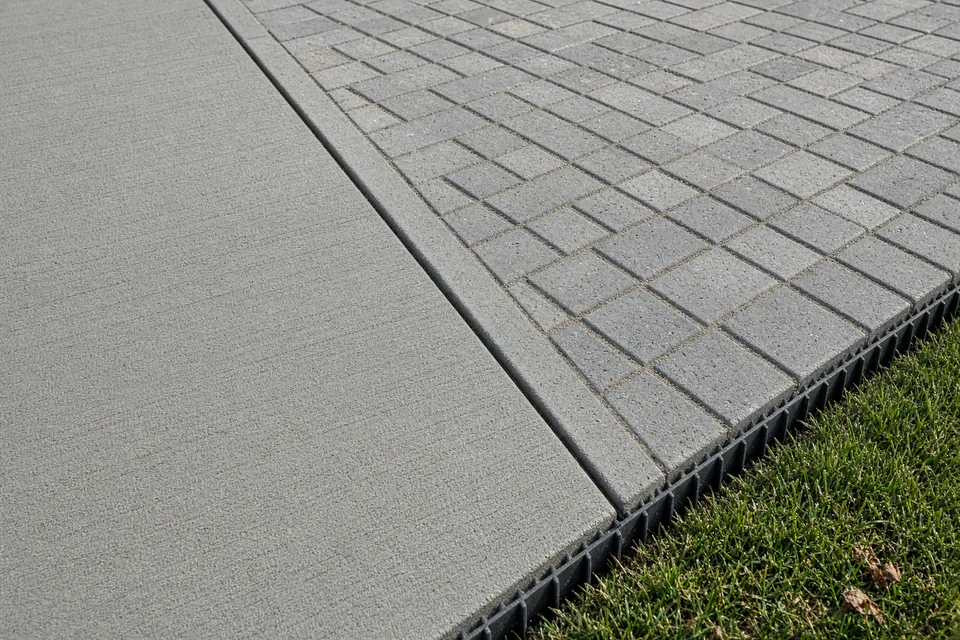
Pour, finish and joint
Pour and screed 4,000 PSI air-entrained concrete, pull a non-slip broom or exposed-aggregate surface texture, and saw-cut control joints every 8 to 10 feet.
Why it matters: Poured concrete ($9–$16/sq ft broom; $14–$24/sq ft decorative) and interlocking pavers ($16–$30/sq ft) offer two distinct looks and repair profiles over a compacted stone base.


On this page
- The diagram, part by part
- Photo guide: hero and 3 project steps
- 2026 concrete & paver patio cost table (consistent with the driveway calculator)
- Three worked scenarios with full arithmetic
- Decision table: broom concrete vs exposed aggregate vs interlocking pavers
- Signs your old patio needs replacement vs concrete leveling
- Quote checklist: 8 items to verify on a flatwork estimate
- Typical patio installation timeline
- Worked example
- Does insurance cover a patio?
- Sources and further reading
- Frequently asked questions
2026 concrete & paver patio cost table (consistent with the driveway calculator)
Because ready-mix concrete, crushed-stone sub-base, and flatwork finishers cost the same per square foot whether placed in the front yard or the backyard, these bands match driveway calculator—same installed concrete, different load and thickness:
| Patio Material / Scope Line | 2026 Low | 2026 High | What Changes the Price |
|---|---|---|---|
| Broom-finished 4,000 PSI poured concrete (published band w/ base) | $9.00 / sq ft | $16.00 / sq ft | $8.50–$14.50 slab rate + $0.50–$1.50 stone base; 4-in default |
| Exposed aggregate or stamped decorative concrete (w/ base) | $14.00 / sq ft | $24.00 / sq ft | $13.50–$22.50 decorative slab rate + $0.50–$1.50 stone base |
| Interlocking concrete or clay brick pavers (separate higher band) | $16.00 / sq ft | $30.00 / sq ft | $15.50–$28.00 paver rate + base; 6-in aggregate + 1-in sand bed |
| Upgrade to 5-inch slab with #4 rebar grid (hot tub / outdoor kitchen) | +12% | +12% | Extra concrete yardage and tied steel rebar on chairs |
| Old 4-inch concrete patio tear-out & dump haul-away | $2.00 / sq ft | $4.50 / sq ft | Matches driveway calculator removal band; gated backyard access |
| Poured concrete or segmental block door step risers | $220 / step | $480 / step | Step width (4 ft vs 6–8 ft wide) and cheek walls |
| Penetrating silane/siloxane sealer or polymeric paver sand | $0.65 / sq ft | $1.40 / sq ft | Invisible penetrating sealer vs high-build decorative acrylic |
| Backyard power-buggy transport & house isolation joint | $150 | $400 | Distance from street mixer to backyard & expansion foam |
Three worked scenarios with full arithmetic
Scenario 1: 300 sq ft broom-finished 4-inch concrete patio on bare lawn, 1 step, sealed (worked example, 1.00x)
A homeowner pours a 15×20-foot (300 sq ft) broom-finished 4-inch concrete patio in a bare backyard with a compacted crushed-stone base, 1 poured step at the sliding door, and penetrating sealer.
- 300 sq ft Broom Concrete Slab ($8.50–$14.50/sq ft): $2,550 – $4,350
- 300 sq ft Excavation & Compacted Stone Base ($0.50–$1.50/sq ft): $150 – $450 (combined slab + base = $9.00–$16.00/sq ft)
- Old Slab Removal: $0 (bare sod site)
- 1 Poured Concrete Door Step: $220 – $480
- 300 sq ft Penetrating Sealer ($0.65–$1.40/sq ft): $195 – $420
- Backyard Buggy Access & House Isolation Joint: $150 – $400
- National Total: $3,265 to $6,100
Scenario 2: 350 sq ft exposed aggregate concrete patio replacing an old cracked slab (1.00x)
A homeowner tears out 350 square feet of root-cracked concrete and pours a new 350 sq ft exposed-aggregate pebble-finish patio with a 5-inch hot-tub pad spec (+12%), 1 step, and glossy acrylic sealer.
- 350 sq ft Exposed Aggregate Slab w/ 5-in Rebar Spec ($13.50–$22.50 × 350 × 1.12): $5,292 – $8,820
- 350 sq ft Re-Graded & Compacted Stone Base ($0.50–$1.50 × 350): $175 – $525
- 350 sq ft Old Concrete Tear-Out & Haul ($2.00–$4.50 × 350): $700 – $1,575
- 1 Poured Concrete Door Step: $220 – $480
- 350 sq ft Acrylic Enhancer Sealer ($0.65–$1.40 × 350): $228 – $490
- Backyard Buggy & Expansion Joint: $150 – $400
- National Total: $6,765 to $12,290
Scenario 3: 400 sq ft interlocking paver patio with 2 block steps & polymeric sand (1.00x)
A homeowner installs a 20×20-foot (400 sq ft) interlocking concrete paver patio over a compacted aggregate and bedding-sand base (no old slab tear-out), with 2 wide block steps and polymeric sand lock.
- 400 sq ft Interlocking Pavers Installed ($15.50–$28.00 × 400): $6,200 – $11,200
- 400 sq ft Deep Base Excavation & Grading ($0.50–$1.50 × 400): $200 – $600 (combined = $16.00–$30.00/sq ft published band)
- 2 Segmental Block Steps ($220–$480 × 2): $440 – $960
- 400 sq ft Polymeric Sand & Joint Sealer ($0.65–$1.40 × 400): $260 – $560
- Backyard Transport & Edge Restraint Spikes: $150 – $400
- National Total: $7,250 to $13,720
Decision table: broom concrete vs exposed aggregate vs interlocking pavers
| Surface Option | Published Band (w/ Base) | Expected Life | Best Advantage | Key Trade-Off |
|---|---|---|---|---|
| Broom-Finished Concrete | $9.00 – $16.00 / sq ft | 30 – 35 yrs | Lowest upfront cost; clean slip-resistant texture | Can develop hairline cracks over time; patch repairs show color differences |
| Exposed Aggregate / Stamped | $14.00 – $24.00 / sq ft | 30 – 35 yrs | Decorative pebble or stone look at lower cost than pavers | Needs periodic re-sealing every 2–3 years; stamped concrete is slick when wet without grit |
| Interlocking Concrete/Brick Pavers | $16.00 – $30.00 / sq ft | 40+ yrs | Individual pavers flex in freeze-thaw and lift out for invisible repairs | Highest upfront labor cost; joints need polymeric sand maintenance |
Signs your old patio needs replacement vs concrete leveling
- Choose concrete leveling calculator (foam or mudjacking, $4–$9/sq ft) when: The concrete panels are still solid and uncracked, but one edge settled 1 to 3 inches or tilted toward the house foundation.
- Choose full tear-out and replacement on this page when: The slab is broken into spiderweb pieces, tree roots are underneath, the surface is flaking (spalling) from de-icing salt, or the patio was poured directly on dirt with no stone base.
Quote checklist: 8 items to verify on a flatwork estimate
- Drainage Pitch Written In: Does the contract state 1/8-in to 1/4-in per foot slope away from the house?
- Compacted Angular Stone Base: Are 4 to 6 inches of compacted crushed stone included beneath the slab or pavers?
- Concrete Mix Design: Is 4,000 PSI air-entrained concrete specified (no adding extra water at the chute)?
- Slab Thickness & Steel: Is a full 4-inch thickness (or 5-inch with #4 rebar under hot tubs) guaranteed?
- Control Joint Spacing: Will joints be saw-cut or tooled every 8 to 10 feet to a depth of 1 inch?
- House Wall Isolation Strip: Is a 1/2-inch closed-cell expansion joint installed against the foundation and brick veneer?
- Paver Edge Restraints: On paver bids, are spiked PVC/aluminum edging or concrete curb borders included around all open lawn sides?
- Turf & Sprinkler Protection: Does the quote cover plywood planks across the lawn for concrete buggies and repairing any nicked irrigation heads?
Typical patio installation timeline
- Day 1: Call 811 for buried lines, strip sod or break/haul old concrete slab, grade drainage slope, compact crushed-stone base, and set forms/rebar.
- Day 2 (Concrete) or Days 2–3 (Pavers): Pour, screed, float, broom/expose concrete, and saw-cut control joints (or screed bedding sand, lay pavers, cut borders, and vibrate polymeric sand).
- Days 3–7: Keep foot traffic off fresh concrete for 24–48 hours; apply penetrating curing/sealing compound according to product schedule.
Worked example
A homeowner installs a 300-square-foot (15×20 ft) broom-finished 4-inch poured concrete patio in the backyard over a new compacted crushed-stone base (no old slab to remove), including 1 step down from the patio door, an expansion joint against the house foundation, and penetrating concrete sealer at the 1.00x national baseline.
The default job, line by line
Worked example| Line item | National planning range |
|---|---|
| 300 sq ft broom-finished 4-in concrete slab, forms & control joints | $2,550 – $4,350 |
| Sod excavation, drainage slope grading & compacted stone base | $150 – $450 |
| One poured concrete step at patio door | $220 – $480 |
| Penetrating concrete sealer | $195 – $420 |
| Backyard power-buggy transport & house wall expansion joint | $150 – $400 |
| Total before regional adjustment | $3,265 – $6,100 |
Midpoint about $4,682. These are the calculator's default inputs, so pressing the button above at the national region reproduces this table.
Does insurance cover a patio?
Many policies treat a backyard patio as either part of the dwelling (if structurally tied in) or an Other Structure under Coverage B (tested in the other structures (Cov B) calculator), where non-building structures are often settled at depreciated Actual Cash Value. More importantly, standard homeowners insurance excludes the three things that damage 95% of patios: earth movement and soil settling, tree-root pressure, and winter freeze-thaw cracking. Insurance responds to a concrete or paver patio only when a sudden covered peril—such as a large storm-felled tree trunk (the tree and tarp calculator), vehicle strike, or explosion—smashes the slab, subject to your policy deductible (check the should-I-file-a-claim calculator and the depreciation (ACV) calculator). Policy wording and the adjuster decide every claim.
What this page will not claim
- That backyard concrete costs less than front-yard concrete: The installed bands match driveway calculator ($9–$16 broom, $14–$24 decorative, $16–$30 pavers).
- This page does not price vehicle-rated driveways or sunken slab lifting: Use the driveway calculator for vehicles and the concrete leveling calculator for mudjacking/foam lifting.
- This page does not claim insurance covers cracked or settled patios: Earth movement, tree roots, and frost heave are excluded on standard policies.
Sources and further reading
Prices on this page are planning ranges built from public 2026 US cost guides and contractor rate sheets, widened where they disagreed, and multiplied by the same regional index as every other ReplaceCost calculator. Codes and rules come from the bodies listed. See the methodology for how ranges are set and reviewed.
Frequently asked questions
Why do interlocking pavers cost $16 to $30 per square foot when broom concrete is $9 to $16?
A poured concrete patio is wheeled in from a ready-mix chute and bull-floated in a few hours. An interlocking paver patio requires excavating deeper (7 to 9 inches total), compacting a thicker 6-inch crushed-stone base in lifts, screeding a precise 1-inch bedding sand layer, hand-laying and wet-saw cutting hundreds of individual concrete or clay bricks, spiking perimeter edge restraints, and vibrating polymeric sand into every joint.
Can I pour a new 4-inch concrete patio directly on top of my old cracked concrete patio?
Only if the old slab is structurally stable with no frost heave, no active tree roots underneath, and enough door-threshold clearance to raise the backyard grade by 4 inches. If the old patio cracked because it was poured on soft clay without a gravel base or lifted from tree roots, pouring a new slab over it without an unbonded separation layer will cause the old cracks and movement to telegraph into the new concrete.
Do I need a thicker slab if I plan to put a hot tub or built-in outdoor kitchen on the patio?
Yes. A filled 6-to-8-person hot tub weighs 4,000 to 6,000 pounds concentrated over an 8-by-8-foot footprint, and a masonry stone grill island creates a permanent heavy line load. Tell your concrete contractor before forming so they can thicken that zone to 5 or 6 inches and tie a #4 steel rebar grid on 12-to-18-inch centers.
What keeps a backyard concrete patio from pooling rainwater against the house?
Two details prevent water damage at the house wall: first, the patio surface must sit at least 2 to 4 inches below your interior house floor framing and be graded with a continuous 1/8-inch to 1/4-inch per foot slope pitching away from the foundation; second, a 1/2-inch closed-cell expansion joint strip sealed with flexible polyurethane caulk must separate the slab from the house wall.
When should I use concrete leveling instead of tearing out and replacing my patio?
If your existing concrete panels are still whole, unspalled, and structurally solid, but one slab section has settled 1 to 3 inches or tilted toward the house foundation, polyurethane foam lifting or mudjacking on the concrete leveling calculator typically costs 50% to 70% less than tearing out and re-pouring the patio. If the concrete is shattered into small pieces or flaking on top, replacement is required.