Home › Shower pan leak
Bathroom · a leaking tiled floorShower pan leak repair cost calculator
Safety first. A leaking tiled shower pan cannot be fixed permanently by smearing silicone caulk or grout sealer on top of the tile—water trapped beneath the mortar bed rots structural floor joists and breeds hidden mold; a licensed plumber (for the drain and 24-hour flood test) and waterproof tile setter govern this repair.
When water stains appear on the ceiling below an upstairs shower or baseboard paint blisters outside the shower curb, regrouting the floor tile will not stop the leak: tile and cement grout are never the waterproof layer. Stop here if you are removing an old bathtub to build a brand-new walk-in shower (the tub to shower calculator), if you are gutting the entire bathroom (the bathroom remodel calculator), or if you need whole-room floor joist and subfloor replacement (the subfloor calculator).
Across the US in 2026, a new drain and 24-hour flood test runs $350 to $800; rebuilding a waterproof pan with floor tile runs $1,400 to $2,800 base plus $35 to $65/sq ft for a 40-mil PVC liner ($1,960 to $3,840 on 16 sq ft) or $1,600 to $3,100 plus $40 to $75/sq ft for a sheet membrane; lower 24-inch wall tile tie-in adds $650 to $1,500; local subfloor/curb rot adds $450 to $1,100; and glass door reset adds $250 to $600.
For a 16-square-foot shower with a PVC liner, mortar bed, lower wall tie-in, local rot patch, flood test, and glass reset, expect $3,660 to $7,840.
Reviewed 25 October 2026 · Written by Mantu Kumar
See the photos · See the cost diagram · Open the calculator · Every part explained
Key facts at a glance
- Plumbing codes require shower pan linings to turn up at least 2 inches above the finished threshold/curb and be water-tested ('flood tested') by plugging the drain and filling the pan to the top of the rough threshold.
- Tearing out the failed shower floor and installing a new 40-mil PVC/CPE liner over a sloped pre-pan mortar bed, upper dry-pack mud bed, and new mosaic floor tile runs $1,400 to $2,800 base plus $35 to $65 per square foot ($1,960 to $3,840 on a 16 sq ft stall), while a bonded sheet-membrane system (ANSI A118.10) runs $1,600 to $3,100 base plus $40 to $75 per square foot.
- Removing and retiling the bottom 18 to 24 inches of cement backer board and wall tile ('Band-Aid' tie-in) runs $650 to $1,500, whereas retiling the full shower wall surround if discontinued wall tiles cannot be matched runs $2,200 to $4,800.
- Replacing the three-piece clamping-ring drain (with pebble weep-hole guard) or bonding-flange drain assembly and performing a 24-hour flood test runs $350 to $800.
- Repairing localized rotted plywood subfloor under the shower footprint and rebuilding a waterlogged 2x4 shower curb (or replacing it with a solid composite/foam curb) runs $450 to $1,100, or $850 to $1,950 if 1 to 2 floor joists must be sistered.
National 2026 planning ranges before your regional multiplier. Sources and method are at the bottom of the page.
2026 planning ranges
- 1Flood test & leak diagnosis
- 2Shower floor & mortar bed tear-out
- 3Lower wall tile tie-in
- 4Clamping-ring or bonding-flange drain
- 5Pre-slope & waterproof pan liner
- 6Shower curb reconstruction
- 7Subfloor & joist rot beneath the pan
- 8Floor tile, grout & glass door reset
- 9Ceiling and mold below (not priced)
Price your shower pan leak repair
No email · nothing sentDiagram, part by part
Shower pan leak repair: every numbered part explained
The drawing above has 9 numbered parts, from Flood test & leak diagnosis to Ceiling and mold below (not priced). Each card zooms in on one part, says what pushes its price up or down, and what to check on a written quote. After you run the calculator, the parts in your scope show their dollar figure.
1 Flood test & leak diagnosis
$350 – $800 (includes new clamping/flange drain & 24-hour flood test)
Three different bathroom defects mimic a shower pan leak: a dripping mixing valve inside the wall, water splashing past a loose glass door sweep, or a ruptured waterproof pan liner under the floor tile. Before tearing out any tile, a plumber inserts an inflatable pneumatic test ball into the drain pipe below the clamping ring and fills the shower threshold with 2 inches of water. Plumbing codes (IPC Section 312.9) require the new liner to pass this flood test before tiling.
What moves it: Accessibility of the shower drain trap and whether the existing P-trap is solvent-welded PVC or old leaded cast iron.
On the quote: Never let a tile setter lay a single floor tile over your new shower pan liner until you have personally seen it hold 2 inches of standing water for 24 hours without dropping.
2 Shower floor & mortar bed tear-out
$1,400 – $3,100 base + $35 – $75 / sq ft (by pan system)
Ceramic or porcelain tile and cement grout are porous—water always migrates down into the 1.5-inch sandy mortar ('mud') bed beneath the tile. When a pan leaks, that entire waterlogged mortar bed must be chiseled out down to the wood subfloor. You cannot glue a new waterproof membrane on top of saturated old shower floor tile without trapping foul water and raising the threshold height out of compliance.
What moves it: Total square footage of the shower floor and whether the old mud bed was reinforced with wire lath.
On the quote: Reject any handyman proposal to 'coat the existing floor tile with liquid epoxy or grout sealer'—that traps moisture and fails within months.
3 Lower wall tile tie-in
$650 – $1,500 (lower 18–24 in Band-Aid) | $2,200 – $4,800 (full walls)
Under the plumbing codes (IRC Section P2709.2, IPC Section 417.5.2), the waterproof shower pan liner must turn continuously up the wall studs at least 2 inches above the finished curb height (typically 6 to 8 inches up the framing) with the wall cement board overlapping inside the liner. That means the bottom 18 to 24 inches of existing wall tile must be removed and retiled ($650–$1,500). If your wall tile is discontinued and you hate a contrasting accent band, retiling full walls runs $2,200 to $4,800.
What moves it: Whether you have spare boxes of the original wall tile, accept a coordinating lower border tile, or choose to retile all three walls.
On the quote: Check your garage or attic for spare boxes of the original wall tile before the estimator arrives—finding 20 matching tiles can save $2,500+.
4 Clamping-ring or bonding-flange drain
Included in the $350 – $800 drain & flood-test line
Over 70% of traditional shower pan failures happen right at the drain assembly—either because the original installer forgot to seal the lower clamping flange with silicone, or because mortar clogged the tiny weep holes around the clamping bolts so water pooled permanently in the mud bed. Traditional pans use a three-piece clamping-ring drain surrounded by washed pea gravel/spacer tabs; modern sheet-membrane pans use a top-surface bonding-flange drain.
What moves it: Moving a drain location on a concrete slab vs replacing the drain body in place over a wood subfloor.
On the quote: On a traditional PVC liner pan, confirm the installer places a weep-hole protector or washed pea gravel around the clamping ring so mortar cannot plug the weep holes.
5 Pre-slope & waterproof pan liner
Included in pan system line ($1,960–$3,840 on 16 sq ft PVC/mud pan)
The #1 code violation found when demolishing leaking showers is a 40-mil PVC liner laid flat on the flat plywood subfloor instead of over a sloped mortar 'pre-slope' (1/4 inch per foot toward the drain weep holes, per TCNA Method B415). Without a pre-slope under the liner, water sits in a stagnant puddle under the mud bed forever. Alternatively, an ANSI A118.10 bonded sheet membrane bonds directly to the top of a single sloped mortar or high-density foam pan.
What moves it: Choosing a traditional 40-mil PVC/CPE liner with pre-slope + mud bed versus a bonded sheet membrane system.
On the quote: Ask the contractor point-blank: 'Do you build a sloped mortar pre-slope underneath the PVC liner, or do you use a top-bonded sheet membrane system?'
6 Shower curb reconstruction
Included in pan & rot lines ($450–$1,100 with local subfloor patch)
Traditional shower curbs framed out of stacked 2x4 wood blocks act like sponges: if the original tile setter wrapped the PVC liner over the wood 2x4s and then nailed wire lath or screwed cement board into the top or inside face of the curb, every nail punctured the waterproof liner. Modern best practice replaces rotted wood 2x4 curbs with solid cellular PVC, masonry block, or pre-formed waterproof foam curbs with zero fastener penetrations.
What moves it: Replacing a rotted stacked-2x4 wood curb with a solid waterproof foam or masonry curb.
On the quote: Specify a solid waterproof foam or masonry block shower curb—never let anyone drive nails or screws into the top or inside face of a wrapped wood curb.
7 Subfloor & joist rot beneath the pan
$450 – $1,100 (local subfloor + curb) | $850 – $1,950 (with 1–2 joists)
Once the old mortar bed and punctured liner are lifted out, the 3/4-inch plywood or OSB subfloor around the drain hole and beneath the threshold is often black, spongy, or delaminated. Cutting out the rotted 4x4-foot plywood section, installing 2x6 blocking between the joists, laying fresh exterior-grade plywood, and rebuilding the curb runs $450 to $1,100. If 1 or 2 floor joists must also be sistered, allow $850 to $1,950 (for whole-room subfloor work, see the subfloor calculator).
What moves it: How many months or years the pan leaked before you noticed the downstairs ceiling stain.
On the quote: Run a commercial dehumidifier and fan on the exposed floor joists for 24 to 48 hours until wood moisture content drops below 15% before closing up the new pan.
8 Floor tile, grout & glass door reset
$250 – $600 (glass door detach & reset)
Because a shower floor slopes in four directions toward the center drain (or in one plane toward a linear drain), traditional pans require small 2x2-inch mosaic tiles whose grout joints conform smoothly to the bowl contour. Before demolition starts, a glazier or tile crew must carefully detach your heavy tempered-glass shower door and side panel, store it safely, and re-mount it on the new tiled curb ($250–$600) using silicone—never drilling deep through the curb liner.
What moves it: Heavy 3/8-inch or 1/2-inch frameless glass enclosures versus a simple framed bypass door or curtain rod.
On the quote: When resetting the glass shower door on the new curb, ensure mounting screws stop short of the waterproof membrane and are bedded in 100% silicone.
9 Ceiling and mold below (not priced)
Priced separately
A long-running pan leak often damages the ceiling below or the subfloor around the shower. Ceiling drywall repair and any mold work are separate trades, so they are kept out of this estimate and priced on their own once the leak is stopped.
What moves it: How long the leak ran and what is directly below the shower.
On the quote: Ask the contractor to note any ceiling or mold damage so it can be priced separately.
Project photo guide
Shower pan repair in photos: tear-out, liner and flood test
A permanent shower pan repair happens entirely beneath the tile surface. These four scenes show the lower 24 inches of wall tile and mud bed removed, a 40-mil PVC pan liner over a pre-slope, a 24-hour standing water flood test, and new mosaic floor tile.

How the job works in 3 key stages
All three step images are AI-generated illustrations for explanation. Not a site inspection, bid, or coverage decision.
 Step 01
Choose the pan system
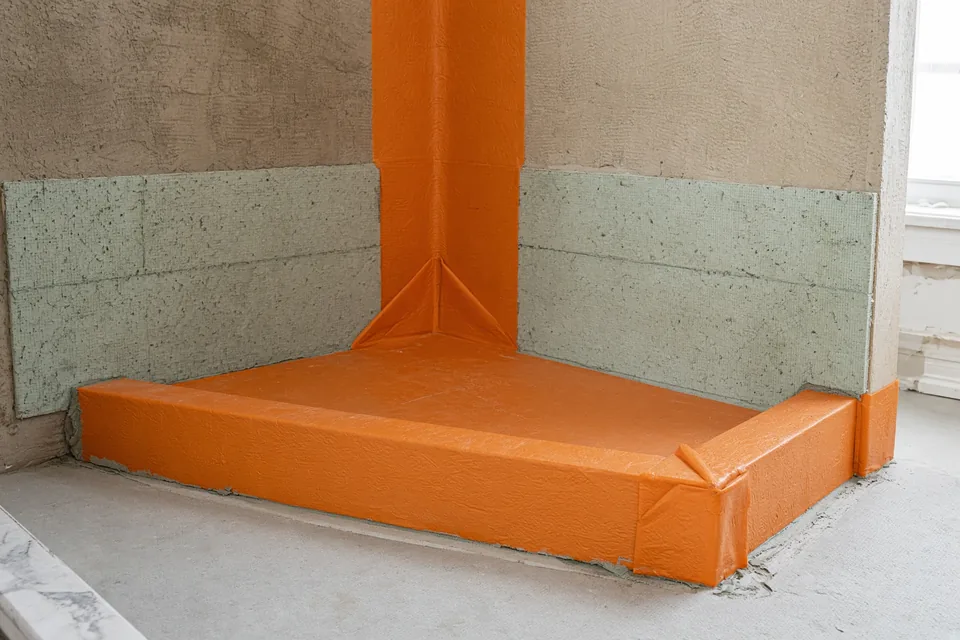
Over a 1/4-inch-per-foot pre-slope, the pan is either a PVC liner clamped at the drain or a bonded sheet membrane over a solid curb, which avoids nail holes through the threshold.
Why it matters: Bonded sheet-membrane pans ($1,600–$3,100 base + $40–$75/sq ft) and solid foam curbs eliminate nail holes through the threshold.
 Step 02
Flood test the pan
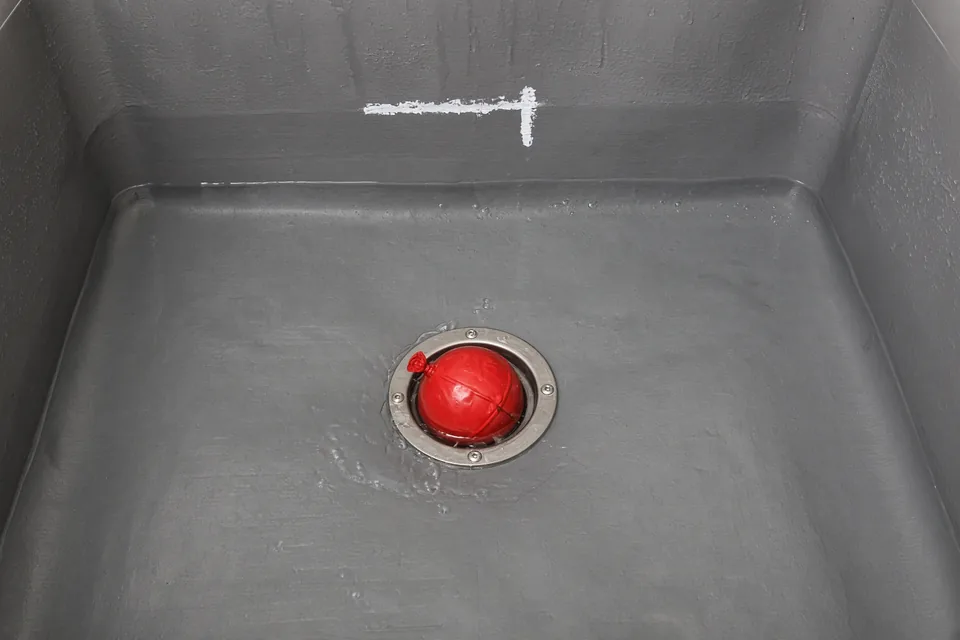
Plug the drain and fill the new pan with about 2 inches of water for 24 hours; the level must not drop before the mortar bed or tile goes in (IPC Section 312.9).
Why it matters: Under IPC Section 312.9, plugging the drain and flood-testing the waterproof pan with water ($350–$800 with new drain) verifies zero leaks before any tile is laid.
 Step 03
Retile and reset the glass
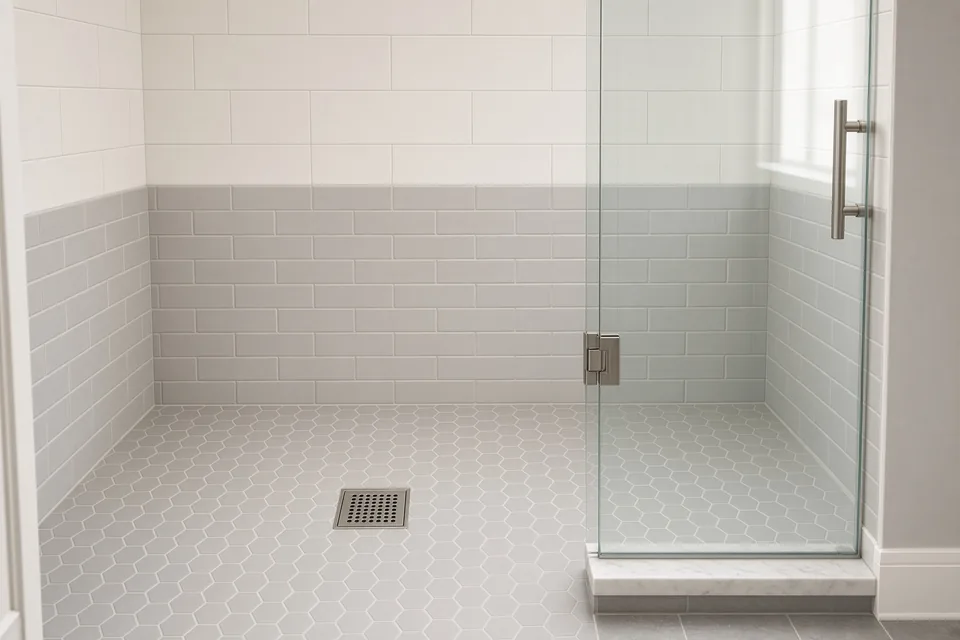
The final mortar bed, lower wall backer board and mosaic tile tie in to the old wall tile, then the glass door is reset and sealed.
Why it matters: Finishing the floor with 2-inch mosaic tile, tying in the lower 24 inches of wall tile ($650–$1,500), and resetting the glass door ($250–$600) completes the repair.


On this page
- The diagram, part by part
- Photo guide: hero and 3 project steps
- 2026 shower pan leak repair cost table
- Three worked scenarios with full arithmetic
- Comparison table: traditional 40-mil PVC liner vs bonded sheet membrane vs acrylic base
- Plumbing and tile code reference: IRC P2709 and the TCNA Handbook
- Quote checklist: 8 questions that catch bad shower pan bids
- Typical flood test, tear-out & retile timeline
- Worked example
- Does insurance pay for a leaking shower pan?
- Sources and further reading
- Frequently asked questions
2026 shower pan leak repair cost table
| Shower Pan Repair Line Item | 2026 Low | 2026 High | What Changes the Price |
|---|---|---|---|
| Traditional 40-mil PVC/CPE liner + pre-slope + mud bed + floor tile | $1,400 + $35/sf | $2,800 + $65/sf | $1,960–$3,840 on 16 sq ft stall; includes old floor tear-out |
| Bonded sheet membrane (ANSI A118.10) + pan + floor tile | $1,600 + $40/sf | $3,100 + $75/sf | $2,240–$4,300 on 16 sq ft stall; top-bonded membrane system |
| Swap to pre-formed acrylic or fiberglass shower base | $950 + $20/sf | $2,100 + $40/sf | $1,270–$2,740 on 16 sq ft stall; requires standard footprint dimensions |
| Lower 18–24 in wall tile & backer board tie-in ('Band-Aid' repair) | $650 | $1,500 | Removes bottom 1–2 rows of wall tile to lap liner up studs |
| Full shower wall surround retile (if wall tile cannot be matched) | $2,200 | $4,800 | Replaces all three shower walls when homeowner rejects an accent band |
| Local subfloor plywood patch & solid curb rebuild | $450 | $1,100 | Replaces rotted plywood under pan + solid non-wood curb |
| Subfloor patch + sistering 1–2 rotted floor joists under drain | $850 | $1,950 | Required when long-term leak softened the joists below the drain |
| Clamping-ring or bonding-flange drain + 24-hour flood test | $350 | $800 | New drain assembly + plugged-drain water test |
| Frameless or framed glass shower door detach & reset | $250 | $600 | Safe removal before curb demo and silicone re-installation |
Three worked scenarios with full arithmetic
Scenario 1: standard 16 sq ft tiled shower pan replacement with lower-wall tie-in (worked example, 1.00x)
A 4x4-foot (16 sq ft) upstairs tiled shower leaks onto the kitchen ceiling below (sqft = 16). The crew removes the glass door (glass_reset = yes), tears out the floor and bottom 24 inches of wall tile (wall_scope = lower_band), patches local subfloor rot and builds a solid curb (rot = local_curb), installs a new clamping drain and passes a 24-hour flood test (drain_test = yes), and installs a 40-mil PVC liner with pre-slope, mud bed, and mosaic floor tile (pan_system = pvc_mud).
- Floor Demo, Pre-Slope, 40-Mil PVC Liner, Mud Bed & Mosaic Tile ($1,400–$2,800 + [16 × $35–$65]): $1,960 – $3,840
- Lower 18–24 In Wall Tile & Backer Board Tie-In: $650 – $1,500
- Local Subfloor Plywood Patch & Solid Curb Rebuild: $450 – $1,100
- Clamping-Ring Drain & 24-Hour Flood Test: $350 – $800
- Glass Shower Door Detach & Reset: $250 – $600
- National Baseline Total (1.00x): $3,660 to $7,840
Scenario 2: budget swap to pre-formed acrylic shower base on a 12 sq ft stall (no rot, curtain only, 1.00x)
A homeowner with a leaking 3x4-foot (12 sq ft) hall shower chooses to tear out the leaking tile floor and install a one-piece pre-formed acrylic receptor base (sqft = 12, pan_system = acrylic), ties into the lower wall tile (wall_scope = lower_band), has dry subflooring (rot = none), includes the drain connection and test (drain_test = yes), and uses a shower curtain (glass_reset = no).
- Floor Tear-Out & Pre-Formed Acrylic Base ($950–$2,100 + [12 × $20–$40]): $1,190 – $2,580
- Lower Wall Tile Tie-In: $650 – $1,500
- Drain Assembly & Water Test: $350 – $800
- National Baseline Total (1.00x): $2,190 to $4,880
Scenario 3: large 25 sq ft primary shower with bonded sheet membrane, full wall retile & joist rot (1.00x)
A 5x5-foot (25 sq ft) primary shower has discontinued large-format wall tiles the owner does not want patched with a border (wall_scope = full_walls), uses an ANSI A118.10 bonded sheet-membrane system (pan_system = sheet_membrane), needs subfloor plus 2 joists sistered (rot = joist_sister), a bonding-flange drain and flood test (drain_test = yes), and frameless glass reset (glass_reset = yes).
- 25 Sq Ft Sheet-Membrane Pan & Floor Tile ($1,600–$3,100 + [25 × $40–$75]): $2,600 – $4,975
- Full Shower Wall Surround Retile: $2,200 – $4,800
- Subfloor Patch + Sistering 1–2 Floor Joists: $850 – $1,950
- Bonding-Flange Drain & 24-Hour Flood Test: $350 – $800
- Frameless Glass Detach & Reset: $250 – $600
- National Baseline Total (1.00x): $6,250 to $13,125
Comparison table: traditional 40-mil PVC liner vs bonded sheet membrane vs acrylic base
| Feature | Traditional 40-Mil PVC/CPE Liner (TCNA B415) | Bonded Sheet Membrane (TCNA B422 / ANSI A118.10) | Pre-Formed Acrylic / Fiberglass Base |
|---|---|---|---|
| 2026 Cost (16 Sq Ft Pan Line) | $1,960 – $3,840 | $2,240 – $4,300 | $1,270 – $2,740 |
| Where Is the Waterproof Layer? | Beneath the 1.5-in upper mortar bed (over pre-slope) | Directly beneath the tile thinset (mud stays dry) | The molded acrylic floor pan itself |
| Drain Style | 3-piece clamping ring w/ weep holes | Top-surface bonding flange (no weep holes to clog) | Compression/caulk gasket drain |
| Fits Custom / Odd Shapes? | Yes (any size or angle) | Yes (custom mortar or cut-to-fit foam) | No (must match standard stock sizes) |
| Drying Time Between Showers | Slower (moisture enters mud bed and drains via weeps) | Fast (only tile and thinset get wet) | Instant (non-porous surface) |
Plumbing and tile code reference: IRC P2709 and the TCNA Handbook
- Shower Lining Height (IRC Section P2709.2, IPC Section 417.5.2): Shower floors built on site must be lined with an approved watertight material that turns up at least 2 inches above the finished threshold (typically 6–8 inches up the rough studs).
- Flood Test (IPC Section 312.9): The finished liner is tested by plugging the drain and filling it with water before any mortar or tile goes on.
- Pre-Slope Requirement (IRC Section P2709.1 and the TCNA Handbook): Waterproof pan liners must never be laid flat on a flat subfloor; they must rest on a smoothly sloped surface pitched at least 1/4 inch per foot (2% slope) toward the drain weep holes.
Quote checklist: 8 questions that catch bad shower pan bids
- Pre-Slope Under the Liner: If the contractor uses a 40-mil PVC liner, does the written scope include a 1/4-inch-per-foot mortar pre-slope underneath the liner?
- Mandatory 24-Hour Flood Test: Will the plumber plug the drain and fill the finished waterproof liner with 2 inches of water for 24 hours before any floor tile is installed?
- Zero Fasteners in the Curb: Is the shower curb built from solid foam, cellular PVC, or masonry block with zero nails or screws penetrating the top or inside face of the liner?
- Weep-Hole Protection: On clamping-ring drains, does the installer place a weep-hole guard or washed pea gravel around the clamping bolts so mortar cannot plug the drain weeps?
- Wall Membrane Overlap: Will the bottom 18 to 24 inches of wall tile and backer board be removed so the wall moisture barrier overlaps inside the pan turn-up?
- Subfloor Moisture Reading (<15%): Will the crew dry out wet joists and verify subfloor wood moisture content is under 15% before closing the floor?
- Glass Door Silicone Mounting: Will the glass door channel be set in 100% silicone without driving long screws through the curb membrane?
- Downstairs Ceiling & Mold Check: Have you checked whether the ceiling below needs drywall calculator patching or the mold remediation calculator?
Typical flood test, tear-out & retile timeline
- Day 1: Detach glass door, demolish old shower floor and lower 24 inches of wall tile, and repair subfloor/curb rot.
- Day 2: Install drain body, pre-slope, and waterproof pan liner or bonded sheet membrane; fill pan with 2 inches of water for the 24-hour flood test.
- Day 3: Drain test water after verifying zero drop; install upper mortar bed, lower wall backer board, mosaic floor tile, and lower wall tile.
- Day 4: Grout floor and wall tile, caulk changes of plane with 100% silicone, and reset glass shower door.
Worked example
A homeowner with a leaking 4x4-foot (16 sq ft) upstairs tiled shower (sqft = 16) hires a tile and plumbing contractor to tear out the floor, install a new 40-mil PVC liner with pre-slope, mortar bed, and mosaic floor tile (pan_system = pvc_mud), remove and retile the lower 24 inches of wall tile (wall_scope = lower_band), patch local subfloor rot and rebuild a solid curb (rot = local_curb), install a new clamping-ring drain with a 24-hour flood test (drain_test = yes), and detach/reset the glass door (glass_reset = yes) at the 1.00x baseline.
The default job, line by line
Worked example| Line item | National planning range |
|---|---|
| Shower floor tear-out, 40-mil PVC liner, pre-slope, mud bed & floor tile | $1,960 – $3,840 |
| Lower 18–24 in wall tile & backer board tie-in | $650 – $1,500 |
| Local subfloor plywood patch & solid curb rebuild | $450 – $1,100 |
| Clamping-Ring drain replacement & 24-hour flood test | $350 – $800 |
| Glass shower door detach & reset | $250 – $600 |
| Total before regional adjustment | $3,660 – $7,840 |
Midpoint about $5,750. These are the calculator's default inputs, so pressing the button above at the national region reproduces this table.
Does insurance pay for a leaking shower pan?
In almost every US homeowners insurance claim involving a leaking shower pan, the policy splits the problem in two: (1) the failed shower pan itself and (2) the resulting water damage to the ceiling or walls below. Standard HO-3 policies universally exclude the cost of repairing or replacing the leaking shower pan, liner, and drain because pan failures result from original installation defects (such as nails in the curb or a missing pre-slope) or gradual wear and tear. Furthermore, most policies exclude water seepage or leakage that occurs over a period of 14 days or more (or 'constant or repeated seepage'). Only when a sudden pipe break or sudden drain rupture causes immediate hidden water damage to the downstairs ceiling (the drywall calculator) or floors (the water damage calculator) will a policy typically consider the ensuing damage—never the pan rebuild itself.
What this page will not claim
- This page does not claim grout sealer, epoxy coatings, or caulk can fix a leaking shower pan: Once water is bypassing the subsurface membrane or drain clamping ring, topical sealers cannot stop the leak.
- This page does not promise your insurer will pay for the new shower pan: Standard HO-3 policies exclude tearing out and replacing a defective or worn-out shower pan liner itself.
Sources and further reading
- Angi — What is shower pan installation?
- Tile Council of North America — TCNA Handbook
- International Code Council — International Residential Code
Prices on this page are planning ranges built from public 2026 US cost guides and contractor rate sheets, widened where they disagreed, and multiplied by the same regional index as every other ReplaceCost calculator. Codes and rules come from the bodies listed. See the methodology for how ranges are set and reviewed.
Frequently asked questions
Can I fix a leaking tiled shower pan by regrouting the floor and sealing the tile without tearing it out?
No, if the waterproof pan liner or drain clamping seal underneath the tile has failed. Ceramic tile and cement grout are never waterproof—they are only a decorative wear surface. Water naturally passes through grout joints into the mortar bed below, where the hidden pan liner directs it into the drain weep holes. Once that hidden liner is punctured or the weep holes clog, surface sealers only trap moisture for a few weeks.
Why do you have to remove the bottom two feet of wall tile just to replace the shower floor pan?
Because a waterproof shower pan is shaped like a shallow bathtub: under the plumbing code, the flexible PVC liner or bonded sheet membrane must turn continuously up the wood wall studs at least 2 inches above the curb (typically 6 to 8 inches high) behind the cement backer board. You cannot fold and fasten a new liner up the wall framing without removing the bottom 18 to 24 inches of wall tile and backer board ($650 to $1,500).
What if my existing shower wall tile is discontinued and I cannot find matching tiles for the bottom two rows?
You have two practical choices. Most homeowners choose a deliberate 'Band-Aid' design upgrade ($650 to $1,500): installing a coordinating solid quartz/marble sill cap or 24-inch wainscot band using the same tile selected for the new shower floor. If you want uniform walls from floor to ceiling and cannot match the old tile, select the Full Shower Wall Retile option ($2,200 to $4,800).
What is a 24-hour shower pan flood test, and how does it work?
Before a single floor tile or upper mortar bed is installed over the new waterproof liner, the plumber inserts an inflatable rubber test ball into the drain pipe below the clamping ring (or plugs a bonding-flange drain), fills the bare waterproof pan with 2 inches of water right up to the rough curb top, marks the water line, and waits 24 hours. If the water level does not drop a millimeter and the framing below stays bone-dry, the pan is watertight.
Which is better when replacing a leaking shower pan: a traditional 40-mil PVC liner or a bonded sheet membrane?
Both last 25+ years when installed strictly to TCNA standards. A traditional 40-mil PVC liner ($1,960 to $3,840 on 16 sq ft) requires a mortar pre-slope underneath the liner and clear drain weep holes. A bonded sheet-membrane system like Kerdi-style ($2,240 to $4,300 on 16 sq ft) bonds the waterproof membrane directly on top of the sloped mortar or foam pan, so water never saturates a thick mud bed and drying between showers is much faster.
Why do wood 2x4 shower curbs cause so many shower pan leaks after 5 to 10 years?
When a builder stacks three 2x4 wood studs to form the shower threshold, wraps a PVC liner over them, and then nails metal lath or screws cement board into the top or inside face of the curb to hold the curb tile, those fasteners punch dozens of holes straight through the waterproof liner. If even a drop of water reaches the wood 2x4s, they swell, crack the curb grout joints, and leak onto the bathroom floor.