Home › Stair railing
Inside · stair rails and balustersStaircase railing replacement cost calculator
Safety first. Interior stair guards and handrails are life-safety fall-prevention barriers that must resist a 200-pound concentrated lateral load and pass strict child-head-entrapment sphere rules; a skilled finish carpenter or stair builder and local building inspector govern structural stair guards.
Replacing a shaky 1980s honey-oak stair railing transforms your front entryway while eliminating loose newel posts and wide baluster gaps that fail modern home inspections. Stop here if you are pricing exterior treated or composite deck railings (the deck calculator), covered front porch balustrades (the covered porch calculator), or exterior ADA wheelchair ramp handrails (the wheelchair ramp calculator).
Across the US in 2026, interior stair railing replacement runs $85 to $165 per linear foot for painted poplar handrails and wood balusters, $120 to $230 per linear foot for stained hardwood handrails with powder-coated wrought-iron balusters, $185 to $340 per linear foot for stainless steel cable railing, and $260 to $480 per linear foot for frameless or post-mounted tempered glass panels; structural newel posts run $220 to $520 each; gooseneck/volute fittings for L-turns or balcony overlooks add $450 to $1,100; old railing tear-out and tread-hole plugging runs $250 to $650; and custom staining, polyurethane finishing, and permit sign-off adds $350 to $850.
For a 16-linear-foot straight interior staircase upgraded to stained oak handrail with iron balusters, 3 newel posts, demolition, and custom finish, expect $3,180 to $6,380.
Reviewed 25 October 2026 · Written by Mantu Kumar
See the photos · See the cost diagram · Open the calculator · Every part explained
Key facts at a glance
- Under IRC Section R311.7.8.1, stair handrail height must be between 34 inches and 38 inches, measured vertically from the sloped plane adjoining the tread nosings.
- Under IRC Section R312.1.3, guard openings cannot allow a 4-inch-diameter sphere to pass through on level balcony overlooks, or a 4-3/8-inch sphere on the open sides of stair treads (and a 6-inch sphere in the triangle between tread, riser, and bottom rail).
- Installed interior railing costs per linear foot run $85 to $165 for painted wood, $120 to $230 for stained hardwood rail with wrought-iron balusters, $185 to $340 for stainless steel cable infill, and $260 to $480 for tempered safety glass panels.
- Supplying and anchoring structural newel posts with mechanical lag/bolt fasteners into the floor framing to resist the code-required 200-pound concentrated lateral load (IRC Table R301.5) runs $220 to $520 per newel post.
- Continuous gooseneck, volute, or quarter-turn hardwood fittings for L-shaped landings and upstairs loft returns add $450 to $1,100, while old railing tear-out ($250–$650) and multi-coat stain/enamel finishing ($350–$850) complete the job.
National 2026 planning ranges before your regional multiplier. Sources and method are at the bottom of the page.
2026 planning ranges
- 1Structural newel posts & framing anchors
- 2Graspable handrail profile & height
- 3Balusters, stainless cable, or glass infill
- 4Shoe rail vs direct tread mounting
- 5Gooseneck, volute & landing fittings
- 6Wall-mounted handrail brackets & returns
- 7Old railing tear-out & tread hole plugging
- 8Custom stain, polyurethane & permit
- 9Exterior railings (not priced here)
Price your staircase railing replacement
No email · nothing sentDiagram, part by part
Staircase railing replacement: every numbered part explained
The drawing above has 9 numbered parts, from Structural newel posts & framing anchors to Exterior railings (not priced here). Each card zooms in on one part, says what pushes its price up or down, and what to check on a written quote. After you run the calculator, the parts in your scope show their dollar figure.
1 Structural newel posts & framing anchors
$220 – $520 per structural newel post installed
The newel post at the bottom, landing turn, and top of your stairs is the structural backbone of the entire railing. Under IRC Table R301.5, the top of a stair guard must withstand a 200-pound concentrated load applied in any direction without flexing or pulling loose. Simply toenailing a newel post to the oak tread is never acceptable: a stair carpenter anchors each newel ($220–$520) directly into the floor joists or carriage framing using concealed through-bolts or structural lag hardware.
What moves it: Solid box newels vs turned poplar/oak posts, and whether subfloor access below allows concealed bolt tensioning.
On the quote: Grab the bottom newel post and push hard in any bid walkthrough—confirm the installer uses concealed structural lag bolts into the framing, not finish nails.
2 Graspable handrail profile & height
Included in per-linear-foot railing tier ($85 – $480 / lf)
Under IRC Section R311.7.8.1, stair handrails must sit between 34 inches and 38 inches measured vertically from the sloped plane connecting the front edges (nosings) of the stair treads, and must be continuous for the full length of the flight. Furthermore, IRC R311.7.8.5 requires a 'graspable' profile (Type I circular 1.25 to 2 inches, or Type II standard 6010/6210 sculpted finger-recess profile) so a falling person can wrap their fingers around the rail—a flat 2x4 or 2x6 board violates code.
What moves it: Selecting red oak, white oak, hard maple, walnut, or paint-grade poplar handrail profiles.
On the quote: If you choose a flat modern metal or wide wood top cap on your guard, make sure it either meets Type II finger-recess dimensions or includes a separate graspable handrail.
3 Balusters, stainless cable, or glass infill
$85–$165/lf (wood) | $120–$230/lf (iron) | $185–$340/lf (cable) | $260–$480/lf (glass)
To prevent small children from slipping through the railing, IRC Section R312.1.3 enforces the strict 4-inch sphere rule: a 4-inch-diameter rigid sphere cannot pass through any opening in a level balcony guard, and a 4-3/8-inch sphere cannot pass between balusters on the sloped stair run. Because 1/8-inch stainless steel cables ($185–$340/lf) deflect slightly when pushed, installers space cables at 3 inches on center and place intermediate spreader posts every 36 to 42 inches so a 4-inch sphere cannot be forced through.
What moves it: Pin-top vs hollow vs solid wrought-iron balusters, or high-tension stainless cable vs 1/2-inch tempered glass panels.
On the quote: If you choose horizontal cable railing, verify that intermediate posts are spaced close enough that a 4-inch sphere cannot be pushed between two cables.
4 Shoe rail vs direct tread mounting
Included in linear-foot installation
On an open-stringer staircase (where the ends of the oak treads are visible from the living room), balusters are dowelled directly into drilled holes in the treads—typically two or three balusters per tread—and glued into the underside of the handrail with epoxy or concealed fasteners. On a knee-wall or closed-stringer staircase, a sloped bottom rail ('shoe rail') with a plowed groove and wooden fillets secures the bottom of the spindles cleanly.
What moves it: Open-end mitered stair treads with decorative brackets versus a closed knee wall capped with a sloped shoe rail.
On the quote: When upgrading from 1.25-inch wood spindles to 1/2-inch square iron balusters on existing treads, ask whether the installer uses decorative base shoes to cover the old round dowel holes.
5 Gooseneck, volute & landing fittings
+$450 – $1,100 (for L-turns, U-turns, or over-the-post runs)
A straight 'post-to-post' staircase where the straight handrail butts into the side of the bottom and top newel posts is the simplest system to build. If your stairs have an intermediate L-shaped or U-shaped landing, an upstairs open balcony overlook, or a classic 'over-the-post' continuous handrail, the carpenter must hand-fit curved hardwood fittings—goosenecks, up-easings, quarter-turns, or a scrolled starter volute (+$450–$1,100)—using hidden rail bolts.
What moves it: Post-to-post mitered connections versus continuous over-the-post carved hardwood fittings.
On the quote: Post-to-post box newels give a clean modern craftsman look and save $450 to $1,100 compared to curved over-the-post gooseneck fittings.
6 Wall-mounted handrail brackets & returns
Included in linear-foot rate
Even when one or both sides of a staircase are enclosed between drywall walls, IRC Section R311.7.8 requires at least one continuous graspable handrail from the bottom riser to the top riser. Wall-mounted handrails must maintain at least 1.5 inches of finger clearance from the finished drywall face, return smoothly into the wall at both ends so purse straps and coat sleeves cannot catch, and anchor with heavy brackets into wood wall studs every 4 feet.
What moves it: Locating solid wood wall studs behind drywall or plaster on older enclosed stairwells.
On the quote: Never accept wall handrail brackets screwed into hollow drywall anchors—every bracket must hit a solid wood stud or backing block.
7 Old railing tear-out & tread hole plugging
$250 – $650
Demolishing an old stair railing ($250–$650) requires finesse so the crew does not split your existing oak stair treads or gouge the foyer drywall. Old newel posts are often glued, lag-bolted, and notched around the bottom riser; old wooden spindles leave 3/4-inch dowel holes in every tread. If your new layout changes post or spindle spacing, the carpenter turns grain-matched hardwood plugs to fill the old tread holes seamlessly.
What moves it: Whether you are keeping existing stained hardwood treads or refinishing/replacing the treads at the same time.
On the quote: Confirm how old spindle holes in your existing hardwood treads will be plugged or covered by iron baluster base shoes before tear-out begins.
8 Custom stain, polyurethane & permit
$350 – $850
Raw red oak, white oak, or maple handrails and newel posts arrive sanded but unfinished. Matching the exact warm or cool stain tone of your existing hardwood floors, applying wood conditioner, wiping on stain, and brushing or spraying two to three coats of low-VOC satin polyurethane (plus painting poplar newels or stair skirts in durable urethane enamel) runs $350 to $850. Pre-staining rails and spindles on sawhorses before final assembly prevents stain drips on carpet or drywall.
What moves it: Custom color-matching an aged hardwood floor stain and two-tone combinations (white painted box newels + dark stained rail).
On the quote: Have the finisher stain and seal the handrail and newel parts on sawhorses before installation so only tiny pin-nail and plug touch-ups are needed on the stairs.
9 Exterior railings (not priced here)
Priced on the deck or porch tools
Deck, porch and ramp railings use different materials and anchoring than an interior stair, and they face weather. They are kept out of this estimate so the interior price stays accurate.
What moves it: Whether the job includes any outdoor railings.
On the quote: Ask for exterior railings to be quoted as their own line.
Project photo guide
Stair railing in photos: newel posts, balusters and handrail height
A code-compliant interior stair railing combines rock-solid structural post anchoring with precise millwork joinery. These four scenes show a finished oak-and-wrought-iron staircase, anchoring a structural newel post into the floor framing, setting square iron balusters with two-part epoxy at <4-inch spacing, and checking the 34–38 inch handrail height.

How the job works in 3 key stages
All three step images are AI-generated illustrations for explanation. Not a site inspection, bid, or coverage decision.
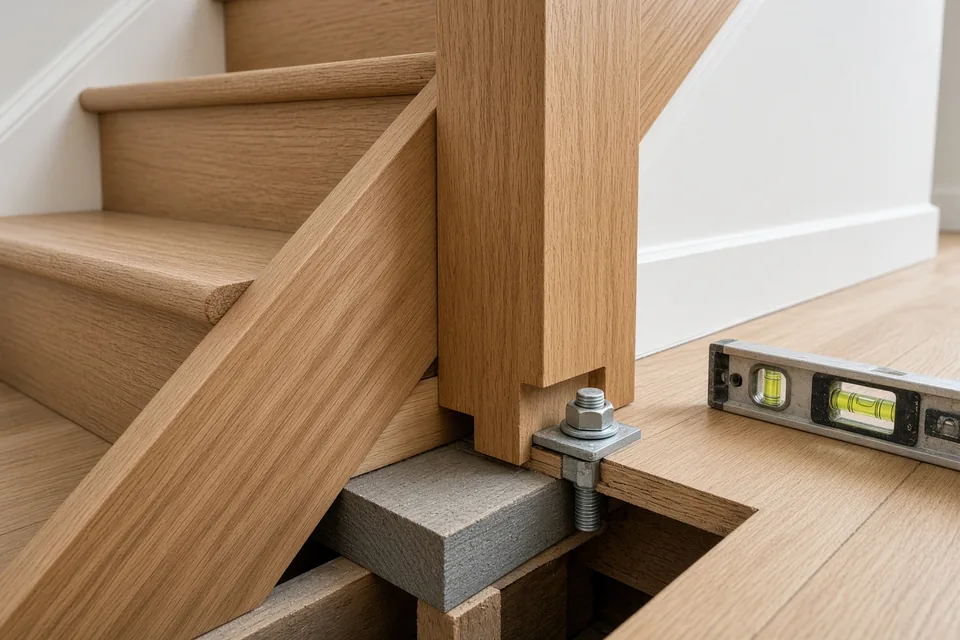 Step 01
Anchor the newel posts
Each structural newel post is bolted into the floor framing so it can resist the 200-pound sideways load the code requires.
Why it matters: Each structural newel post ($220–$520 installed) must anchor directly into the floor framing to resist the code-mandated 200-pound lateral load.
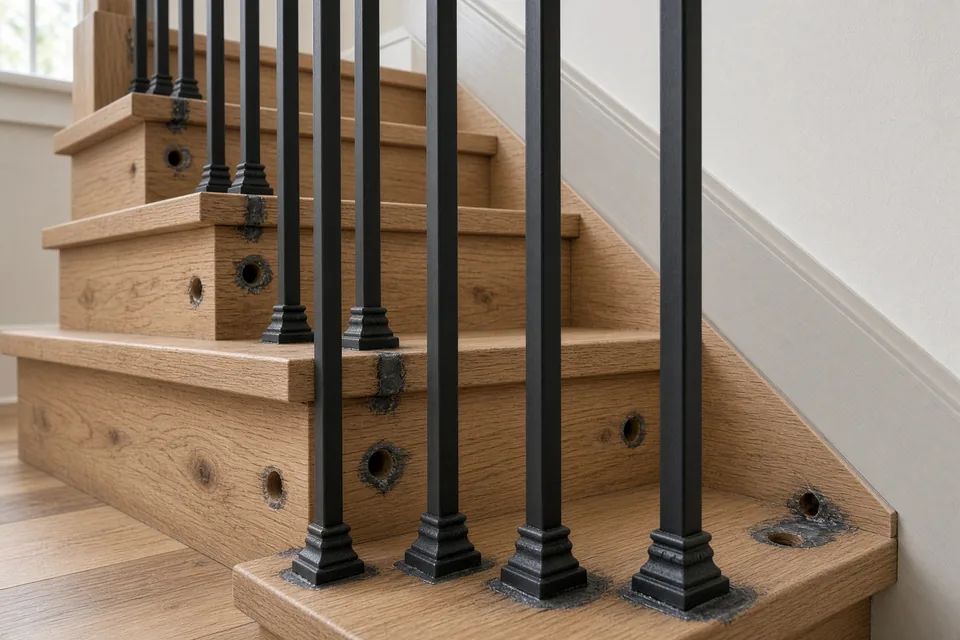 Step 02
Set the balusters
Balusters are set and epoxied into the treads and rail so a 4-inch sphere cannot pass anywhere along the stair.
Why it matters: Under IRC Section R312.1.3, balusters must be spaced so a 4-inch sphere (4-3/8-inch on stair open sides) cannot pass through.
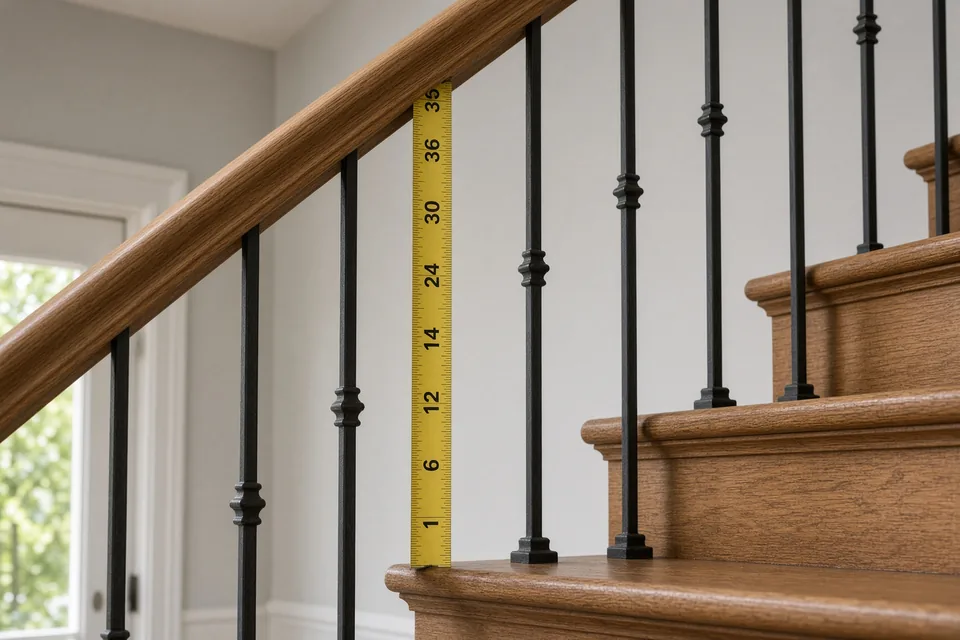 Step 03
Check the handrail height
Measure straight up from the nosing line: the top of the handrail must land between 34 and 38 inches before the stain and finish go on.
Why it matters: IRC Section R311.7.8.1 requires stair handrails to sit between 34 and 38 inches measured vertically from the sloped line of the tread nosings.


On this page
- The diagram, part by part
- Photo guide: hero and 3 project steps
- 2026 interior staircase railing cost table by material
- Three worked scenarios with full arithmetic
- Comparison table: painted wood vs iron balusters vs stainless cable vs tempered glass
- Building code reference: IRC Sections R311.7.8.1 & R312.1.3
- Quote checklist: 8 items to verify before hiring a stair carpenter
- Typical stair railing remodel timeline
- Worked example
- When insurance pays for a staircase
- Sources and further reading
- Frequently asked questions
2026 interior staircase railing cost table by material
| Stair Railing Material or Component | 2026 Low | 2026 High | What Changes the Price |
|---|---|---|---|
| Painted poplar handrail & turned/square wood balusters | $85 / linear ft | $165 / linear ft | Classic colonial or craftsman painted spindles; lowest material cost |
| Stained oak/maple handrail + wrought-iron balusters | $120 / linear ft | $230 / linear ft | Most popular remodel tier; basket, twist, or plain square iron spindles |
| Hardwood or powder-coated frame + stainless steel cable infill | $185 / linear ft | $340 / linear ft | 1/8-in 316 stainless cables at 3-in spacing + intermediate spreader posts |
| Tempered safety glass panels (3/8-in or 1/2-in) in clamps/shoe | $260 / linear ft | $480 / linear ft | Custom-templated angled rake glass panels + graspable top handrail |
| Structural newel post supplied & bolted to floor framing | $220 / post | $520 / post | Turned, craftsman box, or flanged steel newel anchored for 200-lb load |
| Over-the-post gooseneck, volute, or L/U-turn landing fittings | $450 | $1,100 | Hand-fitted curved hardwood rail transitions & hidden rail bolts |
| Old railing tear-out, disposal & stair tread hole plugging | $250 | $650 | Careful removal + grain-matched wood plugs or iron base shoes |
| Custom wood stain, polyurethane or enamel finish & inspection | $350 | $850 | Color-matching floors, 2–3 coats satin poly & enamel on skirts/posts |
Three worked scenarios with full arithmetic
Scenario 1: 16 LF straight staircase upgraded to stained oak & wrought-iron balusters (3 newels, worked example, 1.00x)
A homeowner removes a wobbly 16-linear-foot 1990s oak spindle railing (lf = 16, layout = straight, demo = yes) and installs a stained red-oak handrail with matte-black square wrought-iron balusters (material = stain_iron), 3 structural box newel posts (newels = 3), and custom stain/polyurethane finishing (finish_permit = yes).
- Stained Hardwood Rail & Wrought-Iron Balusters (16 lf × $120–$230/lf): $1,920 – $3,680
- 3 Structural Newel Posts Anchored (3 × $220–$520): $660 – $1,560
- Old Railing Tear-Out & Tread Hole Plugging: $250 – $650
- Custom Stain, Polyurethane Finish & Inspection: $350 – $850
- National Baseline Total (1.00x): $3,180 to $6,740
Scenario 2: 12 LF painted wood craftsman railing on a straight flight (2 newels, 1.00x)
A homeowner installs a 12-linear-foot painted poplar handrail with square craftsman wood spindles (lf = 12, material = wood, layout = straight), 2 newel posts (newels = 2), old rail removal (demo = yes), and two-coat urethane enamel finishing (finish_permit = yes).
- Painted Wood Handrail & Spindles (12 lf × $85–$165/lf): $1,020 – $1,980
- 2 Structural Newel Posts (2 × $220–$520): $440 – $1,040
- Old Railing Tear-Out: $250 – $650
- Enamel Finishing: $350 – $850
- National Baseline Total (1.00x): $2,060 to $4,520
Scenario 3: 24 LF L-turn staircase + upstairs loft overlook with stainless cable railing (5 newels, 1.00x)
A two-story home with an L-shaped landing and upstairs loft balcony totaling 24 linear feet (lf = 24, layout = turn_overlook) upgrades to stainless steel cable railing (material = cable) with 5 heavy anchored newel posts (newels = 5), tear-out (demo = yes), and finish/permit (finish_permit = yes).
- 24 LF Stainless Cable Railing System (24 × $185–$340/lf): $4,440 – $8,160
- 5 Heavy-Duty Anchored Newel Posts (5 × $220–$520): $1,100 – $2,600
- L-Turn & Balcony Return Fittings / Tension Hardware: $450 – $1,100
- Old Railing Tear-Out: $250 – $650
- Stain Finishing & Permit Inspection: $350 – $850
- National Baseline Total (1.00x): $6,590 to $13,360
Comparison table: painted wood vs iron balusters vs stainless cable vs tempered glass
| Feature | Painted Wood ($85–$165/lf) | Oak + Iron Balusters ($120–$230/lf) | Stainless Cable ($185–$340/lf) | Tempered Glass ($260–$480/lf) |
|---|---|---|---|---|
| Visual Openness | Traditional (thick 1.25–1.75 in spindles) | High (slim 1/2 in iron bars) | Very High (1/8 in horizontal wires) | Maximum (clear glass panels) |
| Post Tension Load | Normal | Normal | Very High (200–350 lbs per cable) | Normal (heavy dead weight) |
| Cleaning & Maintenance | Occasional dusting / touch-up paint | Virtually zero | Annual turnbuckle tension check | Fingerprints require glass cleaner |
| 4-Inch Sphere Rule Check | Easy (rigid vertical spindles) | Easy (rigid vertical iron) | Requires 3-in spacing + spreaders | Solid barrier (zero gap) |
Building code reference: IRC Sections R311.7.8.1 & R312.1.3
- Handrail Height (IRC Section R311.7.8.1): Handrails must be installed not less than 34 inches and not more than 38 inches, measured vertically from the sloped plane adjoining the tread nosings, or finish surface of ramp slope.
- Guard Opening Limitations (IRC Section R312.1.3): Required guards shall not have openings from the walking surface to the required guard height (minimum 36 inches on residential level balconies, 34 inches on stair runs per R312.1.2) that allow passage of a sphere 4 inches in diameter. Exceptions: (1) The triangular openings at the open side of a stair formed by the riser, tread, and bottom rail of a guard shall not allow passage of a sphere 6 inches in diameter; (2) Guards on the open sides of stairs shall not allow passage of a sphere 4-3/8 inches (111 mm) in diameter.
Quote checklist: 8 items to verify before hiring a stair carpenter
- Concealed Structural Newel Hardware: Does the bid specify structural lag bolts or through-bolts (such as Keylock/Sure-Tite style) anchored into the floor joists rather than toenails?
- Exact 34–38 In Rake Height: Will the carpenter set the sloped handrail at 34 to 38 inches above the tread nosings (IRC R311.7.8.1) and level balcony guards at minimum 36 inches (IRC R312.1.2)?
- 4-Inch Sphere Compliance: Are balusters spaced at roughly 3.5 inches clear (or cables at 3 inches with spreaders) so a 4-inch sphere can never pass through (IRC R312.1.3)?
- Graspable Profile (Type I or Type II): Does the top rail profile meet IRC R311.7.8.5 graspability rules so fingers can grip it during a slip?
- Two-Part Epoxy on Iron Balusters: Are hollow or solid wrought-iron balusters set in non-sag two-part structural epoxy so they never rattle or spin?
- Tread Hole Plugging or Shoes: How will old dowel holes in your existing oak treads be concealed?
- Pre-Finishing Before Assembly: Will staining and clear-coating happen before spindles are glued into the treads?
- Exterior vs Interior Separation: If you also need front steps or deck rails, compare the covered porch calculator and the deck calculator.
Typical stair railing remodel timeline
- Pre-Staining & Shop Prep: 1 to 2 days (staining handrails and box newels before bringing them into the house).
- On-Site Demolition, Newel Anchoring & Rail Joinery: 1 to 2 days for a standard 16-foot straight or L-turn flight.
- Baluster Epoxy Cure & Final Touch-Up: 1 day.
Worked example
A homeowner replaces 16 linear feet of outdated interior stair railing (lf = 16) on a straight flight (layout = straight) with a stained red-oak handrail and black wrought-iron balusters (material = stain_iron), installs and bolts 3 new structural box newel posts (newels = 3), includes old railing tear-out and tread plugging (demo = yes), and pays for custom stain/polyurethane finishing (finish_permit = yes) at the 1.00x baseline.
The default job, line by line
Worked example| Line item | National planning range |
|---|---|
| Stained hardwood handrail & wrought-iron balusters | $1,920 – $3,680 |
| Structural newel posts & 200-lb framing anchors | $660 – $1,560 |
| Old railing tear-out & stair tread hole plugging | $250 – $650 |
| Custom wood stain, polyurethane finish & inspection | $350 – $850 |
| Total before regional adjustment | $3,180 – $6,740 |
Midpoint about $4,960. These are the calculator's default inputs, so pressing the button above at the national region reproduces this table.
When insurance pays for a staircase
Homeowners insurance does not pay to upgrade outdated, loose, or non-code-compliant interior stair railings. Coverage applies only when a sudden, accidental covered peril—such as a house fire (the fire damage calculator), a fallen tree crashing through the roof into the stairwell, or sudden water damage warping the stair framing—destroys the balustrade. However, insurance underwriters and home inspectors care deeply about interior stair railings: if you have an open staircase with missing handrails or wide baluster gaps exceeding 4 inches, an insurer conducting a post-bind safety inspection can issue an underwriting requirement to bring the guard up to code within 30 to 60 days to avoid liability cancellation.
What this page will not claim
- This page does not price rebuilding structural stair stringers or replacing hardwood stair treads: Stringer/tread carpentry is separate from the railing system.
- This page does not price exterior deck or porch railings: Exterior weather-exposed guards stay on the deck calculator and the covered porch calculator.
Sources and further reading
- HomeAdvisor — Cost to install stair railings and balusters
- Bob Vila — How much does it cost to replace stair railings?
- International Code Council — International Residential Code
Prices on this page are planning ranges built from public 2026 US cost guides and contractor rate sheets, widened where they disagreed, and multiplied by the same regional index as every other ReplaceCost calculator. Codes and rules come from the bodies listed. See the methodology for how ranges are set and reviewed.
Frequently asked questions
Can I replace just my old wooden spindles with wrought-iron balusters and keep my existing handrail and newel posts?
Yes, if your existing hardwood handrail and newel posts are rock-solid, sit at the code-required 34 to 38 inches above the tread nosings (IRC R311.7.8.1), and have not pulled loose from the framing. A 'baluster-only' swap cuts out the old wood spindles, enlarges or adapters the top holes, and epoxies iron balusters with decorative base shoes that cover the old tread holes—typically saving 35% to 45% off a full rail-and-newel replacement.
What is the exact building code for stair handrail height and baluster spacing?
Under IRC Section R311.7.8.1, stair handrails must be installed between 34 inches and 38 inches measured vertically from the sloped plane connecting the stair tread nosings (while level upstairs balcony guards must be at least 36 inches high under R312.1.2). Under IRC Section R312.1.3, baluster openings cannot allow a 4-inch sphere to pass through on level guards or a 4-3/8-inch sphere on stair open sides.
Why does indoor stainless steel cable railing cost so much more than wrought-iron balusters?
Each 1/8-inch stainless steel cable is tensioned to 200 to 350 pounds so it does not sag or fail the 4-inch sphere test. Across 10 to 11 horizontal cables, that puts over 2,500 pounds of pulling force on the end newel posts. Therefore, cable railing ($185 to $340/lf) requires thick-wall steel or oversized reinforced hardwood end posts, stainless swage tensioners, and closely spaced intermediate spreader bars.
How do stair carpenters make a wobbly newel post rock-solid without tearing up my ceiling below?
Professional stair builders use concealed structural newel fasteners—such as a heavy-duty 5/8-inch threaded lag bolt screwed deep into the solid floor joist or stair carriage framing with a wrench-tightened cam nut recessed inside the bottom of the newel post, or a structural steel L-bracket concealed under a decorative base collar. That anchors the post to withstand the 200-pound lateral load without opening the drywall ceiling below.
Are horizontal stair railings (cable or horizontal iron bars) illegal under the building code because kids can climb them?
No. The International Residential Code does not ban horizontal infill; it regulates guard openings by the 4-inch sphere rule (IRC Section R312.1.3). However, because flexible cables can spread apart when pushed, inspectors test cable railings by pressing a 4-inch sphere against the cables with moderate force; keeping cable spacing at 3 inches and post spacing at 36 inches passes inspection.
Do I need a building permit just to replace my interior staircase railing?
If you are only swapping spindles or replacing a handrail in the exact same footprint, many municipalities treat it as minor finish carpentry, though some require a permit whenever a structural guard protecting a drop over 30 inches is removed and rebuilt. Even when no permit is pulled, building strictly to IRC R311.7.8.1 (34–38 in height) and R312.1.3 (under 4-inch sphere) helps your stairs pass a future buyer's home inspection.