Home › Gas line
Plumbing · fuel gas to an applianceGas line installation cost calculator
Safety first. If you smell gas, leave the building and call the gas utility or 911 from outside. A leak in an existing line is a service call, not a quote on this page. All fuel-gas piping, bonding, pressure testing, and pipe sizing must be performed by a licensed gas plumber/fitter and inspected by your local permit office—never attempt DIY gas piping.
Stop here if you are pricing the appliance itself rather than the fuel pipe: whole-house standby generators sit on the generator calculator, tank and tankless heaters sit on the water heater calculator, furnaces sit on the furnace calculator, and domestic water supply pipes sit on the repiping calculator.
Across the United States in 2026, running a new indoor natural gas or propane branch line using rigid black malleable iron or flexible Corrugated Stainless Steel Tubing (CSST) costs $18 to $38 per linear foot, while trenching and burying underground polyethylene (PE) gas pipe with anodeless steel risers runs $24 to $55 per linear foot, plus $150 to $350 per appliance termination and $200 to $500 for the pressure test and permit.
The calculator does not size the pipe: a licensed installer sizes every pipe section using total BTU load, developed length, and supply pressure. If your gas meter or propane regulator may be too small for a generator or tankless water heater, the utility or propane supplier prices that upgrade.
Reviewed 25 October 2026 · Written by Mantu Kumar
See the photos · See the cost diagram · Open the calculator · Every part explained
Key facts at a glance
- Indoor black iron pipe runs $18 to $34 per linear foot installed, and flexible CSST runs $20 to $38 per linear foot installed across open basement or attic framing.
- Trenching and burying yellow polyethylene (PE) underground gas pipe with tracer wire and steel risers at both ends runs $24 to $55 per linear foot.
- Each appliance termination—including a listed manual gas shutoff valve, sediment trap (drip leg), and manifold tee—adds $150 to $350 per appliance.
- Direct electrical bonding of yellow CSST piping with a minimum 6 AWG copper bonding jumper to the grounding electrode system runs $180 to $420.
- Isolating the new branch, holding a pneumatic gauge pressure test for the municipal inspector, and pulling the fuel-gas permit adds $200 to $500.
National 2026 planning ranges before your regional multiplier. Sources and method are at the bottom of the page.
2026 planning ranges
- 1Meter or regulator capacity
- 2Pipe material
- 3Route and length
- 4Shutoff and sediment trap at the appliance
- 5Bonding (CSST)
- 6Pressure test and permit
- 7Appliance hookup (not included)
- 8Buried-line details
- 9Natural gas or propane
Price your gas line installation
No email · nothing sentDiagram, part by part
Gas line installation: every numbered part explained
The drawing above has 9 numbered parts, from Meter or regulator capacity to Natural gas or propane. Each card zooms in on one part, says what pushes its price up or down, and what to check on a written quote. After you run the calculator, the parts in your scope show their dollar figure.
1 Meter or regulator capacity
Not priced on this page
A standard residential natural gas meter (such as an AC-250 rated around 250,000 BTU/hr) easily handles a gas furnace, tank water heater, stove, and dryer. However, adding a 199,000 BTU tankless water heater or a 22 kW whole-house standby generator (250,000 to 350,000 BTU/hr alone) often exceeds the capacity of the existing gas meter or propane two-stage regulator. When the high-BTU flag turns on, the gas utility or propane supplier prices that upgrade.
What moves it: Total connected BTU/hr rating of all gas appliances in the house versus your meter's cubic-feet-per-hour badge rating.
On the quote: Ask the licensed gas fitter to sum the nameplate BTU ratings of every gas appliance in your home before sizing the branch.
2 Pipe material
$18 – $34 / ft (black iron) | $20 – $38 / ft (CSST) | $24 – $55 / ft (buried PE)
Three materials dominate residential fuel gas: rigid Schedule 40 black malleable iron ($18–$34/ft, cut and threaded on site for durable straight runs in open basements), flexible Corrugated Stainless Steel Tubing or CSST ($20–$38/ft, snaked around joists with fewer fittings), and yellow polyethylene (PE) plastic pipe ($24–$55/ft including trenching, approved strictly for underground outdoor burial—never allowed inside a building or above grade).
What moves it: Indoor open basement framing (black iron), fished interior runs (CSST), or outdoor yard trenches (buried PE).
On the quote: Never allow uncoated black iron to be buried directly in soil or yellow polyethylene pipe to run exposed above ground.
3 Route and length
Linear feet × material rate (installer sizes pipe diameter)
Under the International Fuel Gas Code (IFGC Section 402) and NFPA 54, gas pipe diameter cannot be guessed from the appliance fitting size—the licensed installer must size the pipe using the longest developed length method (or branch-length method), accounting for total BTU demand, specific gravity of natural gas versus propane, and allowable pressure drop. Tapping closer to the main meter manifold prevents starving downstream appliances.
What moves it: Total developed length from the meter to the farthest appliance and whether the plumber taps the main manifold or an existing tee.
On the quote: Confirm whether the plumber is tying into the main header near the gas meter or tapping an undersized 1/2-inch branch pipe.
4 Shutoff and sediment trap at the appliance
$150 – $350 per appliance termination
Every gas appliance termination requires an accessible, listed quarter-turn manual shutoff valve located within 6 feet of the appliance in the same room (IFGC Section 409.5). In addition, appliances such as furnaces, water heaters, generators, and boilers require a sediment trap (drip leg)—a tee fitting with a capped 3-inch vertical nipple below the gas inlet (IFGC Section 408.4)—to catch pipe scale and moisture before it fouls the gas valve.
What moves it: Number of appliances being stubbed out on the run and whether a recessed wall box is used behind a slide-in kitchen range.
On the quote: If you are buying a flush-back slide-in kitchen stove, ask the plumber to install a recessed gas outlet box in the wall so the stove pushes tight to the backsplash.
5 Bonding (CSST)
$180 – $420 (when CSST is used)
Standard yellow-jacketed CSST has a thin stainless steel wall that can be punctured by an electrical arc if a nearby lightning strike energizes the house framing relative to the gas pipe. Under NFPA 54 Section 7.12.2 and IFGC Section 310.2, CSST systems must be electrically bonded directly to the home's electrical grounding electrode system using a listed brass clamp on a rigid pipe section and a minimum 6 AWG copper wire ($180–$420).
What moves it: Distance from the gas manifold to the main electrical panel or grounding electrode conductor.
On the quote: Verify that any CSST quote explicitly includes a 6 AWG copper bonding jumper connected to the electrical grounding system—not clipped to a water pipe.
6 Pressure test and permit
$200 – $500
Fuel-gas piping is never inspected by sniffing for leaks with a lighter. Under IFGC Section 406, the plumber isolates the new piping before appliances are connected, pressurizes the line with air or inert gas on a calibrated test gauge (typically 3 to 15+ PSI depending on local code), and holds the pressure with zero drop while the municipal plumbing/gas inspector witnesses the gauge ($200–$500 including permit).
What moves it: Local municipal fuel-gas permit fees and whether the gas utility requires a separate tag-and-turn-on inspection.
On the quote: Never waive the municipal gas permit and pressure test—unpermitted gas work creates severe safety and insurance liability.
7 Appliance hookup (not included)
Not priced on this page
This calculator prices the permanent house fuel-gas piping up to the appliance shutoff valve and sediment trap. Buying and installing the appliance itself—such as a standby generator and automatic transfer switch (the generator calculator), a tank or tankless water heater (the water heater calculator), or a high-efficiency furnace (the furnace calculator)—plus converting stove orifices from natural gas to propane is priced on each appliance's dedicated quote.
What moves it: Whether you are connecting a simple kitchen range or commissioning a standby generator or tankless water heater.
On the quote: If your home uses liquid propane (LP), confirm who installs the LP orifice conversion kit inside the new stove or dryer.
8 Buried-line details
$280 – $620 (anodeless steel risers & tracer wire, plus $24 – $55 / ft trench)
Running gas underground to a pool house, detached garage, standby generator pad, or built-in patio grill requires digging an 18-to-24-inch-deep trench, laying yellow polyethylene (PE) gas pipe on a sand bed with a minimum 18 AWG yellow-insulated copper tracer wire (IFGC Section 404.17.3) so future 811 locators can find the plastic pipe, and transitioning above ground at both ends using factory pre-bent epoxy-coated anodeless steel risers ($280–$620 pair).
What moves it: Trenching through open turf versus hand-digging around tree roots or boring under a concrete patio or walkway.
On the quote: Ensure the quote specifies factory anodeless steel risers at both ends and a continuous 18 AWG copper tracer wire taped along the buried PE pipe.
9 Natural gas or propane
Changes who supplies the meter or regulator
Natural gas comes through the utility meter; propane comes from a tank through a two-stage regulator owned or serviced by your supplier. The pipe inside the house is priced the same way, but propane appliances need the right orifices, and a large new load may need a bigger regulator or tank that the supplier prices separately.
What moves it: The fuel your house uses and whether the new load is large enough to need a supplier check.
On the quote: If you use propane, ask the supplier to confirm regulator and tank capacity before the plumber starts.
Project photo guide
Gas line work in photos: the manifold, the drip leg and the trench
Safe fuel-gas installation relies on rigid support, electrical bonding, and a witnessed gauge pressure test. These four scenes show a basement black-iron and CSST manifold with a 6 AWG copper bonding clamp, an appliance shutoff valve and 3-inch sediment trap behind a range, an underground yellow PE gas trench with tracer wire and steel riser, and a pressure-test gauge.

How the job works in 3 key stages
All three step images are AI-generated illustrations for explanation. Not a site inspection, bid, or coverage decision.
 Step 01
Bury the outdoor run
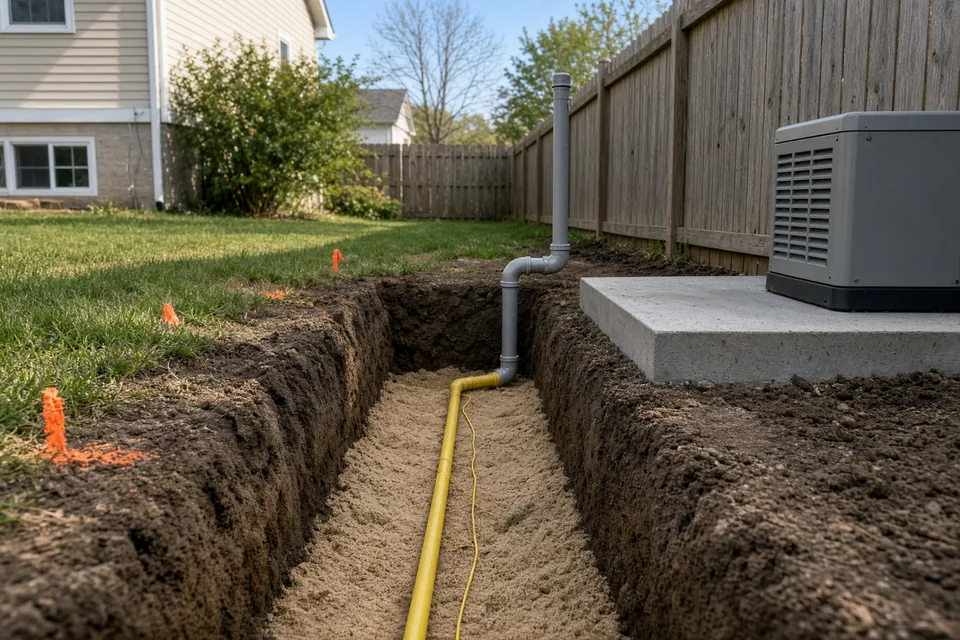
Outdoor runs use yellow polyethylene pipe buried 18 to 24 inches deep with a copper tracer wire, rising out of the soil through anodeless steel risers.
Why it matters: Underground gas lines ($24–$55/ft) use buried polyethylene pipe with an 18 AWG copper tracer wire and anodeless steel risers ($280–$620 pair) where the pipe exits the soil.
 Step 02
Shutoff and drip leg
Each appliance gets an accessible quarter-turn shutoff valve and a 3-inch sediment trap so scale and moisture drop out before gas reaches the burner.
Why it matters: Every gas termination ($150–$350) includes an accessible manual shutoff valve and a 3-inch vertical sediment trap (drip leg) to catch scale before it enters the appliance.
 Step 03
Pressure test and inspect
The new piping is capped and held under air pressure on a gauge for the inspector; CSST also needs its 6 AWG bonding jumper before gas is turned on.
Why it matters: A pneumatic pressure test held on a gauge for the municipal inspector ($200–$500 with permit) verifies zero leaks before the gas cock is opened.


On this page
- The diagram, part by part
- Photo guide: hero and 3 project steps
- 2026 gas line installation cost table by material & line item
- Three worked scenarios with full arithmetic
- Decision table: black iron vs flexible CSST vs buried polyethylene (PE)
- Signs your gas meter or propane regulator needs a capacity check
- Quote checklist: 8 items to verify on a gas fitter estimate
- Typical gas line installation timeline
- Worked example
- Does insurance pay for a new gas line?
- Sources and further reading
- Frequently asked questions
2026 gas line installation cost table by material & line item
| Gas Piping Line Item | 2026 Low | 2026 High | What Changes the Price |
|---|---|---|---|
| Rigid Schedule 40 black iron gas pipe (indoor basement/crawl/attic) | $18 / linear ft | $34 / linear ft | Pipe diameter (1/2 in to 1-1/4 in) and number of threaded elbows/tees |
| Flexible CSST (Corrugated Stainless Steel Tubing — indoor fished) | $20 / linear ft | $38 / linear ft | Standard yellow vs arc-resistant black-jacketed CSST and brass fittings |
| Buried yellow polyethylene (PE) gas pipe (includes 18–24 in trench) | $24 / linear ft | $55 / linear ft | Open lawn trench vs hand-digging around roots or patio crossings |
| Appliance termination (manual shutoff valve, sediment trap & tee) | $150 / appliance | $350 / appliance | Standard stub-out vs recessed range box or outdoor quick-connect |
| CSST 6 AWG copper electrical bonding jumper & listed clamp | $180 | $420 | Required by NFPA 54 / IFGC 310.2 back to grounding electrode system |
| Underground anodeless steel risers (pair) & 18 AWG tracer wire | $280 | $620 | Required wherever buried PE pipe transitions above ground |
| Pneumatic gauge pressure test & municipal fuel-gas permit | $200 | $500 | Municipal permit fee and inspector witness time |
| Meter or propane regulator upgrade (high-BTU flag) | Utility / Supplier | Utility / Supplier | Priced directly by your gas utility or LP supplier if needed |
Three worked scenarios with full arithmetic
Scenario 1: 30-foot indoor black iron gas line to a kitchen stove (worked example, 1.00x)
A homeowner runs 30 linear feet of rigid Schedule 40 black iron pipe across an unfinished basement ceiling and up through the kitchen floor for 1 new gas range.
- 30 ft Black Iron Gas Pipe Installed ($18–$34/ft × 30): $540 – $1,020
- 1 Appliance Termination (Shutoff Valve, Sediment Trap & Tee): $150 – $350
- CSST Bonding: $0 (rigid black iron used)
- Underground Risers: $0 (indoor run)
- Pressure Test & Municipal Gas Permit: $200 – $500
- National Total: $890 to $1,870
Scenario 2: 40-foot fished indoor CSST run to both a kitchen stove and laundry dryer (1.00x)
In a house with a partially finished basement ceiling, the plumber fishes 40 linear feet of flexible CSST to feed 2 appliances (a kitchen range and a gas clothes dryer) and installs the mandatory 6 AWG copper electrical bonding jumper.
- 40 ft Flexible CSST Installed ($20–$38/ft × 40): $800 – $1,520
- 2 Appliance Terminations ($150–$350 × 2): $300 – $700
- Mandatory 6 AWG Copper CSST Electrical Bonding: $180 – $420
- Pressure Test & Municipal Gas Permit: $200 – $500
- National Total: $1,480 to $3,140
Scenario 3: 50-foot buried polyethylene (PE) trench to a standby generator pad (high-BTU flag, 1.00x)
A homeowner trenches 50 linear feet across the side yard from the exterior gas meter to a standby generator pad (meter_flag = yes because a 22 kW generator draws ~250,000+ BTU/hr).
- 50 ft Trenched & Buried Yellow PE Gas Pipe ($24–$55/ft × 50): $1,200 – $2,750
- 1 Generator Termination (Full-Port Shutoff Valve & Sediment Trap): $150 – $350
- Pair of Anodeless Steel Risers & 18 AWG Copper Tracer Wire: $280 – $620
- Pressure Test & Municipal Gas Permit: $200 – $500
- Meter / Regulator Capacity Check: Utility or LP supplier prices any meter upsizing
- National Total: $1,830 to $4,220 (generator unit & transfer switch priced on the generator calculator)
Decision table: black iron vs flexible CSST vs buried polyethylene (PE)
| Pipe Material | 2026 Installed Rate | Where Allowed by Code | Best Advantage | Key Code Requirement |
|---|---|---|---|---|
| Schedule 40 Black Iron | $18 – $34 / ft | Indoors & supported outdoor above-ground (painted) | Rigid, puncture-resistant, lower fitting cost | Cannot be buried directly in soil without corrosion protection |
| Flexible CSST | $20 – $38 / ft | Indoors through joists, studs & chases | Snakes around obstacles with minimal fittings | Requires 6 AWG copper bonding jumper ($180–$420) or conductive jacket |
| Yellow Polyethylene (PE) | $24 – $55 / ft | Strictly underground outdoors (18–24 in deep) | Never rusts or corrodes in wet soil | Requires 18 AWG tracer wire + anodeless steel risers ($280–$620) at ends |
Signs your gas meter or propane regulator needs a capacity check
- Adding a whole-house standby generator (180,000 to 350,000 BTU/hr) or tankless water heater (150,000 to 199,000 BTU/hr): These single appliances often equal or exceed the entire rating of a standard residential 250 CFH natural gas meter.
- Furnace or stove flame drops slightly when another gas appliance kicks on: Indicates an undersized trunk line or a regulator starving for volume.
- Switching from a 35,000 BTU cooktop to a 90,000+ BTU commercial-style 6-burner pro range: Often requires a dedicated 3/4-inch branch back to the meter header rather than tapping an existing 1/2-inch kitchen line.
Quote checklist: 8 items to verify on a gas fitter estimate
- Written BTU Load & Pipe-Sizing Calculation: Did the plumber total all house appliances and calculate developed length before picking pipe diameter?
- Manifold Tap vs Branch Tap: Will the new line connect at the main meter manifold so existing appliances are not starved?
- Shutoff Valve & 3-Inch Sediment Trap: Are both a quarter-turn shutoff valve and a code-required drip leg included at the appliance?
- CSST Electrical Bonding: If yellow CSST is used, is a 6 AWG copper bonding jumper to the grounding electrode system explicitly included?
- Underground Tracer Wire & Anodeless Risers: On buried runs, are an 18 AWG copper locator wire and epoxy-coated steel risers specified?
- 811 Locate Before Trenching: Who calls 811 before digging an outdoor trench?
- Witnessed Gauge Pressure Test & Permit: Is the municipal fuel-gas permit and pressure test included?
- Utility Meter Upgrade Responsibility: If adding a generator or tankless unit, who submits the BTU load sheet to the gas utility?
Typical gas line installation timeline
- Days 1–3 (Prep): Load calculation, municipal gas permit application, and 811 underground locate (for outdoor trenches).
- Install Day (3 to 7 hours): Shut off gas, thread black iron / pull CSST / trench PE pipe, install shutoff valve and sediment trap, connect CSST bonding clamp, and pressurize test gauge.
- Inspection & Turn-On (Same day or next day): Municipal inspector checks gauge pressure and bonding; plumber purges air, connects appliance, soap-tests final joints, and test-fires burner.
Worked example
A homeowner runs 30 linear feet of rigid Schedule 40 black iron gas pipe through an open unfinished basement from the meter manifold up to 1 new kitchen gas range (standard BTU load, no meter upgrade required), including the manifold tee, brass ball shutoff valve, sediment trap (drip leg), pneumatic pressure test, and municipal gas permit at the 1.00x national baseline.
The default job, line by line
Worked example| Line item | National planning range |
|---|---|
| 30 linear feet of black iron gas pipe installed | $540 – $1,020 |
| 1 appliance termination | $150 – $350 |
| Pneumatic pressure test & municipal gas permit | $200 – $500 |
| Total before regional adjustment | $890 – $1,870 |
Midpoint about $1,380. These are the calculator's default inputs, so pressing the button above at the national region reproduces this table.
Does insurance pay for a new gas line?
Running a new natural gas or propane branch line to a kitchen range, clothes dryer, outdoor grill, or standby generator is a voluntary home improvement—homeowners insurance does not pay for new appliance piping. What if an existing buried exterior gas pipe between the street meter and your house corrodes, shifts in frost, or gets crushed by tree roots? Standard homeowners policies exclude underground yard piping outside the foundation, unless you purchased an optional Service Line Coverage endorsement (which you can check on the service line cover calculator). Inside the house, standard policies do not pay the plumber's bill to fix a worn-out leaking pipe joint, though sudden fire or explosion damage resulting from a gas event is a covered peril on the fire damage calculator, subject to your deductible (the should-I-file-a-claim calculator). Policy wording and the adjuster decide every claim.
What this page will not claim
- This page never sizes a gas pipe: Only a licensed gas fitter who measures your total BTU load, supply pressure, and developed length can size gas piping.
- This page never prices gas leak repairs: If you smell gas, leave the building immediately and call the gas utility or 911 from outside.
- This page never invents a utility meter or propane regulator fee: The gas utility or propane supplier prices meter and regulator upgrades directly.
Sources and further reading
- HomeAdvisor — Cost to install or repair gas lines
- Fixr — How much does it cost to install a gas line?
- International Code Council — International Residential Code
Prices on this page are planning ranges built from public 2026 US cost guides and contractor rate sheets, widened where they disagreed, and multiplied by the same regional index as every other ReplaceCost calculator. Codes and rules come from the bodies listed. See the methodology for how ranges are set and reviewed.
Frequently asked questions
Why doesn't this calculator tell me whether I need a 1/2-inch, 3/4-inch, or 1-inch gas pipe?
Under the International Fuel Gas Code (IFGC Section 402) and NFPA 54, gas pipe diameter depends on four variables working together: the total BTU/hr demand of every gas appliance in the house, the longest developed pipe length from the meter to the farthest appliance, the incoming gas pressure (for example, 7 inches water column vs 2 PSI), and the specific gravity of natural gas versus propane. Only your licensed installer can size the pipe.
Why does flexible yellow CSST gas tubing require an electrical bonding wire?
Standard yellow Corrugated Stainless Steel Tubing (CSST) has a thin stainless wall. If lightning strikes near your house, voltage difference between the gas piping and the electrical system can cause an electrical arc to jump from a metal duct or wire to the CSST, burning a pinhole through the gas line. Connecting a 6 AWG copper bonding jumper from a rigid gas hub to the home's grounding electrode system equalizes that voltage.
Can a plumber bury black iron pipe or CSST directly in a backyard trench to my grill or generator?
No. Uncoated black iron pipe corrodes rapidly in damp soil and will pit and leak, and standard indoor CSST is not approved for direct earth burial. Outdoor underground gas trenches use yellow medium-density or high-density polyethylene (PE) plastic gas pipe buried 18 to 24 inches deep with an 18 AWG copper tracer wire taped alongside it and factory anodeless steel risers where the pipe comes out of the ground.
What is a sediment trap (drip leg), and does every gas appliance need one?
A sediment trap is a vertical tee assembly with a 3-inch capped pipe nipple installed right after the manual shutoff valve before gas enters the appliance control valve. As gas flows horizontally into the tee and turns 90 degrees upward into the appliance, any loose pipe-thread sealant, metal shavings, or moisture drops down into the capped 3-inch pocket instead of jamming the expensive electronic gas valve.
When does adding a gas line require the utility company to upgrade my gas meter?
A standard residential gas meter is typically rated for about 250 cubic feet per hour (~250,000 BTU/hr). Adding a 40,000 BTU stove or 22,000 BTU dryer rarely strains the meter. However, adding a 199,000 BTU tankless water heater or a 22 kW standby generator (250,000 to 350,000 BTU/hr) on top of an existing furnace often exceeds 250,000 BTU/hr, requiring the gas utility or propane supplier to install a higher-capacity meter or regulator.
Can I use my existing natural gas pipes if I switch an appliance to liquid propane (LP)?
While black iron, CSST, and buried PE are approved for both natural gas and liquid propane, the two fuels operate at different pressures and energy densities (propane delivers roughly 2,500 BTU per cubic foot vs 1,000 BTU for natural gas), and every appliance burner orifice and gas-valve regulator spring must be converted by a licensed technician using the manufacturer's LP conversion kit.