Home › Whole-house rewire
Electrical · knob-and-tube and aluminumWhole-house rewire cost calculator
Safety first. Working inside energized branch circuits, brittle knob-and-tube porcelain assemblies, or overheated aluminum receptacles carries severe fire and electrocution hazards; a licensed master electrician and your municipal electrical inspector decide the code-compliant scope. Never perform DIY modifications on knob-and-tube or aluminum wiring.
Replacing every branch circuit in an older house is a completely different project from adding a couple of receptacles. Stop here if you only need to swap a few outlets or add a dedicated circuit—those small jobs belong on the wiring & outlets calculator. Likewise, if you are only upgrading a 100-amp fuse box to a 200-amp breaker panel without pulling new house cables, go straight to the electrical panel calculator.
The base rate is $5 to $10 per square foot of living area for new branch-circuit cable runs, which puts a 1,600 sq ft house in the common $10,000 to $15,000 range used on the wiring & outlets calculator. When devices are done in one visit they are priced as a batch: $150 to $300 per outlet or switch box and $200 to $350 per GFCI, a little below a single service call.
Two rules govern older wiring: first, under National Electrical Code (NEC) Section 394.12, knob-and-tube wiring is not allowed in hollow spaces containing loose, rolled, or foamed thermal insulation (see the attic insulation calculator); second, the U.S. Consumer Product Safety Commission's guide Repairing Aluminum Wiring treats pigtailing with a COPALUM crimp connector as a permanent repair and describes AlumiConn as a newer option with a shorter track record, yet some insurers still want full copper rewiring.
Reviewed 25 October 2026 · Written by Mantu Kumar
See the photos · See the cost diagram · Open the calculator · Every part explained
Key facts at a glance
- Whole-house copper branch-circuit rewiring runs $5.00 to $10.00 per square foot of living area with open attic/basement access, so a 1,600 sq ft house sits in an $8,000 to $16,000 base band.
- Device replacement and aluminum copper-pigtailing done in one visit run about $150 to $300 per outlet or switch box and $200 to $350 per GFCI device.
- Fishing new NM-B cables through multi-story wood lath and plaster walls without open attic/basement chases adds 25% to rough-in labor plus $900 to $2,600 for access-hole patching.
- National Electrical Code (NFPA 70) Section 394.12 ('Uses Not Permitted') prohibits concealed knob-and-tube wiring in hollow spaces where loose, rolled, or foamed-in-place thermal insulation envelops the conductors.
- In its guide Repairing Aluminum Wiring (Publication 516), the U.S. Consumer Product Safety Commission calls pigtailing with a COPALUM crimp connector a safe and permanent repair, and describes the AlumiConn connector as a newer option without the same long-term record; some insurers still require full copper rewiring.
National 2026 planning ranges before your regional multiplier. Sources and method are at the bottom of the page.
2026 planning ranges
- 1Old wiring identified
- 2Path through attic and basement
- 3New cable runs
- 4Devices
- 5Panel (link only)
- 6Openings closed
- 7Permit and inspection
- 8Insulation conflict
- 9Aluminum pigtail repairs
Price your whole-house rewire
No email · nothing sentDiagram, part by part
Whole-house rewire: every numbered part explained
The drawing above has 9 numbered parts, from Old wiring identified to Aluminum pigtail repairs. Each card zooms in on one part, says what pushes its price up or down, and what to check on a written quote. After you run the calculator, the parts in your scope show their dollar figure.
1 Old wiring identified
$400 – $950 (K&T de-energizing & cap) | $150 – $400 (cloth/BX disconnect)
Three legacy wiring generations trigger whole-house rewires in the US: knob-and-tube (1890s–1940s individual rubber-cloth wires suspended on white porcelain knobs and tubes with no ground wire), ungrounded cloth-sheathed or early metal-clad cable (1940s–early 1960s with brittle insulation that crumbles inside hot ceiling fixture boxes), and single-strand AA-1350 solid aluminum branch wiring (1965–1973, which expands, creeps, and oxidizes at brass outlet screws). Electricians disconnect and cap abandoned runs safely inside the walls.
What moves it: Whether the house has exposed attic knob-and-tube that must be stripped out before blowing insulation versus concealed wall runs capped dead.
On the quote: Ask the electrician for a written certificate stating that 100% of active knob-and-tube wiring has been disconnected and removed from the panel.
2 Path through attic and basement
1.00x (open attic & basement) | +25% labor (plaster / finished ceiling)
Electricians do not tear down all your drywall to rewire an occupied house. Instead, they use an unfinished basement or crawlspace to feed first-floor receptacles from below and use an open attic to drop switch legs and ceiling light cables down from above. When a two-story house has wood lath-and-plaster walls, horizontal fireblocking, and a finished basement ceiling with no open vertical chase, fishing cables takes roughly 25% more labor.
What moves it: Open unfinished basement and attic access versus multi-story wood lath-and-plaster walls with finished ceilings.
On the quote: Show the estimator your basement ceiling and attic hatch so they can map the vertical chase routes before quoting.
3 New cable runs
$5.00 – $10.00 per sq ft of living area
Whole-house copper NM-B (Romex) branch-circuit rewiring uses the same $5.00 to $10.00 per square foot band as the wiring & outlets calculator. On a 1,600-square-foot home, that puts the base cable and rough-in line at $8,000 to $16,000 (centering on the common $10,000 to $15,000 band). This covers pulling grounded 14/2 and 12/2 copper circuits for general lighting, bedrooms, living areas, bathrooms, and kitchen small-appliance circuits.
What moves it: Total heated square footage of the home and number of stories.
On the quote: Confirm that the quote includes separate 20-amp kitchen countertop, bathroom, and laundry circuits required by current NEC rules.
4 Devices
$150 – $300 / box ($200 – $350 / GFCI) + $750 – $1,850 AFCI/GFCI breaker trim
Every device count on this page uses the exact same range as the wiring & outlets calculator: $150 to $300 per outlet or switch box and $200 to $350 per GFCI outlet. If your 1965–1973 home has solid aluminum branch wiring and you select 'Aluminum pigtail remediation only', the calculator prices copper pigtailing across all device boxes (40 boxes on a 1,600 sq ft home = $6,000 to $12,000) and reminds you that some insurers still require a full copper rewire.
What moves it: Choosing full copper rewiring versus per-box aluminum pigtailing (COPALUM cold-weld crimps or AlumiConn set-screw lugs).
On the quote: Before paying for aluminum pigtailing, get written confirmation from your insurance underwriter stating whether they accept AlumiConn or COPALUM repairs.
5 Panel (link only)
Linked to the electrical panel calculator (not double-priced here)
A whole-house rewire adds dozens of modern arc-fault (AFCI) and ground-fault (GFCI) circuit breakers, which requires a modern 200-amp main breaker panel with 30 to 40+ spaces. If your house still has a 60-amp or 100-amp fuse box or an obsolete split-bus panel, keep that service upgrade separate and price it on the separate electrical panel calculator so your panel, mast, and meter base are never counted twice.
What moves it: Whether your house already has a 200-amp breaker panel with open spaces or needs a full service upgrade on the electrical panel calculator.
On the quote: If you need both a 200-amp panel swap and a whole-house rewire, ask the electrician for a combined permit and single utility disconnect day.
6 Openings closed
$450 – $1,200 (drywall access holes) | $900 – $2,600 (plaster access holes)
Even skilled wire fishers must cut small 4-by-4-inch access holes or circular saw-cuts near top plates, corners, and horizontal fireblocking to guide flexible drill bits from floor to floor. Most electrical contractors either leave those holes open or install rough backing patches. This line budgets $450 to $1,200 on drywall (or $900 to $2,600 on three-coat plaster) for a drywall/plaster finisher to patch and skim-coat the access openings (full walls on the drywall calculator).
What moves it: Number of wall-fishing access cuts and whether the walls are standard drywall or textured plaster over wood lath.
On the quote: Clarify in writing whether the electrical contractor patches their own fishing holes or leaves wall repair to a drywall subcontractor.
7 Permit and inspection
$150 – $450 (starts at exact $150 – $350 wiring & outlets calculator permit band)
Rewiring a house or remediating aluminum branch circuits requires a municipal electrical permit, a rough-in inspection while boxes and cable staples are visible, and a final inspection testing AFCI and GFCI trip functions ($150–$450). More importantly, the signed municipal final inspection sticker is the exact document home insurance underwriters and mortgage lenders demand to prove that knob-and-tube or un-remediated aluminum wiring is gone.
What moves it: Local municipal permit fee schedules and whether a two-stage (rough + final) inspection is required.
On the quote: Never accept an unpermitted rewire—without the city inspector's sign-off, insurance companies will still flag the house as having knob-and-tube.
8 Insulation conflict
Not priced on this page
Knob-and-tube conductors were designed in the early 1900s to dissipate heat into open air inside empty joist bays. Under National Electrical Code (NFPA 70) Section 394.12, concealed knob-and-tube wiring is prohibited in hollow spaces of walls, ceilings, and attics where those spaces are insulated by loose, rolled, or foamed-in-place thermal insulation. You must rewire and disconnect attic knob-and-tube before blowing insulation on the attic insulation calculator.
What moves it: Whether you plan to add blown-in cellulose, fiberglass, or spray foam on the attic insulation calculator.
On the quote: Weatherization programs and insulation contractors will refuse to insulate an attic until an electrician certifies all knob-and-tube is dead.
9 Aluminum pigtail repairs
$150 – $300 per device box
When aluminum branch wiring stays in place, each outlet, switch and light connection gets a short copper pigtail joined with a listed aluminum-to-copper connector. It addresses the overheating risk at device terminals for less than a full rewire, but some insurers still ask for a copper rewire, so check before you choose this path.
What moves it: How many device boxes the house has and how many sit in hard-to-reach places.
On the quote: Ask which connector will be used and get the insurer's acceptance of pigtailing in writing before work starts.
Project photo guide
House rewiring in photos: old wiring, fishing cable and patching
Rewiring an occupied older home is a precision fishing job rather than a gut demolition. These four scenes show old porcelain knob-and-tube wiring exposed in an attic joist bay, an electrician fishing new grounded yellow 12/2 NM-B copper cable into an old-work wall box, a three-port AlumiConn aluminum-to-copper pigtail splice, and small patched access holes along a ceiling line.

How the job works in 3 key stages
All three step images are AI-generated illustrations for explanation. Not a site inspection, bid, or coverage decision.
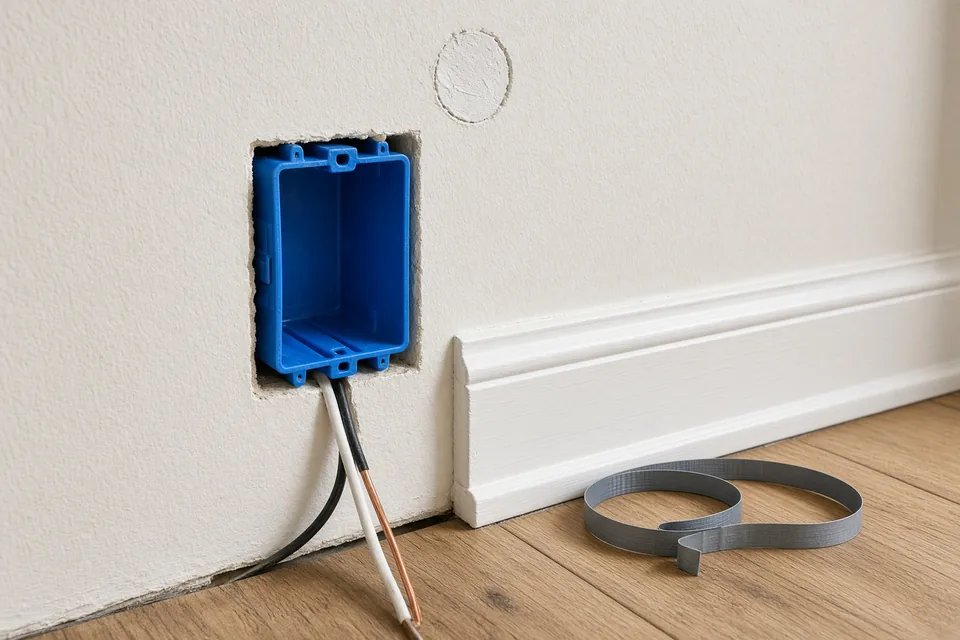 Step 01
Fish the new cable
Fish new grounded 14/2 and 12/2 copper NM-B cables vertically from the basement and attic into old-work remodel outlet and switch boxes while keeping plaster or drywall access openings minimal.
Why it matters: Fishing cables up from an unfinished basement and down from an attic lets electricians rewire a house using only small, easily patched access holes.
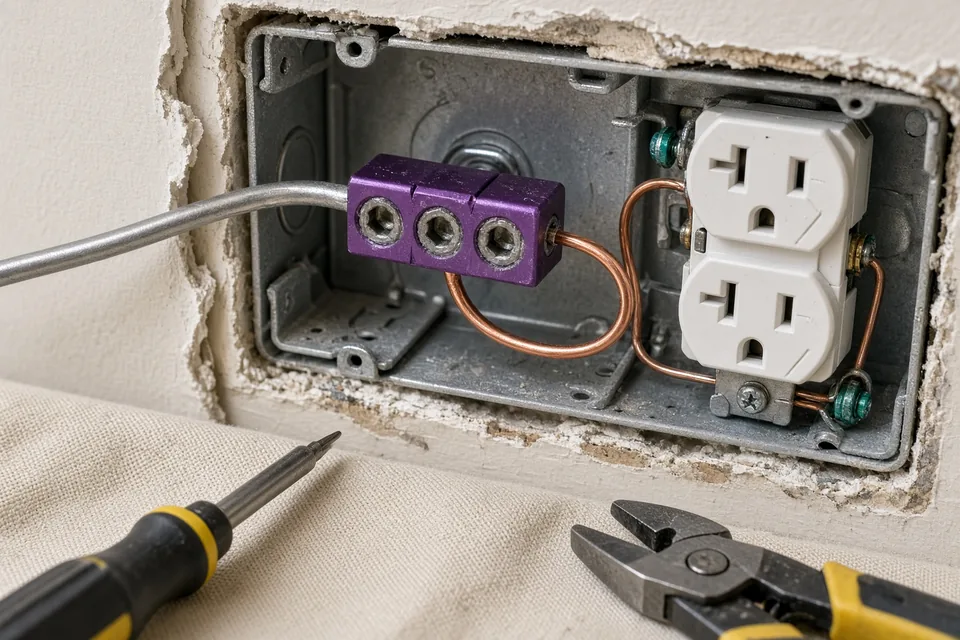 Step 02
Pigtail where aluminum stays
Where aluminum branch wiring stays in place, each device gets a short copper pigtail joined with a listed aluminum-to-copper connector inside the box.
Why it matters: Copper pigtailing ($150–$300 per box) addresses overheating at device terminals, though some home insurance carriers still demand a full copper rewire.
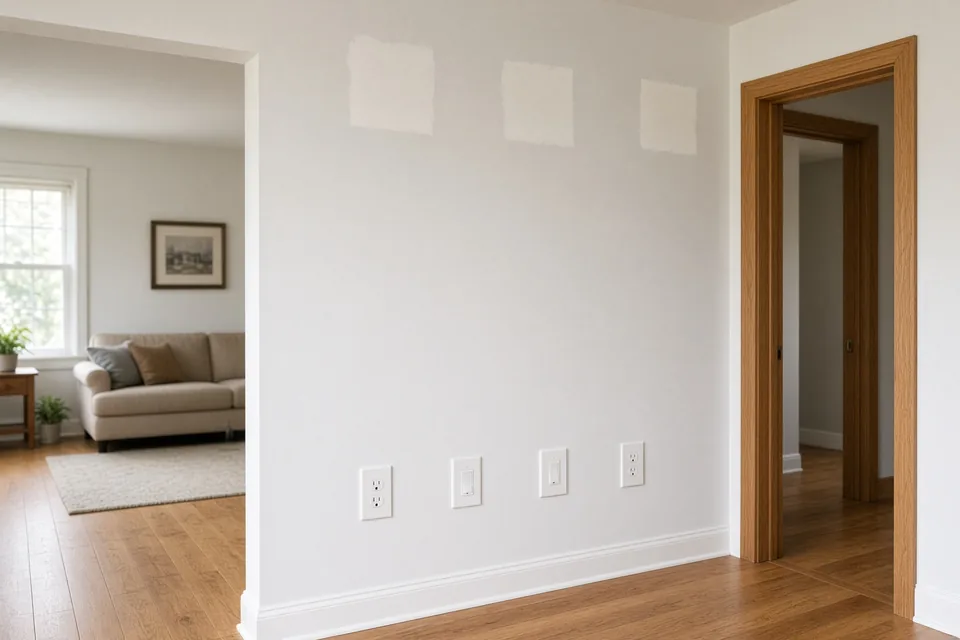 Step 03
Devices, inspection and patching
Install tamper-resistant grounded receptacles and AFCI/GFCI circuit breakers, pass the two-stage municipal electrical inspection, and skim-coat the small drywall or plaster fishing access holes.
Why it matters: Budgeting $450 to $2,600 for drywall or plaster access-hole patching restores your walls and ceilings once the electrical inspector signs off.


On this page
- The diagram, part by part
- Photo guide: hero and 3 project steps
- 2026 whole-house rewire & aluminum remediation cost table
- Three worked scenarios with full arithmetic
- Decision table: full copper rewire vs aluminum pigtail remediation
- NEC 394.12 knob-and-tube insulation rule & CPSC Publication 516 wording
- Quote checklist: 8 items to verify on a rewire estimate
- Typical whole-house rewire timeline
- Worked example
- Does insurance pay to rewire a house?
- Sources and further reading
- Frequently asked questions
2026 whole-house rewire & aluminum remediation cost table
Base rates line up with the wiring & outlets calculator; device work done in one visit is priced as a batch:
| Rewire Scope / Line Item | 2026 Low | 2026 High | What Changes the Price |
|---|---|---|---|
| Whole-house copper branch-circuit rewire (open chase access) | $5.00 / sq ft | $10.00 / sq ft | $8,000–$16,000 on 1,600 sq ft |
| Two-story wood lath & plaster / finished-ceiling fishing surcharge | +25% | +25% | Extra time drilling fireblocking and fishing plaster walls |
| Replace outlet/switch in existing box OR aluminum pigtail per box | $150 / box | $300 / box | Batch rate per box; COPALUM or AlumiConn |
| GFCI outlet installation / replacement | $200 / device | $350 / device | Kitchen, bath and exterior locations |
| AFCI / GFCI breaker trim-out & tamper-resistant receptacles | $750 | $1,850 | Required by NEC 210.12 (AFCI) and 210.8 (GFCI) on new circuits |
| De-energize & cap old knob-and-tube / cloth wiring | $400 | $950 | Clears attic joists for attic insulation calculator per NEC 394.12 |
| Drywall access-hole patching ($450–$1,200) or Plaster ($900–$2,600) | $450 | $2,600 | Closing 4-inch fishing cuts at top plates & ceilings |
| Municipal electrical permit & inspections | $150 | $450 | Local fee schedule and number of inspections |
| 200-amp main breaker panel upgrade (if needed) | Linked on the electrical panel calculator | Linked on the electrical panel calculator | Priced separately on the electrical panel calculator |
Three worked scenarios with full arithmetic
Scenario 1: 1,600 sq ft knob-and-tube rewire, open attic & basement, panel already 200A (worked example, 1.00x)
A homeowner rewires a 1,600-square-foot 1928 bungalow with active knob-and-tube wiring, open basement/attic access, and an existing 200-amp panel.
- Whole-House Copper Rewire (1,600 sq ft × $5–$10/sq ft): $8,000 – $16,000
- Plaster Fishing Surcharge: $0 (open chase access)
- AFCI / GFCI Breakers & Tamper-Resistant Devices: $750 – $1,850
- De-Energize & Cap Old Knob-and-Tube (NEC 394.12 prep): $400 – $950
- Patch & Skim-Coat Drywall Fish Holes: $450 – $1,200
- Electrical Permit & Inspections: $150 – $450
- National Total: $9,750 to $20,450
Scenario 2: 2,200 sq ft two-story plaster home with cloth wiring & finished basement ceiling (1.00x)
A 1948 two-story colonial with brittle ungrounded cloth cable and wood lath-and-plaster walls requires fishing cables between stories (+25% plaster access surcharge) and plaster hole repair.
- Whole-House Copper Rewire (2,200 sq ft × $5–$10/sq ft): $11,000 – $22,000
- Lath-and-Plaster / Multi-Story Fishing Surcharge (+25%): $2,750 – $5,500
- AFCI / GFCI Breakers & Device Trim-Out: $750 – $1,850
- Disconnect Abandoned Cloth / BX Runs: $150 – $400
- Plaster Access-Hole Patching & Skim-Coating: $900 – $2,600
- Electrical Permit & Inspections: $150 – $450
- National Total: $15,700 to $32,800 (plus electrical panel calculator if upgrading a 100A panel)
Scenario 3: 1,600 sq ft 1970 ranch aluminum pigtail remediation (40 device boxes, 1.00x)
A homeowner with 1970 solid aluminum branch wiring elects copper pigtail remediation across all 40 outlet, switch, and fixture boxes at the $150–$300 per-box batch rate.
- Copper Pigtailing at 40 Device Boxes (40 × $150–$300/box): $6,000 – $12,000
- Panel Breaker Check & AFCI/GFCI Trim: $350 – $850
- Box Labeling & Circuit Audit: $150 – $400
- Electrical Permit & Inspection: $150 – $450
- National Total: $6,650 to $13,700 (Note: some insurers still require a full copper rewire rather than pigtailing—verify with your carrier first)
Decision table: full copper rewire vs aluminum pigtail remediation
| Approach | 1,600 Sq Ft Band | Wall Disturbance | Insurance Acceptance | Long-Term Result |
|---|---|---|---|---|
| Full Copper Rewire (NM-B) | $9,750 – $20,450 | Small 4-in fish holes near top/bottom plates | Accepted by 100% of US home insurers | Replaces 100% of old wire; adds 20A kitchen/bath circuits |
| Aluminum Pigtail Remediation | $6,650 – $13,700 (40 boxes) | Zero wall cuts (work is inside existing boxes) | Accepted by many, but some insurers still require full rewire | Keeps aluminum wire in walls; transitions to copper at terminals |
NEC 394.12 knob-and-tube insulation rule & CPSC Publication 516 wording
- Knob-and-Tube & Attic Insulation (NEC Section 394.12): Under the National Electrical Code (NFPA 70), Article 394, Section 394.12 (Uses Not Permitted), concealed knob-and-tube wiring shall not be used in hollow spaces of walls, ceilings, and attics where such spaces are insulated by loose, rolled, or foamed-in-place insulating material that envelops the conductors. Always finish rewiring the attic before scheduling attic insulation calculator.
- Aluminum Branch Wiring (U.S. CPSC Publication 516): U.S. Consumer Product Safety Commission Publication 516 (Repairing Aluminum Wiring) names the COPALUM crimp repair (a powered die crimp with heat-shrink insulation) as its preferred permanent fix, and describes the AlumiConn connector as an alternative where COPALUM is not available, installed by a qualified electrician. Because underwriting rules are private, some insurance companies still insist on full copper rewiring even after a COPALUM or AlumiConn repair.
Quote checklist: 8 items to verify on a rewire estimate
- 100% Knob-and-Tube Elimination Certificate: Will the electrician provide a written letter on company letterhead stating no active K&T remains?
- Counted Device & Circuit Schedule: Does the bid list how many receptacles, switches, overhead lights, and dedicated 20A circuits are included?
- Panel Included or Separate: Is a 200-amp panel upgrade included or priced separately (compare on the electrical panel calculator)?
- Hardwired Smoke & CO Alarms: Does the rewire include interconnecting smoke and carbon-monoxide detectors if required by your city inspector when pulling a whole-house permit?
- Plaster / Drywall Patching Responsibility: Who closes and skim-coats the fishing access holes?
- Attic K&T Removal for Insulation: Will dead porcelain knobs and wires be cleared from the attic floor joists so attic insulation calculator crews can work?
- Aluminum Pigtail Method Named: On aluminum remediation bids, does the quote specify COPALUM or AlumiConn lugs and torque-screwdriver installation in every single box (including light fixtures and switches, not just receptacles)?
- Permit & Two-Stage Inspection: Are both rough-in and final municipal electrical inspections included?
Typical whole-house rewire timeline
- Day 1: Pull permit, map existing circuits, protect floors and furniture with plastic sheeting, and cut small strategic fish accesses.
- Days 2–5: Fish new 14/2 and 12/2 grounded copper cables through basement, walls, and attic; cut in old-work remodel boxes; pass rough-in inspection.
- Days 6–7: Install tamper-resistant outlets, switches, GFCI/AFCI breakers, transfer load off old wiring, disconnect/cap old K&T, and pass final electrical inspection.
- Days 8–9: Drywall or plaster finisher patches and skim-coats the access holes.
Worked example
A homeowner rewires a 1,600-square-foot 1928 bungalow with active knob-and-tube wiring. The home has an open unfinished basement and accessible attic (standard access), already has a modern 200-amp main breaker panel, and includes AFCI/GFCI breakers, disconnecting the old knob-and-tube so the attic can be insulated, patching the fish holes, and pulling a municipal electrical permit at the 1.00x national baseline.
The default job, line by line
Worked example| Line item | National planning range |
|---|---|
| Whole-House copper branch-circuit rewire | $8,000 – $16,000 |
| AFCI / GFCI breakers & tamper-resistant device trim-out | $750 – $1,850 |
| De-Energize & cap old knob-and-tube conductors | $400 – $950 |
| Patch & skim-coat drywall access holes | $450 – $1,200 |
| Municipal electrical permit & inspections | $150 – $450 |
| Total before regional adjustment | $9,750 – $20,450 |
Midpoint about $15,100. These are the calculator's default inputs, so pressing the button above at the national region reproduces this table.
Does insurance pay to rewire a house?
Replacing obsolete knob-and-tube, cloth-sheathed, or solid aluminum wiring is considered homeowner maintenance—a standard homeowners policy does not pay for a preventative rewire. Instead, older wiring is primarily an underwriting issue: many carriers refuse to bind a new policy or send a 30-to-60-day non-renewal notice after a four-point inspection reveals active knob-and-tube or un-remediated 1960s/1970s aluminum branch circuits. While some underwriters accept a licensed electrician's certificate showing COPALUM or AlumiConn pigtailing, others require a complete copper rewire and a 200-amp breaker panel (priced on the electrical panel calculator). Insurance pays to rewire a house only when a covered peril—such as a house fire (the fire damage calculator) or direct lightning strike—destroys the wiring, subject to your deductible and the code upgrade (O&L) calculator sublimits. Policy wording and the adjuster decide every claim.
What this page will not claim
- This page never claims an aluminum pigtail repair satisfies every insurer: Underwriting guidelines vary by company; ask your insurer in writing before choosing pigtailing over a full rewire.
- That any connector is "CPSC-approved": CPSC Publication 516 describes COPALUM and AlumiConn repairs; it does not approve products.
- A different rewire rate from the wiring & outlets calculator: Both pages use the same $5–$10/sq ft rewire band and $150–$300 ($200–$350 GFCI) device rates.
Sources and further reading
- Bob Vila — Cost to rewire a house
- U.S. CPSC — Repairing Aluminum Wiring (Publication 516, PDF)
- NFPA — NFPA 70, National Electrical Code
- Electrical Safety Foundation International
Prices on this page are planning ranges built from public 2026 US cost guides and contractor rate sheets, widened where they disagreed, and multiplied by the same regional index as every other ReplaceCost calculator. Codes and rules come from the bodies listed. See the methodology for how ranges are set and reviewed.
Frequently asked questions
Can electricians rewire my house without tearing down all the drywall or plaster walls?
Yes. Experienced residential rewire crews leave 95% of your walls intact. By working from an unfinished basement or crawlspace below and an attic above, electricians use long flexible auger bits, fish tapes, and fiberglass rods to pull new copper NM-B cables inside the hollow stud bays, cutting only small 4-inch access holes near top plates or fireblocking that are patched afterward.
Why can't attic insulation be blown over active knob-and-tube wiring?
Knob-and-tube wiring runs single conductors suspended in free air so heat from electrical current can radiate safely into the empty joist cavity. Under National Electrical Code (NFPA 70) Section 394.12, burying knob-and-tube wiring in loose-fill cellulose, fiberglass batts, or spray foam traps heat around the 90-year-old rubber-cloth insulation and creates a severe fire hazard.
Will every home insurance company accept AlumiConn or COPALUM pigtails on aluminum wiring?
No. In its guide Repairing Aluminum Wiring (Publication 516), the U.S. Consumer Product Safety Commission calls pigtailing with a COPALUM crimp connector a safe and permanent repair and describes the AlumiConn set-screw connector as a newer option with a shorter track record. However, private insurance companies set their own underwriting rules: many accept a licensed electrician's letter certifying COPALUM or AlumiConn remediation at every box, while some carriers still require a full copper rewire.
Do I also have to replace my main breaker panel when I rewire a knob-and-tube house?
If your house still has a 60-amp or 100-amp fuse box or an older breaker panel with no open spaces, yes—modern NEC rules require dedicated 20-amp kitchen, bathroom, laundry, and garage circuits plus bulky AFCI and GFCI breakers that require a 200-amp panel. If you already upgraded to a 200-amp panel recently, the electrician can wire the new circuits right into it.
Why does rewiring a two-story house with lath-and-plaster walls cost 25% to 35% more than drywall?
In a single-story ranch with drywall, every wall is reachable directly from the attic above or the basement below. In a two-story house with wood lath and three-coat plaster, the first-floor ceiling is sealed between joists, plaster dulls saw blades and cracks if pried roughly, and fishing cables from the basement up to second-floor bedrooms requires cutting and patching strategic transfer holes.