Home › Insurance guide › Other structures (Cov B)
Claim math · detached garage, shed and fenceOther structures (Coverage B) calculator
Structures set apart from your house by clear space—such as a detached garage, storage shed, privacy fence, concrete driveway, retaining wall, or backyard gazebo—are insured under Coverage B (Other Structures), not your main Coverage A dwelling limit. Stop here if your garage or porch is physically attached to the house by a shared wall or continuous roof—attached structures belong to Coverage A—or if you need ground-up construction pricing first, which sits on the detached garage calculator, the fence calculator, the driveway calculator, the deck calculator, and the retaining wall calculator.
Under the common ISO HO-3 homeowners policy form, Coverage B defaults to 10% of Coverage A (though other policy forms and coastal wind contracts differ and let you raise or lower that percentage). On a $350,000 Coverage A policy, that 10% ceiling equals $35,000 for all detached structures combined in a single storm event, subject to one policy deductible.
Crucially, standard policy forms often split how Coverage B losses are settled: roofed buildings (like a detached garage or shed) may qualify for Replacement Cost Value (RCV), while non-building structures without a roof (like fences, driveways, and retaining walls) are frequently settled at depreciated Actual Cash Value (ACV), and structures used for business or rental may be excluded. Your wording decides.
Reviewed 25 October 2026 · Written by Mantu Kumar
See the photos · See the cost diagram · Open the calculator · Every part explained
Key facts at a glance
- Under the common ISO HO-3 homeowners form, Coverage B (Other Structures) defaults to 10% of the Coverage A Dwelling limit; other policy forms differ.
- The Coverage B dollar ceiling is an aggregate cap for all detached structures combined in a single occurrence: Ceiling = Coverage A × Coverage B Percent.
- A structure connected to the main dwelling only by a fence, utility line, or similar connection is still classified as an Other Structure under Coverage B.
- Under standard ISO HO-3 loss-settlement rules, roofed buildings under Coverage B can qualify for RCV, whereas non-building structures (fences, driveways, retaining walls) are settled at depreciated ACV.
- Coverage B excludes other structures rented or held for rental to non-tenants of the dwelling (unless used solely as a private garage) and structures from which any business is conducted.
Policy arithmetic, not a coverage decision. Your declarations page and policy wording decide the real figures; sources are at the bottom of the page.
The claim math, step by step
- 1Coverage B ceiling
- 2Roofed buildings
- 3Yard structures without a roof
- 4Separation rule
- 5One deductible
- 6Rental or business use
- 7Depreciation holdback
- 8What is excluded
- 9Maximum replacement-cost payout
Run the numbers: other structures (Coverage B)
No email · nothing sentDiagram, part by part
Other structures (Coverage B): every numbered part explained
The drawing above has 9 numbered parts, from Coverage B ceiling to Maximum replacement-cost payout. Each card zooms in on one part, says what pushes its number up or down, and what to check on your declarations page or claim letter. After you run the calculator, the parts in your scope show their dollar figure.
1 Coverage B ceiling
Claim step 1
Coverage B (Other Structures) sets one combined dollar ceiling for every detached structure on your residence premises during a single covered loss. On the standard ISO HO-3 form, this ceiling defaults to 10% of your Coverage A Dwelling limit ($35,000 on a $350,000 policy), though some carriers set it at 2% or 5% on coastal or wind policies unless you purchase an increased Coverage B endorsement.
What moves it: Your Coverage A Dwelling limit multiplied by the Coverage B percentage printed on your declarations page.
On the quote: Check your declarations page to verify whether Coverage B is the full 10% of Coverage A or was reduced to 2% or 5%.
2 Roofed buildings
Claim step 2
Detached structures that have a roof and walls—such as a detached two-car garage, a framed workshop, or a backyard storage shed—are classified as 'buildings' under standard ISO HO-3 loss-settlement rules. Because they are buildings, they typically qualify for Replacement Cost Value (RCV) settlement up to the Coverage B limit, meaning you can recover withheld depreciation after the building is repaired or rebuilt.
What moves it: Whether the damaged structure has a roof and enclosed walls that meet your policy's definition of a building.
On the quote: Ask the adjuster to confirm in writing that your detached garage or shed is being settled under the building RCV provision rather than permanent ACV.
3 Yard structures without a roof
Claim step 3
Fences, concrete driveways, detached paver patios, retaining walls, and open arbors are covered under Coverage B against named or open perils (depending on your form), but they are not 'buildings.' Under standard ISO HO-3 Section I — Conditions (paragraph C.1.b), structures that are not buildings are settled strictly at Actual Cash Value (ACV) at the time of loss, meaning age depreciation is permanently subtracted.
What moves it: Age and physical weathering of the fence, driveway, or retaining wall at the time of the storm.
On the quote: Before filing a fence-only wind claim, calculate the depreciated ACV and subtract your deductible to see if any payout remains.
4 Separation rule
Claim step 4
A structure falls under Coverage B if it is set apart from the main dwelling by clear space. Standard policy forms state that if a structure is connected to the main house only by a fence, utility wire, breezeway fence rail, or concrete walkway, it is still treated as a detached Other Structure under Coverage B. Only structures sharing a structural wall or continuous roof plane with the house use Coverage A.
What moves it: Whether there is open ground between the structure and the main house or a shared structural framing connection.
On the quote: If a covered breezeway roof ties your garage structurally into the main house framing, ask whether it qualifies under Coverage A instead of the 10% Coverage B cap.
5 One deductible
Claim step 5
Property insurance deductibles apply once per occurrence, not once per coverage bucket. If a tornado or severe thunderstorm tears shingles off your main house (Coverage A) and simultaneously crushes your detached garage and privacy fence (Coverage B), your deductible is subtracted once from the combined claim total. You do not pay a second deductible to unlock Coverage B, which means your backyard shed or fence claim pays from the first dollar once the house roof absorbs the deductible.
What moves it: Whether your flat or percentage storm deductible was already absorbed by main-house Coverage A repairs in the same event.
On the quote: Check the adjuster's summary page to ensure the policy deductible was deducted only once across Coverage A and Coverage B combined.
6 Rental or business use
Claim step 6
Standard Coverage B wording contains two strict occupancy exclusions: it does not cover other structures rented or held for rental to any person not a tenant of the dwelling (unless used solely as a private garage), and it does not cover other structures from which any business is conducted or which are used to store business property owned by others. Operating a commercial auto shop or short-term rental in a detached building requires a separate endorsement.
What moves it: Whether you rent out a detached guest house/ADU or run a commercial trade inside the detached building.
On the quote: Disclose any backyard office, studio, or accessory dwelling unit to your agent so the correct endorsement is attached before a loss occurs.
7 Depreciation holdback
Claim step 7
Even when a detached garage qualifies for Replacement Cost Value, the insurer usually pays in two checks: an initial Actual Cash Value (ACV) check upfront, followed by the recoverable depreciation holdback once you submit signed contractor invoices showing the structure was actually rebuilt. If your RCV loss exceeds the 10% Coverage B ceiling, the total of both checks still stops at the Coverage B cap.
What moves it: Age of the roofed building for the initial holdback and whether you complete reconstruction within the policy's time limit.
On the quote: Track your recoverable depreciation deadline (often 180 to 365 days from the loss) in the recoverable depreciation calculator.
8 What is excluded
Claim step 8
Even inside Coverage B, standard earth-movement, frost-heave, tree-root pressure, and normal rot exclusions still apply. A concrete driveway or retaining wall that cracks from tree roots, expansive clay soil, or winter freeze-thaw is excluded as earth movement or settling. Likewise, a wooden fence post that rotted at the soil line before blowing over in a mild breeze is often partially or fully denied as wear and tear.
What moves it: Whether sudden wind, fire, lightning, or a vehicle strike caused the damage versus slow soil movement, frost heave, or wood rot.
On the quote: Photograph freshly snapped wood fibers on fence posts or sudden tree impact marks on a driveway to distinguish storm damage from slow settling.
9 Maximum replacement-cost payout
Up to the Coverage B ceiling
If your policy settles the detached structure at replacement cost, the most you can collect is the repair cost minus any deductible still owed, capped at the Coverage B ceiling. Many policies pay actual cash value first and release the depreciation holdback only after the repair is finished and invoiced, often within a set deadline. Fences and other non-building structures are more often held to actual cash value, so read your settlement wording.
What moves it: The Coverage B percentage, the repair cost, any deductible already used on the house, and RCV or ACV settlement wording.
On the quote: Ask the adjuster in writing whether the structure is settled at RCV or ACV, and how long you have to claim the holdback.
Project photo guide
Other structures in photos: the garage, the fence and the snapped post
Coverage B claims depend on whether a structure is detached from the house, whether it has a roof and walls, and how old its materials are. These four scenes show a detached two-car garage separated from a house by clear space, a wind-damaged backyard fence, a crushed storage shed, and an inspection of snapped versus rotted fence posts.

How the claim works in 3 key stages
All three step images are AI-generated illustrations for explanation. Not a site inspection, bid, or coverage decision.
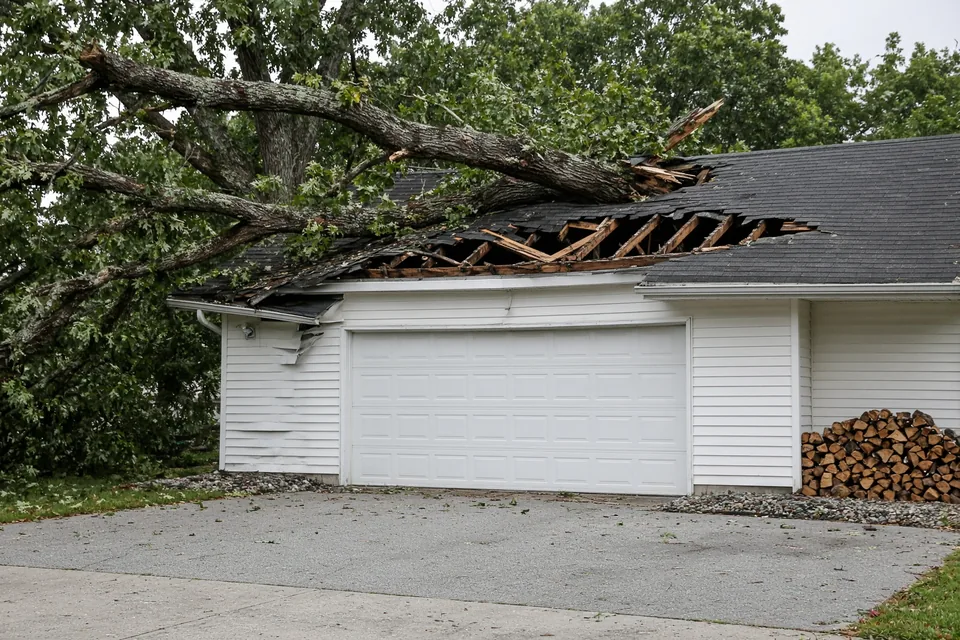 Step 01
Roofed buildings
Photograph the damaged detached garage or shed, the impact point, and the open yard between it and the house so the loss is filed under Coverage B, not the dwelling.
Why it matters: Because a detached garage is a roofed building, standard HO-3 forms often settle it at Replacement Cost Value up to the 10% Coverage B ceiling.
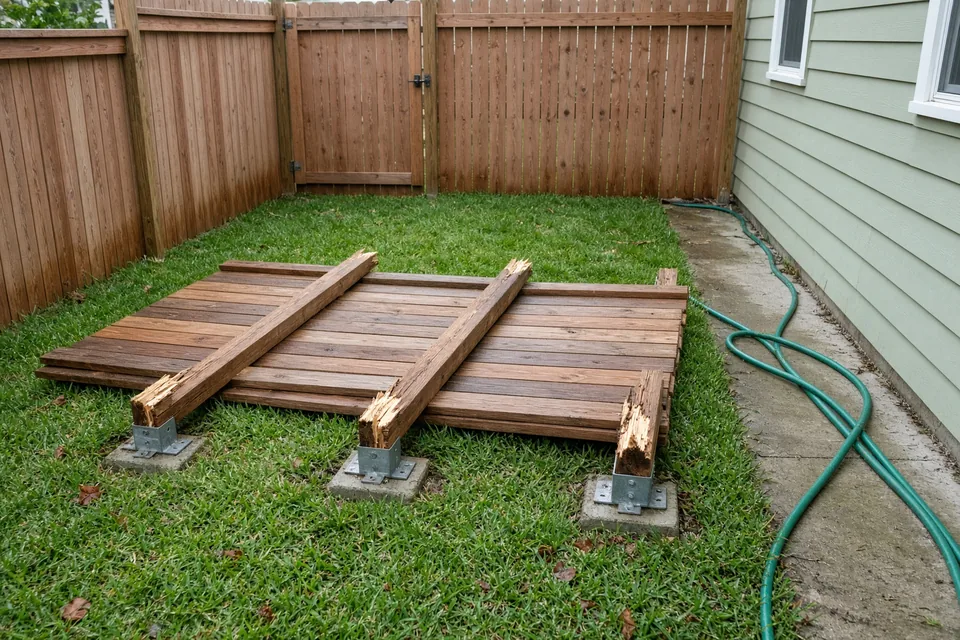 Step 02
Fences and yard structures
List fences, driveways and retaining walls on their own estimate lines, apart from roofed buildings, because many policies settle them differently on depreciation.
Why it matters: Fences are non-building structures under standard HO-3 rules, meaning adjusters usually subtract age depreciation and pay Actual Cash Value.
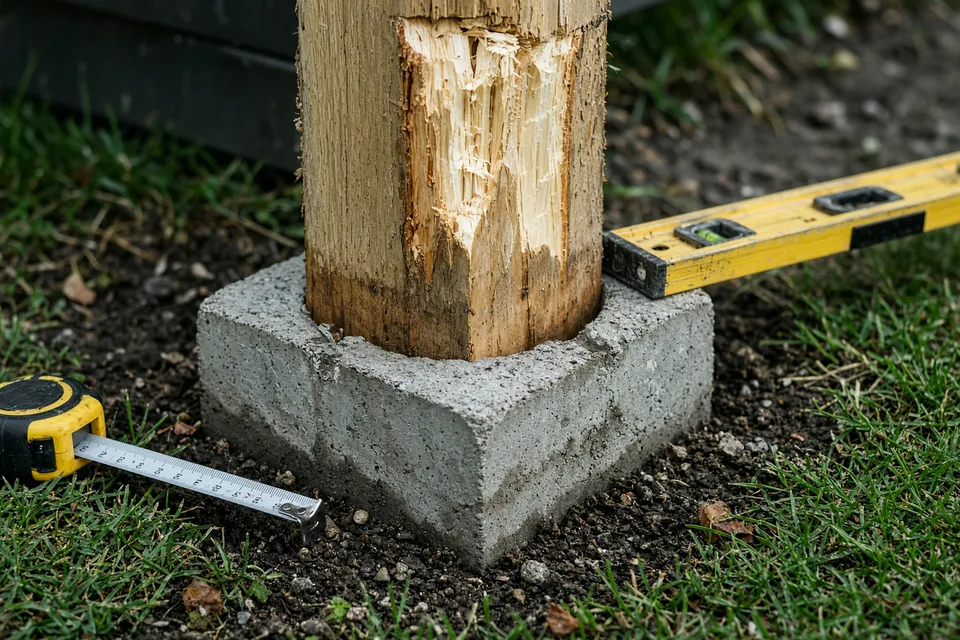 Step 03
Prove sudden damage
Document fresh wood splinters, snapped posts, and tree impact points on fallen fences or crushed sheds before yard cleanup crews haul the storm debris away.
Why it matters: Close-up photos showing clean splintered wood rather than dark insect or moisture rot prove the post snapped from sudden wind force.


On this page
- The diagram, part by part
- Photo guide: hero and 3 project steps
- The Coverage B formula in plain words
- Two worked examples with different outcomes
- What changes the answer
- What documents to look at
- Worked example
- How Coverage B settles a detached structure
- Sources and further reading
- Frequently asked questions
The Coverage B formula in plain words
Under a standard US homeowners policy (such as the ISO HO-3 Special Form), Coverage B — Other Structures insures structures on your residence premises that are set apart from the main dwelling by clear space (including structures connected to the house only by a fence, utility line, or walkway). On the ISO HO-3 form, the Coverage B limit defaults to 10% of your Coverage A Dwelling limit, though other forms and coastal wind contracts may use different percentages or require an endorsement.
In words:
- Calculate your aggregate Coverage B ceiling: multiply your Coverage A Dwelling limit by your Coverage B percentage (default 10%). All detached structures damaged in a single storm share this one ceiling.
- Check business or non-tenant rental exclusions: if a detached structure is used to conduct business or is rented to someone who is not a tenant of the main house (other than as a private garage), standard Coverage B pays $0.
- Determine the settlement basis (RCV vs ACV — your wording decides): under standard ISO HO-3 Loss Settlement conditions, detached structures that are buildings (structures with a roof and walls, such as a detached garage or shed) are eligible for Replacement Cost Value (RCV), while structures that are not buildings (fences, driveways, patios, retaining walls) are settled at depreciated Actual Cash Value (ACV).
- Apply one deductible per occurrence: subtract your policy deductible once per event (if the deductible was already absorbed by main-house Coverage A damage in the same storm, $0 additional deductible is taken from Coverage B), and cap the payout at the Coverage B ceiling.
Two worked examples with different outcomes
Example 1: crushed detached two-car garage hitting the 10% Coverage B cap
A homeowner carries $350,000 in Coverage A with the standard 10% Coverage B limit ($35,000 ceiling) and a $1,500 deductible. A straight-line windstorm drops an oak tree onto a 10-year-old detached two-car garage (no main-house damage occurred). The contractor's rebuild estimate is $42,000 (see the detached garage calculator).
- Coverage B Ceiling: $350,000 × 10% = $35,000.
- Deductible Applied: $42,000 - $1,500 = $40,500 net RCV loss.
- Capped RCV Payout: min($35,000, $40,500) = $35,000. (Assuming 25% initial depreciation of $10,500, the initial ACV check is $31,500 - $1,500 = $30,000, and the remaining $5,000 up to the $35,000 cap is paid when rebuilt.)
- Out-of-Pocket Gap: $42,000 - $35,000 = $7,000 unpaid because the rebuild exceeded the 10% Coverage B ceiling.
Example 2: 10-year-old wood privacy fence settled at ACV ($6,000 loss)
On the same policy ($35,000 Coverage B ceiling, $1,500 deductible), a windstorm blows down 150 linear feet of 10-year-old wood fencing with a $6,000 replacement estimate (see the fence calculator) and causes no other damage.
- Settlement Basis: Because a fence is not a roofed building, standard HO-3 rules settle it at depreciated Actual Cash Value (ACV).
- Depreciation Calculation: At 10 years old out of a 20-year expected life (50% depreciation), $6,000 - $3,000 = $3,000.
- Subtract Deductible: $3,000 - $1,500 = $1,500 final insurance check.
- Out-of-Pocket Gap: $6,000 - $1,500 = $4,500 ($3,000 unrecoverable depreciation + $1,500 deductible).
What changes the answer
| Factor | How It Moves Your Coverage B Payout | Where to Verify |
|---|---|---|
| Coverage B percentage (2%, 5%, 10%, or custom) | Sets the aggregate dollar cap for all detached structures in one storm | Declarations page (Coverage B line) |
| Building vs non-building classification | Roofed buildings (garage, shed) often get RCV; fences/driveways get ACV | Section I — Conditions (Loss Settlement) |
| Simultaneous Coverage A house damage | Absorbs the single event deductible on the main house so Coverage B pays from $1 | Adjuster's combined claim summary |
| Business or rental use inside outbuilding | Voids Coverage B if business is conducted or rented to non-tenants (except private garage) | Section I — Coverage B Exclusions |
| Increased Other Structures endorsement | Lets you schedule higher specific limits (e.g., ISO HO 04 48) for high-value garages/workshops | Policy endorsement schedule |
| Peril type on non-buildings | Under some forms, collapse of patios/driveways/retaining walls requires specific named perils | Section I — Perils Insured Against |
What documents to look at
- Policy Declarations Page: Check the exact dollar amount and percentage listed next to Coverage B — Other Structures, and see if any Scheduled Other Structures endorsements are attached.
- Section I — Property Coverages (Coverage B — Other Structures): Verify the clear-space rule and read the exclusions for business operations and non-tenant rentals.
- Section I — Conditions (Loss Settlement): Read paragraphs C.1 and C.2 to confirm which structures are settled at Actual Cash Value (structures that are not buildings) versus Replacement Cost Value (buildings).
Worked example
A homeowner carries $350,000 in Coverage A with the default 10% Coverage B limit ($35,000 ceiling) and a $1,500 deductible. A severe windstorm crushes a 10-year-old detached two-car garage that costs $42,000 to rebuild (no main-house damage occurred, and the garage is used strictly for personal cars). A $6,000 loss on a 10-year-old wood fence is shown for comparison.
The arithmetic, step by step
Worked example- Step 1 (Coverage B Ceiling): $350,000 Coverage A × 10% = $35,000 aggregate ceiling for all other structures in the event.
- Step 2 (Detached Garage RCV Math — Roofed Building): $42,000 rebuild cost − $1,500 single deductible = $40,500 net loss. Capped at the $35,000 Coverage B ceiling -> Maximum RCV payout = $35,000.
- Step 3 (Detached Garage Depreciation Holdback): At 10 years old (25% of a 40-year useful life), initial depreciation holdback is $10,500 ($31,500 ACV − $1,500 deductible = $30,000 initial check; remaining $5,000 recovered up to the $35,000 cap once rebuilt).
- Step 4 (Detached Garage Out-of-Pocket Gap): $42,000 rebuild cost − $35,000 capped payout = $7,000 unpaid gap.
- Step 5 (Contrast — $6,000 10-Year-Old Wood Fence — Non-Building ACV): At 50% depreciation (10 of 20 years), ACV is $3,000. Subtracting the $1,500 deductible leaves a $1,500 final ACV check and a $4,500 out-of-pocket gap.
These are the calculator's default inputs, so pressing the button above reproduces this example.
How Coverage B settles a detached structure
Many policies follow the ISO HO-3 framework where Coverage B defaults to 10% of Coverage A, one deductible applies per storm occurrence across the entire property, and loss settlement splits between roofed buildings (often RCV) and non-building yard structures like fences, driveways, and retaining walls (often depreciated ACV). Before filing a claim for a detached structure alone, model your depreciation holdback in the depreciation (ACV) calculator, check how to recover withheld building depreciation in the recoverable depreciation calculator, and weigh small fence or shed losses against your deductible in the should-I-file-a-claim calculator. If a contractor's detached garage rebuild quote exceeds your 10% ceiling, compare the shortfall in the claim gap calculator. Policy wording and the adjuster decide every claim.
What this page will not claim
- This page does not claim every policy settles fences at ACV or garages at RCV: Some package endorsements offer replacement cost on fences, while some ACV-only policies depreciate buildings too; your wording decides.
- This page does not provide construction unit costs: Use the detached garage calculator, the fence calculator, the driveway calculator, the deck calculator, and the retaining wall calculator to build your repair estimate.
- This page does not give legal or coverage advice: Always consult your policy contract and licensed adjuster.
Sources and further reading
- MoneyGeek — Does homeowners insurance cover other structures?
- NAIC — Actual cash value vs replacement cost coverage
- Mississippi Insurance Department — Consumer quick guide to home insurance (PDF)
The calculator applies the arithmetic that policy forms and the agencies above describe. It does not read your policy, and it does not decide coverage: your declarations page, the policy wording and the adjuster do. See the methodology for how this site checks its figures.
Frequently asked questions
Why did the adjuster depreciate my wood fence by 50% and refuse to pay replacement cost?
Under standard ISO HO-3 Loss Settlement conditions, property that is 'structures that are not buildings' is settled at Actual Cash Value (ACV), not Replacement Cost Value (RCV). Because a fence, driveway, or retaining wall has no roof or enclosed walls, insurers classify it as a non-building structure and permanently subtract depreciation for age and wear unless you purchased a special replacement-cost endorsement.
If a detached garage is connected to my house by a wooden fence, is it Coverage A or Coverage B?
It is still Coverage B (Other Structures). Standard homeowners policy wording explicitly states that structures connected to the main dwelling only by a fence, utility line, or similar non-structural connection are considered set apart by clear space and remain under Coverage B. To qualify under Coverage A (Dwelling), the garage must share a structural wall or a continuous structural roof assembly with the house.
Do I pay a separate deductible for my detached garage and fence if the same storm also damaged my house roof?
No. Standard homeowners deductibles apply once per occurrence, not separately to Coverage A and Coverage B. If a single windstorm causes $12,000 in damage to your main house roof and $8,000 in damage to your detached garage and fence, your flat or windstorm deductible is subtracted once from the combined $20,000 loss.
Is a detached backyard office or rented carriage house covered under Coverage B?
Often no, unless you added a specific endorsement. Standard ISO HO-3 Coverage B wording excludes any other structure from which a business is conducted, and excludes any structure rented or held for rental to anyone who is not a tenant of the main dwelling (unless it is rented solely as a private garage). Always ask your agent for an endorsement if you use an outbuilding for business or rental income.
What happens if a storm destroys both my detached garage and my storage shed and the total exceeds 10% of Coverage A?
The Coverage B limit printed on your declarations page is an aggregate cap for all detached structures combined in a single occurrence. If your Coverage B limit is $35,000 and a tornado destroys a $38,000 detached garage, a $5,000 shed, and $4,000 of fencing ($47,000 total), the policy pays at most the $35,000 ceiling, leaving a $12,000 out-of-pocket gap unless you scheduled higher Coverage B limits.
Does Coverage B pay when tree roots or winter frost crack my concrete driveway or retaining wall?
No. Even though driveways, patios, and retaining walls are insured structures under Coverage B, they remain subject to the policy's general exclusions for earth movement, soil pressure, tree-root growth, settling, and freeze-thaw cracking. Coverage B responds to driveways and retaining walls only when a covered peril—such as a fallen tree trunk, vehicle impact, or explosion—causes sudden direct physical damage.