Home › Lightning & surge
Electrical · after a strike or surgeLightning and power surge damage cost calculator
Safety first. A lightning strike can char hidden wire insulation inside walls, weld circuit breakers shut, and energize grounding paths; shut off power if you smell ozone or smoke and have a licensed electrician and municipal electrical inspector test the system before restoring circuits.
When lightning strikes a tree, utility pole, or well casing near your house, the resulting electromagnetic pulse and voltage spike rarely stop at one outlet—they travel simultaneously through your breaker panel, HVAC condenser, buried well wire, and appliance circuit boards. Stop here if you are planning a normal whole-house rewire of intact old wiring (the whole-house rewire calculator), a routine 100A-to-200A service upgrade (the electrical panel calculator), or a routine worn-out well pump swap (the well pump calculator).
Across the US in 2026, a licensed electrician lightning diagnostic and megger insulation test report runs $250 to $650; replacing arc-damaged breakers, GFCI/AFCI receptacles, and installing a Type 1/2 surge protective device runs $350 to $850 (or $1,580 to $2,690 for a full 200A panel swap with a new surge device); HVAC surge repairs run $350 to $950 for control boards/transformers or $2,200 to $4,800 for a grounded inverter compressor; well surge repairs run $150 to $450 for the control box or $900 to $5,000 for the submersible pump ($1,400 to $2,800 typical); and destroyed appliance control boards average $300 to $850 per unit, plus $250 to $650 for grounding electrode upgrades and permits.
With an electrician megger report, breaker/SPD replacement, HVAC board, typical well pump + box, 1 appliance, and grounding permit, expect $3,050 to $7,200.
Reviewed 25 October 2026 · Written by Mantu Kumar
See the photos · See the cost diagram · Open the calculator · Every part explained
Key facts at a glance
- A licensed electrician lightning-damage diagnostic inspection, branch-circuit megohmmeter ('megger') insulation-resistance test, and written cause-of-loss report for an insurance adjuster runs $250 to $650.
- Replacing surge-tripped or arc-pitted breakers, shorted GFCI/AFCI receptacles, and adding an NEC 230.67 Type 1 or Type 2 Surge Protective Device (SPD) runs $350 to $850, while a full 200A panel swap with a new surge device runs $1,580 to $2,690.
- HVAC surge repairs run $350 to $950 for a blown low-voltage transformer, defrost/furnace control board, and run capacitor, or $2,200 to $4,800 when a surge welds the outdoor inverter compressor windings to ground.
- replacing a surge-damaged above-ground well control box runs $150 to $450, while pulling and replacing a submersible well pump runs $900 to $1,800 (shallow), $1,400 to $2,800 (typical), or $2,200 to $5,000 (deep).
- Upgrading the grounding electrode system (driving dual 8-foot copper-clad ground rods spaced at least 6 feet apart under NEC Section 250.53 and bonding water/gas piping) plus the municipal electrical permit runs $250 to $650.
National 2026 planning ranges before your regional multiplier. Sources and method are at the bottom of the page.
2026 planning ranges
- 1Grounding electrode system
- 2Breaker panel & Type 1/2 surge device
- 3Electrician megger & diagnostic report
- 4HVAC control board & inverter compressor
- 5Submersible well pump & control box
- 6Branch circuit wiring & GFCI/AFCI outlets
- 7Appliance electronics & circuit boards
- 8Direct lightning vs utility grid surge
- 9Claim documents for the adjuster
Price your lightning and power surge damage
No email · nothing sentDiagram, part by part
Lightning and power surge damage: every numbered part explained
The drawing above has 9 numbered parts, from Grounding electrode system to Claim documents for the adjuster. Each card zooms in on one part, says what pushes its price up or down, and what to check on a written quote. After you run the calculator, the parts in your scope show their dollar figure.
1 Grounding electrode system
$250 – $650 (with municipal electrical permit)
When lightning hits nearby earth or overhead lines, your home's grounding electrode system is the safety valve that routes surge current into the soil. Under NEC Section 250.53, modern code requires two 8-foot copper-clad ground rods driven at least 6 feet apart, connected with continuous copper grounding electrode conductor to the meter/panel and an intersystem bonding termination bridge for coax/network lines. Upgrading older single-rod grounding with a permit runs $250 to $650.
What moves it: Whether your home currently has only an old water-pipe ground or a single corroded ground rod.
On the quote: Ask the electrician to install an NEC 250.94 intersystem bonding bridge outside so cable TV, satellite, and internet grounds share the exact same ground potential.
2 Breaker panel & Type 1/2 surge device
$350 – $850 (breakers + SPD) | $1,580 – $2,690 (200A panel swap + SPD)
High-energy surges weld thermal-magnetic breaker contacts shut, carbonize busbar stabs, and blow out the sensitive electronics inside AFCI and GFCI breakers. If the copper busbar is undamaged, replacing fried breakers and installing an NEC 230.67 Type 1 or Type 2 whole-home Surge Protective Device (SPD) runs $350 to $850. If the main busbar is arc-pitted, a 200A breaker panel swap with SPD runs $1,580 to $2,690.
What moves it: Whether the main copper/aluminum busbar inside the load center is arc-pitted or only individual breakers failed.
On the quote: Never simply flip a breaker back on after a lightning strike if it feels spongy, smells burnt, or shows black soot around the stab.
3 Electrician megger & diagnostic report
$250 – $650
Insurance adjusters rarely approve hidden wiring or multi-equipment surge claims without written diagnostic proof from a licensed electrician ($250–$650). Using a 500V or 1,000V megohmmeter ('megger'), the electrician disconnects sensitive loads and tests the insulation resistance between hot, neutral, and ground conductors inside your walls to prove whether a high-voltage lightning transient punctured the Romex jacket, then writes a formal cause-of-loss report.
What moves it: Number of branch circuits that must be isolated and megger-tested after a close lightning strike.
On the quote: Have the electrician write the exact words 'damage consistent with high-voltage lightning surge transient' and attach the megger ohm readings on company letterhead.
4 HVAC control board & inverter compressor
$350 – $950 (board/capacitor) | $2,200 – $4,800 (outdoor condenser unit)
Central air conditioners, heat pumps (the HVAC calculator), and furnaces sit on dedicated 240V circuits and long outdoor copper refrigerant lines that conduct ground-potential rise right into the equipment. Minor surges blow the 24V transformer, dual-run capacitor, or furnace circuit board ($350–$950). Severe strikes puncture the motor windings inside variable-speed inverter compressors, requiring an outdoor condenser replacement ($2,200–$4,800) plus a dedicated HVAC surge suppressor.
What moves it: Standard single-stage AC contactor/capacitor vs variable-speed inverter boards and compressor windings.
On the quote: When repairing a surge-damaged AC condenser, pay the extra $120 to $220 for a dedicated HVAC disconnect surge arrestor right at the outdoor whip.
5 Submersible well pump & control box
$150 – $450 (control box) | $900 – $5,000 (submersible pump by depth)
Sitting hundreds of feet deep in wet earth at the end of a long copper cable, a submersible well pump is the single most common casualty of a rural lightning strike. replacing the above-ground starter control box alone runs $150 to $450; if the motor windings down the well are shorted to ground, pulling and replacing the submersible pump runs $900–$1,800 (shallow), $1,400–$2,800 (typical), or $2,200–$5,000 (deep).
What moves it: Whether the ohmmeter test at the wellhead shows only the wall control box blew or the submerged motor windings shorted to ground.
On the quote: Always test the above-ground control box ($150–$450) and pressure switch first before paying a well rig to pull the submersible pump.
6 Branch circuit wiring & GFCI/AFCI outlets
Included in breaker/SPD diagnostic repair (or link whole-house rewire calculator)
Every GFCI receptacle in your bathrooms, kitchen, garage, and exterior walls contains a tiny printed circuit board and sensing transformer that sacrifices itself during a voltage spike. After a strike, it is common to find 4 to 10 dead GFCI outlets that will not reset. If the electrician's megger test reveals melted Romex insulation inside a wall cavity, localized cable fishing is added or routed to the whole-house rewire calculator.
What moves it: Number of dead GFCI receptacles, smart dimmers, and smoke alarms on the affected branch circuits.
On the quote: Walk the entire house and press the TEST and RESET buttons on every GFCI outlet and hardwired smoke detector after a thunderstorm.
7 Appliance electronics & circuit boards
$300 – $850 per damaged appliance board or unit
Modern refrigerators, induction ranges, dishwashers, washing machines, and garage door openers rely on microprocessor main control boards that fry when a surge crosses the neutral or ground wire ($300–$850 per appliance repair or board replacement). On an insurance claim, built-in appliances may fall under Coverage A while freestanding appliances and TVs fall under Coverage C (the contents claim calculator), all sharing the same single deductible for the event.
What moves it: Replacing an OEM main control board ($300–$600 installed) versus replacing an older appliance outright.
On the quote: Save every charred circuit board and surge-protector strip in a labeled box until the insurance adjuster closes your claim.
8 Direct lightning vs utility grid surge
Not priced on this page
Standard HO-3 policies cover 'sudden and accidental damage from lightning' as a named peril. However, many policies exclude 'artificially generated electrical current' (such as a utility transformer or grid switching surge not caused by lightning) inside tubes, transistors, and circuit boards unless a fire ensues or you carry an Equipment Breakdown / Service Line endorsement. Documenting thunderstorm activity and lightning strike data on the date of loss is essential.
What moves it: Whether lightning occurred in your area on the date of loss or whether your policy includes an Equipment Breakdown endorsement.
On the quote: Note the exact date and hour the storm rolled through—insurers verify claims against commercial lightning-strike verification databases.
9 Claim documents for the adjuster
Not priced
A surge claim rests on paperwork: the electrician's written cause-of-loss report with test readings, photos of damaged boards and breakers, model numbers and repair invoices. Keep the damaged parts until the adjuster has seen them.
What moves it: How quickly you document damage and whether the parts are kept.
On the quote: Ask the electrician to name lightning or surge as the cause in the report, with test readings attached.
Project photo guide
Lightning and surge damage in photos: testing, boards and grounding
Proving and repairing lightning or surge damage requires methodical electrical testing and targeted component replacement. These four scenes show an electrician running a 1,000V megohmmeter insulation test at an open breaker panel, a Type 2 whole-home Surge Protective Device wired to a 200A load center, a scorched HVAC control board with a multimeter, and dual exterior copper ground rods.

How the job works in 3 key stages
All three step images are AI-generated illustrations for explanation. Not a site inspection, bid, or coverage decision.
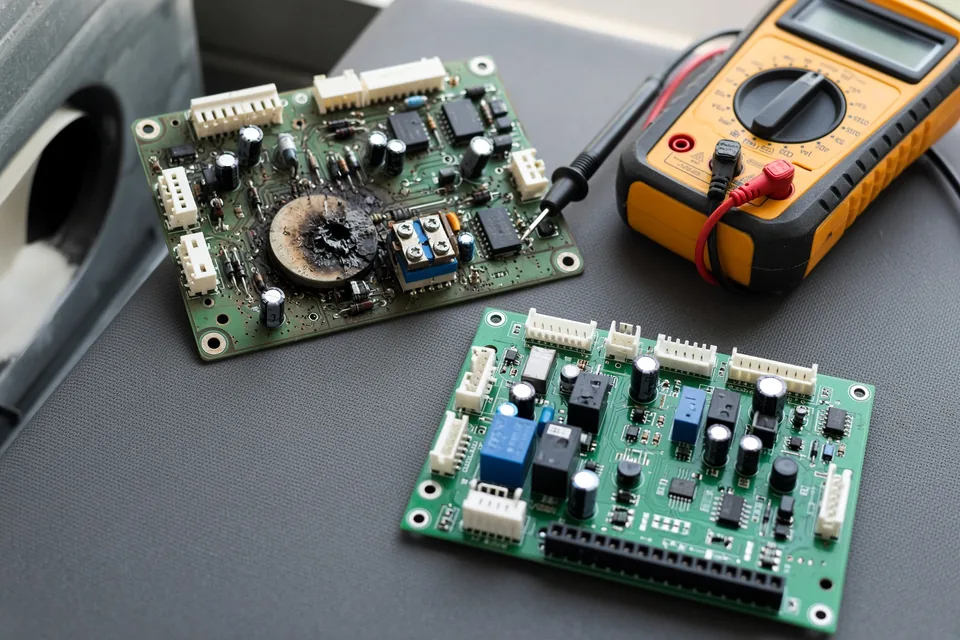 Step 01
Keep the damaged parts
Save every arc-pitted circuit breaker, scorched HVAC or appliance control board, and failed well starter component on a dry table for the insurance adjuster's physical inspection before disposal.
Why it matters: Replacing a surge-blown HVAC control board, transformer, and capacitor runs $350 to $950; keep the scorched board for your insurance adjuster.
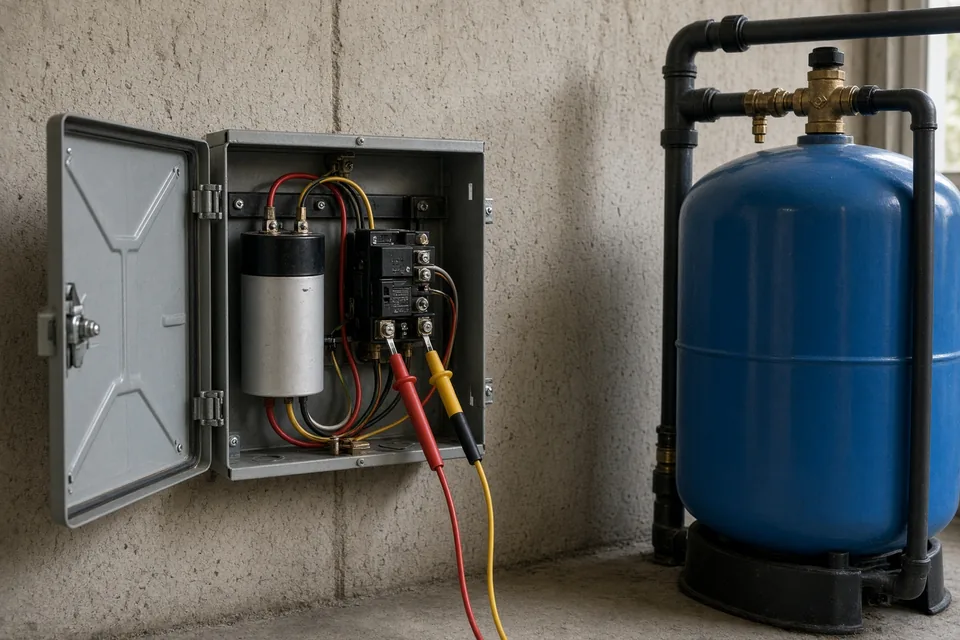 Step 02
Test the well and motors
Well-pump control boxes and motor windings get tested to ground; sometimes only the control box failed, sometimes the submersible pump must be pulled.
Why it matters: Replacing a surge-damaged well control box alone runs $150 to $450, while pulling a shorted typical submersible pump runs $1,400 to $2,800.
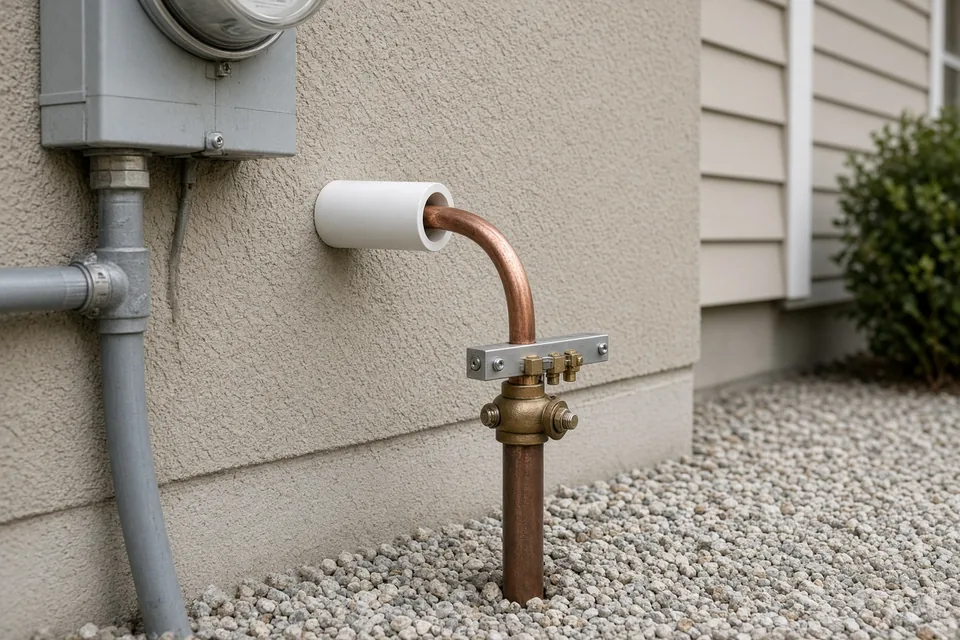 Step 03
Replace, protect and ground
Replace all surge-damaged breakers, control boards, or submersible well pumps, install an NEC 230.67 Type 1 or Type 2 whole-house surge protector, and verify dual exterior grounding rods.
Why it matters: Upgrading your grounding electrode system to dual ground rods (NEC 250.53) with an intersystem bonding bridge and permit runs $250 to $650.


On this page
- The diagram, part by part
- Photo guide: hero and 3 project steps
- 2026 lightning & electrical surge repair cost table
- Three worked scenarios with full arithmetic
- Insurance claim guide: direct lightning vs utility grid surge
- Electrical code reference: NEC Sections 230.67, 250.53 & 250.94
- Quote & claim checklist: 8 steps after a lightning strike
- Typical testing, claim & repair timeline
- Worked example
- Lightning, grid surges and your policy
- Sources and further reading
- Frequently asked questions
2026 lightning & electrical surge repair cost table
| Surge Diagnostic or Repair Line Item | 2026 Low | 2026 High | What Changes the Price |
|---|---|---|---|
| Licensed electrician diagnostic & 1000V megger test report | $250 | $650 | Megohmmeter test on branch wiring + signed cause-of-loss letter |
| Replace damaged breakers/GFCIs + Type 1/2 Surge Device (SPD) | $350 | $850 | Replaces tripped/pitted breakers, dead GFCIs & adds NEC 230.67 SPD |
| Full 200A breaker panel swap + SPD (if busbar is arc-pitted) | $1,580 | $2,690 | Panel swap plus a $180–$340 surge device |
| HVAC control board, 24V transformer & capacitor replacement | $350 | $950 | Low-voltage surge damage without compressor winding failure |
| HVAC outdoor condenser / inverter compressor replacement | $2,200 | $4,800 | Required when high-voltage surge grounds compressor windings |
| Well pump control box only (above-ground starter box) | $150 | $450 | In line with the related calculator |
| Submersible well pump replacement (shallow / typical / deep) | $900 | $5,000 | In line with the related calculator ($1,400–$2,800 typical) |
| Major appliance main control board / electronics replacement | $300 / unit | $850 / unit | Refrigerators, ranges, dishwashers, washers, garage openers |
| NEC 250.53 dual ground rods, intersystem bond & permit | $250 | $650 | Two 8-ft copper rods spaced 6+ ft apart + bonding bridge |
Three worked scenarios with full arithmetic
Scenario 1: multi-system suburban/rural lightning strike (megger + breakers/SPD + HVAC board + typical well pump & box + 1 appliance + grounding, worked example, 1.00x)
Lightning strikes a pine tree 40 feet from a home. The homeowner hires an electrician for a megger test and insurer report (diag = yes), replaces damaged breakers/GFCIs and installs a Type 2 SPD (panel_damage = breakers_spd), replaces a fried HVAC furnace/air-handler board (hvac_damage = board), pulls and replaces a shorted typical submersible well pump and control box (well_damage = typical_pump), replaces 1 refrigerator main board (appliances = 1), and upgrades the grounding rods with a permit (ground_permit = yes).
- Electrician Megger Test & Insurer Diagnostic Report: $250 – $650
- Damaged Breakers/GFCIs + Type 1/2 Surge Protector: $350 – $850
- HVAC Control Board, Transformer & Capacitor: $350 – $950
- Typical Submersible Well Pump ($1,400–$2,800) + Control Box ($150–$450): $1,550 – $3,250
- 1 Appliance Main Control Board: $300 – $850
- NEC 250.53 Grounding Upgrade & Permit: $250 – $650
- National Baseline Total (1.00x): $3,050 to $7,200
Scenario 2: minor surge — diagnostic, dead GFCIs/breakers, whole-home SPD & well control box only (1.00x)
A nearby strike trips the panel, kills four GFCI outlets, and burns out the above-ground well starter box, leaving the submerged pump and HVAC intact (diag = yes, panel_damage = breakers_spd, hvac_damage = none, well_damage = box_only, appliances = 0, ground_permit = no).
- Electrician Diagnostic & Megger Check: $250 – $650
- Damaged Breakers/GFCIs + Type 1/2 SPD: $350 – $850
- Well Control Box Replacement: $150 – $450
- National Baseline Total (1.00x): $750 to $1,950
Scenario 3: direct strike — 200A panel swap, outdoor HVAC condenser, deep well pump & 3 appliances (1.00x)
A direct strike pits the 200A panel busbar (panel_damage = full_panel), grounds the outdoor inverter heat pump condenser (hvac_damage = compressor), shorts a deep submersible well pump and control box (well_damage = deep_pump), fries 3 kitchen appliances (appliances = 3), and requires a full megger test (diag = yes) plus grounding/permit (ground_permit = yes).
- Electrician Megger Report: $250 – $650
- 200A Panel Swap + SPD: $1,580 – $2,690
- Outdoor HVAC Condenser Unit: $2,200 – $4,800
- Deep Submersible Well Pump + Control Box: $2,350 – $5,450
- 3 Damaged Appliance Units (3 × $300–$850): $900 – $2,550
- Grounding Upgrade & Permit: $250 – $650
- National Baseline Total (1.00x): $7,530 to $16,790
Insurance claim guide: direct lightning vs utility grid surge
| Claim Element | Direct or Nearby Lightning Strike | Utility Grid / Transformer Surge (No Storm) |
|---|---|---|
| Standard HO-3 Policy Status | Covered Named Peril (Coverage A & C) | Often Excluded under 'artificially generated current' |
| Endorsement That Helps | Standard policy (check ACV vs RCV on age) | Equipment Breakdown endorsement |
| Coverage Bucket | Built-in panel/HVAC/well = Cov A; plug-ins = Cov C | Equipment Breakdown sublimit & deductible |
| Proof Required by Adjuster | Date/time of storm + electrician cause-of-loss letter | Electrician/tech report showing arcing or mechanical breakdown |
Electrical code reference: NEC Sections 230.67, 250.53 & 250.94
- Mandatory Surge Protection (NEC Section 230.67): The 2020 and 2023 National Electrical Code (NFPA 70) require all dwelling unit electrical services to be provided with a Type 1 or Type 2 Surge Protective Device (SPD)—and require installing one whenever a service panel is replaced.
- Grounding Electrode Rod Spacing (NEC Section 250.53(A)(2) & (3)): Supplemental rod electrodes must be driven to at least 8 feet in depth and spaced at least 6 feet apart.
- Intersystem Bonding Termination (NEC Section 250.94): Requires an external bonding bridge near the meter/service equipment to bond communications, coax, and satellite grounds directly to the main power grounding electrode system so communications and power grounds stay at the same potential during a surge.
Quote & claim checklist: 8 steps after a lightning strike
- Record Exact Storm Date & Time: Write down the exact hour the lightning hit; insurers run automated weather-verification reports for your street address.
- Request a Written Cause-of-Loss Statement: Have your electrician, HVAC tech, and well contractor write on the invoice whether failure shows high-voltage lightning surge damage.
- Keep Every Failed Part on Site: Never let a repair tech throw away a scorched circuit board, melted breaker, or pulled submersible well pump before the adjuster inspects or waives inspection.
- Test the Well Control Box Before Pulling the Pump: On a 3-wire well pump, always check the $150–$450 indoor control box before paying $1,400–$2,800 to pull the pump (the well pump calculator).
- Run a 500V/1000V Megger Test if Close Strike: If lightning struck the roof, chimney (the chimney calculator), or a tree within 50 feet, require a megohmmeter insulation test on branch wiring.
- Check Every GFCI, AFCI & Smoke Detector: Test every safety receptacle and hardwired smoke alarm in the home.
- Bond Coax & Ethernet Grounds (NEC 250.94): Many TV and router losses enter through unbonded cable/satellite lines rather than the power utility drop.
- Compare Claim Total Against Your Deductible: Use the should-I-file-a-claim calculator if the total repair is only slightly above your deductible.
Typical testing, claim & repair timeline
- Emergency Electrical Safety Check & Megger Test: 2 to 4 hours (same or next day).
- Well Control Box / HVAC Board / Breaker & SPD Swap: 1 day once parts are on the truck.
- Full Submersible Well Pull or 200A Panel Swap + Inspection: 1 to 2 days.
Worked example
After a nearby lightning strike, a homeowner hires a licensed electrician for a megger insulation test and insurer report (diag = yes), replaces charred breakers/GFCIs and adds a Type 1/2 surge protector (panel_damage = breakers_spd), replaces a blown HVAC control board (hvac_damage = board), replaces a shorted typical submersible well pump and control box (well_damage = typical_pump), repairs 1 refrigerator main board (appliances = 1), and upgrades the grounding rods with a permit (ground_permit = yes) at the 1.00x baseline.
The default job, line by line
Worked example| Line item | National planning range |
|---|---|
| Electrician diagnostic & megger insulation test report | $250 – $650 |
| Damaged breakers/GFCIs + Type 1/2 surge protector | $350 – $850 |
| HVAC control board, transformer & capacitor replacement | $350 – $950 |
| Typical submersible well pump + control box | $1,550 – $3,250 |
| Damaged appliance main control board | $300 – $850 |
| NEC 250.53 grounding electrode upgrade & permit | $250 – $650 |
| Total before regional adjustment | $3,050 – $7,200 |
Midpoint about $5,125. These are the calculator's default inputs, so pressing the button above at the national region reproduces this table.
Lightning, grid surges and your policy
Under a standard US homeowners policy (HO-3), lightning is a named peril that covers sudden physical damage to both your dwelling's hardwired systems (Coverage A: breaker panel, concealed branch wiring, central HVAC, and submersible well pump) and your personal property (Coverage C: plug-in appliances, TVs, and computers, see the contents claim calculator), all subject to a single policy deductible for the storm event. However, insurers draw a sharp line between a lightning surge and an artificial utility grid surge (such as a downed power line or transformer fault on a clear day), which many base policies exclude for internal electronic components unless you carry an Equipment Breakdown endorsement. Always hire a licensed technician to write a diagnostic cause-of-loss report ($250–$650) and photograph burnt components before discarding them.
What this page will not claim
- This page does not claim a Type 1 or Type 2 surge protector stops a direct cloud-to-house lightning bolt: Whole-home SPDs divert secondary transients and utility surges, but a direct strike onto the roof still requires structural lightning rods (NFPA 780) and can overwhelm any SPD.
- This page does not promise your insurer will pay for every silent electronics failure: Adjusters require diagnostic verification tying the failure to the storm event.
Sources and further reading
- MoneyGeek — Does home insurance cover power surges?
- NFPA — NFPA 70, National Electrical Code
- Electrical Safety Foundation International
Prices on this page are planning ranges built from public 2026 US cost guides and contractor rate sheets, widened where they disagreed, and multiplied by the same regional index as every other ReplaceCost calculator. Codes and rules come from the bodies listed. See the methodology for how ranges are set and reviewed.
Frequently asked questions
What is a megger test after a lightning strike, and why does my insurance adjuster want one?
A megohmmeter ('megger') test ($250 to $650 including the diagnostic inspection report) sends 500 to 1,000 volts DC down isolated house wiring to measure the electrical resistance of the plastic insulation inside your walls. A regular continuity tester only checks if a wire is connected, whereas a megger proves to your insurance adjuster whether lightning arced through hidden Romex insulation between studs.
How do I know if lightning ruined my deep submersible well pump or just the above-ground control box?
On a 3-wire submersible well system, the above-ground control box ($150 to $450) holds the start capacitor and relay that often blow first during a surge. A well technician disconnects the wires at the box and measures ohm resistance and ground continuity down the well cable: if the submerged motor windings read shorted to ground, the pump itself ($900 to $5,000 by depth) must be pulled.
Does homeowners insurance cover appliances and HVAC boards fried by a utility power surge when there was no thunderstorm?
Often no under a base HO-3 policy. Standard policies cover 'lightning' as a named peril, but contain an exclusion for sudden damage to electrical apparatus caused by 'artificially generated electrical current' (such as a utility company transformer malfunction or grid brownout recovery) unless you added an optional Equipment Breakdown endorsement to your policy.
Will installing an NEC 230.67 whole-house surge protector at my breaker panel protect my AC and well pump?
A Type 1 or Type 2 Surge Protective Device at the main panel ($180 to $340 during panel work, or $350 to $850 with breaker/GFCI replacements) clamps voltage spikes entering from the utility power lines. However, because lightning often enters from the earth through buried well wiring or outdoor AC refrigerant lines, adding a dedicated surge arrestor right at the HVAC disconnect and well control box provides much stronger protection.
Why did several GFCI outlets in my kitchen and bathrooms stop working after a nearby lightning strike?
Unlike standard duplex outlets, GFCI and AFCI receptacles contain sensitive solid-state sensing boards and metal-oxide varistors (MOVs) that absorb voltage spikes and permanently trip open when overloaded. After a strike, replacing 4 to 8 dead GFCI/AFCI devices along with any weakened breakers in the panel ($350 to $850 total with an SPD) restores normal protection.
Do my damaged HVAC system, well pump, and kitchen appliances count under one insurance deductible or two?
One deductible per occurrence. Even though built-in systems like your breaker panel, central HVAC, and hardwired well pump are paid under Coverage A (Dwelling) while freestanding appliances and electronics are paid under Coverage C (Personal Property — see the contents claim calculator), all damage caused by the same lightning strike shares a single policy deductible.