Home › Insurance guide › Flood gap
Claim math · flood vs homeownersFlood insurance gap calculator
Water standing on a living-room floor triggers an immediate policy split based on where the water originated. Stop here if your project involves pricing physical drying and structural tear-out after a covered plumbing break—use the water damage calculator and the rebuild cost calculator for those repair numbers, or move to the house raising calculator if you are planning to elevate a structure above the base flood elevation. This tool is pure claim math with no unit construction prices.
Standard US homeowners insurance policies (such as the common ISO HO-3 form) exclude surface flooding, overflowing rivers, tidal water, and storm surge. A separate flood policy—most commonly written through the federal National Flood Insurance Program (NFIP)—covers rising surface water across two separate buckets. As of 24 Oct 2026 on floodsmart.gov, the NFIP residential building limit is $250,000 and the residential contents limit is $100,000.
Use this calculator to select what happened, enter your estimated building and contents losses alongside your policy limits and deductibles, and see which policy column responds. Because water losses often involve overlapping causes, remember that an adjuster, not this page, decides the cause.
Reviewed 25 October 2026 · Written by Mantu Kumar
See the photos · See the cost diagram · Open the calculator · Every part explained
Key facts at a glance
- Standard US homeowners policies pay $0 for rising surface water, river overflow, or coastal storm surge.
- As of 24 Oct 2026, the National Flood Insurance Program (NFIP) caps single-family residential building coverage at $250,000.
- As of 24 Oct 2026, the NFIP caps residential personal contents coverage at $100,000 under a separate coverage part and deductible.
- Sewer or drain backup is excluded on standard homeowners and flood forms unless a specific water-backup endorsement is attached or backup is directly caused by general area flooding.
- Subsurface groundwater seepage through foundation cracks or hydrostatic pressure is usually excluded by both homeowners and standard flood policies.
Policy arithmetic, not a coverage decision. Your declarations page and policy wording decide the real figures; sources are at the bottom of the page.
The claim math, step by step
- 1Cause
- 2Homeowners column
- 3Flood policy column
- 4Building gap
- 5Contents gap
- 6Deductible (which policy)
- 7Not a premium quote
- 8Next tool
- 9Your total out-of-pocket
Run the numbers: flood insurance gap
No email · nothing sentDiagram, part by part
Flood insurance gap: every numbered part explained
The drawing above has 9 numbered parts, from Cause to Your total out-of-pocket. Each card zooms in on one part, says what pushes its number up or down, and what to check on your declarations page or claim letter. After you run the calculator, the parts in your scope show their dollar figure.
1 Cause
Claim step 1
Insurance policies assign coverage based on where the water originated before it touched your floors. Sudden accidental discharge from an interior plumbing supply line is treated differently from surface rainwater running over the yard, municipal sewer backup pushing through a basement floor drain, or subsurface groundwater pressing through concrete cracks. Because storms often combine heavy rain, wind, and power outages, an adjuster, not this page, decides the cause after inspecting high-water lines and plumbing joints.
What moves it: Whether water entered from an overhead roof opening or pressurized pipe versus rising across the ground surface.
On the quote: Ask the adjuster or independent inspector to document the exact entry point and water line height in writing on the field scope.
2 Homeowners column
Claim step 2
A standard homeowners policy (such as the ISO HO-3 form) responds in this calculator only when you select a sudden burst pipe or indoor plumbing appliance failure. Under that scenario, Coverage A responds to structural tear-out and drywall put-back while Coverage C responds to ruined furniture, subject to a single policy deductible. If rising surface water, river overflow, or storm surge enters the structure, the unendorsed homeowners column pays $0.
What moves it: Your Coverage A and Coverage C limits, replacement cost versus actual cash value endorsements, and whether sudden plumbing discharge caused the loss.
On the quote: Check your homeowners declarations page for any water-damage sublimits or cosmetic flooring exclusions before authorizing reconstruction.
3 Flood policy column
Claim step 3
A separate flood insurance policy—written through the National Flood Insurance Program (NFIP) or a private surplus-lines insurer—responds when surface water inundates two or more acres of normally dry land or two or more properties. Under standard NFIP rules as of 24 Oct 2026 on floodsmart.gov, residential building coverage is capped at $250,000 and residential contents coverage is capped at $100,000, and building and contents must be insured separately.
What moves it: Whether an active flood policy had cleared its waiting period before the storm and whether you purchased both building and contents parts.
On the quote: Verify on your flood declarations page whether your policy is an NFIP Standard Flood Insurance Policy or a private excess contract with higher ceilings.
4 Building gap
Claim step 4
The building gap is the unpaid structural repair balance left after the responding policy pays its maximum allowed share. On an NFIP flood claim where structural restoration reaches $310,000, the $250,000 statutory building ceiling leaves $60,000 unpaid once the $2,000 building deductible is counted. In finished basements, NFIP building rules also exclude finished drywall, carpets, and non-essential improvements below the lowest elevated floor, widening the real-world building shortfall.
What moves it: Total structural reconstruction cost above the $250,000 NFIP ceiling, plus any basement finish exclusions and the flood building deductible.
On the quote: Ask your restoration contractor to separate basement mechanical equipment (often covered by NFIP) from finished basement drywall and flooring (excluded by NFIP).
5 Contents gap
Claim step 5
The contents gap measures how much personal property damage—furniture, clothing, rugs, and portable electronics—remains on your shoulders. Standard NFIP policies do not include contents coverage automatically; you must elect Coverage B (Contents) and pay a separate premium, capped at $100,000 as of 24 Oct 2026. Furthermore, standard NFIP contents claims are always settled on an Actual Cash Value (depreciated) basis rather than full replacement cost.
What moves it: Whether you elected flood contents coverage, how far your ruined belongings exceed $100,000, and age-based depreciation on furniture and appliances.
On the quote: Room-by-room photo inventories with model numbers and approximate purchase dates prevent blanket depreciation haircuts on your contents proof of loss.
6 Deductible (which policy)
Claim step 6
Homeowners and flood policies apply deductibles differently. A covered burst pipe under a homeowners policy triggers one deductible across the entire claim (building and contents combined). By contrast, an NFIP flood claim applies two separate deductibles—one subtracted from your building loss and a second subtracted from your contents loss. If your loss exceeds the $250,000 or $100,000 cap even after subtracting the deductible, the policy still stops at the cap.
What moves it: Whether one homeowners deductible applies or two separate NFIP flood deductibles (building plus contents) are subtracted from the loss.
On the quote: Confirm on your flood declarations page whether your building and contents deductibles are $1,000, $2,000, or higher if you chose a premium reduction option.
7 Not a premium quote
Claim step 7
This calculator computes post-loss claim math and coverage gaps; it never estimates annual flood insurance premiums or promises federal disaster grants. NFIP and private flood premiums depend on elevation certificates, distance to water, foundation type, and replacement cost variables that only a licensed flood agent or carrier rating engine can price. Likewise, disaster loans or grants are never automatic and should never be counted as guaranteed coverage.
What moves it: Nothing in this claim calculator moves your premium; only an official underwriting quote from your agent or insurer sets policy cost.
On the quote: Request a written flood coverage comparison showing both NFIP statutory limits and private excess flood options if your home rebuild cost exceeds $250,000.
8 Next tool
Claim step 8
Once you isolate which policy responds and how big your coverage gap is, move to the companion calculator that prices your physical scope or endorsement. If water backed up through a basement drain or sump pit, test your sublimit in the water backup calculator. If a covered pipe break soaked drywall and subfloors, price the tear-out in the water damage calculator and check your personal property inventory in the contents claim calculator.
What moves it: Whether your next decision is pricing physical drying and reconstruction, valuing depreciated contents, or checking a sewer-backup endorsement cap.
On the quote: Keep your mitigation drying invoice separate from your rebuild estimate so each coverage bucket can be tracked cleanly.
9 Your total out-of-pocket
Building gap + contents gap + deductibles
This is the number that matters for your budget: the unpaid building loss, the unpaid contents loss and the deductible that comes off the loss, added together. With flood coverage, the NFIP applies a separate deductible to building and to contents, so two deductibles can come off one flood. Disaster grants and SBA loans can help close part of this gap, but they are never automatic and loans must be repaid.
What moves it: Your building and contents limits, the deductible on each policy, and whether the water rose from outside or came from a burst pipe.
On the quote: Keep the building gap and the contents gap on separate lines when you ask a lender, the SBA or a contractor for help, because each one is funded differently.
Project photo guide
Flood claim evidence in photos: mud lines, drains and contents
Water damage claims turn on physical evidence left inside the house. These four scenes illustrate how adjusters and restoration crews distinguish rising exterior floodwater from interior plumbing failures, document high-water mud lines, inventory ruined personal contents, and strip wet wall assemblies down to bare framing for drying.

How the claim works in 3 key stages
All three step images are AI-generated illustrations for explanation. Not a site inspection, bid, or coverage decision.
 Step 01
Read the water evidence
Inspect exterior mud lines, floor drains, and interior watermark heights on painted drywall to document whether surface water rose from outside or discharged from an overhead plumbing pipe.
Why it matters: Intact overhead supply pipes combined with silt at the slab level point toward surface flooding or drain backup rather than a burst pipe.
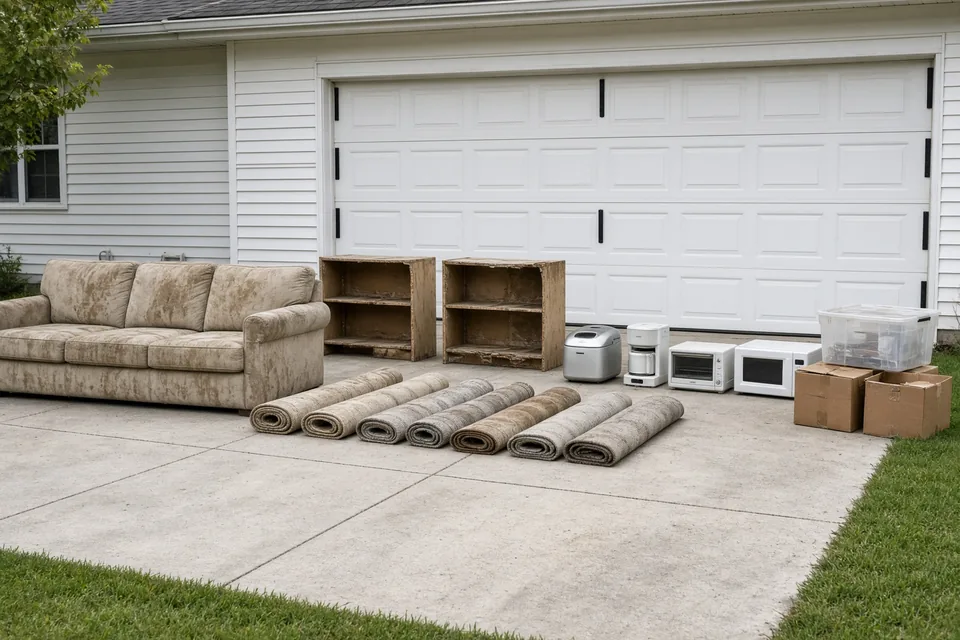 Step 02
Inventory the contents
Sort, inventory, and photograph every piece of waterlogged furniture, area rug, and small appliance on a dry staging area before haul-away so your personal contents claim is fully documented.
Why it matters: Photographing every ruined item before haul-away is essential because NFIP contents coverage caps at $100,000 and settles on actual cash value.
 Step 03
Flood cut and dry-out
Make a clean horizontal flood cut above the high-water mark, pull out soaked fiberglass insulation batts, and run commercial dehumidifiers until wood framing moisture drops below target levels.
Why it matters: Removing soaked drywall and insulation above the high-water mark stops wicking and exposes framing so structural rebuild costs can be scoped.


On this page
The flood gap formula in plain words
When water damages a home, insurance math is governed by a strict coverage routing rule before any arithmetic begins. Standard homeowners policies (ISO HO-3 and similar forms) cover sudden and accidental discharge from an internal plumbing, heating, or air-conditioning system, but exclude surface water, flood, waves, storm surge, overflow of any body of water, and subsurface hydrostatic pressure. Conversely, a Standard Flood Insurance Policy (SFIP) issued through the National Flood Insurance Program (NFIP) covers general and temporary inundation of two or more acres of normally dry land or two or more properties from rising water, but separates Building Property (Coverage A) and Personal Property/Contents (Coverage B) into two non-transferable buckets with separate deductibles.
In words:
- Identify the responding policy based on the verified water source (Homeowners for sudden burst pipe; Flood Policy for rising surface water; $0 on unendorsed forms for sewer backup or groundwater seepage).
- For a rising-water flood with an active flood policy, subtract the flood building deductible from the building loss, cap the result at the policy's building limit ($250,000 maximum under NFIP as of 24 Oct 2026), and subtract that payout from the building loss to find the Building Gap.
- Perform the identical calculation for contents: subtract the flood contents deductible from the contents loss, cap the result at the policy's contents limit ($100,000 maximum under NFIP as of 24 Oct 2026), and subtract that payout from the contents loss to find the Contents Gap.
Two worked examples with different outcomes
Example 1: major river overbank flood exceeding both NFIP ceilings
A suburban two-story house takes 30 inches of river water across the first floor. The restoration contractor estimates $310,000 in building repairs and the family documents $125,000 in ruined furniture, clothing and appliances. The homeowner carries an NFIP policy with the maximum $250,000 building limit, the maximum $100,000 contents limit and a $2,000 deductible on each.
- Homeowners policy column: pays $0 because overland flooding is excluded.
- Flood building payout: min($250,000, $310,000 − $2,000) = $250,000.
- Building gap: $310,000 − $250,000 = $60,000 unpaid ($58,000 over the cap plus the $2,000 deductible absorbed below it).
- Flood contents payout: min($100,000, $125,000 − $2,000) = $100,000.
- Contents gap: $125,000 − $100,000 = $25,000 unpaid.
- Combined Outcome: Flood insurance pays $350,000; the homeowner faces an $85,000 coverage gap.
Example 2: second-floor supply line burst versus uninsured surface water
Compare a $42,000 building loss and $18,000 contents loss ($60,000 total) under two different causes when the homeowner has a homeowners policy with a $1,500 deductible and no flood policy:
- Outcome A (Sudden Burst Pipe): The homeowners policy responds to the entire $60,000 loss. Subtracting the single $1,500 deductible yields a $58,500 payout (subject to policy replacement-cost or actual-cash-value rules) and a $1,500 out-of-pocket cost.
- Outcome B (Flash Flood Surface Water Entering Doors): The homeowners policy pays $0, the nonexistent flood policy pays $0, and the homeowner's out-of-pocket gap is the full $60,000.
What changes the answer
| Factor | How It Moves Your Claim Payout and Gap | Where to Verify |
|---|---|---|
| Water origin classification | Separates $0 flood exclusion on homeowners forms from covered sudden pipe breaks | Adjuster's written cause-of-loss report |
| NFIP $250,000 building cap | Caps federal residential structural payout regardless of actual home rebuild cost | Flood declarations page & 44 CFR 61.6 |
| NFIP $100,000 contents cap | Requires separate purchase; settles personal property at depreciated Actual Cash Value | Flood declarations page (Coverage B) |
| Private excess flood policy | Sits above the $250,000 / $100,000 NFIP limits or replaces NFIP with higher dwelling limits | Private surplus-lines policy schedule |
| Basement & below-grade exclusions | NFIP covers basement mechanicals/foundation but excludes finished basement drywall, floors & furniture | FEMA SFIP Section III.A.8 & III.B.3 |
| Principal residence occupancy | Living in the home 80%+ of the year allows RCV on the building under NFIP; vacation homes get ACV | NFIP Dwelling Form Section VII.R |
What documents to look at
- Homeowners Declarations Page and Exclusions Endorsement: Check your Coverage A limit, all-other-perils deductible, and whether you purchased an optional Water Back-Up and Sump Discharge endorsement (tested in the water backup calculator).
- Flood Insurance Policy Declarations Page: Confirm whether Coverage A (Building) and Coverage B (Contents) both show dollar limits, check the separate deductibles for each column, and verify the policy effective date (NFIP policies normally enforce a 30-day waiting period unless tied to a mortgage closing).
- Adjuster's Preliminary Scope and Reservation of Rights / Denial Letter: When wind-driven rain and rising storm surge occur in the same hurricane, read how the adjuster separated upper-story wind water entry from lower-level surface floodwater.
Worked example
A coastal river overflows into a single-story house during a tropical rainstorm (rising surface water). Building damage is $310,000 and contents damage is $125,000 (total loss $435,000). The homeowner carries an active NFIP policy with the maximum $250,000 building limit, the maximum $100,000 contents limit, and a $2,000 deductible on each flood coverage bucket, plus a homeowners policy with a $1,500 deductible.
The arithmetic, step by step
Worked example- Cause: Rising surface water from storm or river -> Homeowners policy pays $0 (homeowners $1,500 deductible is not used).
- Flood Building Math: $310,000 building loss - $2,000 flood building deductible = $308,000 net loss, capped at the $250,000 NFIP building limit -> $250,000 building payout.
- Building Gap: $310,000 building loss - $250,000 flood building payout = $60,000 unpaid building gap (consisting of $58,000 over the cap + $2,000 deductible).
- Flood Contents Math: $125,000 contents loss - $2,000 flood contents deductible = $123,000 net loss, capped at the $100,000 NFIP contents limit -> $100,000 contents payout.
- Contents Gap: $125,000 contents loss - $100,000 flood contents payout = $25,000 unpaid contents gap (consisting of $23,000 over the cap + $2,000 deductible).
- Combined Result: Total flood policy payout = $350,000 ($250,000 + $100,000). Total out-of-pocket gap = $85,000 ($60,000 building gap + $25,000 contents gap).
These are the calculator's default inputs, so pressing the button above reproduces this example.
Does homeowners insurance cover flooding?
Many policies follow a strict anti-concurrent causation clause: if excluded surface floodwater and a covered peril act together to damage the first floor, the homeowners policy often excludes the entire flood-touched area unless wind first broke open the roof or windows and let rain inside before floodwaters rose. When a sudden pipe break is covered under your homeowners policy, one deductible applies and depreciation holdbacks can be checked in the depreciation (ACV) calculator. If your flood or homeowners payout falls short of contractor bids, compare the difference in the claim gap calculator, organize your ruined personal belongings in the contents claim calculator, and weigh whether a small pipe claim beats your deductible in the should-I-file-a-claim calculator. Policy wording and the adjuster decide every claim.
What this page will not claim
- This page does not classify the legal cause of your water loss: Only a licensed adjuster, forensic engineer, or court of law can determine whether damage resulted from wind-driven rain, a burst pipe, sewer backup, or surface flooding.
- This page does not quote flood insurance premiums: NFIP Risk Rating 2.0 and private flood premiums vary by elevation, distance to coast or river, and replacement value.
- This page does not promise FEMA disaster grants: Individual Assistance grants from FEMA are never a replacement for flood insurance, require a federal disaster declaration, and average only a fraction of major structural repair costs.
- This page does not provide legal advice or interpret carrier-specific endorsements: Always read your complete policy contract.
Sources and further reading
- FEMA FloodSmart — what a flood policy covers and its limits
- eCFR — 44 CFR 61.6, maximum NFIP coverage amounts
- NAIC — Actual cash value vs replacement cost coverage
- Mississippi Insurance Department — Consumer quick guide to home insurance (PDF)
The calculator applies the arithmetic that policy forms and the agencies above describe. It does not read your policy, and it does not decide coverage: your declarations page, the policy wording and the adjuster do. See the methodology for how this site checks its figures.
Frequently asked questions
Why does my NFIP flood policy stop at $250,000 when my house costs $450,000 to rebuild?
The National Flood Insurance Program (NFIP) is governed by federal statute and regulations (44 CFR 61.6), which cap single-family residential building coverage at $250,000 as of 24 Oct 2026 on floodsmart.gov. Even if your homeowners Coverage A limit is $450,000, an NFIP policy cannot pay more than $250,000 for structural flood damage. Homeowners who want protection above that federal ceiling must purchase a private primary flood policy or an excess flood policy that sits above the NFIP limits.
Are my furniture and clothing automatically covered when I buy an NFIP flood policy?
No. Under the NFIP Dwelling Form, Building Property (Coverage A) and Personal Property/Contents (Coverage B) are sold separately. Mortgage lenders require building coverage in high-risk flood zones, but they rarely mandate contents coverage. Unless your flood declarations page explicitly lists a dollar limit for contents—up to the $100,000 NFIP residential maximum—your flood policy pays $0 for ruined furniture, clothing, and portable electronics.
Does flood insurance pay replacement cost or actual cash value on my damaged belongings?
Standard NFIP flood policies always settle personal contents (Coverage B) on an Actual Cash Value (ACV) basis, meaning the adjuster deducts depreciation for age and wear before issuing payment. Replacement Cost Value (RCV) under an NFIP policy is available only on the building structure itself, and only if the house is your principal residence (lived in at least 80% of the year) and insured to at least 80% of its full replacement cost or the maximum $250,000 limit.
Why are two deductibles subtracted on my flood insurance claim?
Because an NFIP policy treats the building structure and your personal contents as two distinct coverage parts, each part carries its own deductible shown on your declarations page. If rising water ruins both your first-floor drywall and your living-room furniture, the adjuster subtracts the building deductible from the structural repair estimate and subtracts the separate contents deductible from your depreciated personal property valuation.
What does an NFIP flood policy cover inside a finished basement?
NFIP basement coverage is strictly limited to essential structural and mechanical items required to make the house habitable—such as foundation walls, furnaces, water heaters, electrical panels, sump pumps, and unpainted drywall or insulation. Finished basement improvements installed below the lowest elevated floor, including carpet, hardwood, finished taped drywall, custom cabinetry, and personal furniture stored in the basement, are excluded from standard NFIP payouts.
When does a sewer backup count as a flood claim instead of a homeowners endorsement claim?
Under the NFIP Standard Flood Insurance Policy, water or sewage that backs up through sewers or drains is covered only if there is a general condition of flooding in the area and the backup is a direct result of that flood. If a municipal sanitary main clogs during a rainstorm without surface flooding on your property, the flood policy pays $0 and you must rely on a homeowners water-backup endorsement.