Home › Well drilling
Plumbing · a new drilled wellWater well drilling cost calculator
Drilling a water well prices the physical borehole, casing, sanitary seal, and flow test—not the submersible pump or house water line. Stop here if your existing well still has plenty of water and only the submersible pump, bladder tank, or control box burned out: pump and pressure-tank swaps belong on the well pump calculator, while trenching the supply pipe to the house sits on the water line calculator.
Across the United States in 2026, rotary rig mobilization runs $900 to $2,400 flat, borehole drilling runs $25 to $65 per foot depending on soil versus hard rock geology, and 6-inch well casing adds $14 to $44 per foot for the cased depth, plus annular grout sealing ($500 to $1,350), a sanitary well cap and pitless adapter ($400 to $950), a drawdown yield test ($350 to $850), and a state/county well permit ($250 to $750).
If you do not know your target depth, compare the 100-foot, 200-foot, and 400-foot scenarios below. Remember that no driller can guarantee gallons per minute before drilling.
Reviewed 25 October 2026 · Written by Mantu Kumar
See the photos · See the cost diagram · Open the calculator · Every part explained
Key facts at a glance
- Rotary drilling rig mobilization and site setup is billed as a flat line of $900 to $2,400 regardless of final depth.
- Borehole drilling runs $25 to $48 per vertical foot in unconsolidated soil, sand, and gravel, and $35 to $65 per vertical foot in hard granite, limestone, or basalt bedrock.
- Six-inch NSF-61 potable-grade PVC well casing runs $14 to $26 per foot installed, while 6-inch Schedule 40 carbon steel casing with a drive shoe runs $24 to $44 per foot.
- Pumping bentonite clay or neat cement grout into the annular space around the upper casing to block surface bacteria runs $500 to $1,350, and a sanitary well cap plus brass pitless adapter runs $400 to $950.
- No water-well driller can guarantee gallons per minute (GPM) or water chemistry before drilling; the submersible pump, pressure tank (the well pump calculator), and trench to the house (the water line calculator) are priced separately.
National 2026 planning ranges before your regional multiplier. Sources and method are at the bottom of the page.
2026 planning ranges
- 1Rig mobilization
- 2Drilling per foot
- 3Casing
- 4Grout seal
- 5Yield test
- 6Cap and pitless adapter
- 7Permit
- 8Pump excluded
- 9Low-yield contingency
Price your water well drilling
No email · nothing sentDiagram, part by part
Water well drilling: every numbered part explained
The drawing above has 9 numbered parts, from Rig mobilization to Low-yield contingency. Each card zooms in on one part, says what pushes its price up or down, and what to check on a written quote. After you run the calculator, the parts in your scope show their dollar figure.
1 Rig mobilization
$900 – $2,400 (flat line)
Moving a 40,000-pound truck-mounted air-rotary or mud-rotary drilling rig, a pipe-and-grout support truck, and an air compressor onto your property is a fixed setup cost regardless of whether the drill bit hits water at 100 feet or 400 feet ($900–$2,400). Mobilization includes leveling the hydraulic outriggers on timber cribbing, digging a mud/cuttings containment pit if needed, and setting up the surface starter pipe.
What moves it: Travel distance from the driller's yard, steep driveway grades, and clearing overhead tree limbs for a 35-foot vertical rig mast.
On the quote: Confirm that the flat mobilization line covers both the rotary drill rig and the water/casing support truck.
2 Drilling per foot
$25 – $48 / ft (soil/sand/gravel) | $35 – $65 / ft (bedrock)
Drillers charge by the vertical foot from ground level down to total completed borehole depth. Unconsolidated sand, gravel, and clay formations drill faster with mud-rotary or hollow-stem auger bits ($25–$48/ft). Consolidated granite, limestone, shale, or basalt bedrock requires a pneumatic down-the-hole (DTH) air hammer bit that pulverizes solid rock ($35–$65/ft). If you do not know your depth, check your state's online well-log database for your street or use the 100 / 200 / 400 ft scenarios below.
What moves it: Total depth needed to intercept water-bearing fractures and whether the formation is soft soil or hard abrasive rock.
On the quote: Ask the driller to pull the state well-completion logs for the three closest neighbors on your road to estimate local depth.
3 Casing
$14 – $26 / ft (6-in NSF-61 PVC) | $24 – $44 / ft (6-in Schedule 40 steel)
Well casing is the structural pipe that lines the borehole so loose dirt, sand, and surface water cannot collapse into your drinking water. In sand-and-gravel aquifers, the well is cased the entire depth with a slotted stainless steel well screen at the bottom. In bedrock wells, 6-inch casing is driven through the upper soil overburden and seated 5 to 15 feet into solid rock with a hardened steel drive shoe, leaving the lower rock borehole open.
What moves it: How many feet of soft soil sit above solid bedrock and whether your state code requires steel casing or allows Schedule 40/80 PVC.
On the quote: Check your contract for both the base casing footage included and the exact per-foot unit price if rock sits deeper than expected.
4 Grout seal
$500 – $1,350
When a drill bit cuts a 9-or-10-inch hole to insert a 6-inch well casing, it leaves an open ring-shaped gap (the annular space) around the outside of the pipe. Without a sanitary seal, lawn fertilizer, septic effluent, and surface rainwater run straight down the outside of the casing into the aquifer. Drillers pump sodium bentonite clay slurry or neat Portland cement grout into the annular space to lock out surface water ($500–$1,350).
What moves it: State minimum grouting depth rules (commonly 20 to 50+ feet below grade or full depth to bedrock).
On the quote: Verify that pumped annular bentonite or neat cement grouting meets your county health department's minimum depth rule.
5 Yield test
$350 – $850
Once the borehole hits water-bearing sand or rock fractures, the driller cleans out rock flour using high-pressure air lifting and runs a drawdown and recovery yield test ($350–$850) to measure static water level and sustainable flow in gallons per minute (GPM). No driller can guarantee gallons per minute before drilling—if a deep rock hole yields under 1 to 2 GPM, you may weigh hydrofracturing ($2,200–$4,500) or a second hole.
What moves it: Length of the required pump/air-lift test (2 hours vs 4–8 hours for mortgage or health department sign-off).
On the quote: Never sign a contract expecting a guaranteed GPM flow rate; geology is unpredictable, and you pay per foot drilled even if a hole is dry.
6 Cap and pitless adapter
$400 – $950
In modern wells, the top of the 6-inch casing sticks 12 to 18 inches above the lawn (never buried in an old unsanitary concrete well pit) and is topped with a gasketed, screened, vermin-proof aluminum sanitary well cap that blocks earwigs, mice, and floodwater. Below ground below the frost line (4 to 6 feet down), a heavy brass slide-together fitting called a pitless adapter connects the vertical pump pipe to the horizontal trench line ($400–$950).
What moves it: Frost-line excavation depth for the brass pitless adapter and 1-inch versus 1.25-inch pipe sizing.
On the quote: Confirm that a frost-below-grade brass pitless adapter and vermin-proof sanitary well cap are included on the drilling quote.
7 Permit
$250 – $750
Every state and county health or environmental department regulates private water wells to protect groundwater aquifers ($250–$750 permit and filing fee). Before issuing the permit, the inspector checks your site plan to verify minimum isolation distances—commonly about 50 feet or more from a septic tank and 100 feet from a drain field (see the septic system calculator); your state sets the exact distances.
What moves it: County health department permit fees and whether a mandatory lab bacteria/nitrate water test is bundled with the permit.
On the quote: Have the driller flag the proposed well stake and measure the exact distance to your septic tank and drainfield before the rig arrives.
8 Pump excluded
Linked to the well pump calculator & water line calculator
Well drillers cannot price the submersible pump, drop pipe, wire, or bladder pressure tank accurately until the hole is finished and they know whether the pump will hang at 120 feet at 15 GPM or 380 feet at 3 GPM. That is why the submersible pump, tank, and control box are excluded here and priced on the well pump calculator ($1,650–$7,700), trenching to the house is on the water line calculator, and filtration is on the water filter calculator.
What moves it: Final pump setting depth and flow rate determined after the borehole yield test is finished.
On the quote: Budget for three separate phases on a brand-new rural home: (1) drilling the borehole here, (2) the pump and tank on the well pump calculator, and (3) trenching on the water line calculator.
9 Low-yield contingency
$2,200 – $4,500 hydrofracture, or about +75% of drilling
If the first borehole yields too little water, there are two common fixes: hydrofracturing the bedrock with high-pressure water to open fractures, or drilling a second hole. The calculator prices one or the other, never both, so you can budget for the risk without counting it twice.
What moves it: Local geology and what neighbors' well logs show about yields.
On the quote: Ask what yield counts as a successful well and what happens to the price if the first hole falls short.
Project photo guide
Well drilling in photos: the rig, the casing and the yield test
Drilling a domestic water well takes heavy rotary machinery and strict sanitary sealing. These four scenes show a truck-mounted rotary drilling rig working in a residential yard, driving and welding 6-inch steel casing through the upper soil, air-lifting water to measure gallons-per-minute yield, and a finished above-ground casing with a vermin-proof sanitary well cap.

How the job works in 3 key stages
All three step images are AI-generated illustrations for explanation. Not a site inspection, bid, or coverage decision.
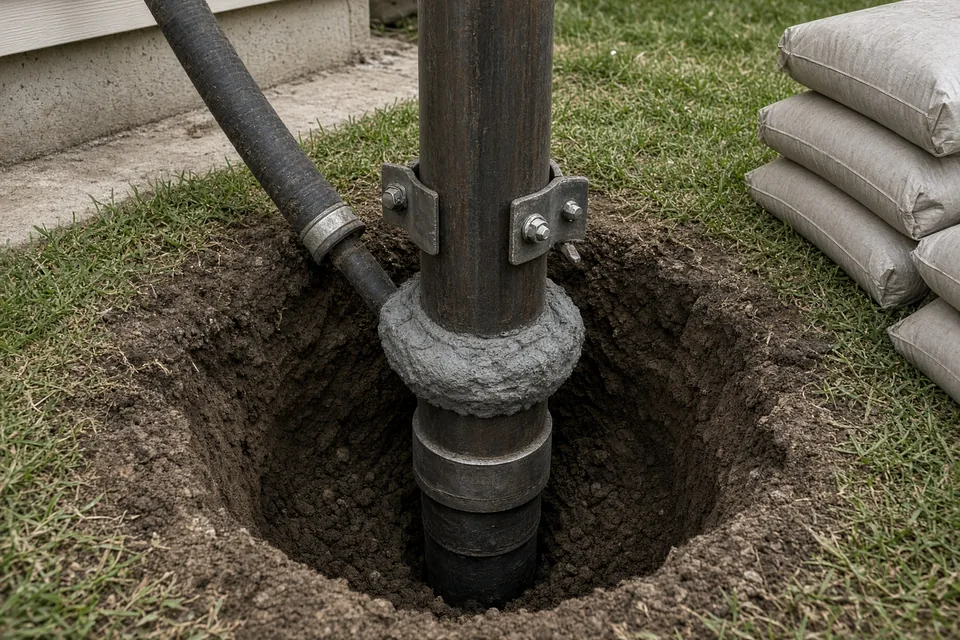 Step 01
Case and grout
Drill through the upper soil overburden, install 6-inch carbon steel or NSF-61 PVC casing into bedrock, and pump bentonite clay or cement grout into the annular space.
Why it matters: Casing ($14–$44/ft) and pumped annular bentonite/cement grout ($500–$1,350) seal out surface runoff and bacteria from the upper soil layers.
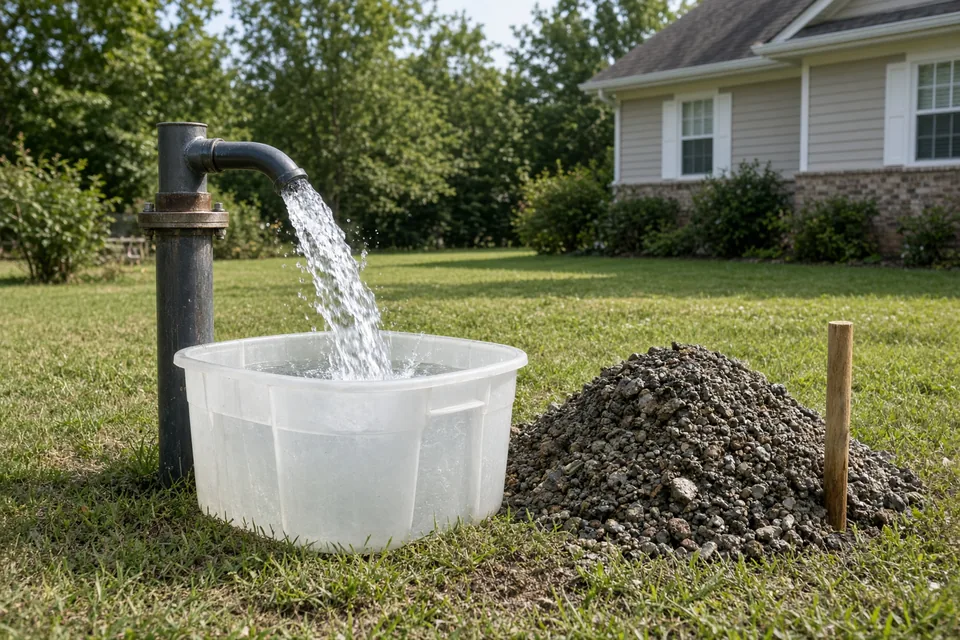 Step 02
Test the yield
Once the borehole reaches water-bearing rock or sand, an air-lift drawdown test measures gallons per minute so the pump can be sized.
Why it matters: An air-lift development and drawdown yield test ($350–$850) measures how many gallons per minute the aquifer produces so the pump on the well pump calculator can be sized.
 Step 03
Cap the wellhead
The casing finishes above grade with a vermin-proof sanitary cap, and a pitless adapter below the frost line carries water sideways to the house.
Why it matters: A vermin-proof sanitary well cap at the surface and a brass pitless adapter below the frost line ($400–$950) complete the borehole before the pump crew arrives.


On this page
- The diagram, part by part
- Photo guide: hero and 3 project steps
- 2026 water well drilling cost table (100, 200 & 400 ft scenarios + unit bands)
- Three worked scenarios with full arithmetic (100 ft, 200 ft & 400 ft)
- Decision table: 6-inch NSF-61 PVC casing vs 6-inch carbon steel casing
- Signs you need a new borehole vs a pump swap on the well pump calculator
- Quote checklist: 8 items to verify on a well driller contract
- Typical well drilling timeline
- Worked example
- Does insurance pay to drill a new well?
- Sources and further reading
- Frequently asked questions
2026 water well drilling cost table (100, 200 & 400 ft scenarios + unit bands)
If you do not know how deep your well will be, start with this 100 / 200 / 400 ft scenario table (complete borehole with rig setup, drilling, casing, grout seal, yield test, cap/pitless adapter, and permit—before adding the submersible pump on the well pump calculator):
| Well Depth Scenario / Unit Line | 2026 Low | 2026 High | What Is Included / What Changes It |
|---|---|---|---|
| 100 Ft Well Scenario (Sand/Gravel, 100 ft PVC Casing) | $6,300 | $13,700 | Rig + 100 ft soil drill ($2.5k–$4.8k) + 100 ft PVC casing ($1.4k–$2.6k) + grout/cap/test/permit |
| 200 Ft Well Scenario (Bedrock, 90 ft Steel Casing) | $11,560 | $23,260 | Rig + 200 ft rock drill ($7k–$13k) + 90 ft steel casing ($2.16k–$3.96k) + grout/cap/test/permit |
| 400 Ft Well Scenario (Deep Bedrock, 180 ft Steel Casing) | $20,720 | $40,220 | Rig + 400 ft rock drill ($14k–$26k) + 180 ft steel casing ($4.32k–$7.92k) + grout/cap/test/permit |
| Rotary drilling rig mobilization & setup (flat line) | $900 | $2,400 | Flat fee regardless of depth; includes rig + water/casing truck |
| Borehole drilling: Soil/Sand ($25–$48/ft) · Bedrock ($35–$65/ft) | $25 / ft | $65 / ft | Unconsolidated alluvial gravel vs hard granite/limestone/basalt |
| 6-inch well casing: PVC ($14–$26/ft) · Carbon Steel ($24–$44/ft) | $14 / ft | $44 / ft | Full depth + screen in sand/gravel; overburden into rock on bedrock wells |
| Sanitary annular grout seal ($500–$1,350) + Yield test ($350–$850) | $850 | $2,200 | Pumped bentonite/cement seal + 4-hr air-lift drawdown test |
| Vermin-proof sanitary well cap + brass pitless adapter ($400–$950) + Permit ($250–$750) | $650 | $1,700 | Frost-line pitless adapter, sealed cap & county health permit |
| Optional hydrofracturing ($2,200–$4,500) OR 2nd borehole (+75% drill) | $2,200 | $9,750+ | Only if first borehole has inadequate yield (never double-counted) |
Three worked scenarios with full arithmetic (100 ft, 200 ft & 400 ft)
Scenario 1: 100-foot sand & gravel well with full-depth 6-inch PVC casing & screen (1.00x)
In a coastal plain or glacial outwash valley, the driller bores 100 feet through sand and gravel (geology = soil) and installs 100 feet of 6-inch NSF-61 PVC casing with a slotted stainless well screen (casing_type = pvc_6).
- Rig Mobilization (Flat Line): $900 – $2,400
- 100 ft Soil/Gravel Drilling ($25–$48/ft × 100): $2,500 – $4,800
- 100 ft of 6-In PVC Casing & Screen ($14–$26/ft × 100): $1,400 – $2,600
- Sanitary Annular Grout Seal: $500 – $1,350
- Development & 4-Hr Yield Test: $350 – $850
- Sanitary Cap & Brass Pitless Adapter: $400 – $950
- County Well Permit & Log Filing: $250 – $750
- National Borehole Total: $6,300 to $13,700 (plus shallow/typical pump on the well pump calculator)
Scenario 2: 200-foot bedrock well with 90 ft of 6-inch steel casing (worked example, 1.00x)
A homeowner drills 200 feet into consolidated bedrock (geology = rock), driving 90 feet of 6-inch carbon steel casing with a drive shoe through the upper soil overburden into sound rock (casing_type = steel_6).
- Rig Mobilization (Flat Line): $900 – $2,400
- 200 ft Bedrock Drilling ($35–$65/ft × 200): $7,000 – $13,000
- 90 ft of 6-In Carbon Steel Casing ($24–$44/ft × 90): $2,160 – $3,960
- Sanitary Annular Grout Seal: $500 – $1,350
- Air-Lift Development & Yield Test: $350 – $850
- Sanitary Cap & Pitless Adapter: $400 – $950
- County Well Permit: $250 – $750
- National Borehole Total: $11,560 to $23,260 (plus typical submersible pump on the well pump calculator)
Scenario 3: 400-foot deep granite bedrock well + hydrofracturing contingency (1.00x)
On a mountain ridge where fractures are tight, the driller bores 400 feet into granite (depth = 400, 180 ft of 6-in steel casing) and performs high-pressure water hydrofracturing (low_yield_opt = hydrofrac) to open water-bearing rock seams.
- Rig Mobilization (Flat Line): $900 – $2,400
- 400 ft Bedrock Drilling ($35–$65/ft × 400): $14,000 – $26,000
- 180 ft of 6-In Steel Casing ($24–$44/ft × 180): $4,320 – $7,920
- Sanitary Grout Seal ($500–$1,350) + Yield Test ($350–$850): $850 – $2,200
- Sanitary Cap, Pitless Adapter & Permit: $650 – $1,700
- Bedrock Hydrofracturing Development: $2,200 – $4,500
- National Borehole Total: $22,920 to $44,720 (plus deep-set pump on the well pump calculator)
Decision table: 6-inch NSF-61 PVC casing vs 6-inch carbon steel casing
| Casing Material | 2026 Installed Rate | Where Used | Key Advantage | Limitation |
|---|---|---|---|---|
| 6-In NSF-61 PVC | $14 – $26 / linear ft | Sand/gravel aquifers, coastal/corrosive water, rotary mud holes | Never rusts, scales, or corrodes in acidic/brackish water | Cannot be driven with a percussion shoe into boulder till or hard rock |
| 6-In Schedule 40 Steel | $24 – $44 / linear ft | Glacial boulder till, fractured bedrock seating, cold climates | High impact strength; drives into solid bedrock with a hardened drive shoe | Can corrode over 40–60 years in low-pH acidic groundwater |
Signs you need a new borehole vs a pump swap on the well pump calculator
- Go to the well pump calculator ($1,650–$7,700) when: Water pressure suddenly stopped, the breaker trips, or the pressure switch clicks rapidly, but the static water level inside the casing is normal and the water is clear.
- Price a new well borehole on this page when: Building on raw land, an old shallow dug well goes dry every summer drought, an old steel casing has rusted through and pumps heavy sand/mud that destroys impellers, or the borehole collapsed.
Quote checklist: 8 items to verify on a well driller contract
- State Well-Driller License Number: Is the contractor licensed with your state water-resources or health department?
- Written Per-Foot Drilling & Casing Rates: Does the contract state the exact $/ft rate if the hole goes deeper or requires more casing than the base estimate?
- NSF-61 Potable Stamp on Casing: Is all PVC or steel pipe certified for drinking water?
- Sanitary Grouting Method & Depth: Does the bid specify pumped bentonite or neat cement grout to state code depth?
- Septic & Property-Line Setback Check: Did the driller verify 50-ft septic tank and 100-ft drainfield clearance (the septic system calculator)?
- Pitless Adapter & Sanitary Cap Included: Are the frost-line brass pitless adapter and vermin-proof cap in the drilling bid or left to the pump installer?
- Dry-Hole / Low-Yield Terms: What is the per-foot rate if a hole is dry or needs hydrofracturing?
- Pump, Tank & Trench Separation: Confirm whether the quote is borehole-only or includes well pump calculator and the water line calculator.
Typical well drilling timeline
- Weeks 1–2: County health department well permit application, septic setback verification, and 811 locate.
- Days 1–3 (Drilling): Mobilize rotary rig, drill borehole (typically 100 to 250 feet per day in rock), drive/set casing, and pump sanitary grout seal.
- Day 4: Air-lift well development, 4-hour drawdown yield test, install pitless adapter and sanitary cap, and hand off the well log to the well pump calculator and the water line calculator crew.
Worked example
A homeowner drills a new 200-foot domestic water well into consolidated bedrock (depth = 200, geology = rock), installing 90 feet of 6-inch Schedule 40 carbon steel surface casing with a hardened drive shoe through the upper soil overburden into sound rock (casing_type = steel_6), plus flat rig mobilization, annular bentonite grout sealing, a 4-hour yield test, a sanitary cap and brass pitless adapter, and a county well permit at the 1.00x national baseline.
The default job, line by line
Worked example| Line item | National planning range |
|---|---|
| Rotary drilling rig mobilization & setup | $900 – $2,400 |
| 200 feet of bedrock borehole drilling | $7,000 – $13,000 |
| 90 feet of 6-inch carbon steel casing & drive shoe into rock | $2,160 – $3,960 |
| Sanitary annular bentonite/cement grout seal | $500 – $1,350 |
| Air-Lift development & 4-hour drawdown yield test | $350 – $850 |
| Vermin-Proof sanitary well cap & frost-line pitless adapter | $400 – $950 |
| County well drilling permit, septic setback check & log filing | $250 – $750 |
| Total before regional adjustment | $11,560 – $23,260 |
Midpoint about $17,410. These are the calculator's default inputs, so pressing the button above at the national region reproduces this table.
Does insurance pay to drill a new well?
Homeowners insurance does not pay to drill a new water well, deepen an existing well when the water table drops during a drought, or replace a collapsed underground well casing. Standard policy forms exclude land, subterranean water, earth movement, and corrosion of exterior well boreholes—and even optional service line cover calculator endorsements cover only the horizontal underground water pipe (the water line calculator) running from the wellhead to the house, explicitly excluding the vertical well borehole itself. Where insurance does occasionally respond is when a direct lightning strike or sudden covered electrical event burns out the submersible pump and control box hanging inside the well—price that equipment on the well pump calculator and the lightning & surge calculator and check the should-I-file-a-claim calculator. Policy wording and the adjuster decide every claim.
What this page will not claim
- This page never guarantees gallons per minute (GPM) or water quality: Subsurface aquifers cannot be guaranteed before drilling, and water chemistry may require treatment on the water filter calculator.
- This page does not include the submersible pump, bladder tank, or house trench: Those are priced on the well pump calculator and the water line calculator once final depth is known.
- This page never claims homeowners insurance pays for a dry well or collapsed borehole: Subterranean earth and water-table changes are excluded.
Sources and further reading
- Bob Vila — Well drilling cost
- U.S. EPA — Private drinking water wells
- National Ground Water Association — WellOwner.org
Prices on this page are planning ranges built from public 2026 US cost guides and contractor rate sheets, widened where they disagreed, and multiplied by the same regional index as every other ReplaceCost calculator. Codes and rules come from the bodies listed. See the methodology for how ranges are set and reviewed.
Frequently asked questions
How can I find out how deep my new water well will need to be before hiring a driller?
Every US state maintains a public online groundwater or well-completion log database (usually hosted by the state Department of Natural Resources, Environmental Protection, or Water Resources). By looking up the well logs filed for the three or four closest houses on your road, you can see the exact total depth, depth to bedrock, casing length, and gallons-per-minute yield of neighboring wells.
Why doesn't the well drilling price include the submersible pump, pressure tank, and trench to the house?
Because a submersible pump and its heavy copper power wire must be sized for the exact depth and gallons-per-minute yield discovered after the borehole is finished. A 1/2 HP pump set at 100 feet uses completely different equipment and wire than a 1.5 HP deep-set pump hanging at 380 feet. Once your borehole is tested, price the pump and tank on the well pump calculator and the trench on the water line calculator.
What happens if the driller drills 300 feet and hits a dry hole with no water?
Water-well drilling contracts are written on a per-foot 'time and materials' basis—no legitimate driller can guarantee how many gallons per minute lies inside solid rock before drilling. If a bedrock borehole produces only 0.25 to 0.5 GPM, homeowners usually choose between two options: hydrofracturing the existing hole ($2,200 to $4,500) to open nearby rock seams, or drilling a second hole at a negotiated per-foot rate.
Why is a bedrock well only cased partway down instead of all the way to the bottom?
In a bedrock well, the upper 20 to 150 feet of loose soil, clay, and weathered rock (the overburden) is lined with 6-inch steel or PVC casing and grouted so surface dirt and bacteria cannot enter. Once the steel drive shoe is seated firmly into solid, unfractured bedrock, the rock itself forms the walls of the lower borehole, allowing clean groundwater to flow in from open rock fractures.
What is a pitless adapter, and why is it better than an old underground well pit?
Decades ago, wellheads were buried inside underground concrete pits to keep pipes from freezing, which allowed surface floodwater, mice, and insects to contaminate the well. Today, the well casing extends 12 to 18 inches above ground with a sealed sanitary cap, and a heavy brass slide-together fitting called a pitless adapter is installed on the side of the casing 4 to 6 feet underground below the frost line.
How far away from my septic tank and leach field must a new water well be drilled?
While state and county health codes vary slightly, the standard minimum isolation distances across most of the United States are at least 50 feet from a watertight septic tank and at least 100 feet from a subsurface septic absorption drainfield or leach field (see the septic system calculator), and upslope from the septic system whenever the lot topography allows.