Home › Insurance guide › Coinsurance (80%)
Claim math · the 80% and 90% ruleHome insurance coinsurance calculator
Carrying $300,000 of Coverage A dwelling insurance does not mean every partial loss under $300,000 is paid in full. Stop here if your policy includes an active Extended Replacement Cost (for example, +25% or +50% above Coverage A) or Guaranteed Replacement Cost endorsement that waives coinsurance penalties—read your declarations page to verify those riders, and use the rebuild cost calculator first if you have not yet calculated your home's true reconstruction value.
Most standard US homeowners policies (including the ISO HO-3 form) require you to insure the house structure to at least 80%—and on some contracts 90% or 100%—of its full replacement cost at the time of the loss, excluding land value. If construction inflation pushes your rebuild cost to $400,000, an 80% clause requires at least $320,000 in Coverage A.
If you carry only $300,000 on that $400,000 house, you hold 93.75% of the required $320,000 limit. On a $20,000 partial roof or fire loss with a $1,000 deductible, the proportional formula pays $17,750 ($20,000 × 93.75% − $1,000) rather than $19,000, costing you a $1,250 coinsurance penalty.
Reviewed 25 October 2026 · Written by Mantu Kumar
See the photos · See the cost diagram · Open the calculator · Every part explained
Key facts at a glance
- Standard ISO HO-3 replacement-cost loss settlement requires Coverage A to equal at least 80% of the dwelling's full replacement cost at the time of loss.
- The required insurance threshold equals calculated structure rebuild cost multiplied by the coinsurance percentage: Required = Rebuild × Percent.
- The coinsurance recovery ratio is capped at 1.00 and equals min(1, Coverage A Limit ÷ Required Limit).
- On a $400,000 rebuild with an 80% clause ($320,000 required) and a $300,000 limit (93.75% ratio), a $20,000 loss with a $1,000 deductible pays $17,750.
- Land value and untouched concrete foundations below ground are excluded when calculating replacement cost for the 80% coinsurance test.
Policy arithmetic, not a coverage decision. Your declarations page and policy wording decide the real figures; sources are at the bottom of the page.
The claim math, step by step
- 1Declarations limit
- 2Rebuild cost (land excluded)
- 3Coinsurance percent
- 4Required limit
- 5Ratio
- 6Loss
- 7Deductible after the ratio
- 8Check versus full payment
- 9Full payment without a penalty
Run the numbers: home insurance coinsurance
No email · nothing sentDiagram, part by part
Home insurance coinsurance: every numbered part explained
The drawing above has 9 numbered parts, from Declarations limit to Full payment without a penalty. Each card zooms in on one part, says what pushes its number up or down, and what to check on your declarations page or claim letter. After you run the calculator, the parts in your scope show their dollar figure.
1 Declarations limit
Claim step 1
Your Coverage A Dwelling limit is the dollar ceiling printed on the first page of your homeowners policy. Many homeowners set this figure when they close on their mortgage and forget to adjust it as local lumber, roofing, and skilled-trade rates climb. In coinsurance math, your Coverage A limit is the numerator ('Did Carry')—if it lags behind construction inflation, even a small partial loss can be penalized.
What moves it: Your initial underwriting valuation, annual inflation-guard adjustments, and any unrecorded home additions or kitchen remodels.
On the quote: Check your Coverage A limit on your renewal declarations page every year after any major renovation or local construction surge.
2 Rebuild cost (land excluded)
Claim step 2
Rebuild cost—also called full replacement cost—is what a licensed general contractor would charge at the time of the loss to reconstruct your house structure on the existing lot using like-kind materials, including debris haul-off, permits, and contractor overhead. It never includes the market value of the land under the house, and standard forms also exclude underground excavations, footings, and piers below the lowest basement floor.
What moves it: Living square footage, story height, roof complexity, custom interior finishes, and local post-storm contractor labor rates.
On the quote: Run rebuild cost calculator before renewal so you know your structure's true replacement value independent of tax assessments or Zillow prices.
3 Coinsurance percent
Claim step 3
The coinsurance percent is the minimum proportion of full rebuild cost you agree to insure in exchange for replacement-cost settlement on partial claims. Standard US homeowners policies (such as the ISO HO-3 form) set this requirement at 80%. Some specialized dwelling forms, coastal policies, or high-value contracts require 90% or 100%. This percentage is a contract condition, not a deductible.
What moves it: The specific policy form (80% standard HO-3 versus 90% or 100% dwelling/commercial-style clauses) printed in your Loss Settlement conditions.
On the quote: Read Section I — Conditions (Loss Settlement) in your policy booklet to verify whether your replacement-cost threshold is 80%, 90%, or 100%.
4 Required limit
Claim step 4
The required limit ('Should Carry') is the exact Coverage A dollar amount needed to satisfy your policy's coinsurance clause with zero penalty. You calculate it by multiplying the structure's full rebuild cost by the coinsurance percentage: Required = Rebuild × Percent. On a house that costs $400,000 to rebuild under an 80% clause, the required limit is $320,000 ($400,000 × 0.80).
What moves it: Changes in total structure rebuild cost multiplied by your policy's 80%, 90%, or 100% coinsurance factor.
On the quote: Ask your insurance agent for a written replacement-cost estimator printout showing the carrier's calculated 100% and 80% figures.
5 Ratio
Claim step 5
The coinsurance ratio divides the Coverage A limit you actually carried by the required limit you should have carried, capped at 1.00 (100%). in the worked example, carrying $300,000 when $320,000 was required produces a ratio of $300,000 ÷ $320,000 = 0.9375, or 93.75%. If you carry $320,000 or more, the ratio caps at 100%—carrying extra insurance never pays more than 100% of a loss.
What moves it: The gap between your Coverage A limit and the required 80% or 90% rebuild threshold at the date of loss.
On the quote: If an adjuster claims you are underinsured, request their line-by-line Xactimate or CoreLogic valuation worksheet to verify every square-foot assumption.
6 Loss
Claim step 6
The loss is the verified replacement-cost repair estimate for the partial damage—for example, a $20,000 hail roof tear-off or kitchen smoke repair. When your coinsurance ratio is below 100%, the insurer multiplies the partial loss by the ratio first ($20,000 × 93.75% = $18,750). Under standard HO-3 rules, if the depreciated Actual Cash Value of the damaged parts is higher than the coinsurance figure, the policy pays the ACV floor instead.
What moves it: The agreed contractor repair scope for the damaged building components and the age-based ACV floor on standard HO-3 forms.
On the quote: Check both the proportional coinsurance number and the Actual Cash Value calculation on your claim worksheet.
7 Deductible after the ratio
Claim step 7
In standard coinsurance arithmetic, the flat policy deductible is subtracted after the partial loss has already been multiplied by the coinsurance ratio: Payment = max(0, Loss × Ratio − Deductible). In the $20,000 loss example at a 93.75% ratio, the loss drops to $18,750 first, and then the $1,000 deductible is subtracted, leaving a net check of $17,750.
What moves it: The flat dollar deductible ($500, $1,000, $2,500) listed on your declarations page for all-other-perils losses.
On the quote: Verify on the adjuster's settlement summary that the deductible was subtracted once from the adjusted loss, not twice.
8 Check versus full payment
Claim step 8
Comparing the coinsurance check against an unpenalized claim shows the exact dollar penalty caused by underinsurance. Without a coinsurance shortfall, a $20,000 loss minus a $1,000 deductible pays $19,000. Because the 93.75% ratio reduced the payout to $17,750, being $20,000 short on Coverage A cost the homeowner $1,250 in lost claim money on a single $20,000 repair.
What moves it: How far your Coverage A limit falls below the 80% or 90% mark and the size of the partial repair bill.
On the quote: Compare the small annual premium to raise Coverage A by $20,000–$50,000 against losing thousands on a partial roof or fire claim.
9 Full payment without a penalty
Covered loss minus the deductible
This line shows what you would have collected if your Coverage A limit met the coinsurance requirement: the covered loss minus the flat deductible. The difference between this figure and the coinsurance payment is the penalty in dollars. Raising the dwelling limit to the required amount at renewal, or carrying an endorsement that waives coinsurance, is how homeowners close that gap before the next loss.
What moves it: How far your limit sits below the required amount, and the size of the loss.
On the quote: Ask for the carrier's replacement-cost estimate in writing and compare it with your declarations limit at every renewal.
Project photo guide
Coinsurance in photos: the partial loss, the measuring and the upgrades
Coinsurance disputes happen when a home's true reconstruction cost outgrows the Coverage A number on an old policy. These four scenes show a partial roof and siding loss where coinsurance math applies, measuring exterior living area to verify rebuild value, inspecting upgraded interior millwork that raises replacement cost, and reviewing the settlement worksheet.

How the claim works in 3 key stages
All three step images are AI-generated illustrations for explanation. Not a site inspection, bid, or coverage decision.
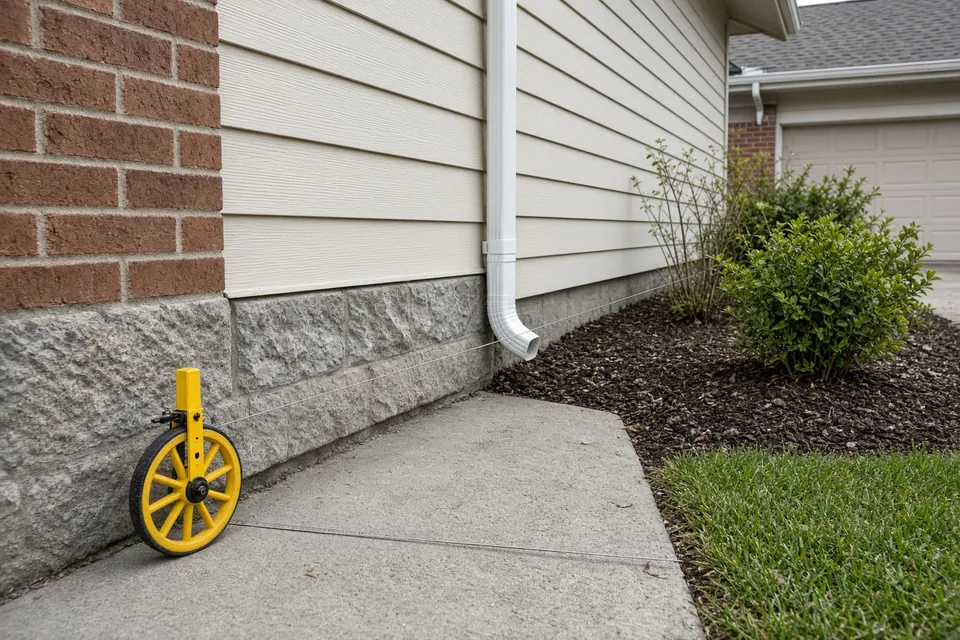 Step 01
Measure the house
Measure the exterior heated footprint, garage separation, and story height after a partial storm loss so the adjuster's total structure valuation matches your actual house dimensions.
Why it matters: Adjusters verify total heated square footage during a claim to compute full structure rebuild cost and test the 80% coinsurance threshold.
 Step 02
Log the finish upgrades
Document every interior finish upgrade—such as solid oak hardwood floors, custom shaker cabinetry, and thick stone counters—that raises full replacement cost above basic builder-grade estimates.
Why it matters: Remodeling a kitchen or adding living space without raising Coverage A is the most common way homeowners accidentally drop below the 80% coinsurance line.
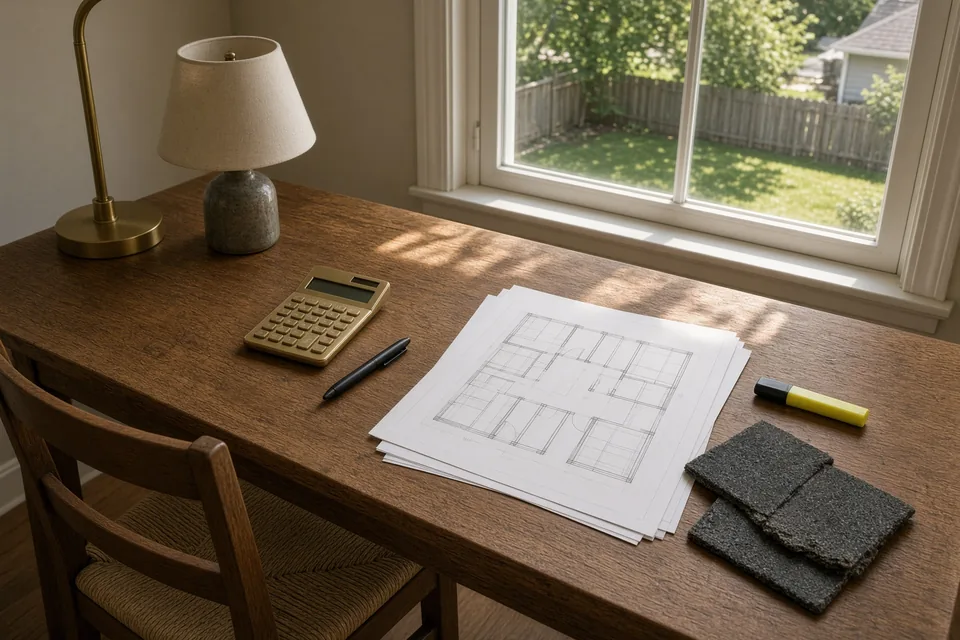 Step 03
Check the 80% math
Compare the field adjuster's total replacement-cost valuation and the 80% threshold line against your current policy declarations page and active endorsements before accepting a reduced partial-loss settlement check.
Why it matters: Checking your rebuild cost on the rebuild cost calculator and locking in an Extended Replacement Cost endorsement prevents surprise coinsurance reductions.


On this page
- The diagram, part by part
- Photo guide: hero and 3 project steps
- The coinsurance formula in plain words
- Two worked examples with different outcomes
- What changes the answer
- What documents to look at
- Worked example
- How the coinsurance rule changes a claim check
- Sources and further reading
- Frequently asked questions
The coinsurance formula in plain words
In property insurance, a coinsurance clause (or the standard ISO HO-3 80% replacement-cost loss settlement rule) requires the homeowner to maintain a Coverage A dwelling limit equal to at least a stated percentage—most commonly 80%, 90%, or 100%—of the structure's full replacement cost at the time of loss. Why does this rule exist? Because almost all property losses are partial losses (such as a $20,000 roof or kitchen fire), and without an 80% threshold a homeowner could buy only $100,000 of insurance on a $400,000 house and still expect every $20,000 repair to be paid in full.
In words:
- Calculate the Required Limit ("Should Carry"): multiply the structure's full rebuild cost (excluding land) by the coinsurance percentage.
- Calculate the Coinsurance Ratio: divide your actual Coverage A limit ("Did Carry") by the Required Limit, and cap the ratio at 1.00 (100%) so over-insurance never exceeds 1.00.
- Compute the Coinsurance Payment: multiply the partial loss by the ratio, subtract the flat deductible, and floor the result at $0.
(Note: Under standard ISO HO-3 Section I — Conditions, when Coverage A is less than 80% of full replacement cost, the policy pays the greater of the depreciated Actual Cash Value of the damaged part or the proportional coinsurance amount above, never exceeding the Coverage A policy limit.)
Two worked examples with different outcomes
Example 1: underinsured partial claim ($300,000 limit on a $400,000 rebuild, 80% clause)
A homeowner carries a $300,000 Coverage A dwelling limit. After several years of lumber and labor inflation, the structure's current full rebuild cost (excluding land) is $400,000. The policy contains an 80% coinsurance clause and a $1,000 flat deductible. A storm causes a $20,000 partial loss.
- Required Limit: required = $400,000 × 0.80 = $320,000.
- Coinsurance Ratio: ratio = min(1, $300,000 ÷ $320,000) = 0.9375 (93.75%).
- Loss Times Ratio: $20,000 × 0.9375 = $18,750.
- Subtract Flat Deductible: payment = max(0, $18,750 - $1,000) = $17,750.
- Penalty Comparison: Had the homeowner carried at least $320,000 in Coverage A, the claim would have paid $20,000 - $1,000 = $19,000. Being $20,000 short on Coverage A reduced the partial-loss check by $1,250, leaving the homeowner with $2,250 total out-of-pocket ($1,000 deductible + $1,250 penalty).
Example 2: compliant policy vs severe 90% coinsurance shortfall on a $50,000 fire loss
Suppose a house costs $500,000 to rebuild and suffers a $50,000 kitchen fire with a $2,000 deductible:
- Outcome A (80% Clause with $410,000 Limit — No Penalty): Required limit = $500,000 × 0.80 = $400,000. Because $410,000 ≥ $400,000, ratio = min(1, 1.025) = 1.00 (100%). Payment = $50,000 × 1.00 - $2,000 = $48,000. Coinsurance penalty = $0.
- Outcome B (90% Clause with $360,000 Limit — Severe Penalty): Required limit = $500,000 × 0.90 = $450,000. Ratio = $360,000 ÷ $450,000 = 0.80 (80.00%). Payment = $50,000 × 0.80 - $2,000 = $40,000 - $2,000 = $38,000. The homeowner loses $10,000 to the coinsurance penalty on top of the $2,000 deductible.
What changes the answer
| Factor | How It Moves Your Coinsurance Ratio and Payout | Where to Verify |
|---|---|---|
| Post-loss rebuild valuation | Higher calculated rebuild cost raises the 80%/90% required bar and lowers your ratio | rebuild cost calculator & adjuster's valuation report |
| Land & foundation exclusion | Removing lot value and below-slab footings lowers the rebuild denominator in your favor | Policy Loss Settlement conditions |
| Extended / Guaranteed RCV rider | Adds +20% to +50% above Coverage A if you insured to 100% of the carrier's initial estimate | Declarations page endorsements |
| Inflation Guard endorsement | Automatically increases Coverage A each quarter or renewal by a construction index | Declarations page endorsements |
| Unreported home additions | Adding a sunroom, bath, or finished attic increases rebuild cost without raising Coverage A | home addition calculator & agent review |
| Actual Cash Value (ACV) floor | Standard HO-3 pays at least the depreciated ACV if ACV exceeds the coinsurance figure | depreciation (ACV) calculator |
What documents to look at
- Policy Declarations Page: Locate your Coverage A Dwelling limit and check whether an Extended Replacement Cost, Guaranteed Replacement Cost, or Inflation Guard endorsement is attached.
- Section I — Conditions (Loss Settlement) in Your Policy Form: Read paragraph C.2 (in standard ISO HO-3 forms) to see the exact 80% replacement-cost rule and how the policy compares the proportional ratio against Actual Cash Value.
- Adjuster's Total Insurable Value (TIV) / Replacement Cost Worksheet: If the adjuster applies a coinsurance reduction, request the software printout (such as Xactimate or CoreLogic) used to value your whole house and check for errors in square footage, garage vs living area, or finish grade.
Worked example
A homeowner carries a $300,000 Coverage A dwelling limit on a home whose current calculated rebuild cost (excluding land) is $400,000. The policy has an 80% coinsurance clause and a $1,000 flat deductible. A windstorm causes a $20,000 partial roof and siding loss.
The arithmetic, step by step
Worked example- Step 1 (Required Limit): Rebuild × Coinsurance Percent = $400,000 × 0.80 = $320,000 required.
- Step 2 (Coinsurance Ratio): min(1, Limit ÷ Required) = min(1, $300,000 ÷ $320,000) = 0.9375 (93.75%).
- Step 3 (Apply Ratio to Partial Loss): Loss × Ratio = $20,000 × 0.9375 = $18,750.
- Step 4 (Subtract Flat Deductible): Payment = max(0, $18,750 − $1,000) = $17,750.
- Step 5 (Compare Against Full Unpenalized Payment): Without a coinsurance shortfall, a $20,000 loss minus a $1,000 deductible pays $19,000. The underinsurance penalty costs the homeowner $1,250 ($19,000 − $17,750), making total out-of-pocket cost $2,250 ($1,000 deductible + $1,250 penalty).
These are the calculator's default inputs, so pressing the button above reproduces this example.
How the coinsurance rule changes a claim check
Many policies enforce the 80% replacement-cost rule quietly in Section I — Conditions: you never notice the clause until a storm or fire triggers a whole-house replacement valuation by the field adjuster. Under common ISO HO-3 wording, if your Coverage A limit is less than 80% of the structure's full rebuild cost at the time of loss, the policy pays the larger of the depreciated Actual Cash Value (which you can model in the depreciation (ACV) calculator) or the proportional coinsurance amount calculated above. Before you accept an underinsurance penalty, verify your home's true reconstruction cost in the rebuild cost calculator, compare any contractor estimate shortfall in the claim gap calculator, and check whether a small repair beats your deductible in the should-I-file-a-claim calculator. Policy wording and the adjuster decide every claim.
What this page will not claim
- This page does not repeat per-square-foot rebuild cost tables: Use the rebuild cost calculator to estimate your home's reconstruction value before entering that dollar figure here.
- This page does not name carriers or state-specific statutory rules: Always verify the exact Loss Settlement language in your contract.
- This page does not quote premiums for raising Coverage A: Contact your agent to price an updated dwelling limit.
Sources and further reading
- Property Insurance Coverage Law — What are coinsurance clauses?
- NAIC — Actual cash value vs replacement cost coverage
- Insurance Information Institute — Background on hurricane and windstorm deductibles
The calculator applies the arithmetic that policy forms and the agencies above describe. It does not read your policy, and it does not decide coverage: your declarations page, the policy wording and the adjuster do. See the methodology for how this site checks its figures.
Frequently asked questions
Why am I penalized on a $20,000 roof claim when my Coverage A limit is $300,000?
Because replacement-cost settlement on partial claims is conditioned on insuring the entire house to at least 80% (or 90%) of its full rebuild value. If your house costs $400,000 to rebuild, the 80% rule requires $320,000 in Coverage A. Carrying only $300,000 means you funded 93.75% of the required coverage, so the coinsurance formula scales a $20,000 repair down to $18,750 before subtracting your $1,000 deductible, paying $17,750 instead of $19,000.
Does the 80% coinsurance calculation include the market value of my land?
No. Insurance rebuild cost measures only the labor and materials required to reconstruct the physical dwelling structure—it never includes land value, lot desirability, or school-district real estate premiums. In addition, standard ISO HO-3 loss-settlement rules exclude the cost of excavations, underground pipes, wiring, and foundations that sit below the undersurface of the lowest basement floor or below the ground inside foundation walls when testing the 80% threshold.
How does the Actual Cash Value (ACV) floor interact with the coinsurance formula on an HO-3 policy?
Under standard ISO HO-3 Loss Settlement wording, if your Coverage A limit is below 80% of full replacement cost at the time of loss, the insurer pays the greater of two amounts (not to exceed the policy limit): (1) the Actual Cash Value (replacement cost minus age depreciation) of the damaged part of the building, or (2) the proportional coinsurance ratio multiplied by the replacement cost of the damage.
What can I do if the adjuster inflated my home's total rebuild cost to trigger a coinsurance penalty?
Ask the adjuster for a copy of the complete replacement-cost valuation report used to compute the 100% rebuild figure. Check every input line for common errors—such as counting an unfinished basement or attached garage as heated living space, listing custom architectural millwork on a standard builders-grade home, or using the wrong square footage. Providing county property records or a contractor rebuild estimate can correct an overstated denominator.
Does an Extended Replacement Cost endorsement protect me from a coinsurance penalty?
Often yes, provided you complied with the endorsement's conditions. Extended Replacement Cost riders (which add 20%, 25%, or 50% above Coverage A) typically require you to insure the home to 100% of the insurer's estimated replacement cost at policy inception, allow the carrier to adjust Coverage A for inflation at each renewal, and notify the company within 30 to 90 days of any home addition or remodel exceeding a stated dollar threshold.
If I carry more than 80% of my rebuild cost, does the ratio pay more than 100% of my loss?
No. The coinsurance ratio is strictly capped at 1.00 (100%). If your house costs $400,000 to rebuild ($320,000 required under an 80% clause) and you carry $400,000 in Coverage A, your raw division is 1.25, which the formula caps at 1.00. You receive 100% of your covered partial loss minus your deductible, and you also have full protection if a total fire destroys the entire $400,000 structure.