Home › Insurance guide › Public adjuster fee
Claim math · disputed claim amountPublic adjuster fee vs appraisal calculator
When your insurance company's estimate is thousands of dollars below your contractor's bid, hiring help reduces your net check by whatever fee you agree to pay. Stop here if your carrier issued a coverage denial saying the peril itself is excluded—a coverage denial is a policy-interpretation or legal question, not an amount-of-loss appraisal dispute, and this page never gives legal advice or recommends hiring or not hiring anyone.
Two non-litigation paths exist for a pure price or scope-of-repair dispute: hiring a licensed public adjuster on a contingency percentage, or invoking your policy's appraisal clause by hiring an independent appraiser and splitting a neutral umpire fee. Critically, there is no single national public adjuster fee cap—state rules differ, and some states change caps after declared emergencies—so check your state Department of Insurance and type the exact fee percentage from your proposed contract.
Use this calculator to compare three outcomes side by side: accepting the carrier's current offer, hiring a public adjuster (whether the fee applies to the total claim or only to new money above the prior offer), and invoking the appraisal clause.
Reviewed 25 October 2026 · Written by Mantu Kumar
See the photos · See the cost diagram · Open the calculator · Every part explained
Key facts at a glance
- There is no single national public adjuster fee cap in the United States; state statutes and emergency rules vary widely, so homeowners must check their state Department of Insurance.
- A percentage fee applied to the total claim settlement takes a cut of the carrier's initial offer, whereas a 'new money' fee applies only to additional dollars recovered above the prior written offer.
- Under the standard ISO HO-3 Appraisal clause, each party pays its own chosen appraiser and bears half the cost of the neutral umpire.
- The appraisal clause resolves disputes over the dollar amount of a covered loss only; it cannot overturn a coverage denial or rewrite policy exclusions.
- Neither public adjuster contingency fees nor homeowner appraiser/umpire fees are added to the insurance policy payout; both come out of the homeowner's recovery.
Policy arithmetic, not a coverage decision. Your declarations page and policy wording decide the real figures; sources are at the bottom of the page.
The claim math, step by step
- 1The disputed gap
- 2Fee base (total versus new money)
- 3Contract percent
- 4State cap check
- 5Your appraiser
- 6Umpire share
- 7Net cash for repairs
- 8Not legal advice
- 9Accepting the carrier's offer
Run the numbers: public adjuster fee vs appraisal
No email · nothing sentDiagram, part by part
Public adjuster fee vs appraisal: every numbered part explained
The drawing above has 9 numbered parts, from The disputed gap to Accepting the carrier's offer. Each card zooms in on one part, says what pushes its number up or down, and what to check on your declarations page or claim letter. After you run the calculator, the parts in your scope show their dollar figure.
1 The disputed gap
Claim step 1
The disputed gap is the dollar spread between your insurance company's gross valuation of the covered repair and your contractor's itemized estimate—for example, a $24,000 carrier scope versus a $40,000 roofer and general contractor bid, leaving a $16,000 gap. Before paying anyone to fight that gap, check the roof supplement checker to see whether the carrier simply omitted line items (such as drip edge, starter strip, or code upgrades) that your contractor can document directly.
What moves it: Omitted line items, unit-price differences between adjuster software and local trade bids, and repair-versus-replace disagreements.
On the quote: Ask your contractor for a line-by-line scope comparison against the adjuster's worksheet before signing a representation contract.
2 Fee base (total versus new money)
Claim step 2
When you hire a public adjuster after the insurance company has already made a written settlement offer, the contract's fee base decides how much you pay. A 'new money only' agreement charges the contingency percentage strictly on additional dollars recovered above the carrier's prior $24,000 offer ($16,000 base). A 'total claim' agreement charges the percentage against the entire $38,000 net claim, taking a cut of money the insurer already offered you.
What moves it: Whether the written public adjuster contract applies the percentage only to new money above the prior offer or to the entire settlement.
On the quote: Insist that any post-offer public adjuster contract state in writing the exact prior dollar offer that is exempt from the contingency fee.
3 Contract percent
Claim step 3
Public adjusters work on a contingency percentage typed into a written contract signed by the homeowner. There is no single national cap, so read the proposed contract and enter its percentage in the calculator. Every percentage point you pay comes directly out of the insurance settlement check, which means you will still have to fund both your policy deductible and the adjuster's fee to pay the contractor.
What moves it: The exact contingency percentage negotiated and written in your public adjuster contract.
On the quote: Remember that contingency fees are negotiable up to your state's statutory limit, especially on large fire or hurricane losses.
4 State cap check
Claim step 4
There is no single national public adjuster fee cap. State laws regulate public adjuster licensing, contract rescission windows (how many days you have to cancel after signing), whether fees can be charged on prior carrier offers, and whether lower emergency fee caps apply after a governor-declared disaster. Because state rules vary and can change by statute or emergency order, always check your state Department of Insurance website before signing.
What moves it: Your state's specific Department of Insurance statutes and whether the loss occurred during a declared state of emergency.
On the quote: Verify the public adjuster's active state license number and emergency fee rules on your state Department of Insurance portal before signing.
5 Your appraiser
Claim step 5
Most US homeowners policies include an Appraisal clause for resolving disputes over the dollar amount of a covered loss. When either you or the insurer demands appraisal in writing, each side selects and pays its own competent, impartial appraiser. Because you pay your appraiser a flat or hourly fee rather than a percentage of the claim, appraisal costs do not balloon on large claims.
What moves it: The complexity of the scope (a single roof versus a whole-house fire rebuild) and whether an engineer or estimator is hired as your appraiser.
On the quote: Request a written flat-fee or capped-hour agreement from your chosen appraiser before submitting your formal appraisal demand letter.
6 Umpire share
Claim step 6
Once your appraiser and the insurance company's appraiser are selected, the two appraisers choose a neutral third party called an umpire. If the two appraisers agree on a repair value, that number sets the amount of loss without needing the umpire. If they disagree on specific lines, they submit their differences to the umpire, and a written agreement signed by any two of the three sets the binding amount of loss. You and the insurer split the umpire's fee 50/50.
What moves it: Whether the two appraisers settle the scope directly or require the neutral umpire to inspect the property and rule on disputed items.
On the quote: Budget for your 50% half of the neutral umpire's fee in addition to your own appraiser's invoice when comparing net cash.
7 Net cash for repairs
Claim step 7
Net cash for repairs is the bottom-line figure that matters: the total claim recovery minus your policy deductible and minus whatever fee you paid to a public adjuster or appraisal panel. Because insurance policies do not reimburse you for hiring a public adjuster or an appraiser, winning a $40,000 award on a $40,000 contractor bid with a $2,000 deductible and a $3,200 appraisal cost still leaves you $5,200 short of the contractor's invoice.
What moves it: Total settlement achieved minus your policy deductible and minus your representative's fee.
On the quote: Compare the net cash left in your pocket across all three columns before deciding how to handle a scope dispute.
8 Not legal advice
Claim step 8
Neither a public adjuster nor an appraisal panel can practice law, interpret ambiguous policy exclusions, or force an insurer to cover a peril that was denied as excluded (such as earth movement, flood, or long-term wear and tear). Even after an appraisal award is signed, the insurer applies policy deductibles, sublimits, and coverage exclusions. This page provides neutral arithmetic only and never offers legal advice or endorses hiring anyone.
What moves it: Whether the dispute is strictly over the dollar price of a covered repair versus a legal dispute over coverage or bad faith.
On the quote: If your claim was denied on coverage grounds rather than repair price, consult your state Department of Insurance consumer division or a licensed property insurance attorney.
9 Accepting the carrier's offer
Offer minus deductible, no fees
Path A is the baseline the other two paths have to beat: you accept the current offer, pay no representation fees and receive the offer less your deductible. When the disputed gap is small, a public adjuster's percentage or appraisal costs can leave you with less cash than accepting the offer and asking for a supplement on the missed items. The calculator shows all three paths side by side so the difference is visible in dollars.
What moves it: The size of the disputed gap compared with the fee percentage and the appraisal costs.
On the quote: Before you hire anyone, send the carrier your contractor's line-item estimate and ask for a written reply on each missing item.
Project photo guide
Claim disputes in photos: two scopes, missed items and the appraisal
Claim valuation disputes come down to comparing written line-item scopes against physical building damage. These four scenes show a side-by-side comparison of two repair estimates, an inspection of roof flashings and decking omitted from an initial scope, a neutral three-party site walkthrough during an appraisal, and reviewing contract terms before signing.

How the claim works in 3 key stages
All three step images are AI-generated illustrations for explanation. Not a site inspection, bid, or coverage decision.
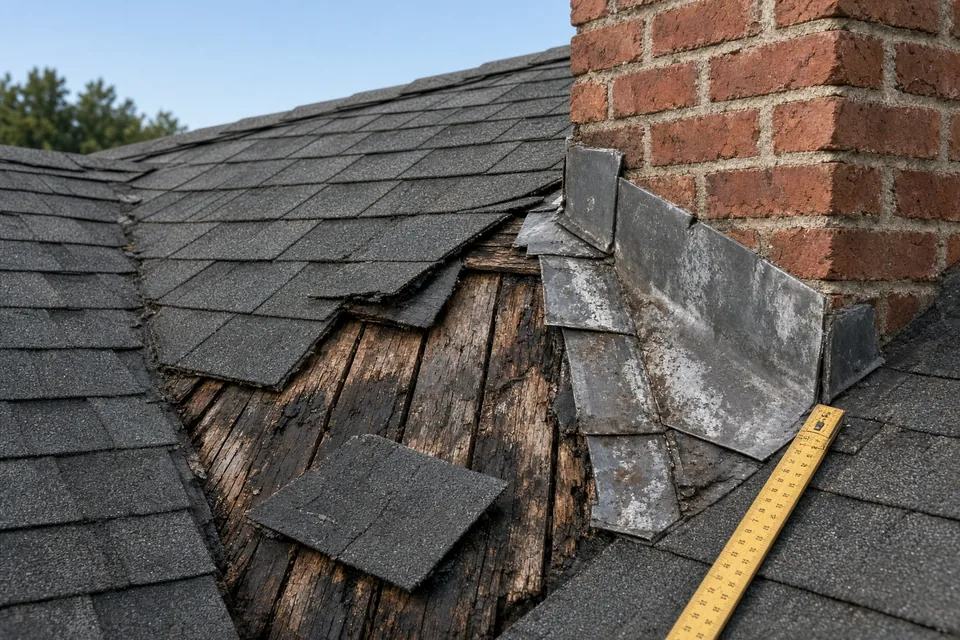 Step 01
Photograph missed items
Inspect and photograph disputed physical details—such as rotted roof decking, valley flashing, or code-required ice barrier—so any supplement or appraisal has clear visual proof.
Why it matters: Many claim gaps stem from omitted physical line items—like rotted plank decking or step flashing—that can be documented in a contractor supplement.
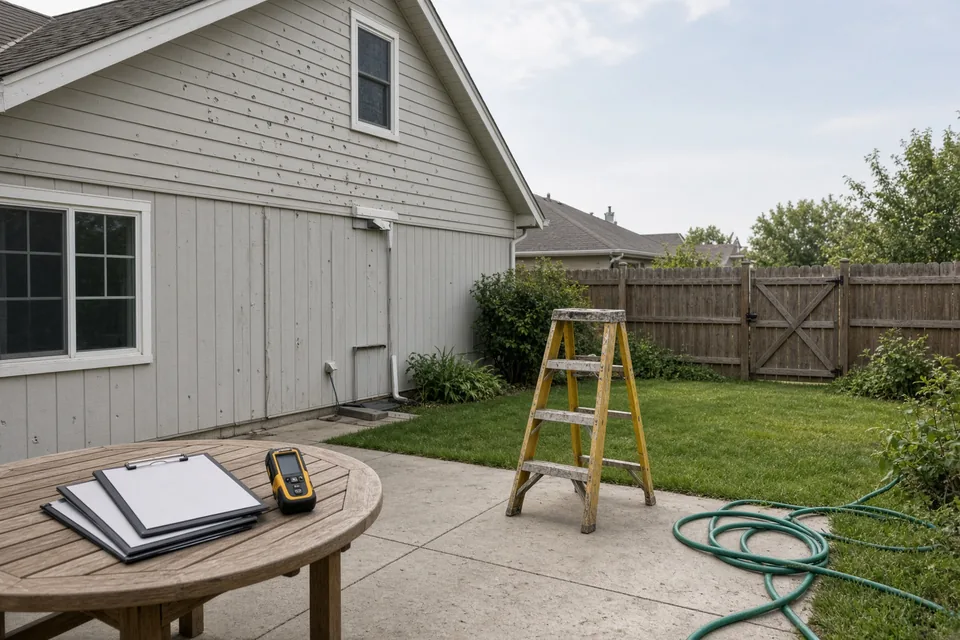 Step 02
Walk it with the appraisers
If the gap stays open, each side names an appraiser who inspects and measures the disputed damage; differences they cannot settle go to a neutral umpire.
Why it matters: In an insurance appraisal, your chosen appraiser and the carrier's appraiser inspect the disputed damage independently and submit any remaining differences to a neutral umpire.
 Step 03
Read the fee contract
Read the written contract fee base (new money above the prior offer versus total claim), right-to-cancel window, and state Department of Insurance rules before signing any representation contract.
Why it matters: Always verify whether a proposed contingency fee applies only to new money above the carrier's prior offer or to the entire claim before signing.


On this page
- The diagram, part by part
- Photo guide: hero and 3 project steps
- The three-path claim dispute formula in plain words
- Two worked examples with different outcomes
- What changes the answer
- What documents to look at
- Worked example
- Who pays the adjuster, the appraiser and the umpire
- Sources and further reading
- Frequently asked questions
The three-path claim dispute formula in plain words
When your insurance company accepts coverage for a storm, fire, or water loss but offers a gross repair valuation that sits well below your contractor's repair estimate, you face a valuation gap. Because neither public adjuster contingency fees nor policy appraisal fees are reimbursed by your insurance policy, the right mathematical comparison is Net Cash Toward Repairs across three paths:
In words:
- Path A (Accept the Carrier's Offer): subtract your policy deductible from the carrier's gross offer. You pay $0 in representation fees, but you fund the entire disputed gap plus your deductible out of pocket.
- Path B (Hire a Public Adjuster): if the claim settles higher (up to your contractor's estimate), subtract the deductible and the public adjuster's contingency fee. Check whether your contract applies the percentage only to new money recovered above the prior offer or to the total net claim.
- Path C (Invoke the Policy Appraisal Clause): if the appraisal award sets a higher gross loss, subtract the deductible, subtract your independent appraiser's fee, and subtract your 50% share of the neutral umpire's fee.
Two worked examples with different outcomes
Example 1: $16,000 roof & interior scope dispute ($24,000 offer vs $40,000 contractor estimate, $2,000 deductible)
A homeowner receives a $24,000 gross replacement-cost offer from the insurer ($22,000 net after a $2,000 deductible), while a licensed contractor estimates $40,000 to complete the restoration (a $16,000 disputed gap). The homeowner compares a proposed 12% public adjuster contract (both on new money only and on the total net claim) against invoking the appraisal clause with a $2,200 appraiser fee and a $1,000 half-share of the umpire ($3,200 total appraisal cost), assuming a full $40,000 recovery:
- Path A (Accept Offer): $24,000 - $2,000 = $22,000 cash for repairs. Out-of-pocket gap to pay the $40,000 contractor = $18,000.
- Path B1 (Public Adjuster — 12% on New Money Only): New money recovered = $40,000 - $24,000 = $16,000. Fee = $16,000 × 12% = $1,920. Net cash for repairs = ($40,000 - $2,000) - $1,920 = $36,080. Out-of-pocket gap = $3,920 ($2,000 deductible + $1,920 fee).
- Path B2 (Public Adjuster — 12% on Total Net Claim): Total net claim = $40,000 - $2,000 = $38,000. Fee = $38,000 × 12% = $4,560. Net cash for repairs = $38,000 - $4,560 = $33,440. Out-of-pocket gap = $6,560 ($2,000 deductible + $4,560 fee).
- Path C (Appraisal Clause — $3,200 Flat Cost): Net cash for repairs = ($40,000 - $2,000) - ($2,200 + $1,000) = $34,800. Out-of-pocket gap = $5,200 ($2,000 deductible + $3,200 appraisal fees).
Example 2: large $120,000 fire rebuild where total-claim percentage eats existing offer money
Suppose a carrier already offered $95,000 (after deductible) on a major fire loss, and the contractor's estimate is $120,000 (after deductible)—a $25,000 disputed gap:
- Appraisal Clause ($3,500 Appraiser + $1,500 Umpire Share = $5,000): Winning the $25,000 gap yields $120,000 - $5,000 = $115,000 net cash (a +$20,000 net gain over the carrier's offer).
- Public Adjuster Charging 15% on Total Claim: 15% of $120,000 = $18,000 fee, leaving $102,000 net cash (only a +$7,000 net gain because $14,250 of the fee was taken out of the $95,000 the carrier had already offered). Had the 15% applied only to the $25,000 new money, the fee would be $3,750, leaving $116,250 net cash.
What changes the answer
| Factor | How It Moves Your Net Cash Toward Repairs | Where to Verify |
|---|---|---|
| Fee base (new money vs total claim) | Charging a % on the carrier's prior offer drastically reduces net cash on partially paid claims | Public adjuster written contract |
| State DOI statutory fee rules | State laws govern fee caps, emergency disaster caps, and whether prior offers are exempt | Your state Department of Insurance |
| Size of the disputed gap | Flat appraisal fees ($2,000–$4,500) beat total-claim percentages on large claims, but can exceed small ($3,000) gaps | Contractor vs adjuster scope comparison |
| Contractor supplement first | Submitting a free contractor supplement for omitted code/scope lines often closes gaps at $0 fee | roof supplement checker & code upgrade (O&L) calculator |
| Coverage denial vs valuation gap | Appraisal only prices covered damage; it cannot force payment on an excluded peril | Carrier denial or reservation letter |
| Recoverable depreciation release | Winning a higher RCV scope still requires completing repairs to release withheld depreciation | recoverable depreciation calculator |
What documents to look at
- Carrier's Written Estimate and Settlement Letter: Note the exact gross Replacement Cost Value (RCV), withheld depreciation, deductible, and Actual Cash Value (ACV) already offered in writing before you sign any representation agreement.
- Proposed Public Adjuster Contract: Check the exact fee percentage, whether it applies to the total claim or only to new money recovered above the prior written offer, the right-to-cancel rescission period (commonly 3 to 5 business days depending on state law), and the adjuster's state license number.
- Policy Section I — Conditions (Appraisal Clause): Read the exact wording in your policy form to see how appraisal is demanded, how many days each side has to name an appraiser (often 20 days), and whether your carrier modified the standard ISO clause to require mutual agreement before appraisal can proceed.
Worked example
A homeowner has a $40,000 contractor roof and interior repair estimate, a $24,000 initial gross offer from the carrier, and a $2,000 policy deductible (leaving a $16,000 disputed gap). The homeowner types a 12% public adjuster fee from a proposed contract (comparing 'new money only' vs 'total net claim') and compares an appraisal clause costing $2,200 for their appraiser plus $1,000 for their half of the umpire ($3,200 total appraisal cost), assuming both paths win the full $40,000 scope.
The arithmetic, step by step
Worked example- Path A (Accept Carrier Offer): $24,000 gross offer − $2,000 deductible = $22,000 net cash toward repairs. Out-of-pocket gap to pay the $40,000 contractor = $18,000.
- Path B1 (Public Adjuster on New Money Only at 12%): Disputed new money recovered = $40,000 − $24,000 = $16,000. Fee = $16,000 × 12% = $1,920. Net cash toward repairs = ($40,000 − $2,000 deductible) − $1,920 fee = $36,080. Out-of-pocket gap = $3,920 ($2,000 deductible + $1,920 fee).
- Path B2 (Public Adjuster on Total Net Claim at 12%): Total net claim = $40,000 − $2,000 = $38,000. Fee = $38,000 × 12% = $4,560. Net cash toward repairs = $38,000 − $4,560 = $33,440. Out-of-pocket gap = $6,560 ($2,000 deductible + $4,560 fee).
- Path C (Appraisal Clause Winning $40,000): Total appraisal cost = $2,200 appraiser + $1,000 umpire share = $3,200. Net cash toward repairs = ($40,000 − $2,000 deductible) − $3,200 = $34,800. Out-of-pocket gap = $5,200 ($2,000 deductible + $3,200 appraisal fees).
These are the calculator's default inputs, so pressing the button above reproduces this example.
Who pays the adjuster, the appraiser and the umpire
Many policies allow you to resolve pure scope and pricing disagreements first by having your contractor submit a documented line-item supplement—which you can organize using roof supplement checker and the claim gap calculator at zero representation fee. When a formal dispute remains over the dollar amount of a covered roof or structural loss (such as wind or hail damage on the roof repair calculator), standard homeowners forms provide an Appraisal clause where each party pays its own appraiser and splits the umpire fee, while licensed public adjusters work for a contingency percentage regulated by your state Department of Insurance. If the disputed amount is small, check the should-I-file-a-claim calculator first. Policy wording and state regulations govern every dispute.
What this page will not claim
- This page does not publish a single national fee cap or list of state percentages: State Department of Insurance rules vary and change during declared emergencies; always verify with your state regulator.
- This page does not give legal advice or tell you whether to hire anyone: Every claim dispute is fact-specific.
- This page does not apply to coverage denials: If your insurer denied the claim as an excluded peril, appraisal cannot resolve that legal coverage question.
Sources and further reading
- Conventus Law — The legal framework for public adjusters in the United States
- Claims Journal — Florida public adjuster fee caps (2023)
- NAIC — Actual cash value vs replacement cost coverage
The calculator applies the arithmetic that policy forms and the agencies above describe. It does not read your policy, and it does not decide coverage: your declarations page, the policy wording and the adjuster do. See the methodology for how this site checks its figures.
Frequently asked questions
What is the difference between a public adjuster fee on 'new money' versus the 'total claim'?
If your insurer already offered $24,000 in writing and your final settlement reaches $40,000, the additional recovery ('new money') is $16,000. A 'new money' contract charges the contingency percentage only on that $16,000 increase. A 'total claim' contract applies the percentage to the entire $38,000 net payout (or $40,000 gross), meaning you pay a commission on the $24,000 the insurance company had already agreed to pay before you hired anyone.
Why doesn't this calculator show a standard 10% or 15% public adjuster fee cap?
Because insurance is regulated at the state level in the United States, there is no single national public adjuster fee cap. State laws differ on maximum contingency percentages, whether fees can be charged on prior carrier offers, and whether lower statutory caps take effect after a governor-declared catastrophe or state of emergency. Always check your state Department of Insurance website and type the exact percentage from your contract.
How does the insurance policy appraisal clause work, and who pays the umpire?
Under the standard ISO HO-3 Appraisal condition, when you and your insurer disagree on the dollar amount of a covered loss, either side can demand an appraisal. You hire and pay your own independent appraiser, and the insurer hires and pays its appraiser. The two appraisers select a neutral umpire whose fee is split 50/50 between you and the insurer. Any two of the three signatures set the binding amount of the loss.
Can I invoke the appraisal clause if the insurance company denied my roof claim as wear and tear?
Generally no. The appraisal clause is strictly limited to determining the dollar value or repair scope of a covered loss; appraisers and umpires have no authority to decide legal coverage questions or overturn a policy exclusion. If the carrier issued a full coverage denial stating that no covered peril damaged the roof, the dispute is over coverage causation rather than price, though partial scope disputes on an accepted claim often qualify.
Does my homeowners insurance pay for my public adjuster fee or my appraiser fee if I win?
No. Standard homeowners insurance policies do not reimburse you for public adjuster contingency fees, your independent appraiser's invoice, or your half of the neutral umpire's fee. Even if the public adjuster or appraisal panel wins 100% of your contractor's $40,000 repair estimate, the policy pays $40,000 minus your deductible, and you must pay your representative's fee out of that recovery.
What should I try before hiring a public adjuster or demanding appraisal?
Start by asking your licensed contractor to compare their itemized estimate line by line against the field adjuster's worksheet (see the roof supplement checker). Often, an initial estimate gap is caused by missing building-code items (like drip edge, ice-and-water shield, or starter course shingles) or unmeasured damaged areas. Submitting photos, local code citations, and a written contractor supplement directly to the desk adjuster frequently closes the gap with zero fee.