Home › Insurance guide › Water backup
Claim math · sewer and sump backupWater backup coverage calculator
Black water rising through a basement floor drain or overflowing from a dead sump pit is excluded on standard unendorsed US homeowners forms. Stop here if muddy surface water overflowed a creek, ran across your lawn, and poured through a basement window well—overland floodwater is a flood-policy question and belongs in the flood gap calculator. Likewise, if you only need retail installation prices for a new pump or main line without claim math, go straight to the sump pump calculator or the sewer line calculator.
When you add a Water Back-Up and Sump Discharge or Overflow endorsement (such as ISO form HO 04 95), you buy a dedicated dollar sublimit—commonly offered in tiers of $5,000, $10,000, $15,000, $25,000, or $50,000. Unlike standard dwelling coverage, that single endorsement cap must pay for emergency water extraction and antimicrobial sanitizing, finished-basement drywall and flooring reconstruction, and ruined basement furniture combined.
Even when the endorsement pays for the water cleanup, the failed sump pump, sewage ejector, or backwater valve itself is usually excluded as mechanical breakdown unless you also carry equipment breakdown coverage. Enter your endorsement tier, deductible, and loss lines below to see your exact payout and shortfall.
Reviewed 25 October 2026 · Written by Mantu Kumar
See the photos · See the cost diagram · Open the calculator · Every part explained
Key facts at a glance
- Unendorsed standard homeowners policies (ISO HO-3) exclude water or waterborne material that backs up through sewers or drains or overflows from a sump.
- Optional water-backup endorsements (such as ISO HO 04 95) establish a single combined sublimit—often starting at $5,000—that caps mitigation, building repairs, and contents together.
- The mechanical cost to replace the broken sump pump, sewage ejector, or backwater valve is excluded by standard water-backup riders unless separate equipment-breakdown coverage applies.
- Category 3 black-water sewage sanitization and tear-out require personal protective containment and antimicrobial treatment under IICRC S500 standards before rebuild begins.
- Overland surface floodwater entering a basement window well overrides a water-backup endorsement under policy surface-water exclusions and requires a flood policy.
Policy arithmetic, not a coverage decision. Your declarations page and policy wording decide the real figures; sources are at the bottom of the page.
The claim math, step by step
- 1Endorsement sublimit
- 2Mitigation and sanitizing
- 3Finished-space rebuild
- 4Contents under the same cap
- 5The failed pump or valve
- 6Backup versus surface flood
- 7One deductible
- 8The shortfall
- 9Payout capped at the sublimit
Run the numbers: water backup coverage
No email · nothing sentDiagram, part by part
Water backup coverage: every numbered part explained
The drawing above has 9 numbered parts, from Endorsement sublimit to Payout capped at the sublimit. Each card zooms in on one part, says what pushes its number up or down, and what to check on your declarations page or claim letter. After you run the calculator, the parts in your scope show their dollar figure.
1 Endorsement sublimit
Claim step 1
A water-backup endorsement attaches a fixed dollar ceiling—such as $5,000, $10,000, $15,000, $25,000, or $50,000—to your homeowners policy specifically for water or sewage that backs up through sewers or drains or overflows from a sump pit. Unlike a burst domestic water pipe that can draw up to your full Coverage A dwelling limit, a drain or sump backup stops cold at the endorsement sublimit printed on your declarations page.
What moves it: The specific endorsement tier you selected and paid for on your homeowners declarations page prior to the storm.
On the quote: Check your policy declarations page under Optional Coverages or Endorsements for form numbers like HO 04 95 and the exact dollar cap.
2 Mitigation and sanitizing
Claim step 2
Emergency mitigation is the first expense billed against your water-backup sublimit. When a municipal sanitary sewer or septic line backs up through a basement drain, restoration crews classify the liquid as Category 3 black water, requiring hazmat extraction, removal of porous carpet pad, HEPA air scrubbers, and hospital-grade antimicrobial treatment. On a $5,000 starter endorsement, a $4,200 emergency extraction and drying invoice leaves almost nothing for rebuilding the room.
What moves it: Square footage of wet flooring, whether clean groundwater or raw sanitary sewage backed up, and how many days commercial dehumidifiers run.
On the quote: Ask the mitigation crew for an itemized daily equipment and sanitization log so you can see how much of your sublimit remains for reconstruction.
3 Finished-space rebuild
Claim step 3
Once the concrete slab and wood studs are dry and sanitized, a carpenter must hang new drywall along the two-foot or four-foot flood cut, tape and paint the walls, install new baseboards, and lay replacement flooring. Because this reconstruction draws from the exact same endorsement bucket as the emergency drying crew, finished basements routinely blow past $5,000 and $10,000 endorsement caps before the flooring contractor even starts.
What moves it: Height of the drywall flood cut, flooring material (carpet versus luxury vinyl plank or tile), and custom millwork or bathroom vanities.
On the quote: Get a separate put-back estimate from a general contractor rather than letting the emergency drying invoice absorb your entire endorsement unmonitored.
4 Contents under the same cap
Claim step 4
Many homeowners assume ruined basement sofas, area rugs, exercise machines, and stored electronics are paid out of their main Coverage C Personal Property bucket. Under standard water-backup endorsements, however, all covered property damaged by the backup—both structural building finishes and personal contents—must share the single endorsement sublimit. Every dollar paid for a ruined sectional couch is one less dollar available to replace your basement drywall.
What moves it: How much furniture, electronics, and clothing were sitting directly on the basement floor when the sump or drain backed up.
On the quote: Verify in your endorsement wording whether personal property shares the single aggregate sublimit with building repairs.
5 The failed pump or valve
Claim step 5
Standard water-backup endorsements pay for the resulting water damage, not for repairing or replacing the broken mechanical device that failed. If your primary submersible sump pump, sewage ejector pump, or cast-iron backwater valve burns out or seizes, the plumber's invoice to swap in a new pump ($400 to $1,500+ on the sump pump calculator) comes out of your own pocket unless you also carry an optional equipment-breakdown endorsement.
What moves it: Whether the pump failed from normal wear and mechanical burnout versus whether your policy includes an equipment-breakdown rider.
On the quote: Ask your plumber to write the pump replacement on a separate invoice line from any drain clearing or water cleanup so the adjuster can separate them cleanly.
6 Backup versus surface flood
Claim step 6
A water-backup endorsement is not a mini flood policy. If heavy rain pools in your backyard, overflows a basement window well, or seeps through foundation wall cracks, standard water-backup endorsements still exclude the loss as surface water or subsurface seepage. Likewise, if widespread neighborhood street flooding pushes water into your house, the homeowners carrier may deny the backup rider and point to the flood exclusion tested in the flood gap calculator.
What moves it: Whether water backed up strictly through an interior pipe or sump basin versus entering overland through a window, door, or wall crack.
On the quote: Photograph the dry window wells and exterior thresholds immediately after the event to prove water originated from the sump pit or floor drain.
7 One deductible
Claim step 7
A covered water-backup claim applies one endorsement deductible per occurrence—commonly $500, $1,000, or your policy's standard all-other-perils deductible. In claim math, the adjuster subtracts the deductible from the total eligible water damage first, and then compares the remaining loss against your endorsement sublimit. If your eligible damage is $19,500 and your deductible is $1,000, the net $18,500 loss still hits a $10,000 cap, paying the full $10,000.
What moves it: Whether your endorsement specifies a dedicated water-backup deductible (such as $500 or $1,000) or uses your main Coverage A deductible.
On the quote: Look next to the Water Back-Up line on your declarations page to see if a special deductible is listed for that rider.
8 The shortfall
Claim step 8
The shortfall is the total cash you must bring to the table to finish restoring the basement. It combines three pieces: any mitigation, rebuild, and contents costs that exceed your endorsement cap; the deductible absorbed on the claim; and the mechanical cost of replacing the failed sump pump, backup battery, or backwater valve. Knowing this gap before you remodel a basement helps you pick an endorsement limit that matches your finishes.
What moves it: The gap between your total basement restoration cost (mitigation + rebuild + contents + pump) and your capped insurance check.
On the quote: Compare the annual cost of raising your endorsement limit to $25,000 or $50,000 whenever you finish a basement or install new flooring.
9 Payout capped at the sublimit
Up to the endorsement limit on your declarations page
The check this endorsement can write is the covered damage minus the deductible, and it never goes above the sublimit printed on your declarations page, often $5,000, $10,000 or $25,000. Drying, rebuild and contents all draw from that one pool, so a large mitigation invoice can use most of the limit before drywall and flooring go back in. The failed pump itself stays outside the payout.
What moves it: The sublimit tier you bought, how much the drying and sanitizing crew bills, and how much finished space was wet.
On the quote: Ask your agent whether the sublimit applies per occurrence or per policy year, and whether a higher tier is available at renewal.
Project photo guide
Sewer and sump backup in photos: the pit, the dry-out and the new pump
Sewer and sump backup losses leave clear mechanical and water-level clues inside a basement. These four scenes show a typical finished basement after a sump overflow, a close inspection of a submerged sump basin and check valve, the two-foot drywall flood cut during antimicrobial drying, and a new cast-iron primary and battery-backup pump installation.

How the claim works in 3 key stages
All three step images are AI-generated illustrations for explanation. Not a site inspection, bid, or coverage decision.
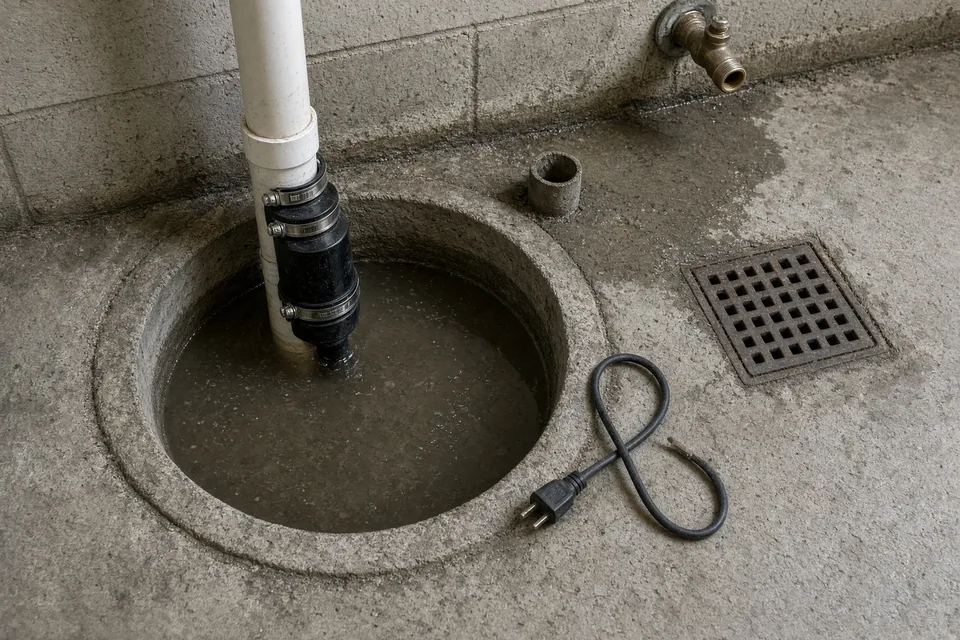 Step 01
Check the sump pit first
Check the sump basin, float switch, and check valve first, and photograph dry window wells to confirm water rose from the pit rather than overland.
Why it matters: The failed submersible pump inside the pit is excluded as mechanical breakdown under standard water-backup endorsements, even when the resulting water cleanup is covered.
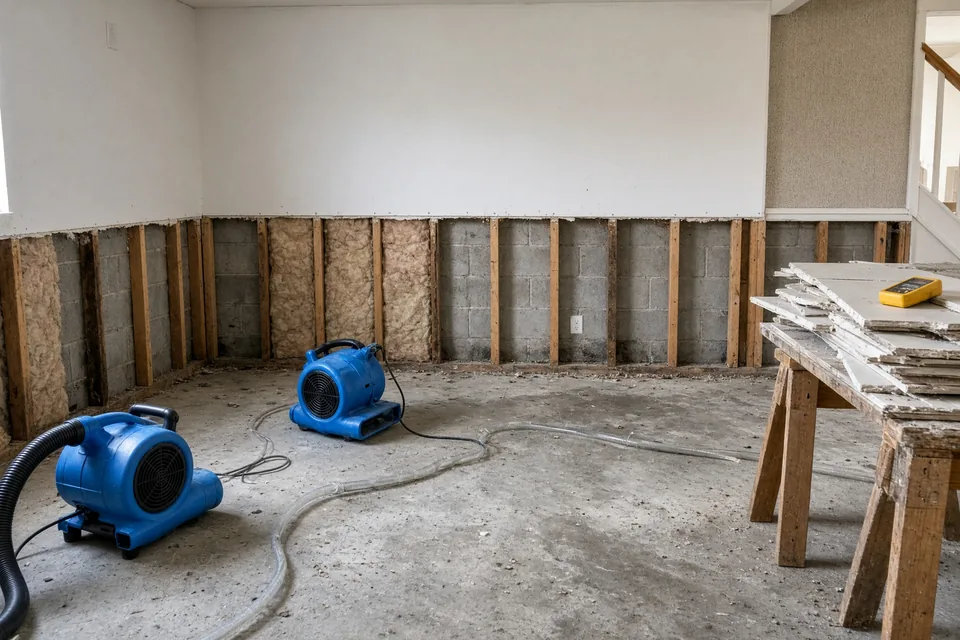 Step 02
Extract, cut and dry
Extract standing water, strip wet carpet and pad, and cut soaked drywall above the moisture line so commercial dehumidifiers and antimicrobial spray can dry the studs.
Why it matters: Emergency water extraction, flood cuts, and antimicrobial treatment bill first against your endorsement limit, reducing what remains for drywall and flooring put-back.
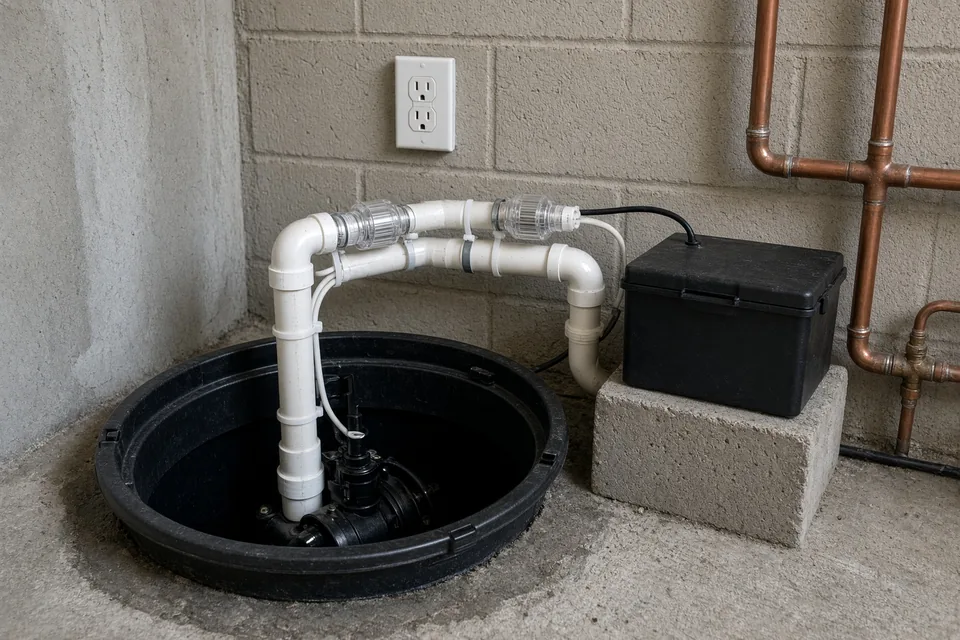 Step 03
Replace the pump separately
Install a new cast-iron primary submersible pump and a DC battery backup on a separate invoice line, since the water-backup rider excludes the pump hardware.
Why it matters: Upgrading to a cast-iron primary pump with a DC battery backup prevents repeat power-outage overflows and should be billed separately from claim restoration.


On this page
- The diagram, part by part
- Photo guide: hero and 3 project steps
- The water-backup sublimit formula in plain words
- Two worked examples with different outcomes
- What changes the answer
- What documents to look at
- Worked example
- Does homeowners insurance cover sewer or sump backup?
- Sources and further reading
- Frequently asked questions
The water-backup sublimit formula in plain words
When water or sewage backs up through a basement floor drain or overflows from a sump pit, standard homeowners forms (such as ISO HO-3) exclude the loss under the water-damage exclusion. Adding a Water Back-Up and Sump Discharge or Overflow endorsement (such as ISO HO 04 95) restores coverage for direct physical loss to covered property, but replaces your policy's main Coverage A and Coverage C limits with a single aggregate endorsement sublimit.
In words:
- Sum all eligible water-damage buckets: add emergency mitigation and sanitization, finished-space structural rebuild, and damaged personal contents into one combined water-backup loss.
- Separate the excluded mechanical hardware: keep the cost to replace the failed sump pump, sewage ejector, or backwater valve outside the water-backup formula because standard water-backup forms exclude mechanical breakdown of the pump itself.
- Subtract the endorsement deductible and cap at the sublimit: subtract your single endorsement deductible from that combined loss, and cap the resulting insurance payment at your endorsement sublimit.
- Compute your total out-of-pocket shortfall: subtract the capped insurance payout from the total project bill.
Two worked examples with different outcomes
Example 1: finished basement sump overflow on a $10,000 endorsement cap
During a severe summer thunderstorm, grid power drops and a 9-year-old submersible sump pump fails to restart. Clean groundwater overflows the pit across an 800-square-foot finished basement.
- Mitigation & Drying: $4,200 for water extraction, carpet removal, 2-foot drywall flood cut, and 4 days of dehumidifiers.
- Finished-Space Rebuild: $11,500 for new moisture-resistant lower drywall, taping, painting, baseboards, and luxury vinyl plank flooring.
- Damaged Contents: $3,800 for a soaked fabric sectional sofa, media console, and area rug.
- Failed Sump Pump Replacement: $1,100 for a new 1/2 HP cast-iron pump and check valve.
- Endorsement Terms: $10,000 sublimit with a $1,000 deductible.
- Step-by-Step Math:
- Eligible water loss: $4,200 + $11,500 + $3,800 = $19,500.
- Subtract deductible: $19,500 - $1,000 = $18,500.
- Apply $10,000 sublimit cap: min($10,000, $18,500) = $10,000 insurance payout.
- Total project bill: $19,500 + $1,100 = $20,600.
- Out-of-Pocket Shortfall: $20,600 - $10,000 = $10,600 (comprising $8,500 in unpaid water damage above the cap, the $1,000 deductible, and the $1,100 excluded sump pump).
Example 2: unfinished utility basement sanitary drain backup on a $15,000 cap
A tree root blocks the lateral sewer line and pushes sewage through an unfinished basement floor drain.
- Mitigation & Category 3 Sanitization: $3,600 for black-water extraction and antimicrobial treatment on bare concrete.
- Finished Rebuild: $0 (unfinished concrete walls and slab).
- Damaged Contents: $1,900 for items stored on lower utility shelves.
- Backwater Valve / Auger: $850 to clear the line and replace the floor-drain backwater flap.
- Endorsement Terms: $15,000 sublimit with a $500 endorsement deductible.
- Step-by-Step Math:
- Eligible water loss: $3,600 + $0 + $1,900 = $5,500.
- Subtract deductible: $5,500 - $500 = $5,000.
- Apply $15,000 sublimit cap: min($15,000, $5,000) = $5,000 insurance payout.
- Total project bill: $5,500 + $850 = $6,350.
- Out-of-Pocket Shortfall: $6,350 - $5,000 = $1,350 (only the $500 deductible plus the $850 mechanical plumbing work, with $10,000 of sublimit head-room remaining).
What changes the answer
| Factor | How It Moves Your Claim Payout and Shortfall | Where to Verify |
|---|---|---|
| Endorsement sublimit tier ($5k to $50k+) | Sets the hard ceiling for mitigation, rebuild, and contents combined | Declarations page under Endorsements |
| Category 1 vs Category 3 water | Raw sewage backup requires hazmat sanitization and full porous tear-out, doubling mitigation cost | Mitigation scope / IICRC S500 category note |
| Finished vs unfinished basement | Drywall, trim, and flooring put-back easily adds $8,000–$25,000+ to the same sublimit | basement finish calculator & water damage calculator |
| Equipment breakdown endorsement | May cover the failed sump or ejector pump hardware under a separate rider | Policy equipment-breakdown endorsement |
| Service-line endorsement | Covers excavating a collapsed exterior underground sewer pipe, not interior backup | service line cover calculator & sewer line calculator |
| Overland surface water entry | Shifts the loss out of the water-backup rider and into the flood exclusion | flood gap calculator |
What documents to look at
- Homeowners Declarations Page: Confirm whether a Water Back-Up and Sump Discharge endorsement is listed, note its exact dollar limit (for example, $5,000 or $10,000), and check whether it carries a separate endorsement deductible.
- Water Back-Up Endorsement Form (such as ISO HO 04 95): Read the insuring agreement and exclusions to verify that Building and Contents share the single sublimit and that the sump pump itself is excluded.
- Emergency Mitigation Contract and Plumber's Invoice: Ensure the plumber separates the cost of the new sump pump or sewer line repair from the water-damage cleanup so the adjuster does not delay the water-backup payment.
Worked example
A finished basement floods when a primary sump pump fails during a thunderstorm. Emergency drying and sanitization cost $4,200, replacing the lower drywall and luxury vinyl plank flooring costs $11,500, ruined basement furniture costs $3,800, and installing a new cast-iron sump pump costs $1,100. The homeowner carries a $10,000 water-backup endorsement with a $1,000 deductible.
The arithmetic, step by step
Worked example- Eligible Water-Backup Scope (Mitigation + Rebuild + Contents): $4,200 + $11,500 + $3,800 = $19,500.
- Excluded Mechanical Hardware (New Sump Pump): $1,100 (excluded from water-backup endorsement; paid out-of-pocket unless equipment breakdown applies).
- Total Project Bill: $19,500 + $1,100 = $20,600.
- Apply Endorsement Deductible: $19,500 eligible loss - $1,000 deductible = $18,500 net eligible loss.
- Apply Endorsement Sublimit Cap ($10,000): min($10,000 cap, $18,500 net loss) = $10,000 insurance payout.
- Out-of-Pocket Shortfall: $20,600 total project bill - $10,000 insurance payout = $10,600 unpaid gap ($8,500 over the cap + $1,000 deductible + $1,100 excluded sump pump).
These are the calculator's default inputs, so pressing the button above reproduces this example.
Does homeowners insurance cover sewer or sump backup?
Many policies exclude water or sewage that backs up through sewers or drains or overflows from a sump unless you purchase an optional water-backup endorsement before the loss occurs. Even when that endorsement is active, emergency drying, finished drywall put-back, and ruined basement furniture all draw from the same sublimit, and replacing the broken pump or digging up a collapsed yard sewer pipe is excluded unless you carry equipment-breakdown or the service line cover calculator. Before signing a mitigation contract that could consume your entire cap on day one, compare drying ranges in the water damage calculator, check depreciation rules in the depreciation (ACV) calculator, and evaluate small losses against your deductible in the should-I-file-a-claim calculator. Policy wording and the adjuster decide every claim.
What this page will not claim
- This page does not claim every policy works identically: Some insurers write broader package policies or separate building and contents backup caps; always read your form.
- This page does not quote endorsement premiums: Adding or raising a water-backup sublimit must be priced by your insurance agent or carrier.
- This page does not classify whether your basement water was backup or surface flood: An adjuster inspects the physical entry point to make that determination.
Sources and further reading
- MoneyGeek — What is water backup coverage?
- Mississippi Insurance Department — Consumer quick guide to home insurance (PDF)
- FEMA FloodSmart — what a flood policy covers and its limits
- NAIC — Actual cash value vs replacement cost coverage
The calculator applies the arithmetic that policy forms and the agencies above describe. It does not read your policy, and it does not decide coverage: your declarations page, the policy wording and the adjuster do. See the methodology for how this site checks its figures.
Frequently asked questions
Why did my $10,000 water-backup endorsement run out before my basement walls and floors were rebuilt?
Under most water-backup endorsements (such as ISO HO 04 95), the sublimit printed on your declarations page is a single combined cap for the entire event. Emergency water extraction, carpet tear-out, antimicrobial sanitization, dehumidifier rentals, finished drywall reconstruction, and ruined basement furniture all pull from that same $10,000 pool. Once the emergency drying company bills $4,000 to $6,000, only the remaining balance is left for your rebuild contractor and personal contents.
Does a water-backup endorsement pay for the plumber to replace my burned-out sump pump?
No. Standard water-backup endorsements cover the resulting physical water damage to the house and contents, but explicitly exclude the cost of repairing or replacing the failed sump pump, sewage ejector pump, or backwater valve itself. Unless you also carry an optional equipment-breakdown endorsement that covers mechanical or electrical failure of household systems, the $400 to $1,500 plumber bill for the new pump is an out-of-pocket expense.
If a thunderstorm knocks out power and my sump pit overflows, is that covered by the endorsement?
Often yes, provided the water entered strictly by overflowing from the sump basin or backing up through an interior drain and you carry an active water-backup endorsement. Standard ISO HO 04 95 wording states that the endorsement responds even if the backup or overflow is caused by mechanical breakdown or an off-premises power outage that disables the sump pump, up to your endorsement sublimit.
What is the difference between a water-backup endorsement and service-line coverage?
A water-backup endorsement covers the interior water and sewage cleanup, drywall, flooring, and contents inside your basement when a drain or sump overflows. Service-line coverage is a separate rider that pays to excavate and replace a collapsed, root-intruded, or frozen underground utility pipe (such as your exterior sewer lateral) in the yard. On a collapsed sewer main that floods a basement, both endorsements may be needed for full protection.
Why was my water-backup claim denied when heavy rain filled my basement window well?
Water that pools on the ground outside, fills an exterior window well or stairwell, and pours through a basement window or door is classified by insurers as surface water or flood, not sewer or sump backup. Water-backup endorsements leave the main policy's surface-water exclusion intact, meaning overland storm water entering through a window well requires a separate flood insurance policy.
How much water-backup coverage should I carry if my basement is fully finished?
While an unfinished concrete basement may only need $5,000 to $10,000 to cover black-water sanitization, a water heater, and utility shelving, a finished basement with drywall, luxury vinyl plank or carpet, a bathroom, and family-room furniture commonly costs $15,000 to $40,000+ to dry out and rebuild after a backup. Compare your finished square footage on the basement finish calculator and the water damage calculator against the $25,000 and $50,000 endorsement tiers.