Ridge vent installation cost calculator
Safety first. Cutting a continuous ventilation slot along the peak of a roof requires working at the highest fall-hazard point of the house and staying clear of the structural ridge board; a licensed roofing contractor using OSHA fall-arrest harnesses governs roof ridge work.
A continuous roof ridge vent sits along the highest peak of your roof, using natural thermal buoyancy (the stack effect) and external wind baffles (the Bernoulli effect) to exhaust superheated summer air and winter moisture from the very top of your attic. Stop here if you are pricing a full shingle or metal roof tear-off (the roof calculator), if you need to replace solid eave overhangs with perforated soffit panels (the soffit and fascia calculator), or if you are blowing fiberglass or cellulose across the attic floor (the attic insulation calculator).
Across the US in 2026, a rigid external-baffle shingle-over ridge vent with cap shingles runs $7 to $14/lf during a reroof ($280–$560 on 40 lf) or $14 to $26/lf as a standalone retrofit ($560–$1,040 on 40 lf); aluminum/metal vent adds $5 to $11/lf; closing old box vents or an attic fan adds $250 to $650; adding 25–35 attic rafter baffles runs $300 to $700; and steep/2-story access adds $250 to $600.
For a 40-linear-foot standalone retrofit on a single-story walkable roof that installs a baffled shingle-over ridge vent, closes old box vents, and adds attic rafter baffles, expect $1,110 to $2,390.
Reviewed 25 October 2026 · Written by Mantu Kumar
See the photos · See the cost diagram · Open the calculator · Every part explained
Key facts at a glance
- Under IRC Section R806.2, the minimum total net free ventilating area (NFVA) of an attic is 1/150 of the vented floor space, or 1/300 when either a Class I/II ceiling vapor retarder is present in Climate Zones 6, 7, and 8 or between 40% and 50% of the required ventilation is located in the upper portion of the attic no more than 3 feet below the ridge.
- Adding a rigid molded external-baffle shingle-over ridge vent (~18 sq in NFVA per linear foot) with matching ridge cap shingles runs $7 to $14 per linear foot during a full reroof, or $14 to $26 per linear foot as a standalone retrofit on an existing roof.
- Upgrading from high-density copolymer shingle-over vent sections to heavy-gauge aluminum or standing-seam metal ridge vent profile adds $5 to $11 per linear foot.
- Removing old upper roof box/turtle vents, turbines, or a failed electric attic fan and patching the plywood sheathing and shingles—required to prevent the new ridge vent from pulling air sideways through old upper vents instead of up from the soffits—runs $250 to $650.
- Clearing attic insulation out of blocked eave chutes and stapling 25 to 35 foam or cardboard rafter baffles from inside the attic runs $300 to $700, while steep-pitch (>7:12) or 2-story harness setup adds $250 to $600.
National 2026 planning ranges before your regional multiplier. Sources and method are at the bottom of the page.
2026 planning ranges
- 1Continuous ridge slot cut
- 2External-baffle vs metal ridge vent
- 3Ridge cap shingles & 3-inch nails
- 4Balanced soffit intake (IRC R806.2)
- 5Rafter insulation baffles
- 6Closing old box vents or attic fans
- 7End caps, foam weather plugs & hips
- 8Roof pitch & two-story access
- 9Reroof or standalone retrofit
Price your ridge vent installation
No email · nothing sentDiagram, part by part
Ridge vent installation: every numbered part explained
The drawing above has 9 numbered parts, from Continuous ridge slot cut to Reroof or standalone retrofit. Each card zooms in on one part, says what pushes its price up or down, and what to check on a written quote. After you run the calculator, the parts in your scope show their dollar figure.
1 Continuous ridge slot cut
Included in $14 – $26 / lf standalone retrofit ($7 – $14 / lf during reroof)
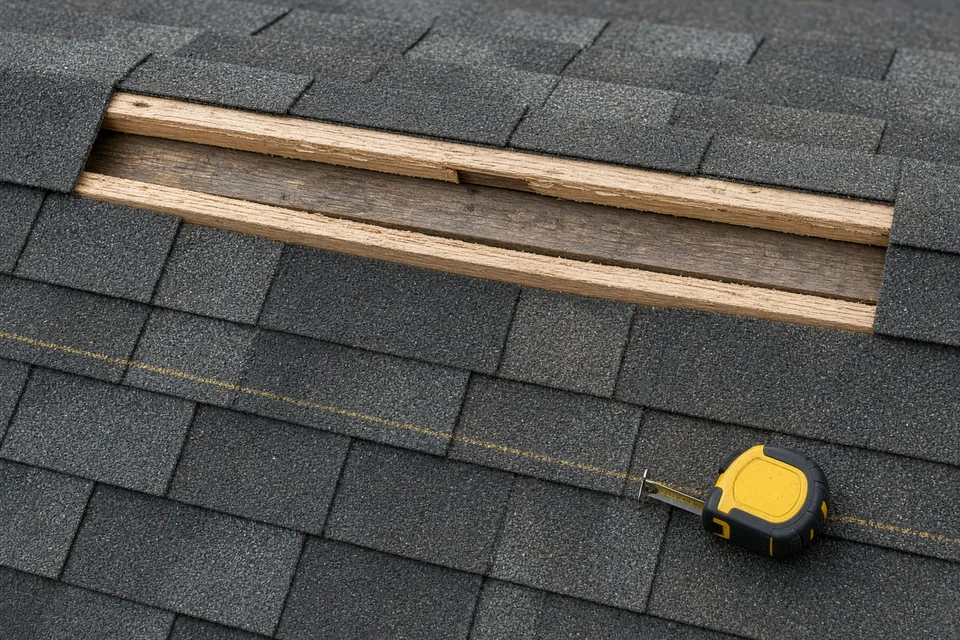
A ridge vent only works if air can actually exit the attic at the peak. On an existing roof without a ridge slot, the roofer removes the old ridge cap shingles, snaps chalk lines along both sides of the peak, sets a circular saw blade depth to 5/8 inch so it cuts only the plywood sheathing without nicking the structural rafters or ridge board, and cuts a continuous 1.5-to-2-inch open air slot stopping 12 to 18 inches short of each gable end wall.
What moves it: Standalone retrofit on an existing shingled roof ($14–$26/lf) versus cutting the slot during a full roof replacement ($7–$14/lf).
On the quote: Check your attic with the lights off on a sunny day: if you do not see a continuous 1.5-inch ribbon of daylight under the ridge vent, the previous roofer forgot to cut the sheathing slot.
2 External-baffle vs metal ridge vent
Base (molded external-baffle shingle-over) | +$5 – $11 / lf (aluminum/metal)
Never confuse a cheap, squishy 'mesh roll' ridge vent with a rigid molded external-baffle shingle-over vent. External wind baffles stand along both outer edges of the vent: when wind blows across your roof from any direction, the baffle deflects air upward over the peak, creating a low-pressure Bernoulli zone that actively pulls hot attic air out while blocking wind-driven rain and snow. Upgrading to heavy extruded aluminum or metal profile adds $5 to $11 per linear foot.
What moves it: Standard rigid copolymer shingle-over vent (~18 sq in NFVA/lf) vs heavy aluminum or standing-seam metal ridge vent.
On the quote: Specify a rigid 4-foot-section molded external-baffle shingle-over ridge vent—never let a roofer unroll porous fibrous mesh pad that crushes flat under nail guns.
3 Ridge cap shingles & 3-inch nails
Included in the per-linear-foot ridge vent installation
Once the 4-foot rigid ridge vent sections are snapped together along the peak, the roofer nails matching architectural or high-profile ridge cap shingles directly on top of the vent so the vent practically disappears from the street. Because the vent body is 3/4 to 1 inch thick, standard 1.25-inch roofing nails will never reach the wood deck—installers must use 2.5-to-3-inch corrosion-resistant ring-shank nails that penetrate completely through the plywood sheathing.
What moves it: Standard 3-tab cut ridge caps versus thick high-profile architectural hip-and-ridge cap shingles.
On the quote: Verify the crew switches from 1.25-inch coil nails to 3-inch ring-shank nails when fastening the ridge vent and cap shingles—short nails blow off in the first 50 mph storm.
4 Balanced soffit intake (IRC R806.2)
Linked to the soffit and fascia calculator
An exhaust ridge vent at the peak is useless without equal intake air entering at the lowest eaves. Under IRC Section R806.2, minimum attic net free ventilating area (NFVA) is 1/150 of the attic floor area, or 1/300 when 40% to 50% of the NFVA is upper exhaust within 3 feet of the ridge balanced by lower soffit intake (with a Class I/II vapor retarder in Zones 6–8). On 1,800 sq ft at 1/300, you need 24 linear ft of ridge vent.
What moves it: Whether your home already has perforated soffit vents (priced on the soffit and fascia calculator if missing).
On the quote: Ask the roofer to confirm open soffit intake at least equal to the new ridge exhaust; a ridge vent with blocked or missing soffit vents moves almost no air.
5 Rafter insulation baffles
$300 – $700 (unblock eaves & staple 25–35 baffles from attic)
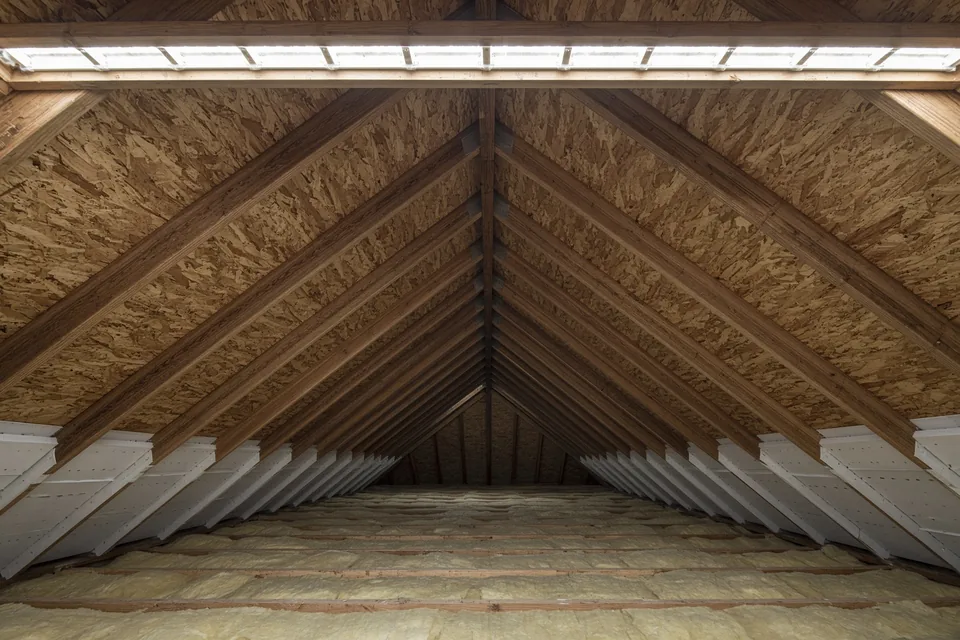
Even when the outside of your house has perforated soffit panels, blown-in fiberglass or cellulose insulation frequently slides down into the narrow eave corners and plugs the air channel shut. For $300 to $700 during a standalone ridge-vent retrofit, a crew climbs into the attic, pulls the insulation back from the top plates, and staples rigid foam or corrugated rafter baffles (properfents) under the roof deck so cool intake air flows freely up to the new ridge vent (for full insulation work, see the attic insulation calculator).
What moves it: Low-pitch roofs with tight eave access inside the attic and number of blocked rafter bays.
On the quote: Have the installer check every eave bay from inside the attic—adding a ridge vent when blown insulation is choking your soffits cuts airflow by 80%.
6 Closing old box vents or attic fans
$250 – $650
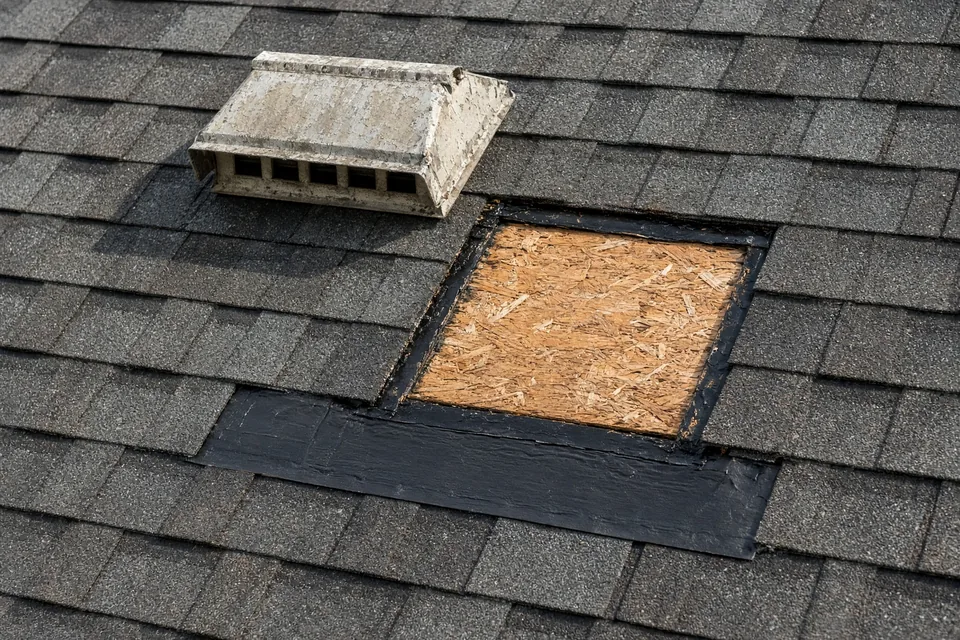
A classic roofing mistake is installing a new continuous ridge vent while leaving old static box ('turtle') vents, turbines, high gable vents, or a roof-mounted electric attic fan open nearby. Air takes the path of least resistance: instead of drawing cool air up from the low soffits to flush the full attic, the ridge vent 'short-circuits'—sucking air and rain in through the old upper vents. Removing old vents and patching the deck/shingles runs $250 to $650.
What moves it: Number of old static roof cans, turbines, or powered fan openings that must be decked over with plywood and shingled.
On the quote: Never mix a continuous ridge vent with open static box vents, roof turbines, or a powered roof fan on the same attic space—close and shingle over the old upper vents.
7 End caps, foam weather plugs & hips
Included in per-linear-foot ridge vent installation
Bats, wasps, squirrels, and wind-driven snow enter through the open ends of a ridge vent if the installer leaves the last section uncapped. Proper installation stops the cut sheathing slot 12 to 18 inches back from the gable rake walls (and 12 inches back from any chimney cricket or intersecting dormer valley), snaps solid molded plastic end caps onto both ends of the ridge vent run, and seals internal weather-blocking baffles.
What moves it: Cut-up hip roofs with very short horizontal ridge lines (if a hip roof has only 6–10 ft of horizontal ridge, special hip-rated vents may be needed).
On the quote: Ask the roofer to confirm that molded solid end caps are snapped onto every terminal end of the ridge vent so bats and wasps cannot enter.
8 Roof pitch & two-story access
$0 (1-story walkable 7:12)
When a ridge vent is installed during a full roof replacement (the roof calculator), ladders, roof jacks, and fall-protection anchors are already set up on the house. On a standalone ridge-vent retrofit, however, a two-story roof or a steep roof pitch above 7:12 requires setting 32-to-40-foot extension ladders, securing a ridge hook and OSHA safety harness, and hauling tools and cap bundles up the steep slope—adding $250 to $600 to the standalone job.
What moves it: Single-story ranch roof with a gentle 4:12 to 6:12 slope versus a steep 9:12 two-story colonial.
On the quote: If your roof shingles are already 17 to 20 years old and brittle, wait and install the ridge vent during your full roof replacement (the roof calculator) to save 50% on labor and avoid cracking old shingles.
9 Reroof or standalone retrofit
$7 – $14/lf at a reroof · $14 – $26/lf retrofit
Adding a ridge vent while the roof is already being replaced costs about half as much per foot, because the ridge is open and new cap shingles are going on anyway. A standalone retrofit means cutting into a finished roof and matching cap shingles.
What moves it: Whether a reroof is planned in the next few years.
On the quote: If a reroof is coming soon, ask for the ridge vent to be priced into that job instead.
Project photo guide
Ridge vent install in photos: the slot, old vents and baffles
Installing a continuous roof ridge vent requires an open slot at the peak paired with clear intake at the eaves. These four scenes show cutting the 1.5-inch sheathing slot, nailing down an external-baffle vent, patching an old box vent, and clear attic rafter baffles.

How the job works in 3 key stages
All three step images are AI-generated illustrations for explanation. Not a site inspection, bid, or coverage decision.
 Step 01
Cut the ridge slot
Remove the old ridge cap shingles, chalk a cut line stopping 12 to 18 inches from the gable ends, and saw a 1.5-to-2-inch slot through the roof sheathing without cutting rafters.
Why it matters: Cutting the 1.5-to-2-inch sheathing slot (stopping 12–18 inches from the gable ends and setting saw depth to miss the rafters) lets hot attic air exit.
 Step 02
Close old vents, clear intake
Remove and deck over any old upper roof box vents, turbines, or electric fans so airflow cannot short-circuit, and verify that attic rafter baffles keep the lower soffit intake open.
Why it matters: Removing old upper box vents or turbines and patching the roof deck ($250–$650) prevents the new ridge vent from short-circuiting.
 Step 03
Set the vent and cap
Snap the rigid 4-foot external-baffle ridge vent sections over the open peak slot with weatherproof molded end caps and fasten architectural ridge cap shingles using 3-inch corrosion-resistant ring-shank nails.
Why it matters: Clearing blocked eave chutes and stapling 25 to 35 rafter baffles ($300–$700) ensures balanced soffit intake air flows continuously to the ridge under the balanced-intake rule in IRC R806.2.


On this page
- The diagram, part by part
- Photo guide: hero and 3 project steps
- 2026 roof ridge vent installation cost table
- Three worked scenarios with full arithmetic
- Timing & vent type comparison: reroof add-on vs standalone retrofit
- Building code reference: IRC Section R806.2 (1/150 & 1/300 rule + NFVA math)
- Quote checklist: 8 items to verify before hiring a roofer
- Typical ridge vent retrofit timeline
- Worked example
- Does insurance pay for a ridge vent?
- Sources and further reading
- Frequently asked questions
2026 roof ridge vent installation cost table
| Ridge Vent Line Item | 2026 Low | 2026 High | What Changes the Price |
|---|---|---|---|
| Ridge vent & cap shingles added during a full reroof | $7 / linear ft | $14 / linear ft | $280–$560 on 40 lf ridge; roof deck is already bare (reroof on the roof calculator) |
| Standalone ridge vent retrofit on an existing shingle roof | $14 / linear ft | $26 / linear ft | $560–$1,040 on 40 lf ridge; pry off old caps, cut slot, install vent & new caps |
| Heavy aluminum or standing-seam metal ridge vent upgrade | +$5 / linear ft | +$11 / linear ft | +$200–$440 on 40 lf ridge; heavy metal profile over copolymer |
| Remove old box vents, turbines, or attic fan & patch deck/shingles | $250 | $650 | Prevents upper-attic airflow short-circuiting across 2 to 5 old openings |
| Unblock eave chutes & staple 25–35 attic rafter baffles | $300 | $700 | Pulls blown insulation back from eaves so soffit air reaches the ridge |
| Two-story or steep-pitch (>7:12) harness & safety setup | $250 | $600 | High-work ladder and safety-anchor rigging on standalone retrofits |
Three worked scenarios with full arithmetic
Scenario 1: 40 LF standalone ridge vent retrofit + close old box vents + attic rafter baffles (worked example, 1.00x)
A homeowner with a 7-year-old single-story walkable roof (access = normal) has hot attic temperatures and 3 old static box vents. A roofer cuts a 40-linear-foot ridge slot and installs a rigid external-baffle shingle-over vent with new cap shingles (ridge_lf = 40, timing = standalone, vent_type = baffle_shingle), removes and patches over the 3 old box vents (close_old = yes), and installs 30 attic rafter baffles at the eaves (baffles = yes).
- 40 LF Standalone Slot Cut, Baffled Ridge Vent & Cap Shingles (40 × $14–$26/lf): $560 – $1,040
- Remove Old Box Vents & Patch Deck/Shingles: $250 – $650
- Unblock Eave Chutes & Install 25–35 Rafter Baffles: $300 – $700
- National Baseline Total (1.00x): $1,110 to $2,390
Scenario 2: 40 LF ridge vent added while the roof is already being replaced (1.00x)
While having a full roof replacement done (base roof priced on the roof calculator), a homeowner whose soffits and baffles are already clear (close_old = no, baffles = no, access = normal) adds 40 linear feet of rigid external-baffle shingle-over ridge vent (ridge_lf = 40, timing = with_reroof, vent_type = baffle_shingle).
- 40 LF Ridge Vent Added During Reroof (40 × $7–$14/lf): $280 to $560
Scenario 3: 60 LF aluminum ridge vent retrofit on a steep 2-story roof with old attic fan closure & baffles (1.00x)
A homeowner with a steep 9:12 two-story colonial (access = steep_high) retrofits 60 linear feet of heavy aluminum ridge vent (ridge_lf = 60, timing = standalone, vent_type = aluminum_metal), removes a broken roof-mounted electric attic fan and patches the hole (close_old = yes), and adds eave baffles (baffles = yes).
- 60 LF Standalone Ridge Vent Base (60 × $14–$26/lf): $840 – $1,560
- 60 LF Heavy Aluminum Vent Upgrade (60 × $5–$11/lf): $300 – $660
- Remove Old Attic Fan & Patch Roof Deck/Shingles: $250 – $650
- Unblock Eaves & Install Rafter Baffles: $300 – $700
- Two-Story / Steep-Pitch (>7:12) Harness Setup: $250 – $600
- National Baseline Total (1.00x): $1,940 to $4,170
Timing & vent type comparison: reroof add-on vs standalone retrofit
| Vent Option | Cost for 40 LF Ridge | Net Free Area (NFVA) | Weather & Wind Performance |
|---|---|---|---|
| Rigid External-Baffle Shingle-Over (During Reroof) | $280 – $560 | ~18 sq in / linear ft | High (Bernoulli wind baffle deflects rain/snow & pulls air) |
| Rigid External-Baffle Shingle-Over (Standalone Retrofit) | $560 – $1,040 | ~18 sq in / linear ft | High (includes prying old caps, sawing slot & new caps) |
| Heavy Aluminum / Metal Ridge Vent (Standalone Retrofit) | $760 – $1,480 | 18–22 sq in / linear ft | Maximum hail & UV resistance; required on metal roofs |
| Mesh / Fibrous Roll Vent (Avoid) | Not recommended | 10–12 sq in / linear ft | Lacks external wind baffles; compresses under nail guns & clogs |
Building code reference: IRC Section R806.2 (1/150 & 1/300 rule + NFVA math)
- Minimum Net Free Ventilating Area (IRC Section R806.2): The minimum net free ventilating area shall be 1/150 of the area of the vented space.
- The 1/300 Exception (IRC Section R806.2 Exception): The minimum net free ventilation area shall be 1/300 of the vented space provided both of the following conditions are met: (1) in Climate Zones 6, 7, and 8, a Class I or II vapor retarder is installed on the warm-in-winter side of the ceiling, and (2) not less than 40 percent and not more than 50 percent of the required ventilating area is provided by ventilators located in the upper portion of the attic space not more than 3 feet below the ridge or highest point of the space, with the balance of the required ventilation provided by eave or cornice vents.
- How to Calculate Required Ridge Vent Length (1,800 Sq Ft Attic Example):
- At the balanced 1/300 ratio: 1,800 sq ft ÷ 300 = 6.0 sq ft of total Net Free Ventilating Area (6.0 × 144 = 864 sq in total NFVA).
- Split 50/50 between intake and exhaust: 432 sq in at the lower soffits (the soffit and fascia calculator) and 432 sq in at the ridge.
- Because a standard external-baffle shingle-over ridge vent provides 18 sq in of NFVA per linear foot: 432 sq in ÷ 18 sq in/ft = 24 linear feet minimum of unobstructed ridge vent.
Quote checklist: 8 items to verify before hiring a roofer
- Rigid External Wind Baffle (Not Mesh Roll): Does the contract specify a rigid 4-foot-section molded copolymer or aluminum ridge vent with external wind baffles (~18 sq in NFVA/ft)?
- Exact Sheathing Slot Width: Will the crew cut a full 1.5-inch to 2-inch open slot (7/8 to 1 inch on each side of a ridge board) stopping 12–18 inches from gable ends?
- Saw Depth Set to 5/8 Inch: Will the carpenter set the circular saw blade depth so it never cuts into the top chords of your roof trusses or rafters?
- 3-Inch Ring-Shank Nails Included: Does the quote include 2.5-to-3-inch ring-shank nails to anchor the ridge cap shingles through the vent body into the wood deck?
- Molded Solid End Caps: Are weatherproof end caps fitted on both ends to block bats, squirrels, and wasps?
- Close Competing Upper Vents: Will the roofer remove and deck over old static box vents, turbines, or electric attic fans so airflow does not short-circuit?
- Soffit Intake & Baffle Check: Did the estimator verify that your soffits (the soffit and fascia calculator) and attic rafter baffles (the attic insulation calculator) provide at least equal NFVA?
- Brittle Shingle Check: If your existing roof is over 15 years old, are the surrounding shingles pliable enough for a standalone retrofit without cracking?
Typical ridge vent retrofit timeline
- 40 LF Ridge Vent Added During a Reroof: 1 to 2 hours while the cap crew finishes the peak.
- 40 LF Standalone Retrofit + Box-Vent Closure + Attic Rafter Baffles: 4 to 7 hours (completed in 1 day).
Worked example
A homeowner with an overheating attic on a single-story walkable roof (access = normal) hires a roofer for a standalone retrofit along 40 linear feet of roof peak (ridge_lf = 40, timing = standalone) using a rigid external-baffle shingle-over ridge vent and new ridge cap shingles (vent_type = baffle_shingle), removes and patches over 3 old static box vents so airflow does not short-circuit (close_old = yes), and unblocks the eaves with 30 attic rafter baffles (baffles = yes) at the 1.00x baseline.
The default job, line by line
Worked example| Line item | National planning range |
|---|---|
| Standalone ridge slot cut, external-baffle vent & ridge cap shingles | $560 – $1,040 |
| Remove old box vents & patch roof deck/shingles | $250 – $650 |
| Unblock eaves & staple 25–35 attic rafter baffles | $300 – $700 |
| Total before regional adjustment | $1,110 – $2,390 |
Midpoint about $1,750. These are the calculator's default inputs, so pressing the button above at the national region reproduces this table.
Does insurance pay for a ridge vent?
Homeowners insurance does not pay to retrofit a ridge vent onto an unvented or under-ventilated roof, nor does it cover roof sheathing delamination or attic mold (the mold remediation calculator) caused by long-term lack of attic ventilation. However, because ridge vents sit at the highest, most exposed line of your roof, hailstones and high wind gusts frequently crack plastic ridge vent baffles and rip off ridge cap shingles. When a covered hailstorm or windstorm damages your roof (the roof calculator or the roof repair calculator), replacing the ridge vent ($7–$14/lf during a reroof or $14–$26/lf standalone) is a standard covered line item on the adjuster's scope of loss, subject to your policy deductible.
What this page will not claim
- This page does not claim a ridge vent lowers indoor air-conditioning bills by a fixed percentage: Attic ventilation protects roof sheathing from moisture rot, reduces winter ice dams (the ice dam calculator), and relieves shingle heat stress, while ceiling air sealing and R-49 insulation (the attic insulation calculator) control indoor cooling loads.
- This page does not recommend installing a ridge vent on a hip roof with less than 12 feet of horizontal ridge unless engineered hip vents are added.
Sources and further reading
- Angi — How much does a roof ridge vent cost to install?
- International Code Council — International Residential Code
- ENERGY STAR — Seal and insulate
Prices on this page are planning ranges built from public 2026 US cost guides and contractor rate sheets, widened where they disagreed, and multiplied by the same regional index as every other ReplaceCost calculator. Codes and rules come from the bodies listed. See the methodology for how ranges are set and reviewed.
Frequently asked questions
Why should I pay to remove and cover my old roof box vents or electric attic fan when adding a ridge vent?
Because combining two different types of upper exhaust vents on the same attic space 'short-circuits' the airflow. Air always follows the path of least resistance: instead of pulling cool air all the way up from the low soffit eaves to flush the entire roof deck, a continuous ridge vent will suck replacement air straight in through nearby box vents, turbines, or high gable vents—leaving the lower two-thirds of your attic stagnant and sometimes pulling rain into the old vents.
Will a roof ridge vent leak during a heavy sideways rainstorm or blizzard?
Not if you install a rigid molded ridge vent with external wind baffles rather than a cheap flat mesh roll. External baffles stand along both outer edges of the vent: when wind blows rain or snow up the roof slope, the baffle deflects the wind stream upward over the ridge, creating upward air pressure across the vent opening that blocks water droplets while sucking attic air out.
Can I add a continuous ridge vent if my house has no soffit vents at the eaves?
A ridge vent with zero lower intake ventilation barely moves any air at all—it is like trying to draw smoke up a fireplace chimney with the damper and room doors sealed shut. Under IRC Section R806.2, upper ridge exhaust should be balanced by at least an equal amount (50% to 60%) of lower intake net free area. If your eaves are solid unvented wood, price perforated soffit vents on the soffit and fascia calculator or ask your roofer about shingle-over deck-intake vents.
How many linear feet of ridge vent does my house need under IRC Section R806.2?
Under the balanced 1/300 rule in IRC Section R806.2, divide your attic floor square footage by 300, multiply by 144 to get total square inches of Net Free Ventilating Area (NFVA), and assign half to the ridge and half to the soffits. For a 2,000 sq ft attic, half of the required NFVA is 480 sq in; divided by 18 sq in per linear foot for a standard baffled ridge vent, you need at least 27 linear feet of open ridge vent.
Why does cutting a ridge vent into an existing roof cost twice as much per foot as adding it during a reroof?
When a roof is already torn off for replacement (the roof calculator), the plywood at the peak is bare and the crew is already on site with ridge cap bundles—adding the vent runs just $7 to $14 per linear foot. As a standalone retrofit on an existing roof ($14 to $26/lf), the roofer must pry off old ridge cap shingles without tearing the top course of field shingles, cut the slot, install the vent, and buy and nail new matching ridge cap shingles.
Does a hip roof have enough horizontal ridge length for a ridge vent to work?
Often no on square pyramid-style hip roofs. While a gable roof runs the full length of the house (35 to 60 linear feet of horizontal peak), a hip roof slopes inward from all four sides, sometimes leaving only 8 to 15 feet of horizontal ridge at the very top—not enough linear footage to provide 400+ square inches of exhaust NFVA unless supplemented with hip-rated vents or low-profile exhaust hoods.