Home › Hurricane shutters
Storm hardening · per openingHurricane shutter cost calculator
Safety first. Hurricane shutters must carry state or High-Velocity Hurricane Zone (HVHZ) large-missile impact approval and anchor into structural masonry or framing; a licensed shutter contractor, licensed electrician (for motorized roll-downs), and local building permit inspector govern the installation.
Protecting every glass opening on a coastal home does not always require tearing out sound windows. Stop here if you want to replace the window frames themselves with laminated impact glass (the impact windows calculator), if you are pricing a wind-rated overhead garage door (the garage door calculator), or if you need roof-to-wall strap and deck re-nailing prices (the wind mitigation calculator).
Across coastal markets in 2026, matching the shutter bands on the impact windows calculator, installed prices per typical window opening run $200 to $650 for removable corrugated storm panels, $220 to $700 for rated hurricane fabric screens, $450 to $1,400 for permanent accordion shutters, $550 to $1,650 for architectural colonial or Bahama shutters, and $900 to $2,800 for roll-down shutters (plus $300 to $650 per opening if motorized), with $250 to $900 for the municipal permit and product-approval packet.
For a 10-opening single-story house with typical windows and a building permit, a full set of accordion shutters totals $4,750 to $14,900.
Reviewed 25 October 2026 · Written by Mantu Kumar
See the photos · See the cost diagram · Open the calculator · Every part explained
Key facts at a glance
- Removable corrugated aluminum, steel, or clear polycarbonate storm panels with permanent header/sill tracks or masonry anchors run $200 to $650 per typical opening installed.
- Permanent one-piece or two-piece aluminum accordion hurricane shutters on upper and lower tracks run $450 to $1,400 per typical opening installed.
- Hinged aluminum colonial or top-hinged Bahama impact-rated shutters run $550 to $1,650 per typical opening, while resin-coated hurricane fabric panels run $220 to $700 per opening.
- Roll-down aluminum hurricane shutters in an overhead hood box run $900 to $2,800 per typical opening (manual crank), plus $300 to $650 per opening for electric tubular motorization and wiring.
- Size multipliers adjust per-opening costs by 0.80x for small openings and 1.70x for large windows or sliding glass doors, second-story work adds 1.12x (+12%), and municipal permits with Florida Product Approval or Miami-Dade NOA engineering sheets add $250 to $900.
National 2026 planning ranges before your regional multiplier. Sources and method are at the bottom of the page.
2026 planning ranges
- 1Shutter type
- 2Opening count and size
- 3Anchors and tracks
- 4Second-story access
- 5Motorization and electrician hookup
- 6Permit and product approval
- 7Storage and deployment time
- 8Insurance opening-protection rule
- 9Hurricane fabric screens
Price your hurricane shutters
No email · nothing sentDiagram, part by part
Hurricane shutter: every numbered part explained
The drawing above has 9 numbered parts, from Shutter type to Hurricane fabric screens. Each card zooms in on one part, says what pushes its price up or down, and what to check on a written quote. After you run the calculator, the parts in your scope show their dollar figure.
1 Shutter type
$200 – $2,800 per typical opening installed (by style)
Hurricane shutters fall into five main categories that all pass large-missile impact testing when properly anchored: removable corrugated metal or clear polycarbonate storm panels ($200–$650/opening), resin-coated hurricane fabric screens ($220–$700/opening), permanent folding aluminum accordion shutters ($450–$1,400/opening), hinged architectural Colonial or Bahama shutters ($550–$1,650/opening), and overhead roll-down shutters ($900–$2,800/opening). Panel, accordion, and roll-down bands match impact windows calculator.
What moves it: Selecting removable panels vs permanent track-mounted accordion, architectural hinged louvers, or roll-down housings.
On the quote: Ask the contractor whether mixing styles—such as accordion on the second floor and storm panels on the ground floor—fits your budget.
2 Opening count and size
0.80x (small) | 1.00x (typical ~3x5 ft) | 1.70x (large window or patio slider)
Contractors price hurricane shutters by measuring the width and height of every rough opening and multiplying by your total opening count. Small bathroom or transom openings run roughly 0.80x the typical window price, while wide double windows, lanai spans, and 6-foot to 8-foot sliding glass doors (the patio door calculator) run roughly 1.70x because longer spans require heavier-gauge slats and deeper tracks.
What moves it: Number of wide sliding glass doors, bay windows, or arched transoms that require custom-fabricated headers.
On the quote: Walk around the exterior and count every distinct glass opening—including glass entry doors and garage side windows—before requesting quotes.
3 Anchors and tracks
Included in per-opening install ($0 separate line)
During a hurricane, negative wind suction at the corners of your house tries to rip the shutters off the wall. Every permanent upper header track, lower sill track, or removable sidewalk bolt must be anchored into solid concrete block, poured bond beams, or structural wood framing at the exact edge distance and spacing specified on the engineering sheet. Anchors are included in the per-opening price.
What moves it: Hollow concrete block vs poured concrete lintels vs wood frame walls with thick foam stucco.
On the quote: Confirm that permanent tracks use stainless steel fasteners and capped anchor sleeves so rust streaks never stain your stucco.
4 Second-story access
1.12x multiplier (+12% when second story is in the mix)
Installing shutter tracks and heavy overhead roll-down housings on second-story windows requires extension ladders, pump jacks, or exterior scaffolding, raising the installed cost by roughly 12% (1.12x multiplier). More importantly for homeowners, climbing a 20-foot ladder in rising pre-storm gusts to bolt up sharp metal storm panels is hazardous—making permanent accordion or roll-down shutters strongly preferred upstairs.
What moves it: Two-story elevations, narrow side-yard clearances over AC condensers, or steep lower roof overhangs.
On the quote: Even if you use budget storm panels downstairs, price permanent accordion shutters that lock from inside the window for every second-story bedroom.
5 Motorization and electrician hookup
+$300 – $650 per roll-down opening
Overhead roll-down hurricane shutters ($900–$2,800 base) can operate with a manual detachable hand crank or an internal 120-volt tubular electric motor (+$300–$650 per opening) controlled by a wall switch or remote. Motorized units require a licensed electrician to fish wire to each window header and connect to your breaker panel (the electrical panel calculator). Always include an emergency manual override crank for power outages.
What moves it: Adding a manual override crank loop and how far the electrician must fish Romex or conduit to each header.
On the quote: Never install a motorized roll-down shutter over a bedroom egress window or patio exit without a manual hand-crank override that works when the grid fails.
6 Permit and product approval
$250 – $900 per project
Coastal building departments require a building permit ($250–$900) and wind-load calculations for permanent hurricane shutter tracks and anchors. Each shutter must bear a permanent sticker showing its Florida Product Approval number (FL#) or Miami-Dade Notice of Acceptance (NOA) verifying large-missile impact certification (a 9-pound 2x4 timber fired at 50 feet per second followed by 9,000 pressure cycles).
What moves it: High-Velocity Hurricane Zone (HVHZ) Miami-Dade/Broward requirements vs standard coastal wind zones.
On the quote: Make sure the installer leaves the permanent FL# or Miami-Dade NOA sticker adhered to every shutter—your building and insurance inspectors will look for it.
7 Storage and deployment time
Not priced on this page
Before choosing $200–$650 corrugated storm panels over $450–$1,400 accordion shutters, weigh deployment reality. Twenty aluminum panels stack in the garage, weigh 15 to 30 pounds each with sharp edges, and take two people 3 to 6 hours on ladders with a nut driver to bolt up before a storm. Permanent accordion or colonial shutters deploy in 15 to 30 minutes; motorized roll-downs close at a button press.
What moves it: Whether you live in the home full-time, travel during hurricane season, or can physically lift panels on a ladder.
On the quote: Ask the installer to stencil the window number on every removable storm panel and give you a corresponding numbered house diagram.
8 Insurance opening-protection rule
Linked to the wind mitigation calculator (see the wind mitigation calculator)
To qualify for the Hurricane Opening Protection tier on your wind mitigation inspection form (such as Florida Form OIR-B1-1802, covered in the wind mitigation calculator), you must protect 100% of glazed openings—every window, sliding door, entry door glass lite, glass block, and skylight (the skylight calculator). Leaving even one small bathroom window or entry transom un-shuttered disqualifies the entire house from receiving the opening protection credit.
What moves it: Remembering to shutter or replace glass entry doors, transoms, garage window lites, and skylights.
On the quote: Have your shutter contractor walk the entire perimeter with your wind-mitigation form so not a single small glazed opening is missed.
9 Hurricane fabric screens
$220 – $700 per opening
Rated fabric screens are lightweight panels that attach to anchors around each opening. They store in a small bag, let some light through and can be put up by one person, but they still need permanent anchors installed and approved for your wind zone.
What moves it: Opening size, anchor type and whether the fabric carries product approval for your area.
On the quote: Confirm the product approval number and that anchors are installed at every opening.
Project photo guide
Hurricane shutters in photos: accordion, panels and roll-downs
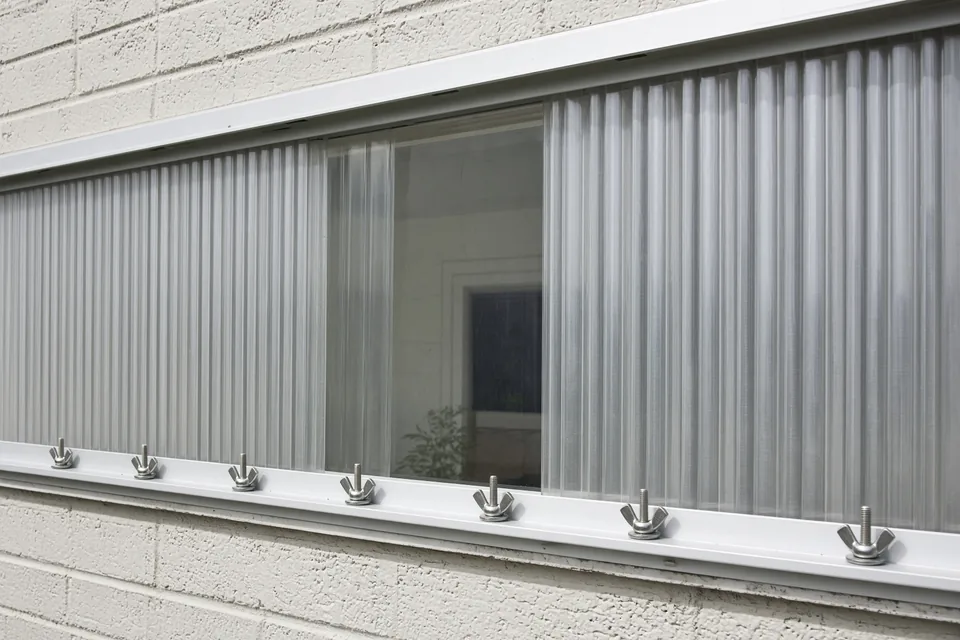
Choosing hurricane shutters is a trade-off between everyday curb appeal, pre-storm deployment effort, and per-opening price. These four scenes show a coastal home with permanent accordion shutters, removable storm panels bolted into masonry tracks, an overhead motorized roll-down housing, and the required product-approval label.

How the job works in 3 key stages
All three step images are AI-generated illustrations for explanation. Not a site inspection, bid, or coverage decision.
 Step 01
Removable storm panels
Corrugated aluminum or clear polycarbonate panels bolt into permanent tracks before a storm; they cost the least per opening but take the most work to put up.
Why it matters: Removable storm panels ($200–$650 per typical opening) are the lowest-cost code-approved option; adding a clear polycarbonate panel prevents a pitch-black room.
 Step 02
Roll-down shutters
A roll-down shutter lives in a housing above the opening and lowers by crank or motor, which makes it the easiest to deploy and the most expensive.
Why it matters: Roll-down hurricane shutters run $900 to $2,800 per typical opening (1.70x for wide patio sliders), plus $300 to $650 per opening for electric motorization.
 Step 03
Test-close and label
Test-close every hurricane shutter across the house, verify smooth key-lock or manual hand-crank operation, and leave the permanent NOA or FL# stickers visible for the building and wind-mitigation inspectors.
Why it matters: Municipal building inspectors ($250–$900 permit) and wind-mitigation inspectors check fastener spacing and the permanent product-approval label on each shutter.


On this page
- The diagram, part by part
- Photo guide: hero and 3 project steps
- 2026 hurricane shutter cost table by style
- Three worked scenarios with full arithmetic
- Comparison table: panels vs fabric vs accordion vs colonial vs roll-down
- Quote checklist: 8 items to verify in any shutter bid
- Typical fabrication, installation & inspection timeline
- Worked example
- Shutters, deductibles and the opening-protection credit
- Sources and further reading
- Frequently asked questions
2026 hurricane shutter cost table by style
| Shutter System / Line Item | 2026 Low | 2026 High | What Changes the Price |
|---|---|---|---|
| Corrugated metal or polycarbonate storm panels (per typical opening) | $200 | $650 | Matches impact windows calculator; permanent tracks or masonry bolts + removable panels |
| Hurricane fabric / astro-screen panels (per typical opening) | $220 | $700 | Resin-coated aramid/polypropylene screen; lightweight storage |
| Permanent aluminum accordion shutters (per typical opening) | $450 | $1,400 | Matches impact windows calculator; permanent side stacks & upper/lower tracks |
| Hinged aluminum Colonial or Bahama shutters (per typical opening) | $550 | $1,650 | Architectural louvers mounted permanently beside or above window |
| Overhead roll-down hurricane shutters (per typical opening, manual) | $900 | $2,800 | Matches impact windows calculator; overhead hood box + vertical guide tracks |
| Electric tubular motor & licensed electrician hookup (per roll-down) | +$300 | +$650 | 120V wiring to each header + wall switch/remote + manual override |
| Opening size multipliers | 0.80x | 1.70x | Small window = 0.80x; Typical = 1.00x; Large / slider = 1.70x |
| Second-story installation multiplier | 1.12x | 1.12x | Matches impact windows calculator (+12% for 2-story ladder/scaffold work) |
| Municipal building permit & product-approval packet (FL# / NOA) | $250 | $900 | Matches impact windows calculator; wind-load charts & municipal inspection |
Three worked scenarios with full arithmetic
Scenario 1: 10 typical single-story openings with permanent accordion shutters (worked example, 1.00x)
A homeowner installs white powder-coated aluminum accordion shutters across 10 typical-size window openings (count = 10, size = typ, shutter_type = accordion) on a single-story block home (stories = 1), including the municipal building permit (permit = yes).
- 10 Accordion Shutters Installed (10 × $450–$1,400 × 1.00 size × 1.00 story): $4,500 – $14,000
- Structural Masonry Anchors & Tracks: $0 (included in per-opening install)
- Municipal Permit & Product-Approval Packet: $250 – $900
- National / Coastal Baseline Total: $4,750 to $14,900
Scenario 2: 10 typical single-story openings with removable storm panels (budget option, 1.00x)
A homeowner on a strict budget chooses corrugated aluminum storm panels with one clear polycarbonate panel per room across 10 typical openings (count = 10, size = typ, shutter_type = panel, stories = 1, permit = yes).
- 10 Storm Panel Openings Installed (10 × $200–$650): $2,000 – $6,500
- Municipal Permit & Product-Approval Packet: $250 – $900
- National / Coastal Baseline Total: $2,250 to $7,400
Scenario 3: 8 large openings / sliders with motorized roll-down shutters on a 2-story home (1.00x)
A coastal homeowner outfits 8 large picture windows and patio sliders (count = 8, size = large [1.70x]) across a two-story home (stories = 2 [1.12x]) with electric motorized roll-down shutters (shutter_type = roll, motor = electric) and a building permit (permit = yes).
- 8 Large 2-Story Roll-Down Shutters (8 × $900–$2,800 × 1.70 × 1.12): $13,709 – $42,649
- Electric Tubular Motors & Electrician Wiring (8 × $300–$650): $2,400 – $5,200
- Municipal Permit & Product-Approval Packet: $250 – $900
- National / Coastal Baseline Total: $16,359 to $48,749
Comparison table: panels vs fabric vs accordion vs colonial vs roll-down
| Feature | Storm Panels ($200–$650) | Fabric Screen ($220–$700) | Accordion ($450–$1,400) | Colonial / Bahama ($550–$1,650) | Roll-Down ($900–$2,800+) |
|---|---|---|---|---|---|
| Permanently Mounted? | No (tracks/bolts stay) | No (anchors stay) | Yes (side stacks) | Yes (decorative louvers) | Yes (overhead hood) |
| Deployment Time (10 Windows) | 3 to 6 hours (2 people) | 1.5 to 3 hours | 15 to 25 minutes | 15 to 30 minutes | 2 minutes (motorized) |
| Safe for 2nd Story? | Difficult (requires ladder) | Moderate | Yes (locks from inside) | Yes (if accessible) | Yes (push-button/crank) |
| Daylight Inside When Closed? | Only w/ clear poly panels | Translucent filtered light | Dark (tiny perforations) | Filtered through louvers | Dark |
| Garage Storage Required? | Yes (heavy stack) | Yes (lightweight bag) | No | No | No |
Quote checklist: 8 items to verify in any shutter bid
- 100% Opening Count for Mitigation Credit: Did the contractor count every glazed window, sliding door (the patio door calculator), entry door with glass (the front door calculator), and skylight (the skylight calculator) so your home qualifies on the wind mitigation calculator?
- Valid FL# or Miami-Dade NOA: Does the bid list the exact Florida Product Approval number or Miami-Dade NOA for each shutter model?
- Stainless Steel Fasteners & Anchors: Are all masonry Tapcons, sidewalk bolts, and track screws 300-series or 410 stainless steel?
- Inside-Locking Option on 2nd Story: Can second-floor accordion or roll-down shutters be closed and locked from inside the room without climbing a ladder outside?
- Manual Override on Motorized Roll-Downs: Does every electric roll-down shutter include an accessible manual hand-crank override if power fails?
- Clear Escape / Egress Path: Can at least one bedroom window per room be opened rapidly from the inside after a storm passes in case of fire?
- Licensed Electrician Included: On motorized shutters, is the licensed electrical hookup included or billed separately?
- Permit & Final Inspection: Does the price include pulling and closing out the municipal building permit ($250–$900)?
Typical fabrication, installation & inspection timeline
- Field Measurement & Permit Filing: 1 to 3 weeks for municipal permit review.
- Custom Shutter Fabrication: 3 to 6 weeks for custom-cut tracks, accordion stacks, or powder-coated louvers.
- On-Site Installation: 1 to 2 days for a 10-opening house (plus 1 day for electrician wiring on motorized roll-downs).
- Building Inspection & Wind-Mitigation Update: 1 day for municipal sign-off, followed by updating your wind mitigation form (the wind mitigation calculator).
Worked example
A coastal homeowner installs permanent aluminum accordion hurricane shutters across 10 typical-size window openings (count = 10, size = typ, shutter_type = accordion) on a single-story masonry home (stories = 1), including the municipal building permit and Florida Product Approval packet (permit = yes), at the 1.00x baseline.
The default job, line by line
Worked example| Line item | National planning range |
|---|---|
| Permanent accordion shutters installed | $4,500 – $14,000 |
| Municipal permit & product-approval paperwork | $250 – $900 |
| Total before regional adjustment | $4,750 – $14,900 |
Midpoint about $9,825. These are the calculator's default inputs, so pressing the button above at the national region reproduces this table.
Shutters, deductibles and the opening-protection credit
Homeowners insurance does not pay to install preventative hurricane shutters on an undamaged home. However, protecting 100% of glazed openings (every window, glass door, and skylight) with code-approved impact shutters or impact glass is required to unlock the Hurricane Opening Protection tier on coastal wind mitigation inspection forms—such as Florida Form OIR-B1-1802 (see the wind mitigation calculator). If a single glazed bathroom window or entry door lite is left unprotected, many carriers award zero opening credit. If a named storm damages existing shutters, replacement is a covered windstorm claim subject to your percentage hurricane deductible (the hurricane deductible calculator) and ACV depreciation. Never rely on a shutter salesperson's promised insurance discount percentage; ask your carrier for an exact dollar quote.
What this page will not claim
- This page does not price impact-glass replacement windows: Full-frame and insert impact windows stay on the impact windows calculator.
- This page never quotes an insurance premium discount percentage: Only your insurer can quote a dollar credit from a signed inspection form (the wind mitigation calculator).
Sources and further reading
- Fixr — How much does it cost to install hurricane shutters?
- HomeServe — How much do hurricane shutters cost?
- Florida Building Commission — Florida Building Code and product approval
- IBHS — FORTIFIED Home program
Prices on this page are planning ranges built from public 2026 US cost guides and contractor rate sheets, widened where they disagreed, and multiplied by the same regional index as every other ReplaceCost calculator. Codes and rules come from the bodies listed. See the methodology for how ranges are set and reviewed.
Frequently asked questions
How do hurricane shutters compare in cost to replacing my windows with impact glass?
Using the exact same 2026 baseline as the impact windows calculator, full-frame laminated impact windows run $800 to $1,800 per typical opening (plus $40 to $100 haul-away), whereas removable storm panels run $200 to $650 and permanent accordion shutters run $450 to $1,400 per opening. If your existing windows are drafty or have rotten frames, impact windows solve both problems; if your windows are newer and tight, shutters cost 40% to 70% less.
Will I get an insurance wind-mitigation credit if I only put shutters on my large front windows?
Almost never. On Florida Form OIR-B1-1802 and most coastal wind-pool schedules, the Opening Protection credit is strict: every single glazed opening on the building envelope—including small bathroom windows, sliding glass doors, glass entry doors, and skylights—must be protected by impact-rated shutters or impact glass. See the wind mitigation calculator for how the inspection works.
Are clear polycarbonate storm panels and hurricane fabric screens approved for building permits?
Yes, provided the specific panel or fabric system carries a valid Florida Product Approval number (FL#) or Miami-Dade Notice of Acceptance (NOA) for your wind zone and is anchored at the tested spacing. Clear polycarbonate panels ($200 to $650/opening) and rated fabric screens ($220 to $700/opening) let daytime light into the house so you are not sitting in total darkness when the power goes out.
Can I mix different hurricane shutter styles on the same house to save money?
Yes, and coastal contractors call this a 'value-engineered combo.' A very common setup is installing permanent accordion shutters ($450 to $1,400/opening) on second-story windows so you never have to climb a ladder before a storm, Colonial or Bahama shutters ($550 to $1,650) on street-facing front windows for curb appeal, and low-cost storm panels ($200 to $650) on easily reached side and back ground-floor windows.
What happens if the power goes out and I have motorized roll-down hurricane shutters over my bedroom windows?
Building and fire safety codes require a way out of sleeping rooms during an emergency. When ordering motorized roll-down shutters ($900 to $2,800 base plus $300 to $650 for the motor), always specify an interior manual hand-crank override loop or battery backup on every bedroom egress window and primary exit door so you are never trapped inside after a hurricane knocks out utility power.
Do I need a building permit to install hurricane shutters on my own home?
Yes. Coastal municipalities require a building permit ($250 to $900) for permanent shutter tracks, hoods, and masonry anchors so an inspector can verify that the product-approval numbers match your wind zone and that anchors have proper embedment depth into the concrete block or framing. Furthermore, wind-mitigation inspectors often verify the permit record when signing your insurance inspection form.